
Table of Contents
Table of Contents
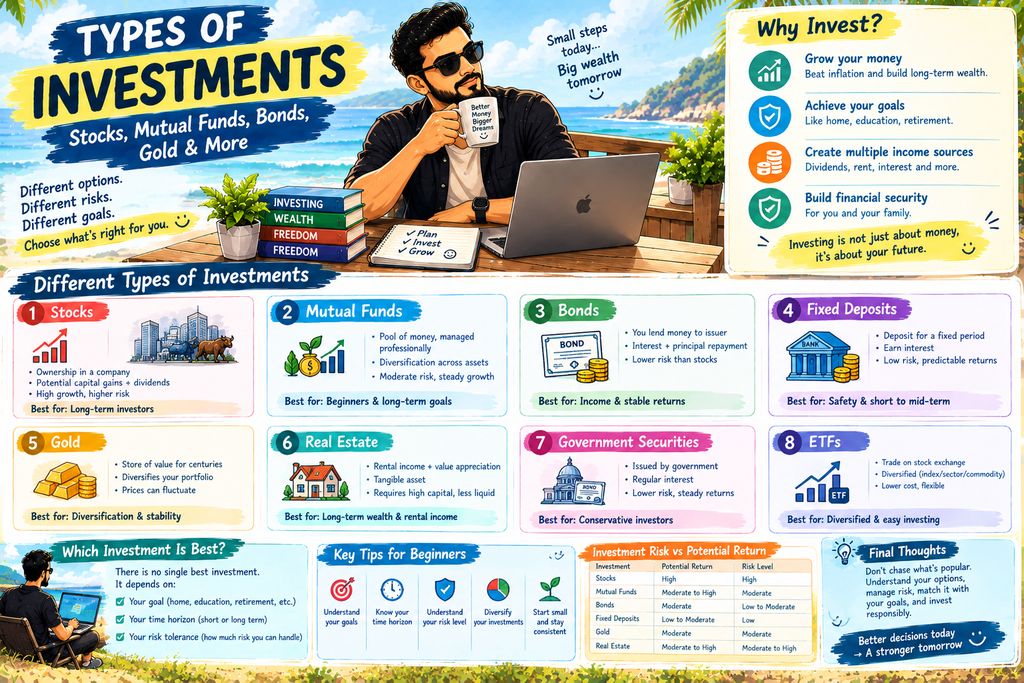
What are the Different Types of Investments?
Once you unserstand what investing is your next question arise:
“Where I am suppose to investing like in which assest or instrument?”
There are differment types of investment option available. Each one have there own risk level, Potential Returns, Liquidity and purposes.
You don’t need to invest in every Instrument or assets.
The Goal is to Understand the investment option and choose as per your financial goal, responsbilities, and risk tolerence.
Let look into common types of investment available in simple word.
1. Stocks
When you buy shares of a company you are buying small ownership stake in company.
Example:
If buy shares of listed company shares from market, you become a small part owner of that company.
How can you make money?
- Increase in share price
- Dividends, if company pays
Advantages:
- Start with small amount in stocks
- High potential in long term growth
- Eay to buy or sell in market hours
Risks:
Stock price fluctuation every day price fall and rise.
Stocks is best for those who have patience for longer time period and risk tolerence is better.
2. Mutuals Funds
A mutual funs collect money from many investor and invest that money a portfolio of assets according to its investment strategy.
Example:
Buying individual companies shares, Euity mutual fund may invest in shares of multiple companies. According to the fund strategy.
Advantages:
- Professional managment
- Diversification
- Many diiferent fund to invest
- SIPs make easier to invest regularly
Risks:
Mutual funs are not risk free. There risk depends on the assets and strategy of the particular fund.
Bets suited for: Investors who want diversification and don’t necessarily wan tot select individual stocks.
3. Bonds
A bond is essentially a form of borrowing.
When you purchase a bond, you are lending money to a brorrow such government or a company, according to a bond terms.
In return, the bond may provide interest payments and repayment od principal according to bond terms.
Advantages:
- Can provide predictable income
- Can play role in portifolio diversification
- Some bonds are very low risky than stocks.
Risks:
Bonds still carry some risks, includes credit riaks, market pricefluctuation and interest rate risk also.
Best Suite for:
Investor who looking for diversification and regular income other than salaries.
4. Fixed Desposits
Fixed deposits Commonly called as FDs, allow you to desposit money with bank or institution for specfic period ot time and earn interest.
Advantages:
- Simple to understand
- Fixed return to guarntee
- predictable interest
- Generally lower risk than market linked investment
Risk:
Returns are generally lower risk than potential long term returns of higher risk assets.
You can withdrawn after fixed term pass.
You should aslo consider taxation, inflation and term for premayure withdrawal.
Best suited for:
Investors who looking dor stability and fixed returns.
5. Gold
Gold has been used as a store of value for centuries.
People can gain exposure to gold in many forms like in physical, digtial form and Certain fiancial insturment linked to gold.
Advantages:
- Can diversify in portfolio
- Globally recognized as a assets.
- May provide safety in bad economic in personal or country.
Risks:
Gold prices also fluctuate.
Physical goals can also sotage, security, making charges and other cost depending on the form pruchases.
Best suited for:
Investors who wants gold in their portfolio.
6. Real Estate
Real estate include such as residential property, commerical building and land.
Investor may can make money:
- Appreication in property value
- Rental income
Advantages
- Rental income
- Long term apperication potential
- Physicl asset
- land value appericated more
Risks:
Real estate required good amount o capital.
It is difficult to seel quickly and investor faces maintenance, legal and other costs.
Best suited for:
Investors who have good capital and long term investment.
7. Government securities
Government issue securities to borrow money.
Dpendign on the countryand security these include treasury bills and govrnement bonds.
This bonds are very lower risks than equity investment and many corporate, but they are not completey free from risk.
Best suited for:
Investor who want to predictable reurn and lower risk investment.
8. Exchange-traded Fund(ETFs)
Which Investment Is Best?
There is no single best investment for everyone.
Your Goal:
- A House
- Retierment
- Education
- Wealth creation
- Future business
- Another long term goals
Your Risk Horizon
Money needed in the next year is very difficult to grow.
Money you won’t need over 20 year period.
Longer time horizons can give investor ability to tolerate fluctuations.
Your Risk Tolerence:
Your tolerence depends on your family responsilitibies, income, expenses and savings.
Don’t put All Your Money in One Place
One Important investing to be done by everyone is diversification.
Diversification means spreading your investment across different assets rather than put it in one place.
Example:
You have 1000 rupees at your hand . instead of putting in one asset you smal amount in different asset like 200 in gold, 300 in mutual fund and 250 in ETF remaining ion government bonds.
Diversification can reduce your risk of losing your money by putting into at one asset place.
Investment Risk vs Potential Return
A useful beginner concept is that risk and potential retuens are connected.
Investment with greater potential are can experience great looser sometimes.
Example:
Stocks – Higher growth potential + Higher volatility
Bonds – Genrally lower volatility than stocks, risk remains.
Fixed Deposits – Predictable returns, generally low risk and regularly income.
They serve different purposes.
FAQs
1. What are main types of investments?
Common Investment types includes stocks, mutual funds, bond, fixed deposits, gold, real estate, government bonds.
2. Which Investment has the highest return?
There is no such investment that consistently provides return every year without any risks. higher potential returns may have higher risk.
3. Are Fixed deposits an investment?
Yes. Fixed deposits is an investment products that provides interest according to its terms.
4. Are mutual funds safer than stocks?
Not necessary. mutual funds can be diversified, which may reduced risk but their investment can still lose value.
5. Should beginners invest in multiple assets?
Diversification can be useful, but the mix appropiate dpends on your goals risk tolerence and financial situation.
Link this article to:
- What Is Money? Meaning and Importance of Money
- What is Financial Literacy?
- Financial Literacy Vs Financial Education : What Is the Difference?
- What Are The 5 Main Areas of Personal Finance?
- What Is Financial Planning? A Beginner’s Guide
- What Is Money Management? A Beginner’s Guide
- What Is an Emergency Fund?
- How to Build an Emergency Fund
- What is Saving?
- What is Compound Interest?
- What Is Inflation?
- What is Insurance?
- What is investing?
- What is Income?
- What is an Expense?
- What is Budget?
- Saving vs Investing
- What is Net worth?
One thought on “Types of Investments: Stocks, Mutual Funds, Bonds, Gold & More”