What Is a Trading Account? — How Buying and Selling Shares Works

What Is a Trading Account?

A trading account is an account that allows you to place buy and sell orders for securities in the financial markets thorugh a stockbroker.

In India, investors commonly use trading accounts to buy ans sell shares listed on the stock exchanges such as the National Stock Exchange(NSE) and Bombay STock Exchange(BSE).

Example:

Let’s say you want to buy shares of a company listed on the NSE. You use your trading account to place an order> If the order is excuted and the transaction is settled, h purchased hsares are generally credited to your demat account.

A trading account acts as a connection between you and the market. It lets you place orders, view prices, check order status and monitor trading activity thorugh the broker’s platform.

In Simple Words:

A trading account help you buy and sell securities, while a Demat account holds eligible securities electronically.

A trading account does not guranteed profits. The outcome depends on the securities you trade, market movements, transaction costs and your decisions.
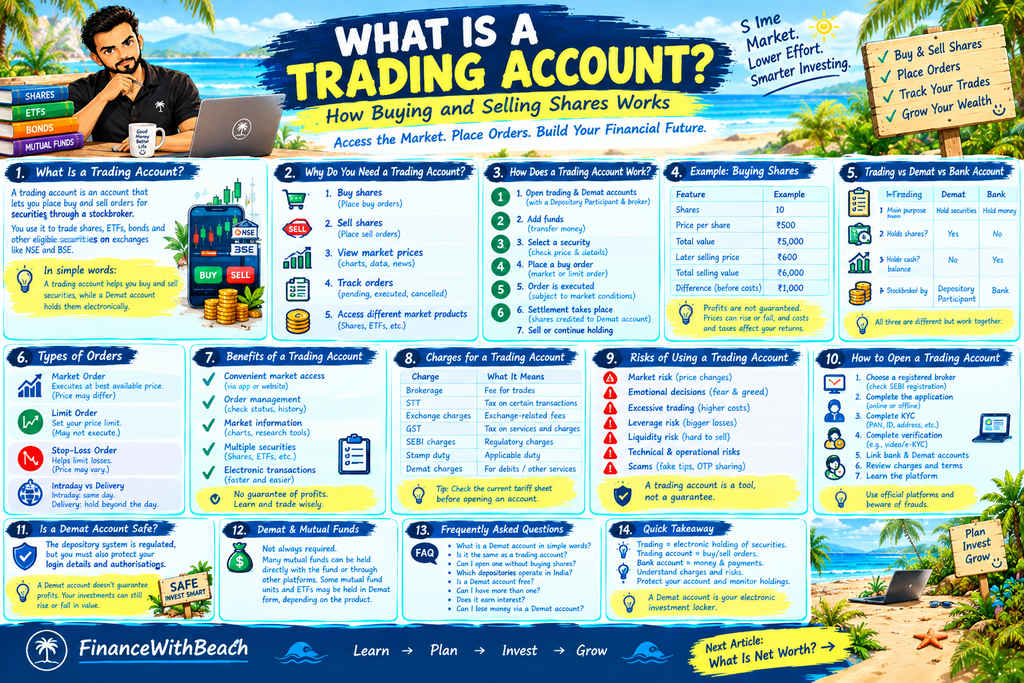
Table of Contents

Why Do You Need a Trading Account?

If you want to buy and sell excahnge-listed shares through a stockbroker, you generally need a trading account.

Here are comes of its main purposes.

1. Buy Shares

You can place orders to purchase shares of eligible companies listed on a supported stock exchange.

2. Sell Shares

You can place orders to sell securities you own, Subject to the relevent trading, holding and settlement reqirements.

3. View Market Prices

Most trading platform provide market-price information, charts and other tools. Some information may be delayed or require a paid subscription.

4. Track Orders

You can check whether an ordewre is pending, excecuted, partially executed, rejected or cancelled.

5. Access Different Market Products

Depending on the broker, your eligibility and the applicable rules, a trading account may provide access to porducts such as shares, ETFs and other permitted market instruments.

Important: Not every product is suitable for beginners. Derivates and leveraged trading can create substantial losses and require a separate inderstanding of their risks.

How Does a Trading Account Work?

The process with a simple example.

Let say you want to purchase shares worth ₹5,000.

Step 1: Open the required Accounts

You generally open a trading account with a stockbroker and a demat account with a registed depository participant,. A bank account is used for payments and withdrawals.

Some providers offer linked services to mke the process easier.

Step 2: Add Funds

Transfer money through the supported payment method so you have sufficient fund for your intended purchase and applicable charges.

Step 3: Slect a Security

Search for the company or security you want to trade. Check its name, exchange, price and other relevent information before proceeding.

Step 4: Place a Buy Order

Enter the quantity and select the ordeer type. You May use a market order or a limit order, depending on the available options and your needs.

Step 5: The Order Is Executed

An order is executed only when it can be matched according to market conditions and exchange rules. An order may remain pending,be partially filled or not execute at all.

Step 6: Settlement Takes Place

After the trade is executed, the application settlemen process takes place. For a ref=gular settled purchase, the securities are credited to your demat account according to the relevent settlement rules.

Step 7: Sell or continue Holding

You can continue holding the shares or place a sell order later. Your eventual profit or loss depends on the sale price, purchase price, costs and applicable taxes.

Example: Buying Shares Through a Trading Account

Let’say Want to buy 10 shares of a company.

FeatureExample
Number of shares10
Purchase price per share₹500
Total purchase value₹5,000
Later selling price per share₹600
Total selling value₹6,000
Difference before costs and taxes₹1,000

In this hypothetical example, you buy 10 shares at ₹500 each, giving a purchase value of ₹5,000.

Later, you sell all 10 shares at ₹600 each, giving a selling value of ₹6,000.

Your difference before transaction costs and taxes is ₹1,000.

However, if the selling pice falls to ₹400 per share, your selling value would be ₹4,000, resulting in a ₹1,000 loss or fall, and a profit is never guranteed.

What Is the Difference Between a Trading Account, Demat Account and Bank Account?

These accounts work together but have different purposes.

FeatureTrading AccountDemat AccountBank Account
Main purposePlaces buy and sell ordersHolds eligible securities electronicallyHolds money and processes payments
ExampleOrders 10 sharesRecords the 10 shares after settlementProvides funds for the purchase
Holds shares?No, not as the primary securities-holding accountYes, for eligible securitiesNo
Holds bank deposits?Not like a regular savings accountNoYes
Usually provided byStockbrokerDepository ParticipantBank

A Simple Way to remmeber

  • Bank account: Your money
  • Trading account: Your market orders.
  • Demat account: Your electronic securities.

The accounts may be linked, but they are not interchangeable.

What Are the Main Types od Orders in a Trading Account?

When Placing an order, it is important to understand how to order will be handled.

The exact options available may vary by broker, Market segement and security.

1. Market Order

a market order instructs the broker to buy or sell at the best available price under the applicable market rules.

Example:

A share is currently quoted near ₹500 and you place a market but order.

The execution price may differ from ₹500 because prices can change and the available quantity may be limited.

Main consideration: A market order priorities execution, but it does not guranteed a specfic price.

2. Limit Order

A limit order specifies the maximum pirce you are willing to pay when buying or the minmum price you are willing to accept when selling.

Example:

A share is trading near ₹500, but you set a buy limit of ₹480.

Your order may excute at ₹480 or better if matching market conditions allows it. If the share never reaches a suitable price, your order may remain unexecuted.

Main Consideration: A limit order controls your price limit, but execution is not guranteed.

3. Stop-loss Order

A Stop-loss order is designed to help manage potential losses by triggering an order whena specified trigger condition is reached.

The precise operation depends on the order type and the broker’s supported features.

Example:

A trader holding a share may set a trigger below the purchase price to initiate a sell order if the price falls.

main Consideration: A stop-loss does not guranteed the final selling price. Gaps,volatility,Liquidity and other execution can lead to a different outcome.

4. Day trading and Delivery-Based Trading

Theses terms describe different approaches to tradin rather than just order types.

  • Intraday trading: Position are opened and closed within the same trading day under the relevent rules.
  • Delivery-based trading: Shares are purchased for holding beyond the trading session and are settled into the investor’s Demat account according to applicable procedures.

Intraday trading can involve rapid price movements and may be paticularly risk for inexperienced traders.

What Are the Benefits of a Trading Account?

1. Convenient Market Access

A trading account lets you place orders through a broker’s website, app or supported platfrom.

2. Order Managements

You can view orders and monitors their status without handing physicall papaerworks.

3. Market Information

Depending on the platform, you may have access to cahrts, prices, company information and research tools.

4. Multiple Securities

A broker may support trading in different eligible securities and market segments through the same account.

5. Electronic Transactions

Trading and settement processes are largely electronic, making transaction more convenient than older paper-based methods.

Convenience does not remove market risk. You still need to understand what you are buying or selling.

What are the Charges for a trading Account?

Trading costs vary between broker, products and transaction types.

ChargeWhat It Means
BrokerageThe fee charged by the broker for eligible transactions
Securities Transaction Tax (STT)A tax applicable to specified securities transactions
Exchange transaction chargesCharges associated with exchange transactions
GSTApplicable tax on specified services and charges
SEBI-related chargesApplicable regulatory charges under current rules
Stamp dutyApplicable duty on specified transactions
Demat-related chargesCertain charges may apply when securities are debited or when other depository services are used

Not every charge applies in the same way to every product or tasnaction. The amount can depend on the market segment, transaction value and current rules.

Example: Why Trading Costs Matter

Let’s say a trader makes several small trades and earns ₹500 in gross gains.

If brokerage and other applicable charges total ₹200, the amount remaining before other costs and taxes would be ₹300.

This simplified shows why it is important to consider costs rather than looking only at gross profits.

Check the broker’s current traiff sheet and applicable official rules before trading.

What Are the Risks of Using a Trading Account?

A trading account provides market access, but trading itself involves risks.

1. Market Risk

Prices can fall because of company-specfic developments, economic conditions, interest rates, investor sentiment or other factors.

You may lose some or all of the money invested in a particular security.

2. Emotional Decisions

Fear,greed and the desire to recover losses quickly can lead to impulsive trades.

A written plan and a clear understanding of your risk limits can help you avoid see emotional mistakes.

3. Excessive Trading

Frequent trading can increase costs and encourage unneceassary decisions.

More trades do nto automatically lead to higher profits.

4. Leverage Risk

Some products allows traders to take positions larger than the fund they initally commit.

Leverage can magnify gains, but it can also magnify losses. Certains products may require additonl funds or reults in losses beyond the amount initally expected.

Beginners shoul;d understand these risks fully beofre using leveraged products.

5. liquidity Risk

A security may have limited buyers or sellers. you may be unable to execute an order at your preferred price or at the time you want.

6. techanical and operational Risks

Connectivity problems, Platform disruption, incorrect order details or unauthorised account access can cause difficultes.

Use official platforms, portect your credentials and review ordeer details before submitting them.

7. Misleading Tips and Scams

Be cautions of people promising guaranteed porfits, secret trading strategies or assured terms.

Do not share passwords,PINs, or OTPs with people claiming they can trade on your behalf.

How to Open a Trading Account in India

Opening a trading account is often possible online through an eligible broker.

Step 1: Choose a Registered broker

Check the broker’s registration and available services. Compare the fees, customer support, security features and product offered.

You can use official resoruces from SEBI to learn about regulated market intermediairies.

Step 2: Complete the Application

Enter the required details on the broker’s official website or app.

Step 3: Complete KYC

KYC means Know Your Customer. Dpending on the applicable requirements, you may need PAN, identity and address infromation, bank details and other documentation.

Step 4: Complete Vertification

Follow the provider’s official verfication process. Never share your OTP or password with anyone who contacts you ynexpectedly.

Follow the Broker’s instructions for linking yur bank account and demat account or opening the required services where offered.

Step 6: review the Charges and Agreements

Read the account terms,fee schedule and relevant risk disclosures before accepting them.

Step 7: Learn the Platform Before trading

understand how to search for securities, choose an order types, check order status and review charges.

Ypu do not need to start trading immediately after opeing an account.

trading vs investing: What Is the Difference?

Trading an dinvesting both involve buying and selling financial assets, but they often have different objectives and time horizons.

FeatureTradingInvesting
Typical time horizonMay range from minutes to monthsOften years or longer
Main focusPrice movements and trading opportunitiesLong-term financial goals and asset growth
Activity levelCan involve frequent transactionsMay involve fewer transactions
CostsFrequent trades may increase costsCosts depend on the investments and activity
Main risksMarket movements, timing, costs, and executionMarket movements, business performance, inflation, and other risks

These are general distinction, not strict definitions. Some traders hold positions for months and some investors make changes more frequently.

Neiher approach gurantees a profits. Choose an approach based on your know;edge, goals, time and ability to handle losses.

Common Mistakes Beginners Should Avoid

Mistake 1: trading without understanding the ordwer type

Know the difference between market orders and limit orders before placing a trade.

Mistake 2: Confusing a trading account with a Demat Account

one places orders; the other holds eligible securities electronically.

Mistake 3: Ignoring fees and taxes

Review the total cost of a transaction, not just the share price.

Mistake 4: trading beased on rumours

Check reliable information instead of blindly following social-media tipes or messages from strangers.

Mistake 5: Using borrowed money without understanding the risks

Borrowing to trade can increase financial pressure and magnify losses.

Mistake 6: Expecting quick profits

Markets aare uncertain and repeated can results in losses.

Mistake 7: Sharing account credentials

Keep passwords, PINs and OTPs private and use the broker’s offical security features.

Mistake 8: Starting with complex product too early

Learn the basics of shares,market orders,costs and risk before cosndiering derivatves or leveraged trading.

Is a Trading Account Suitable for Beginners?

A trading account can be useful if you want to access the stock market, but opening one does not mean you must trade frequently.

Beginners should first learn how markets works, understand the difference between trading investing and become familiar with risk and costs.

If your goals is long term wealth building, compare different approaches and avoid assuming that frequent trading is necessary.

The Key lesson: Learn the system before risking your money. A rading account is a tool for placing market orders, not a shortcut to guranteed income.

FAQs

What is trading account in simple words?

A trading account is an account that allows you to place buy and sell orders for securities in the financial markets thorugh a stockbroker.

Is a trading account the same as a Demat account?

No. A trading account is used to place orders, while a Demat account holds eligible securities electronically.

Can I open a trading account without a Demat Account?

Rquirements depend on the product and market segemnt. For regular delvery-based share investing, a Demat account is genrally required. Some trading product may operate under different arranagemnts.

How much money do I need to open a trading account?

The amount depends on the broker’s reuqiremnts and the products you intend to trade. Account opening may be free, but other charges and minmum funding requiremnts may apply.

Does a trading account guaranteed profits?

No. market Prices can move against you, and costs can reduce returns. You can lose money when trading.

Can I use a trading account on my phone?

Many broker provide mobile apps as wells as websites. Download apps on from official sources and secure your account.

What is the difference between trading and investing?

Trading often focuses on shorter-term price movements, while investing commonly focuses on longer-term finacial goals. Bothe involve risk.

Is intraday trading suitable for beginners?

intraday trading can be risky because prices may change quickly and costs can accumulate. Beginners should learn the risks carefully before considering it.

Link this article to:

What Is a Demat Account? — How Investors Hold Shares and Securities Electronically

What Is a Demat Account?

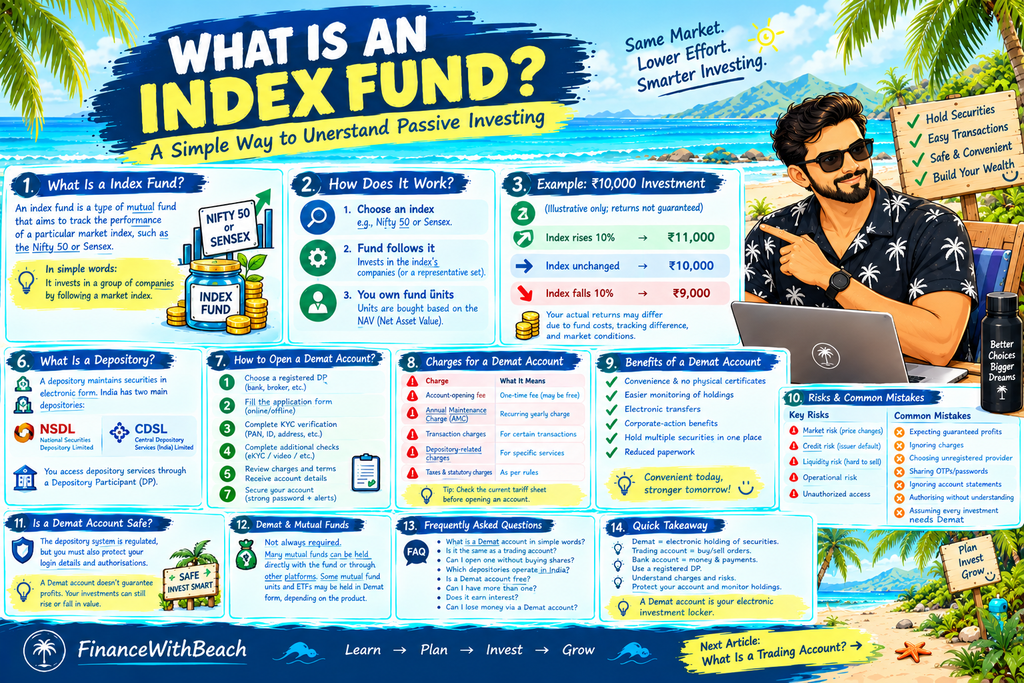
A Demat account is an account used to hold financial securities in electronic form. The word Dmat comes from dematerialisation, which means converting physical securities into electronic records.

In India, investors commonly use demat accounts to hold shares,exchanges-traded fund (ETFs), bonds and other eligible securities electronically.

Think of a demat account as digital locker for your investments. Instead of keeping physical share certificates, your securities are recorded electronically through India’s depository system.

Example:

Let’s suppose you buy 10 shares of a company through a stockbroker. Once the transaction is completed and settled the shares are credited to your Demat account according to the settlement porcess.

You can then view your holding thorugh the services provided by your Depository Participart(DP).

In Simple Words:

A demat account holds your investments electronically, while a trading account helps you buy and sell securitites in the market.

According to SEBI Investor, Investor generally need a Demat account , a trading account and a bank account to participate in securities-market transactions.

Table of Contents

Why Do You Need a Demat Account?

When securities were hed as physical certificates, Investors had to manage paperwork and deal with risks such as loss, theft, damage and forgery.

electronic Holding makes many investment-related processes easier.

Here are some important reasons Demat accounts are useful.

1. Hold Shares Electronically

A Demat account records eligible shares in electonic form, eliminating the need to store physical share certficates for those holdings.

2. Hold Differeent Types of Securities

Dpending on eligibility and the services offered, a Dmeat account can hold various securities, including shares, ETFs, Bonds and certains mutual fund units.

3. Make Transfer Easier

Eligible securities can be transfered electronically under the applicable procedures, reducing the need for physical paperwork.

4. Receive Corporate Benefits

Eligible corporate actions, such as bonus shares and stock splits can be reflected in your demat Holdings Through the relevent processes.

Dividends are generally paid through the applicable payment arrangements rather than stored as securities in the Demat account.

5. View Your Investment Holdings

You can check your holding and trasnaction records thorugh the services offered by your Depositiory participant or depository.

6. Reduce Physical-Cerificate Risks

Electronic records reduce the risks associated with lost, gamaged or forged physical certificates.

However, you still need to protect your account credentials and authorisations.

How Does a Demat Account Work?

Let’s Understand the process using a simple example.

You want to purchase shares worth ₹5,000.

Step 1: Open the required Accounts

You open a demat account with a registered depository Participart and a trading account with an eligible stockbroker. Your bank account is used to make or receive payments.

Some providers offer linked account-opening services, but the accounts perform different functions.

Step 2: Add Money to your Trading Account

You transfer money thorugh the supported banking method to fund your purchase.

Step 3: Place a Buy Order

You are the trading platform to place an order for the shares you want to buy.

The order is subject to market availability, execution and settlement rules.

Step 4: The Trade Is Settled

After the trade is executed, the relvent settlement process takes place.

Once settlement is completed, the purchased securities are credited to your demat account, subject to the applicable rules and timelines.

Step 5: View Your Holdings

You can check the shares held in your account through your broker’s platform or the services offered by your Depository Participant.

Step 6: Sell When You Choose

if you to sell the shares later, you place a sell order through your trading account. The securities are transfered through the applicable settlement process and the sale proceeds are credited according to the broker’s and market’s procedures.

What Is the Difference Between a Demat Account Trading Account and bank Account?

These three accounts serve different purposes.

FeatureDemat AccountTrading AccountBank Account
Main purposeHolds eligible securities electronicallyPlaces buy and sell ordersHolds money and processes payments
What it handlesShares, ETFs, bonds, and other eligible securitiesMarket transactionsMoney deposits, withdrawals, and transfers
Used to buy shares?Holds the shares after settlementUsed to place the orderProvides or receives money
Holds cash like a bank deposit?No, not like a bank accountUsually handles trading-related balances through the broker’s arrangementsYes
Opened withA Depository ParticipantA stockbrokerA bank
ExampleRecords 10 shares you ownPlaces an order to buy 10 sharesProvides funds to pay for the purchase

What Can You Hold in a Demat Account?

The eligible securites depend on the account and the applicable rules.

Common example includes:

1. Shares

Shares represent ownership in a company. If you buy shares and the transaction settles, eligible shares are recorded in your Demat account.

2. Exchanged-Traded Funds(ETFs)

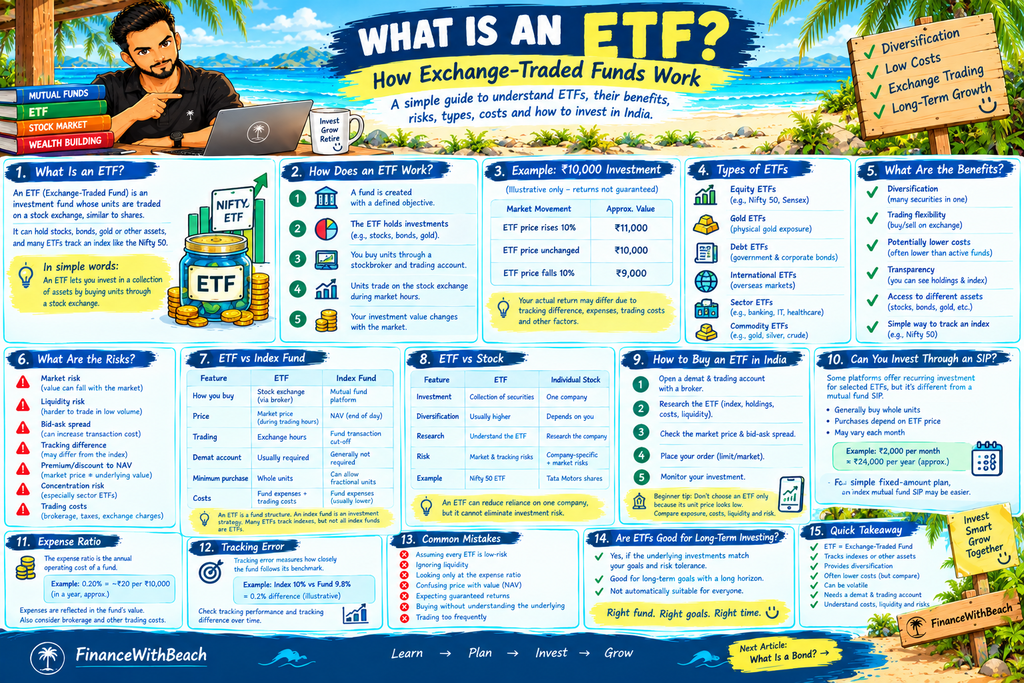
ETFs are investment funds whose units trade on stocks excahnges. Eligible ETF units can be held electronically in a Dmeat account.

3. Bonds and Debentures

Certains bonds and debentures can be held in electronic form. Their interest payments, maturity and risks depend on the specific security.

4. Certain Mutual Fund Units

Eligible mutual fund units may be held in Demat form when the relevent facility and arrangements are available. Many invstors also hold mutual fund units directly with the mutual fund or thorugh other permitted arrangements.

5. Other Eligible Securities

Additional securities may be held depending on thr product, the depository system and the account’s facilities.

Remember: A Demat acount is way to hold eligible investments electronically. it is not itself an investment product and opening one does not require you to [urchase securities immediately.

What Is a Depository?

A depository is an institution that maintains securities in electronic from and supports their transfer through the securities-market system.

India has two main securities depositories:

  • Nationl Securities Depository Limited (NSDL)
  • Central Depository Services (India) Limited (CDSL)

Both operate within India’s securities-market regulatory framework.

A depository maintains the electronic records of securities, while invstors generally access depository services through a Depository Participant.

What Is Depository Participant(DP)?

A Depository Participant (DP) acts as the link between an investor and a depository.

A DP may be a bank, broker, financial institution, or another eligible entity registered to provide depository services.

You generally open a Demat account through a DP rather than opening it directly with NDSL or CDSL.

The DP may help you with:

  • Opening and maintaining your demat account.
  • Comparing the required vertifcation process.
  • Providing statements of holdings and transactions.
  • Processing eligible transfer and other instructions.
  • Providing services related to securities pleding and other permitted activities.

Before choosing a DP, verify its registration and review its charges, customer support, security features and available services.

How to Open a Demat Accounts in India?

Opening a Demat Account can often be completed online, although the exact process depends on the providers.

Step 1: Choose a Registered Depository Participant

Compare eligible providers, including banks, brokers and other registered participant.

checking their services, charges, security features and account conditions.

Step 2: Complete the application

Fill in the required details through the provider’s official website or app.

Step 3: Complete KYC Vertification

KYC means Know Your Customer. You may need to provide isentity, address, PAN,bank and other information as reuired under current rules.

The exact documents and vertification steps depends in your circumstances and the provider.

Step 4: Complete Any Required Vertification

The provider may require electronic verifcation, a video-based vertification step or other checks.

Follow the official instruction and do not share your passowrds or one-time passwords with anyone claiming to help you.

Step 5: Review the charges and terms

Read the account-opening documents and the sechdule of charges before accepting them.

Step 6: Receive Your Acccount Details

After the application is approved, the provider will give you your account details and access instructions.

Step 7: Secure Your Account

Use Strong, unique password, enable available security features and monitors transaction alerts and statements.

What Are the Charges for a Demat Account?

Demat accounts may involve different charges depending on the provider, servicees used and account type.

ChargeWhat It Means
Account-opening feeA fee that may be charged to open the account
Annual Maintenance Charge (AMC)A recurring charge for maintaining the account
Transaction chargesFees that may apply to certain debit or other transactions
Depository-related chargesCharges associated with certain services or instructions
Taxes and statutory chargesApplicable taxes or other charges under current rules

Some provider advertise zero account-opening fees or reduced maintenance charges. However that does not mean every service is free.

Always read the current traiff sheet before opening an account.

What Is a Basic Services Demat Account (BSDA)?

Basic Services Demat Account (BSDA) is a category of demat account intended to make securities holding more accessible to eligible indvidual investors, with specfiied service and charge conditions.

Eligibility and applicable maintenance charges depend on current SEBI rules and value and types of securites Held.

If you are a beginner with relatively small holdings, check whether you qualify for a BSDA and compare its condtitons with a regular Demat account.

What Are the Benefits of a Demat Account?

1. Convenience

You can hold eligible securities electronically without managing physical certificates.

2. Easier Monitoring

You can review your holding and transaction records using the services provided by your DP or depository.

3. Electronic Transfers

Eligible securities can be transfered electronically through the relevent procedures.

4. Corporate-Action Processing

Eligible Bonus shares, stock splits and other coprate actions can be reflected in your holdingd thorugh the applicable processes.

5. Muiltiple Securities in one Place

Depending on eligibility, you may be able to hold different types of securities in a single account.

6. Reduced paperwork

Electronic holding reduces many of the administrative tasks associated with physical certficates.

However, convenience does not remove investment risk. The value of your haolding can still rise or fall.

What Are the Risks and Common Mistakes?

A Demat account is an account Facility, not a guaranteed of investment safety or returns.

Beginners should avoid these common mistakes.

Mistake 1: Believing a Demat Account guranteed Profits

Your returns depends on the investments you choice. You can lose money if the maket value of your holding declines.

Mistake 2:Ignoring account charges

Small recurring or transaction-related charges may affect your overall. review the traiff sheetcarefully.

Mistake 3: Choosing an Unregistered provider

Open accounts through appropriately registered and authorised entities. Verify the provider’s registration using official sources.

Mistake 4: Sharing OTPs and Passwords

Never discloses your password, PIN or one-time password to strangers or people prmising guaranteed returns or trading profits.

Mistake 5: ignoring account statements

review your holding and transaction records regualry. report unauthorised transaction or disrepancies promptly.

Mistake 6: Authorising transactions without understanding them

Read the instruction carefully before authorising transfers, Pledges or other actons involving your securities.

Mistake 7: Assuming every investment must be held in demat form

Different investment products have different holding arranagements.Check the available options for each product.

Mistake 8: Forgetting account administration

Keep your contact information and KYC details updated, review nominee arrangements where applicable and follo current account requirements.

Is a Demat Account Safe?

A demat account provides electronic record-keeping for eligible securities and India’s depository system operates within a regulatory framework.

However, there are two separate issues to undeerstand:

  • Account security: Porctecting your login credentials transaction authorisation and personal information.
  • Investment risk: Understanding that the market value of shares, bond ETF and other investments can fluctuate.

A secure account does not make a risky investment safe.

Use official apps and website, enable available security features, check alerts and contact your provider promplty if you notice an unfamiliar transaction.

Do you Need a Demat Account to Invest in Mutual Funds?

Not Always.

Many mutual fund investors hold units directly with the mutual fund or through permitted investment platforms without using a Demat account.

However, certain mutual fund units may be held in Demat form and ETFs generally trade on stock exchanges and are held electronically through a Demat Account.

The appropriate arranagements depends on the investment product and how you choose to hold it.

FAQs

What is Demat account in simple account?

A demat account holds your investments electronically, while a trading account helps you buy and sell securitites in the market.

Is a Demat account the same as a trading account?

No. A demat account holds securities electroniclly, while a trading account is used to place buy and sell orders in the market.

Can I open a Demat account without buying Shares?

Yes. Opening a Demat account does not automatically require you to buy shares. you can open the account and decide whether and when to invest, subject to the provider’s terms.

Is a Demat account free?

Some providers offer free account opening, but maintebnance or transaction-related charges may apply. Check the current fee schdule before opening an account.

Can I have more than one dmat account?

Investors may have mulitple Demat accounts, subject to applicable rules amd prviders requirements. Cosnider the additional administration and potential charges before opening mulitple accounts.

Which Companies operate India’s main Depositories?

India’s two main securities depositories are NDSL and CDSL. Investors generally access their services through registered Depository Participant.

What documents are required to open a Demat account in India?

Requirements depend on current rules and your circumstances. Common reuirements may include PAN, Identity and address infrmation, bank details and KYC verfications.

Link this article to:

What Is a Government Bond? — How Government Borrowing Works

What Is a Government Bond?

A government bond is a financial instrument through which a government borrows money from investors to fund its expenses, infrastructure porjects and other public needs.

When you purchase a government bond, you are essentially leding money to the government. In return, essentially lending money to the government. In return, the governement agrees topay interest according to the bond’s term, if applicable and repay the principal accroding to its repayment condition.

In India, the Cnetral Governement and state governments issue government securities to borrow money. These are commonly known as G-Secs (Government Securities). Long-term government are often called governement bonds or dated securitites, while short-term Central government securities include Treasury Bills.

In Simple Words:

A government bond allows you to lend money to a government in exchange for interest, if the bond pays interest, and repayments under its time.

Table of Contents

Why Do Government Issue Bonds?

Governments collect revenue through sources such as taxes, fees and other receipt. However, these fund may not cover every expenses or planned project.

To raise additional money, Government can borrow from investors by issuing securities.

Common reasons include:

  • Infrastructure development: Funding roads, Bridges, railways and public transport.
  • Public Services: Supporting government expenditure on healthcare, education and other services.
  • Budget Financing: Meeting funding requirements when government expenditiure exceeds available receipts.
  • Managing borrowing needs: Raising money according to the government’s financial plans.

Instead of lending money to a [rivate company, an investor buying a government bond lends money to the issuing government.

How Does a Government Bond Work?

Let’s Undertsand the process step by step.

Step 1: The government needs to borrow money

The government determines its borrowing requirements and issues securities according to its funding plans.

Step 2: The bond is issued

The government specifies details such as the bond’s maturityy date, interest terms and other conditions.

Investors can participate in an eligible government securities auction or buy certain securities in the secondary market.

Step 3: Investors purchase the bond

You invest money by purchasing the bond. The amount you pay may be equal to above or below its face value depending on the issue or market price.

Step 4: Interest may be paid

Some government bonds pay interest periodically. Others, such as Tresury bills are genrally issued at a discount and redeemed at face value rather than opaying periodic coupon interest.

Step 5:The security reaches maturity

At maturity, the government repays the amount due under the security’s terms. For a coventional bond held until maturity, this generally means repayment of its face value.

The actual outcome depends on the particular security;s terms and the investor’s purchase price.

What Are the Main Types of Government Securities in India?

Government securitites come indifferent forms and maturities.

1. Government Bonds or dated Government Securities

These are securities issued by the Central Government or state governments with sepcfied maturity dates.

Central government dated securtities often pay interest periodically, commonly every six months, according to their terms.

They can be used investors seeking expsoure to government for a defined Period.

2. Treasury Bills (T-Bills)

Treasury Bill are short-term securities issued by the Government of India.

They generally have original maturities of less than one year and do not pay periodic coupon interest.

Example:

A Treasury Bill may be purchased for less than its face value and redeemed at face value maturity. The difference reperesents the investor’s return before applicable costs and taxes.

3. State Development Loans (SDLs)

State Developments loans are securities issued by issued governements to borrow money.

They are government securities, but they are issued by state government rather than the Cnetral government.

Their terms, yields and market prices may differs from those of Central Government Securities.

4. Sovereign Gold Bonds (SGBs)

Sovereign Gold Bonds are governement securities linked to the price of gold and denominated in grams of gold. They have specific terms, including interest and redemption provisions.

They are different from ordinary governemnt bonds because their value is linked to gold rather than being a conventional fixed- principal bond.

The availability of new SGB issues depends on government announcements. If considering an exisiting SGB, check its terms and market availability.

What Is the Difference Between a Government Bond and a Corporate Bond?

Nothe Government bonds and corporate bonds involve lending money to an issuer. The main difference is who borrows the money.

FeatureGovernment BondCorporate Bond
IssuerCentral or state governmentCompany
PurposeGovernment borrowing and public funding needsBusiness and corporate funding
InterestDepends on the security’s termsDepends on the bond’s terms
Credit riskDepends on the issuing government and securityDepends on the company’s ability to pay
Market priceCan fluctuateCan fluctuate
Main risksInterest-rate, inflation, and liquidity risks, among othersCredit, interest-rate, and liquidity risks, among others

Central governemnt securities issued in India’s domestic market are generally treated as having very low credit risk in rupee terms. However, this does not mean their market prices never falls or that they are free from every investment risk.

Corporate bonds can have greater credit risk because a company may expereience financial difficulties and fail to meet its obligations.

What Are the Benfits of Government Bonds?

Government bonds can offer several potential benefits depending on the security.

1. Relatively low Vredit risk for central Government securities.

Central Government securities in the domestic market are generally considered to have very low credit risk in rupee terms.

However, other risks-particularly market-price and inflation risks-remains relevent.

2. Interest income

Some government bonds pay interest at regular intervals. This may helps investors plan for scheduled income.

The payment frequency and coupon terms depend on the particular security.

3. Defined maturity

Many government secutities have a stated maturuty date. This helps investors understand when the security is secheduled to mature.

4. Portfolio Diversification

Government securities can provide expsoure to an asset class that behaves differently from stocks in some market conditions.

Diversification may helps manage portfolio risk, although it cannot eliminate losses.

5. Different maturity options

Investors can find securites with different matruities, from short-term treasury Bills to longer-term government bonds.

Choosing an appropriate maturity is important because m,arket-price sensitivity can vary cosndierably between securities.

6. Access through RBI Retail Direct

Eligible indiviual investors can use the RBI Retail Direct platform to access certain government securitites directly, subject to the platform’s ruls and the security’s availability.

What Are the Risks of Government Bonds?

Although some government securities have very low credit risk, they are not automatically risk-free investments in every respect.

1. Interest-Rate Risk

Bond prices and market interest rates generally move in opposite directions.

When market interest rates rise, the price of an existing fixed-rate bond may fall. when market interest rates decline, its price may rise.

Example:

If you own a bond paying 6% interest and newly issued comparabale bonds begin offering higher rates, buyers may prefer the newer bonds. Your existing bond may need to trade at a lower price to remain competitive.

If you sell before maturity, you may receive less than you paid.

2. Inflation Risk

Inflation reduces the purchasing power of money over time.

Let’s say pays ₹700 in annual interest. If the prices of goods ans services rise significantly, that ₹700 may buy fewer things than ir did perviously.

An investment can provide positive nominal returns while delivering a much smaller returns after inflation.

3. Liquidity Risk

Liquidity refers to how easily an investment can be brought or sold at a reasonable price.

Some government securities trade more actively than others. If a particular security has limited trading activity selling it quickly ay your desired price may be difficult.

4. Reinvestment Risk

If you recive interest payments, you may not be able to reinvest them at the same interest rate.

Example:

If your bond pays 7% interest but available rates later fall to 5% reinvesting those payments may generate less income.

5. Long-Maturity Price Risk

Longer-term Fixed-rate bonds are generally more sensitive to changes in market interest rates than otherwise comparable shorter-term bonds.

This means a long-term bond-s market price may fluctuate cosniderably when interest rates change.

6. Opportunity Cost

If market rates risk after you buy a fixed-rate bond, your bond may pay less interest than newly available alernatives with comparable risk.

Your scheduled coupon may remain unchanged, but the investment may become less attractive relative to newer securities.

How Can You Invest in Government Bonds in India?

Individual investors have several possible routes depending on the security and their circumstances

Option 1: RBI Retail Direct

The RBI Retail Direct scheme allows eligible individual investors to access certain government securities directly.

The platform provides facilties for purchasing eligible securities through primary issuance processes and for buying or selling eligible securites in the secondary marke, Subject to its rules.

You generally need to complete the rquired registration and identity-vertification process. Check the current eligibility requirements, account conditions and transaction rules on the official website.

Option 2: Through a broker or other authorised intermediary

Dpending on the product, investors may be able to access govenement securities through a broker or another authorised platform.

Before proceeding, check the provider’s regulatory status charges, available securities and transaction conditions.

Option 3: through a debt mutual fund

Some debt mutual fund invest in government securities. This can provide indirect exposure without requiring you to purchase and manage an individual bond yourself.

However, debtmutual fund is not the same as directly holding a government bond. Its value fluctuations, its costs differ and it does not necessarily promise repayment of a fixed amount ona specfic date.

Before investing, check these details

  • The issuer and types of security
  • The maturity date
  • Thge coupon rate and payment schedule, if applicable
  • The purchase price and yield to maturity
  • The security’s liquidity and market- prices risks.
  • Trabsaction charges and appicable taxes
  • Whether the maturity matches your financial goals.

What Is Yield to Maturity (YTM)?

Yield to maturity (YTM) is an estimate of the annualised return assoiciated with a bond’s current pirce, assuming it is held held until maturity and the relevent cash flows occur as expected.

Ytm takes into account factors such as the bond’s purchase price, scheduled interest payments, face value and time remaining until maturity.

Example:

A bond with an 8% coupon rate doe not necessarily provide an 8% YTM.

If you purchase a bond below or above its face value, its YTM may differ from itscoupon rate.

YTMis an estimate, not a guranteed return. The realised outcome can differ if you sell early, reinvestment rates change, cost apply or the issuer does not meet its obigations.

Government Bond vs Fixed Deposit

Governement bonds and bank fixed deposits can both be used by people seeking relatively perdictable financial outcomes, but their structures differ.

FeatureGovernment BondBank Fixed Deposit
IssuerGovernmentBank
Return structureDepends on the security’s termsDepends on the FD’s terms
Market priceCan fluctuate if tradedNormally not traded on an exchange like a bond
Early exitMay require a market sale or follow security-specific rulesDepends on the bank’s premature-withdrawal terms
Interest paymentsDepends on the securityDepends on the FD payout option
Risk considerationsMarket, inflation, liquidity, and issuer-specific risksBank risk, inflation, and early-withdrawal conditions
Deposit insuranceNot applicable as bank-deposit insuranceEligible deposits are insured by DICGC up to the applicable limit and conditions

In India, DICGC deposit insurance genrally covers eligible deposits up to ₹5 lakh per depositor per bank, including principal and interest, in the same right and capacity.

Neither product is autmatically best for everyone. COmpare the return structure, liquidity, risk, time horizon and tax treatment before deciding.

Common Mistakes Beginners Should Avoid

Mistake 1: believing government bonds can never lose value

Some government securites have very low credit risk, but their market prices can fall when interest rates rise.

Mistake 2:

Looking OPnly at the coupon rate

The coupon rate alone does not tell you the total return. Purchase price and maturiy also matter.

Mistake 3: Ignoring maturity

A long-term bond may not suit someone who needs the money soon, parcularly if selling early could results in a loss.

Mistake 4: Foregetting Inflation

A positive payment does not guranteed that your purchasing power will increase.

Mistake 5: Assuming every government security works the same way

treasury bills, conventional government bonds, state development loans and sovereign Gold bonds have different structures and risks

Mistake 6: Confusing a bond with a debt mutual fund

A directly held bond and a fund investing in bonds have different strucutres, costs and returns charcteristcs.

Mistake 7: Investing without reading the terms

Always understand the maturity, interest schedule, purchase price and exit conditions before investing.

Are Government Bonds Suitable for Beginners?

Government bonds may be worth learning about if you want to understand fixed-income investing and how government rasie money.

They may be useful for investors seeking scheduled interest payments or ecposure to government securities, depending on their financial goals and the particular bond.

However, suitability depends on your time horizons, need for liquidty =, tolerance for market-price fluctuations and overall fiancial situation.

If you need money for an emrgency or an expense due soon, do not assume that a long-term gpvernment bond is an appropriate subsititute for readily accessible savings.

The key lesson: Understand the specfic security vefore investing rather than assuming every government bond identical or risk-free.

FAQs

What is a government bond in simple words?

A government bond allows you to lend money to a government in exchange for interest, if the bond pays interest, and repayments under its time.

Are goovernment bodn safe in India?

Central Governemnt securities in the domestic market are generally considered to have very low credit risk in rupee terms. however, their prices can flucutate and inflation and liquidity risks may affects investors.

Can I invest in governement bonds with ₹1,000?

The minmum amount depends on th type of senrity and the method used to invest. Check the current minmum investment requirements on the official platform or with the authorised provider before placing an order.

Do government bonds pay manothy interest?

Not necesarily. Interest payments frequency depends on the security’ s. terms. Many conventional dated government securities pay interest periodically, often every six months, while treasury Bills generally do not pay periodic coupon interest.

Can I Sell a government bond before maturity?

Sme government securities can be sold in the secondary market, subject to availability and transaction rules. The sale price may be higher or lower than your pruchase price.

What is the difference between a government bond and a treasury bill?

Tearsury Bills are short-term Central government securitites, generally with original maturities of less than one year. Government bonds or dated securities usually have linger maturities and may pay periodic interest.

Do I have to pay tax on Government Bond income?

Interest and capitla gains may have tax implication depending on the security, type of income, the investor’s circumstances and current Indian tax rules. Consult current oficial tax guidance or a qualified tax professional for your situation.

What is the difference between a government bond and a government bond mutual fund?

A government bond is a security you hold directly. A government bond mutual fund pools investors’ money and invests in government securities. The fund’s value fluctuates and it does promise the same maturity repayment as an individual bond.

 and Investing

What Is a Bond?

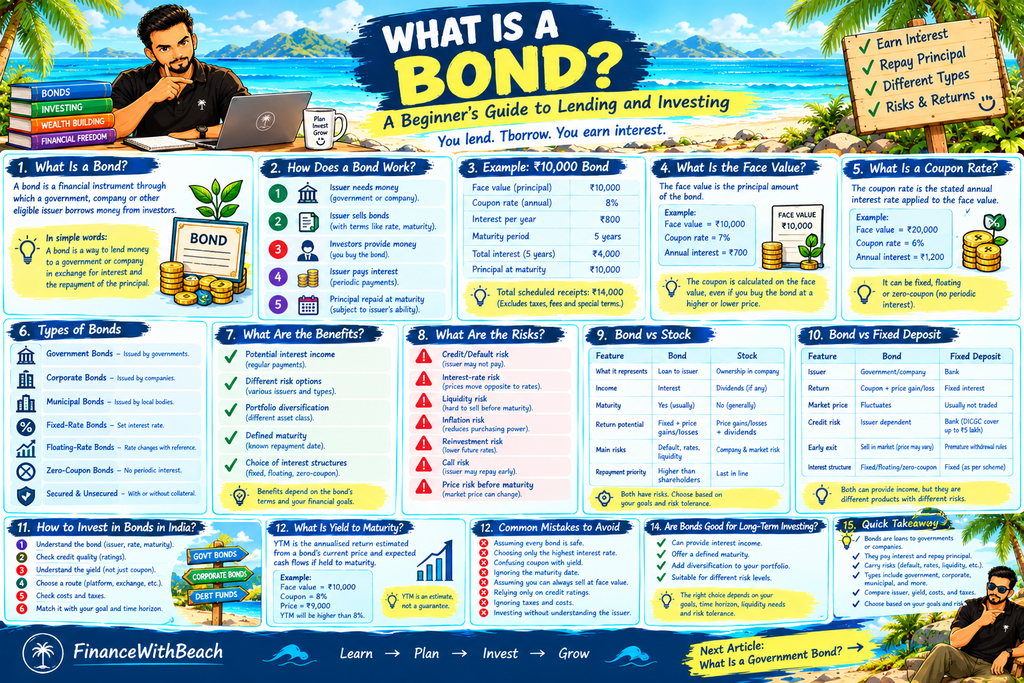
A bond is a financial instrument through which a government, company or other eligible issuer borrows money from investors.

When you buy a bond, you are essentially lending money to the issuer. In return, the agrees to pay interest according to the bond’s terms and repay the principal at maturity, subject to its ability to meet its obligations.

Example:

A company may issue bonds to raise money for expanding its business, purchasing equipment or funding new projects. A government may issue bonds to finance public speaking.

In Simple words:

A bond is a way to lend money to a government or company in exchange for interest and the agreed repayment of the principal.

Bonds are commonly called fixed-income investments, although not every bond pays a fixed interest rate and bond returns are not guaranteed.

Table of Contents

How Does a Bond Work?

Let’s understand the basic process step by step.

Step 1: An issuer needs money

A government or company needs funds to finance its activities or projects.

Step 2: The issuer sells bonds

The issuer offers bonds to investors. Each bond has specfic terms, such as its face value, interest rate and maturity date.

Step 3: Investors provide money

When you purchase a bond, you lend money to the issuer under the bond’s terms.

Step 4: The issuer pays interest

Dpending on the bond, you may recieve interest payments monthly, quarterly, half yearly, annually or at another specfied time. SOme bonds do not make periodic interest payments.

Step 5: The bond reaches maturity

At maturity, the issuer is generally required to repay the principal according to the bond;s terms. However, repayment depends on the issuer fulfilling its obligation; default is possible.

Example: How Does a Bond Work?

Let’s say you buy a bond with these hypothetical terms:

FeatureExample
Face value₹10,000
Annual coupon rate8%
Interest per year₹800
Maturity period5 years
Principal due at maturity₹10,000

If the bond pays an 8% annual coupon on its ₹10,000 face value, the scheduled interet would be ₹800 per year.

Over five years, you would recieive ₹4,000 in total interest if every scheduled payment is made. At maturity, the issuer would repay the ₹10,000 principal according to the bond’s terms.

Your total scheduled receipt would be ₹14,000 over five years, assuming the bond is held for the full term and and payments are made.

This example excludes taxes, fees and any special bond conditions. It also assumes you purchased the bond at face value. Of you a bond for more or less than its face value, your actual return can differ.

What Is the Face Value of a Bond?

The Face value, a;sp called the par value or nominal value, is the pricncipal amount specified for a bond.

Example:

A bond may have a face value of ₹1,000 or ₹10,000.

The face value is imoortant because the coupon payment is often calculated as a percentage of it.

Let’s say A bond has a face value of ₹10,000 and a coupon rate of 7%.

Annual coupon interest:

₹10,000 x 7% = ₹700

If you purchase that bond for ₹9,500 in the market, the coupon is still generally calculated on the face value of ₹10,000 according to the bond’s terms. Your overall return, however, also depends on th price you paid and the amount received at maturity.

What Is a coupon Rate?

The coupon rate is the stated annual interest rate applied to a bond’s face value.

Example:

A bond with a face of ₹20,000 and a 6% annual coupon rate would pay ₹1,200 in annual interest if it pays coupons annually and all payments are made.

Coupon payments may occur at different intervals depending on the bond’s terms.

Some bonds have fixed coupon rates, while others have variable of floating rates. Zero- coupon bonds generally do not pay periodic interest.

What Is the Maturity Date of a Bond?

The maturity date is th date on which a bond is scheduld to reach the end of its term.

On that date, the issuer is genrally expected to repay the outstanding principal according to the bond’s conditions.

Example:

  • A Bond issued for one year has a one-year term.
  • A bond issued for five year has A five-year term.
  • A bond issued for ten year has A ten-year term.

The maturity date matters becuase it helps investors understand when repayments is scheduled and how long their money may remain committed.

However, if you sell a bond before maturity, you may reiceve more or less than the amount you orginally invested.

What Are the Different Types of Bonds?

Bonds differ according to who issues them, how they pay interest and the irsks involved.

1. Government bonds

Government bonds aree issued by governments to borrow money.

India, the Central Governement issues government securities, including longer-term dated securitites. State governments issue State development loans.

Government securitiescarry risks that differ from corporate bonds. Their market prices can still fluctuate, particularly when interest rate changes.

Example:

An investor purchases a government security that pays interest according to its stated terms.

2. Corporate Bonds

Corporate bonds are issued by companies to raise money for business purposes.

A company may use the funds for ecpansion, new equipment, infrastructure or refinancing existing debt.

Corporate bonds involve the risk that the company may not make its scheduled interest payments or repay the principal.

credit ratings can help investors assess credit risk, but a rating is an opinion, not a guarantee of repayment.

3. Municipal Bonds

Municipal bonds are debt instruments issued by egilable local government bodies or municipal entities to fund projects such as water supply, roads or ublic infrastructure.

Their availability, structure and risks depend on the specfic issue and applicable rules.

4. Fixed-rate Bonds

Fixed-rate bonds have a stated interest rate that generally remains unchanged during the relevant term.

Example:

A bond with a 7% annual coupon may continue paying that rate according to its terms, even if market interest rate change.

Its market price may nevertheless rise or fall.

5. Floating-Rate Bonds

Floating-rate bonds have interest payments linked to a reference rate or another specified formula.

Their interest payments may change when the reference rate changes.

6. Zero-coupon Bonds

Zero-coupon bonds generally do not pay regular interest.

They may be issued or purchased at a discount to their maturity value. If the issuer makes the required repayment, the difference between the purchase price and the maturity payment contributes to the investor’s return.

7. Secured and Unsecured Bonds

A secured bond is backed specified collateral, subject to its legal terms.

An unsecured bond does not have the same specific collateral backing. The recovery available in a default depends on the issuer’s financial position, legal arrangements and applicable insilvency rules.

Remember:

The name of a bond oes not tell you its complete risk profile. Review The terms, issuer, repyment obligation and relevent disclosures before investing.

What Are the Benefits of Bonds?

Bonds can play a role in an investment portfolio, depending on the investor’s goals and the bond’s charcheristics.

1. Potential interest income

Many bond pay interest according to schedule, which can help investors plan their expected cash flows.

However, payments depend on he bond’s terms and the issuer meeting its obligations.

2. Different risk options

Governement and coprorate bonds offer different types of exposure. Investors can compare maturity periods credit quality and interest structures.

Different option come with different risks.

3. Portfolio diversification

Bonds cn provide expsoure to adifferent asset class from stocks.

Their returns do not always move in the same way as equity returns, although bonds can also decline in value and diversification cannot eliminate investment risk.

4. Defined maturity

Many bonds have a specfied maturity date, which helps investors understand when principal repyament is scheduled.

This can be useful when matching investments with future financial goals, provided the investors accounts for repayments and market risks.

5. Choice of interest Structures

Investors may find fixed-rate, floating-rate and zero-coupon bonds depending on the market and available products.

Each structure behave differently when interest rates and ecnomic conditions change.

What Are the Risks of Bonds?

Bonds are not automatically safe simply because they pay interest.

1. Credit or Default Risk

The issuer may fail to pay interest or repay the principal as promised.

Example:

A financially troubled company may struggle to meet its bond obligations.

Coprorate bonds with higher credit risk may offer higher yields to compensate investors but a higher uiled does not make the investment better or safer.

2. Interest-Rate Risk

Bodn rpices generally move in the opposite diection to market interest rates, all else being equal.

when markey interest rates rise, existing bonds with lower coupon rates may beomce les attractive, causing their prices to fall. When market fall, existing bonds with higher coupon rates may become more attractive, potentially raising their prices.

3. Liquidity Risk

some bonds are not traded frequently

If you need to sell one before maturity, there may not be enough buyers at a reasonable price. You mighe have to accept a lower price or wait longer to sell.

4. Inflation Risk

Inflation reduces the purchasing power of money over time.

Even if a bond pays interest as cheduled, rising prices can reduce the real value of the income you receive.

5. Reinvestment Risk

if you receive interest payments and want to reinvest them future investment opportunites may offer lower rates than your orginal bond.

This can effecr the total return you earn over time.

6. Call Risk

Some bonds allow the issuer to repay them early under specified conditons.

If a bond is called when market interest rates are lower, you may have difficulty finding another investment with a similar yield.

7. Price Risk Beofre maturity

if you sell a bond before its maturity date, the market price may be above or below what you paid.

Even When a bond has scheduled interest payments, you can still expernience a loss if you sell it an unfavorable price.

What Is the difference Between a Bond and a Stock?

FeatureBondStock
What it representsMoney lent to an issuerOwnership in a company
Investor’s roleCreditor or bondholderShareholder
Potential incomeInterest payments, if specified and paidDividends, if declared
MaturityMany bonds have a maturity dateOrdinary shares generally have no maturity date
Return potentialInterest plus possible price gains or lossesDividends and possible share-price gains or losses
Main risksDefault, interest rates, liquidity, inflationCompany performance and market movements
Repayment priorityBondholders generally rank ahead of shareholders, subject to the law and instrument termsShareholders generally rank behind creditors

Neither investment tyoe is risk free. their suitability depends on your goals, time horizons and tolerence for losses.

What is the Difference Between a Bond and a Fixed Deposits?

Bothe can be used people looking for income, but they are different financial products.

FeatureBondBank Fixed Deposit
Who receives your moneyA government or other bond issuerA bank
ReturnDepends on the bond’s coupon, purchase price, and other termsDepends on the FD’s interest terms
Market priceCan fluctuate if the bond is tradedUsually not quoted like a traded bond; premature withdrawal is subject to the bank’s terms
Credit riskDepends on the issuer and bondDepends on the bank and applicable deposit-protection rules
Early exitMay require selling at the market priceMay involve premature-withdrawal rules or penalties
Interest structureFixed, floating, zero-coupon, or other termsDepends on the chosen deposit scheme

In India, Eligible bank deposits are covered by DICGC insurance up to the applicable limit of ₹5 lakh per depositor per bank, including principal and interest, subject to the insurance rules. THis is different from bond protection and bonds should not be assumed to carry deposit insurance.

How can Beginners Invest in Bonds in India?

The process depends on th type of bond you want to buy.

Step 1: Understand the bond

Identify the issuer, maturity date, coupon rate, repayment terms and risks.

Step 2: Review credit quality

For corporate bonds, examine the credit rating and other infromation about the issuer’s ability to repay its debts. Never rely on a rating alone.

Step 3: Understand the Yield

The coupon rate is not the same as yield to maturity. Yeild to maturity estimates the annualised return implied by the bond’s price and cash flows, assumin the relvent payments occur as expected and the bond is held to maturity.

Step 4: Choose an appropriate route

Dpending on the security, Investors may access bonds thrugh official government-security platform, public issues, registered inetermediearies or the stock exchange.

The account requirements and avilable instruments vary.

Step 5: Check costs and taxes

Review trnsaction charges, applicable taxes and tax treatment of interest income and any capital gains.

Step 6: Consider your financial Goals

Think about when you may need the money, whether you can hold the bond until maturity anfd how much risk you can accept.

What IS Yield to Maturity?

Yield to maturity (YTM) is an estimate of the annualised return implied by a bond’s current price and its expected cash flows if held to maturity.

YTM cosniders factors suchs as the bond’s purchase price, coupon payments, fsce value, and remaining time until maturity.

Example:

A bond purhchased below it face value may have a higher yield to maturity than its coupon rate, assuming the issuer makes all requiredpayments. A bond purchased above face value may have a lower yiled to maturity than its coupon rate.

YTM is an estimate, not gurnateed. The actual outcome may differ if the bond is sold early, oayments are missed or other assumpption do not hold.

Common Beginner Mistakes to Avoid

Mistake 1: Assuming every bond is safe

bonds have different levels odf credit, interest-rate and liqudity risk.

Mistake 2: Choosing only the highest interest rate

A high advestised rate may reflect higher risk. Understand why the bond offers that rate.

Mistake 3: confusing coupon rate with yield

The coupon is based on the bond’s terms, while yield also depends on the price you pay and other factors.

Mistake 4: Ignoring the maturity date

Make sure the inevstment period suits when you expect to need the money.

Mistake 5: Assuming you can always sell at face value

A bond’s market price may change before maturity.

Mistake 6: relying only on credit ratings

Ratings can chnage and do not gurantee repayement. Read the avialable issuer and bond information.

Mistake 7: ignoring taxes and costs

Taxes and transaction charges can reduce your net worth.

Mistake 8: Investing without understanding the issuer

Before invsting, check who owes you the money and howthe issuer is expected to repay it.

Are Bonds Good for Long-Term investing?

Bonds may be useful for investors who want interest incopme, a defined maturity or exposure beyond stocks. However. different bonds have different risks and returns charcterisitcs.

Example:

A governemtn security and a lower-rated corporate bond should not be treated as equivalent investments. Even givernement bonds can flucluate in market price before maturity.

The right coice depends on your financial goals, time horizons, liquidity needs and risk tolerence.

there is no single bond that is best for everyone.

FAQs

What is a bond in simple words?

A bond is a way to lend money to a government or company in exchange for interest and the agreed repayment of the principal as scheduled.

How do bonds make Money

Investors may earn interest payments and may also make a gain igf they sella bond for more than they paid. Theyu can als experience losses.

Are bond risk-free?

No. Bonds can carry default risk, interest-rate risk, liquidty risk, inflation risk and other risks.

What is the difference between a bond and a stock?

A bond rperesnetsa loan to an issuer, while a stock generally represents ownership in a company.

What is the maturity date of a bond?

It is the date on wich the bond is scheduled to mature and the principal is genrally due for repayment according to its terms.

What is a coupon rate?

The coupon rate is the stated annual interest rate applied to the bond’s face value.

Can I Lose money in bonds?

Yes. You may lose money if the issuer defaults or if you sell the bond for less than you paid. The exact risk depend on the bond.

Can beginners invest in bonds in India?

Yes, subject to the eligibility and requirements of the investment route. Beginners should first understand the bond’s terms, risk costs and tax treatment.

Link this article to:

What Is a Bond? — A Beginner’s Guide to Lending and Investing

What Is a Bond?

A bond is a financial instrument through which a government, company or other eligible issuer borrows money from investors.

When you buy a bond, you are essentially lending money to the issuer. In return, the agrees to pay interest according to the bond’s terms and repay the principal at maturity, subject to its ability to meet its obligations.

Example:

A company may issue bonds to raise money for expanding its business, purchasing equipment or funding new projects. A government may issue bonds to finance public speaking.

In Simple words:

A bond is a way to lend money to a government or company in exchange for interest and the agreed repayment of the principal.

Bonds are commonly called fixed-income investments, although not every bond pays a fixed interest rate and bond returns are not guaranteed.

Table of Contents

How Does a Bond Work?

Let’s understand the basic process step by step.

Step 1: An issuer needs money

A government or company needs funds to finance its activities or projects.

Step 2: The issuer sells bonds

The issuer offers bonds to investors. Each bond has specfic terms, such as its face value, interest rate and maturity date.

Step 3: Investors provide money

When you purchase a bond, you lend money to the issuer under the bond’s terms.

Step 4: The issuer pays interest

Dpending on the bond, you may recieve interest payments monthly, quarterly, half yearly, annually or at another specfied time. SOme bonds do not make periodic interest payments.

Step 5: The bond reaches maturity

At maturity, the issuer is generally required to repay the principal according to the bond;s terms. However, repayment depends on the issuer fulfilling its obligation; default is possible.

Example: How Does a Bond Work?

Let’s say you buy a bond with these hypothetical terms:

FeatureExample
Face value₹10,000
Annual coupon rate8%
Interest per year₹800
Maturity period5 years
Principal due at maturity₹10,000

If the bond pays an 8% annual coupon on its ₹10,000 face value, the scheduled interet would be ₹800 per year.

Over five years, you would recieive ₹4,000 in total interest if every scheduled payment is made. At maturity, the issuer would repay the ₹10,000 principal according to the bond’s terms.

Your total scheduled receipt would be ₹14,000 over five years, assuming the bond is held for the full term and and payments are made.

This example excludes taxes, fees and any special bond conditions. It also assumes you purchased the bond at face value. Of you a bond for more or less than its face value, your actual return can differ.

What Is the Face Value of a Bond?

The Face value, a;sp called the par value or nominal value, is the pricncipal amount specified for a bond.

Example:

A bond may have a face value of ₹1,000 or ₹10,000.

The face value is imoortant because the coupon payment is often calculated as a percentage of it.

Let’s say A bond has a face value of ₹10,000 and a coupon rate of 7%.

Annual coupon interest:

₹10,000 x 7% = ₹700

If you purchase that bond for ₹9,500 in the market, the coupon is still generally calculated on the face value of ₹10,000 according to the bond’s terms. Your overall return, however, also depends on th price you paid and the amount received at maturity.

What Is a coupon Rate?

The coupon rate is the stated annual interest rate applied to a bond’s face value.

Example:

A bond with a face of ₹20,000 and a 6% annual coupon rate would pay ₹1,200 in annual interest if it pays coupons annually and all payments are made.

Coupon payments may occur at different intervals depending on the bond’s terms.

Some bonds have fixed coupon rates, while others have variable of floating rates. Zero- coupon bonds generally do not pay periodic interest.

What Is the Maturity Date of a Bond?

The maturity date is th date on which a bond is scheduld to reach the end of its term.

On that date, the issuer is genrally expected to repay the outstanding principal according to the bond’s conditions.

Example:

  • A Bond issued for one year has a one-year term.
  • A bond issued for five year has A five-year term.
  • A bond issued for ten year has A ten-year term.

The maturity date matters becuase it helps investors understand when repayments is scheduled and how long their money may remain committed.

However, if you sell a bond before maturity, you may reiceve more or less than the amount you orginally invested.

What Are the Different Types of Bonds?

Bonds differ according to who issues them, how they pay interest and the irsks involved.

1. Government bonds

Government bonds aree issued by governments to borrow money.

India, the Central Governement issues government securities, including longer-term dated securitites. State governments issue State development loans.

Government securitiescarry risks that differ from corporate bonds. Their market prices can still fluctuate, particularly when interest rate changes.

Example:

An investor purchases a government security that pays interest according to its stated terms.

2. Corporate Bonds

Corporate bonds are issued by companies to raise money for business purposes.

A company may use the funds for ecpansion, new equipment, infrastructure or refinancing existing debt.

Corporate bonds involve the risk that the company may not make its scheduled interest payments or repay the principal.

credit ratings can help investors assess credit risk, but a rating is an opinion, not a guarantee of repayment.

3. Municipal Bonds

Municipal bonds are debt instruments issued by egilable local government bodies or municipal entities to fund projects such as water supply, roads or ublic infrastructure.

Their availability, structure and risks depend on the specfic issue and applicable rules.

4. Fixed-rate Bonds

Fixed-rate bonds have a stated interest rate that generally remains unchanged during the relevant term.

Example:

A bond with a 7% annual coupon may continue paying that rate according to its terms, even if market interest rate change.

Its market price may nevertheless rise or fall.

5. Floating-Rate Bonds

Floating-rate bonds have interest payments linked to a reference rate or another specified formula.

Their interest payments may change when the reference rate changes.

6. Zero-coupon Bonds

Zero-coupon bonds generally do not pay regular interest.

They may be issued or purchased at a discount to their maturity value. If the issuer makes the required repayment, the difference between the purchase price and the maturity payment contributes to the investor’s return.

7. Secured and Unsecured Bonds

A secured bond is backed specified collateral, subject to its legal terms.

An unsecured bond does not have the same specific collateral backing. The recovery available in a default depends on the issuer’s financial position, legal arrangements and applicable insilvency rules.

Remember:

The name of a bond oes not tell you its complete risk profile. Review The terms, issuer, repyment obligation and relevent disclosures before investing.

What Are the Benefits of Bonds?

Bonds can play a role in an investment portfolio, depending on the investor’s goals and the bond’s charcheristics.

1. Potential interest income

Many bond pay interest according to schedule, which can help investors plan their expected cash flows.

However, payments depend on he bond’s terms and the issuer meeting its obligations.

2. Different risk options

Governement and coprorate bonds offer different types of exposure. Investors can compare maturity periods credit quality and interest structures.

Different option come with different risks.

3. Portfolio diversification

Bonds cn provide expsoure to adifferent asset class from stocks.

Their returns do not always move in the same way as equity returns, although bonds can also decline in value and diversification cannot eliminate investment risk.

4. Defined maturity

Many bonds have a specfied maturity date, which helps investors understand when principal repyament is scheduled.

This can be useful when matching investments with future financial goals, provided the investors accounts for repayments and market risks.

5. Choice of interest Structures

Investors may find fixed-rate, floating-rate and zero-coupon bonds depending on the market and available products.

Each structure behave differently when interest rates and ecnomic conditions change.

What Are the Risks of Bonds?

Bonds are not automatically safe simply because they pay interest.

1. Credit or Default Risk

The issuer may fail to pay interest or repay the principal as promised.

Example:

A financially troubled company may struggle to meet its bond obligations.

Coprorate bonds with higher credit risk may offer higher yields to compensate investors but a higher uiled does not make the investment better or safer.

2. Interest-Rate Risk

Bodn rpices generally move in the opposite diection to market interest rates, all else being equal.

when markey interest rates rise, existing bonds with lower coupon rates may beomce les attractive, causing their prices to fall. When market fall, existing bonds with higher coupon rates may become more attractive, potentially raising their prices.

3. Liquidity Risk

some bonds are not traded frequently

If you need to sell one before maturity, there may not be enough buyers at a reasonable price. You mighe have to accept a lower price or wait longer to sell.

4. Inflation Risk

Inflation reduces the purchasing power of money over time.

Even if a bond pays interest as cheduled, rising prices can reduce the real value of the income you receive.

5. Reinvestment Risk

if you receive interest payments and want to reinvest them future investment opportunites may offer lower rates than your orginal bond.

This can effecr the total return you earn over time.

6. Call Risk

Some bonds allow the issuer to repay them early under specified conditons.

If a bond is called when market interest rates are lower, you may have difficulty finding another investment with a similar yield.

7. Price Risk Beofre maturity

if you sell a bond before its maturity date, the market price may be above or below what you paid.

Even When a bond has scheduled interest payments, you can still expernience a loss if you sell it an unfavorable price.

What Is the difference Between a Bond and a Stock?

FeatureBondStock
What it representsMoney lent to an issuerOwnership in a company
Investor’s roleCreditor or bondholderShareholder
Potential incomeInterest payments, if specified and paidDividends, if declared
MaturityMany bonds have a maturity dateOrdinary shares generally have no maturity date
Return potentialInterest plus possible price gains or lossesDividends and possible share-price gains or losses
Main risksDefault, interest rates, liquidity, inflationCompany performance and market movements
Repayment priorityBondholders generally rank ahead of shareholders, subject to the law and instrument termsShareholders generally rank behind creditors

Neither investment tyoe is risk free. their suitability depends on your goals, time horizons and tolerence for losses.

What is the Difference Between a Bond and a Fixed Deposits?

Bothe can be used people looking for income, but they are different financial products.

FeatureBondBank Fixed Deposit
Who receives your moneyA government or other bond issuerA bank
ReturnDepends on the bond’s coupon, purchase price, and other termsDepends on the FD’s interest terms
Market priceCan fluctuate if the bond is tradedUsually not quoted like a traded bond; premature withdrawal is subject to the bank’s terms
Credit riskDepends on the issuer and bondDepends on the bank and applicable deposit-protection rules
Early exitMay require selling at the market priceMay involve premature-withdrawal rules or penalties
Interest structureFixed, floating, zero-coupon, or other termsDepends on the chosen deposit scheme

In India, Eligible bank deposits are covered by DICGC insurance up to the applicable limit of ₹5 lakh per depositor per bank, including principal and interest, subject to the insurance rules. THis is different from bond protection and bonds should not be assumed to carry deposit insurance.

How can Beginners Invest in Bonds in India?

The process depends on th type of bond you want to buy.

Step 1: Understand the bond

Identify the issuer, maturity date, coupon rate, repayment terms and risks.

Step 2: Review credit quality

For corporate bonds, examine the credit rating and other infromation about the issuer’s ability to repay its debts. Never rely on a rating alone.

Step 3: Understand the Yield

The coupon rate is not the same as yield to maturity. Yeild to maturity estimates the annualised return implied by the bond’s price and cash flows, assumin the relvent payments occur as expected and the bond is held to maturity.

Step 4: Choose an appropriate route

Dpending on the security, Investors may access bonds thrugh official government-security platform, public issues, registered inetermediearies or the stock exchange.

The account requirements and avilable instruments vary.

Step 5: Check costs and taxes

Review trnsaction charges, applicable taxes and tax treatment of interest income and any capital gains.

Step 6: Consider your financial Goals

Think about when you may need the money, whether you can hold the bond until maturity anfd how much risk you can accept.

What IS Yield to Maturity?

Yield to maturity (YTM) is an estimate of the annualised return implied by a bond’s current price and its expected cash flows if held to maturity.

YTM cosniders factors suchs as the bond’s purchase price, coupon payments, fsce value, and remaining time until maturity.

Example:

A bond purhchased below it face value may have a higher yield to maturity than its coupon rate, assuming the issuer makes all requiredpayments. A bond purchased above face value may have a lower yiled to maturity than its coupon rate.

YTM is an estimate, not gurnateed. The actual outcome may differ if the bond is sold early, oayments are missed or other assumpption do not hold.

Common Beginner Mistakes to Avoid

Mistake 1: Assuming every bond is safe

bonds have different levels odf credit, interest-rate and liqudity risk.

Mistake 2: Choosing only the highest interest rate

A high advestised rate may reflect higher risk. Understand why the bond offers that rate.

Mistake 3: confusing coupon rate with yield

The coupon is based on the bond’s terms, while yield also depends on the price you pay and other factors.

Mistake 4: Ignoring the maturity date

Make sure the inevstment period suits when you expect to need the money.

Mistake 5: Assuming you can always sell at face value

A bond’s market price may change before maturity.

Mistake 6: relying only on credit ratings

Ratings can chnage and do not gurantee repayement. Read the avialable issuer and bond information.

Mistake 7: ignoring taxes and costs

Taxes and transaction charges can reduce your net worth.

Mistake 8: Investing without understanding the issuer

Before invsting, check who owes you the money and howthe issuer is expected to repay it.

Are Bonds Good for Long-Term investing?

Bonds may be useful for investors who want interest incopme, a defined maturity or exposure beyond stocks. However. different bonds have different risks and returns charcterisitcs.

Example:

A governemtn security and a lower-rated corporate bond should not be treated as equivalent investments. Even givernement bonds can flucluate in market price before maturity.

The right coice depends on your financial goals, time horizons, liquidity needs and risk tolerence.

there is no single bond that is best for everyone.

FAQs

What is a bond in simple words?

A bond is a way to lend money to a government or company in exchange for interest and the agreed repayment of the principal as scheduled.

How do bonds make Money

Investors may earn interest payments and may also make a gain igf they sella bond for more than they paid. Theyu can als experience losses.

Are bond risk-free?

No. Bonds can carry default risk, interest-rate risk, liquidty risk, inflation risk and other risks.

What is the difference between a bond and a stock?

A bond rperesnetsa loan to an issuer, while a stock generally represents ownership in a company.

What is the maturity date of a bond?

It is the date on wich the bond is scheduled to mature and the principal is genrally due for repayment according to its terms.

What is a coupon rate?

The coupon rate is the stated annual interest rate applied to the bond’s face value.

Can I Lose money in bonds?

Yes. You may lose money if the issuer defaults or if you sell the bond for less than you paid. The exact risk depend on the bond.

Can beginners invest in bonds in India?

Yes, subject to the eligibility and requirements of the investment route. Beginners should first understand the bond’s terms, risk costs and tax treatment.

Link this article to:

What Is an ETF? — How Exchange-Traded Funds Work

What Is an ETF?

An ETF (Exhange-Traded Fund) is an investment fund whose units are traded on a stock exhange, similar to how shares of a company are bought and sold.

An ETF can hold a collection of investments, such as stocks, bonds or gold-related assets, depending on its investment objective. Many ETFs are designed to track an index, such as the nifty 50 or Sensex.

Example:

A nifty 50 ETF aims to track the performance of the Nifty 50 index by investing in securites that represent the index.

In Simple Words:

An ETF allows you to invest in a collection of assets by buying units of a fund thorugh a stock exchange.

Unlike a typical index mutual fund, an ETF’s market price changes throughout the trading day as buyers and sellers trade its units. It price may be Slightly different from the value of its underlying assets.

Table of Contents

How Does an ETF Work?

Let’s ynderstand how an ETF works step by step.

Step 1: A fund is created

A fund provider creates an ETF with a defined investment objective . For example, it may aim to track a stock market index or provide exposure to gold.

Step 2: The ETF holds investments

Dpending on its objective, the ETF holds a collection of securties or other eligible assets.

Example:

A Nifty 50 ETF aims to mirror the composition of the Nifty 50 Index.

Step 3: Investors buy ETF units

A retail Investors generally buy and sell ETF units through a stocknroker using a trading account. A demat account is used to hold the units electonically.

Step 4: The ETF trades on the stock exchange

ETF units can be bought or sold during exchange trading hours. Their market prices change according to supply an demand and the value of the underlying assets.

Step 5: Your Investment value changes

I fth ETFs market price rises, the value of your holding may increase. If its price falls, your holding may lose value.

Important: ETFs do not guranteed profits. Your returnss depend on the ETF’s onvestment, expneses, Trading price, and other relevent factors.

Example: Investing ₹10,000 in an ETF

Lety’s say you buy ETf units worth ₹10,000. Imagine the ETFs’s market price changes by 10%.

Hypothetical price movementApproximate investment value
ETF price rises 10%₹11,000
ETF price remains unchanged₹10,000
ETF price falls 10%₹9,000

These figures are simplied inllustrations before brokerage, applicable Taxes, other charges and any difference between the ETF’s market price and the value of its underlying assets.

Your actual return may differ from the return of the index or asset the ETF tracks.

What Are the Different Types of ETFs?

ETFs can provide exposure to different markets and asset classes.

1. Equity ETFs

Example:

A Nifty 50 ETF aims to track the nifty 50 inde, providing exposure to a group of major Indian companies through one investment.

Main Risk: The ETF can lose value when the stock market declines.

2. Gold ETFs

Gold ETFs aim to provide exposure to Gold prices thorugh a fund structure.

They can be an alternative to holding physical gold, although they involve fund expenses and market-related risks.

Main risk: The value of your investment can fall if gold prices decline.

3. Debt ETFs

Debt ETFs invest in fixed-income securties, such as government securities or other bonds, accroding to their investment objectives.

Main risk: Their prices can be affected by Interest-rate changes, credit risk and other market conditions.

4. International ETFs

International ETFs provide exposure to overseas markets or securities.

Example:

An ETf may aim to track an index representing companies in another country.

Main risk: Your investment may be affected by overseas market movements, currency fluctuatiopn and other international risks. Avilability and access can vary.

5. Sector ETFs

Sector ETFs focus on a particular industry, such as banking, information technology or healthcare.

They may offer targeted exposure, but concentrating on one setor can increase risk.

6. Commodity ETFs

Commodity-related ETFs aim to provide exposure to paticular commoditites or commodity-related investment, depending on their structure.

Investors should understand exactly what the fund holds and how it racks the relevent commodity.

Remember: An ETF’s name alone does not tell you everything about its risk. Always review its investment objective, underlying holdings and scheme documents.

What Are the Benefits of ETFs?

ETFs can offer several advantages, depending on the types of fund.

1. Diversification

An Etf holding multiple securities can give exposure to several companies or investments through a single purchase.

However, diversification does not eliminate market risk and sector-soecfic ETFs be concentrated.

2. Trading Flexibility

ETF units generally be brought and sold during stock exchange trading hours, unlike ordinary mutual fund transactions that use the applicable NAV-based proces.

This gives investors more control over the timing and price of their trades.

3. Potentially lower expenses

Many ETFs have relatively low fund-management costs, particularly those that track broad indexes.How ever, expenses ratios differ and brokerage and other trading costs can affect your total cost.

4. Price visibility

You can see the ETF’s market price during trading hours and place orders thorugh your broker.

The market price may differ from the ETF’s underlying net asset value.

5. Acccess to different assets

Depending on availability, ETFs can help investors access stock indexes, bonds, gold-relate investments and international markets thorugh an exchnage- traded product.

6. Simple Acces to a market Index

Instead of buying every share in an index spearately, youn can purchase units of an ETF that aims to track that Index.

What Are the Risks of ETFs?

ETFs are investment, not guaranteed savings products.

1. Market Risk

If the ETF’s underlying investments decline in vlaue, the ETF’s price can also fall.

Example:

An equity ETF may lose value during a stock market downturn.

2. Liquidity risk

Some ETFs have limited trading actviy. You may find it harder to buy or sell at your preferred price, especially when trading volumes are low.

3. Bid-ask spread

The Bid price is what buyers are willing to pay, while the ask price is what sellers are asking.

The difference between themis called the bid-ask spread. A wider spread can increase the cost increase the cost of buying or selling an ETF.

4. Tracking difference

An ETF designed to track an index may not deliver exactly the same return as that index. Expenses, trading costs, cash holdings and other factors can cause differences.

5. Premium or discount to NAV

An ETF’s market price can be higher or lower than its net asset value per unit.

This means you should not assume the market price always exactly equals the value of the ETF’s underlying assets.

6. Concentration risk

An ETF focused on one sector or a narrow group of investments may be more edxposed to particular risks than a broad- market ETF.

7. Trading costs

Brokerage, applicable taxes, exhange-relate charges and pther costs may apply. These costs depend on the broker, transaction and current rules.

Beofre investing investing, understand the ETF’s structure, trading liquidity, underlying investments and total costs.

What Is the Difference Between an ETF and an Index Fund?

An ETF and an index fund are related concepts, but they are not identical.

An index fund follows a partcular index as its investment strategy. An ETF is a fund structure that trades on a stock exchange.

Many ETFs track indexes and some index mutual funds track those same indexes without trading on the exchange like shares.

FeatureETFIndex Mutual Fund
How you buyThrough a stock exchange and brokerThrough the mutual fund’s transaction process
PriceMarket price changes during trading hoursTransaction price based on the applicable NAV
TradingDuring exchange trading hoursAccording to mutual fund transaction rules
Demat accountGenerally required for ordinary exchange-traded purchasesGenerally not required for direct mutual fund transactions
CostsFund expenses plus applicable trading costsFund expenses and any applicable transaction costs
Minimum purchaseUsually whole units on the exchangeMay allow fractional units based on the amount invested and scheme rules
LiquidityDepends on exchange trading activity and market conditionsDepends on the fund’s redemption terms

Niether option is automatically better. Your choice dpends on how you prefer to invest, the costs involved and the partcular fund.

What Is the Difference Between an ETF and a STock?

A stock represents ownershi in an individual company. An ETF represents units in a fund that holds investments according to its stated objectives.

FeatureETFIndividual Stock
What you ownUnits of an investment fundShares of a company
Underlying exposureMay include many securities or assetsOne company
DiversificationCan provide diversification through one purchaseDepends on your other investments
Main risksFund, market, tracking, and liquidity risksCompany-specific and market risks
ExampleNifty 50 ETFShares of one listed company

An ETF may reduce reliance on the performance of a single company, but it cannot eliminate the risk of losing money.

How Do You Buy an ETF in India?

For a ordinary retail investor, buying and ETF typically involves a demat account and trading account.

Here are the basic steps.

Step 1: Open an account with a broker

Choose a registered stockbroder and complete the rquired account-opening and identity- vertification process.

step 2: Research the ETF

Understand what the ETF tracks, What it holds, it risk level, expenses ratio and trading actvity.

Step 3: Check the market price

Look at the current bid and ask prices, trading volumes and the difference between the market price and NAV wehere relvent.

Step 4: Place your order

use your broker’s platformto place an order for the number of units you want to buy.

A limit order can help you specify the maximum price you are willing to pay, athough execution is not guaranteed.

Step 5: Monitor your Investment

Review the ETF’s peerformance, costs and continued uitability for your financial goals.

Beginner Tip: Avoid choosing an ETF only because it unit price looks low. COmpare its underlying exposure, costs, Liquidity and risks instead.

Can You Invest in ETFs Through an SIP?

Some brokers and investment platforms offer recurring investment facilities for slected ETFs. However, this process may differ from a mutual fund SIP.

with an ETF, units are generally purchased on the stock exchange at market prices and purchases usually involve whole units. The amount invested each time can thereforevary depending on the ETF’s’s price and the platform’s features.

Example:

Let’s say you plan to invest approximately ₹2,000 every month in an ETF.

  • Monethy target: ₹2,000
  • Number of purchases: 12 per year
  • Approximate yearly contribution: ₹24,000

This represents the amount you plan to contribute, not a guranteed future value. Actual purchases depend on the ETF price, available units and applicable costs.

If you prefer an automatic fixed-amount monthy investment, an index Mutual fund with a regular SIP facility may be simpler to operate.

What Is the Expense Ratio of an ETF?

The Expense ratio is the annual operating expense of a fund expressed as perecntage of its assets.

Let say An ETF has an expense ratio of 0.20%.

At that rate, the annual fund expense is equivalent to approximately ₹20 per ₹10,000 invested, based on tht percentage.

This is an Illustration, not a separate bill for exactly ₹20. Fund expesnes are reflected in the fund’s value over time and your actual cost depends on the fund and the amount invested.

Remember that the expense ratioo is not necessarily your only cost. Brokerage and other applicable transaction charges can also affect your net return.

How Should Beginners Choose an ETF?

Before buying an ETF, consider these points.

  1. Understand the underlying asset: know whether the ETF track an Equity index, bnds, gold or another investment.
  2. CHeck rhe Investment objectives: Make sure the ETF’s strategy matches yopur goals.
  3. Compare expense ratios: Lower costs can help, but they should not be your only slection criterion.
  4. Review liquidity: Look at Trading volume and the bid-ask spread.
  5. Check tracking peeformance : for Index ETFs, compare how closely the ETF follows its benckmarks.
  6. Understand all costs: Consider brokerage, applicable taxes, and other charges.
  7. Read the scheme documents: Review the holding, risks and investm,ent terms.
  8. Consider your time horizons: Don’t invest money needed for essential expesnses or near-term goals in a product whose value may fluactuate signifantoly.

Common Beginner Mistakes to Avoid

Mistake 1: Assuming every ETF is low-risk

An ETF that tracks a volatile market or focuses on one sector can carry subsantial risk.

Mistake 2: Ignoring Liquidity

An ETF with low trading actvity may have a wider bid-ask spread.

Mistake 3: Looking only at the expense ratio

Trading costs and tracking performance also matter.

Mistake 4: Confusing an ETF’s price with its value

The market price can differ from NAV.

Mistake 5: Expecting guaranteed returns

ETf prices can rise or fall and losses are possible.

Mistake 6: Buying without understanding the underlying investment

Always fiund out what you are imvesting in beofre placing an order.

Mistake 7: Trading too frequently

Frequent buying and selling cn increase costs and encourage inpulsive decision. Make investment decisions based on your plan rather than every shor-term market movement.

Are ETFs Good for Long-Term Investing?

ETFs can be useful for long-term investing when their underlying investments match your goals and risk tolerence.

Example:

A brad- market equity ETF may offer diversified expsoure to a stock index. A gold ETF, however, provides a different kind od exposure and has different risks.

The right choice depends on the asset class, your financial objectives, your investment horizon and your ability to tolerate losses.

These is no sinle ETF that is Best for everyone.

FAQs

1. What is an ETF in simple words?

An ETf is an investment fund whose units trade on a stock exchange. It may hold a collection od shares, bonds or other assets.

2. What Does ETf stand for?

ETF stands for exhange-Traded Fund.

3. Is an ETF a Mutual Fund?

An ETF is a type of investment fund. In India, ETFs are structured as mutual fund schemes but their units trade on stock exchanges, unlike ordinary open-ended mutual fund transactions.

4. Can I lose money in an ETF?

Yes. If the underlying investments decline in value, the ETF’s price can fall and you may lose some or all of your invested money.

5. Do I neededa Demat account to buy an ETF in India?

For ordinary retail purchases of ETFs on stock exchange, you generally need a demat account and a trading account.

6. Are ETFs Suitable for Beginners?

They can be, provided ou understand the underlying investments, market risks, lquidity and costs. Beginners should research a fund before investing.

7. Do ETFs pay dividends?

Some ETFs may distribute income if thier structure ans scheme terms allow it. Other may retain income or reflect it in the fund’s value. Check he particular ETF’s scheme documents.

8. Are ETFs guaranteed to make money?

No. ETFs returns depend on their underlying investments and market conditions. Returns are not guaranteed.

Link this article to:

What Is an Index Fund? — A Simple Way to Understand Passive Investing

What Is an Index Fund?

An Index fund is a types of mutual fund that aims to tracks the performance of a particular market index, such as the Nifty 50 oe sensex.

Instead of trying to select individual stocks to outperform the market, an index fund follows a predefined index and investes according to its composition.

Example:

A nifty 50 index fund aims to track the performance of the nifty 50, which represents 50 major companies listed on the national stock exhanges of india.

In simple Words:

An Index fund Allows you to invest in a group of companies through single fund designed to foolow a market index.

Table of Contents

How Does an Index Fund Work?

An index fund follows the rules of its chosen index.

Let’s understand the process step to step.

Step 1: Choose a market index

The fund selects an index to track, such as the nifty 50 or sensex.\

Step 2: Follow the market

The fund invests in the securities included in the index, generally in proportions designed to reflect the index’s composition.

Step 3: Investors Buy fund units

When you invest in an index mutual fund, you recieve units based on the apllication Net Asset Value(NAV).

Step 4: The investment value changes

As the prices of the underlying securitis change, the fund’s NAV can rise or fall.

Step 5: The fund aims to track its index

The fund attempts to deliver performance similar to its benchmark. Its actul return may differ because of expenses, trading costs, cash holdings, and tracking differences.

Example: Investing ₹10,000 in an Index Fund

Let’s say you invest ₹10,000 in an index fund.

Hypothetical market movementApproximate investment value
Index rises 10%₹11,000
Index remains unchanged₹10,000
Index falls 10%₹9,000

These figures are simplified illustrations before fund expenses, taxes and tracking differences.

The example shows that index funds can grow when their underlying investment perform well, but they can also lose value when the markey falls.

Important: Index Fund Returns are not guaranteed.

What Is Passive Investing?

Passive Investing is an investment approach in which a fund follows a predefined index or strategy rather than actively trying to otuperform the market by slecting individual investments.

Index Funds are a common examples of passive investing.

A nifty 50 index fund geberally folloes the composition of the nifty 50 rather than independently deciding which 50 companies it believes will perfrom test.

The objective is to track the index, not necessarily beat it.

What Is the difference Between and Index Fund and an Active Mutual Fund

Both are mutual fund, but they use difference inestment approaches.

FeatureIndex FundActive Mutual Fund
Main objectiveTrack a market indexTry to outperform a benchmark
Investment decisionsFollows index rulesFund manager selects investments
Portfolio changesGenerally follows index changesDepends on the manager’s strategy
Management stylePassiveActive
CostsOften lower, but varyMay be higher, but vary
ReturnsMay differ from the indexMay outperform or underperform its benchmark

Neither approach guranteed bbetter performance. The right choice depends on the fund’s strategy, costs, risks, and your financial goals.

What Are th Different Types of Index Funds?

Index Fund can track different types of indexes.

1. Nifty 50 Index Fund

This type of fund aims to tracks the nifty 50 index, which represents 50 major companies listed on the National Stock Exchanges.

If offers exposure to large Indian Companies across different sectors,although the portfolio actual sector and company weights can vary.

2. Sensex Index Fund

A sensex index fund aims to track the BSE Snesex, an index representing 30 major companies listed on the Bombay stock Exchange.

3. Broad Market Index Fund

Some index Fund track broader indexes that represents a larger group of companies.

Example:

A fund tracking the nifty 500 aims to follow a much broader slection of indian companies than a nifty 50 fund.

4. Mid-Cap or small -cap Index Fund

These fund trackm indexe found on mid-sized or smaller companies.

They may havd idffeent risk charcherisic from large company indexes, including potentially greater volatility.

5. International Index Fund

Some funds provide exposure to international ,arkets by tracking indexes containing companies outside India.

Their risk may include international market moavemnts and currency fluctuations.

Remember: The index a fund Tracks determine much of its investment exposure and risk profile.

What Are the benfits of Index Funds?

Index Fund can offer severals advantages of investors.

1. Diversification

A broad index fund can provide exposure to mulitple companies through one investment.

Thsi reduce dpendence on any single company copared with holdinbg only that company’s shares. however, diversifcation does not eliminate market risk.

2. Simple Investing

You don’t need to research and buy every company individually.

The fund follows its index’s rules, making the investment approach relatively staright forward.

3. Potentially Lower costs

Because index fund generally follow a predefined strategy, they often have lower management costs than actively managed funds.

However, Expense ratios vary, so always compare the actual costs.

4. transparency

You can identify the index being tracked and review the fund’s holding and investment strategy.

5. Suitable for long term goals

An index fund may be useful gor long term investing when its market exposure matches your goals and risk tolerence.

It is not automatically suitable for every investor or every financial goals.

6. SIP investment options

Many index mutual funds offer systematic Investment Plans (SIPs), allowing investors to contributea fixed amount regularly, subject to the fund’s terms.

What Are the risks of Index Funds?

Index Funds are not risk-free investments.

1. Market risks

If the index falls, the fund’s value can also fall.

Example:

A ₹50,000 investment copuld decline to ₹40,000 after a hypothetical 20% fall, before considering expenses or tracking differences.

2. Concentration risk

Some indexes are heavily weighted towards particular companies or sectors. Holding many stocks does not necessarily means risk is evenly distributed.

3. Tracking difference

An index fund mayu deliver return that differs from its benchmark because of expenses,trading costs,cash golding and other factors.

4. Nor guaranteed returns

An index fund cannot guarantee profits simply because it tracks a well-known index.

5. timing risk

Investingn just before a market decline can lead to shor-term losses.Even long-term investos can experience periods of poor performance.

6. International and currency risk

International index fund can be affected by cahnges in overseas markets and exchanges rates.

Before investing, understand what the index contains and whether you can tolerate the potentil losses.

What Is an Expense Ratio?

The expense ratio represents the annual operating expenses of a mutual fund as percentage od its assets.

Example:

Let’s say an index fund has an expense ratio of 0.30%.

This means the fund’s mutual annual operating expenses are equivalent to approximately ₹30 oer ₹10,000 invested, based on that percentage.

You generally don’t pay this as a separate monthy bill. Fund expenses are reflected in the fund’s NAV over time.

When comparing index fund, look at both the epxense ratio and tracking differene rather than choosing a fund on cost alone.

What Is Tracking Error?

Tracking error measures how closely a fund’s returns follow the returns of its benchmark over time.

Example:

Let’s say and index deliversa 10% return over a partcular period while fund tracking it delivers 9.8%

The fund’s return differs from the index by 0.2 percentage pointss foir that period. This single- peiod difference is not istelf the tracking error, which is genrally msaured using the variability of return differnces over time.

When comparing fund tracking the same index, review their costs, tracking performance and investment terms.

Index Fund vs Indvidual Stock

An index fund and an individual stock provide different types of exposure.

FeatureIndex FundIndividual Stock
InvestmentA collection of securitiesShares of one company
DiversificationUsually greater for broad indexesDepends on your other holdings
Research requiredUnderstand the index and fundResearch the company
RiskMarket and index-specific risksCompany-specific and market risks
ManagementFollows index rulesYou decide when to buy or sell
ExampleNifty 50 index fundShares of one listed company

An idnex fund can make diversification easier, but it does not rmeove the possibility of investment losses.

Index Fund vs ETF: What Is the Difference?

An index fund and an exchange-traded fund(ETF) are not exactly the same thing.

An index fund describes an investment strategy:tracking a particular index.

An ETF describes a Fund structures whose units trade on a stocks exchnages during market hours. Many ETFs track indexes, whike some mutual fund also track indexes without being ETFs.

FeatureIndex Mutual FundIndex ETF
How you investThrough the mutual fund’s transaction processThrough a stock exchange using a trading account
PriceUsually based on the applicable NAV for the transactionTrades at market prices during exchange hours
TradingAccording to fund rules and cut-off timesDuring market hours
Additional considerationFund costs and trackingFund costs, brokerage where applicable, bid-ask spread and liquidity

Both can provide index ecposure. The more suitable option depends on your prefences, costs and access to investing facilites.

Can Beginners Invest in invest Fund Through an SIP?

Yes. many index mutuals fund offers SIP facilities.

An SIp allows you to invest a fixed amount at regular intervals instead of investing all your money at once.

Example: Let’s say you invest ₹3,000 per month in an index fund.

  • Monthly invetsment: ₹3,000
  • Total invested in one year: ₹36,000
  • Total Investment in Fuve years: ₹1,80,000
  • Total invested in ten years: ₹3,60,000

These amount represent contribution only, not investment returns.

Your actual investment vlue may be higher or lower depending on the perromance of the index and fund.

An SIP can Help build a consistent investing habit, but it does not guranteed a profit or prevent losses.

How Should Beginners Choose an Index Fund?

Before selecting an Index Fund, cosnider the following points.

1. Understand the Index

Find out which companies, sectors, countries or assets classes the index represents.

2. Match it to your goal

A broad large-company index fund has a different risk profile from a small-cap or sector-specfic index fund.

3. Compare expense ratios

Lowe costs can help preserve returns,all else being equal, but cost should not be your only considertion.

4. Review Tracking performance

Check hoe closely the fund has followed its benchmark over diferent periods.

5. Check he investment method

understand the minmum investment, SIP availability, redemptions rules and any applicable charges.

6. Consider your time horizon

Equity index fund can experence significant market declines. Don’t invest money needed for essential expenses or near-term goals without understanding the risk.

7. Read the scheme documents

Review the fund’s sated objective, risk information, benckmarkl and other relvent disclosures before investing.

Are Index Fund Good for Long-Term Investing

Index Funds can be useful for long-term investing because they offer a straightforward way to access a market index.

Their suitability depends on the index they track, your financial objectives, your investment eriod and your risk tolerence.

Example: A broad equity index fund may suit an investor seeking long-term expsoure to the stock market, while someone who needs the money soon may reqire a different approach.

There is no single index fund that is best for everyone.

Common Beginner Mistakes to Avoid

Mistake 1: Assuming index fund are risk free

Index fund can lose value when the underlying market falls.

Mistake 2: Choosing a fund only because of its low NAV

NAV lone does not tell you whether a fund is better or cheaper.

Mistake 3: Assuming every index is diversified equally

Some indexes are concentrated in particular companies or sectors.

Mistake 4: Ignoring expenses

Costs can reduce your investment returns over time.

Mistake 5: Expecting an index fund to beat the index

The primary objective is usually to track to track the index, not outperform it.

Mistake 6: Investing Without a financial Plan

Choose investment based on your goals, time horizons and ability to tolerate losses.

Mistake 7: Reacting to every market movement

Review your plan thoughtfully rather than making frequent decisions based only on short term market changes.

FAQs

1. what is an Index fund in simple words?

An index fund is amutual fund that aims to follow a market index, suchs as the nifty 50 or sensex.

2. Is an index fund a mutual fund?

Yes. An index mutual fund is a types of mutual fund that follow a partcukar index.

3. Can I Lose money in an index fund?

Yes. If the underlying declines, your investment can lose value.

4. Are Index funds good for beginners?

They can be a simple gain exposure to a market index, but beginners should understand the fund’s risks and costs before investing.

5. What is the difference between an index fund and in SIP?

An index fund is an investment product.An SIP is amehtod of investing regularly in a mutual fund. You can use an SIP to invest in an eligible index mutual fund.

6. Are index guranteed to make money?

No. Index Fund are market-linked investments, and their returns are not guaranteed.

7. Do Index funds have fees?

Yes. Index funds generally have an expense ratio, and other costs may apply depending on the fund and investment method.

8. What is better: an index fund or an ETF?

It depends on hoe your refer to invest, the costs invloved, Liquidity and the paicular porducts available. Many ETFs track Indexes, but an ETF and an index fund are not interchangeable terms.

9. How long should I stay invested in an inde fund?

There is no universal holding period. It dpends on the index, the fund’s risk and your goals. Equity index funds ae generallly better considered for goals with a sufficiently long investment horizon rather than money needed immediately.

gularly

What Is an SIP?

An SIP(Systematic Investment Plan) is method of investing a fixed amount of money at regular intervals, usually monthy, into a mutual fund.

Instead of investing a large amount all at once, you can invest smaller amounts regularly, This makes investing easieer to organise and helps build a consistent investing habits.

Example

Let’s say you decide to invest ₹2,000 every month ina mutual fund.

  • Month 1: ₹2,000
  • Month 2: ₹2,000
  • Month 3: ₹2,000
  • Month 4: ₹2,000

After four months, you would have invested ₹8,000 in total.

Over time, regular investments may help you build wealth, depending on the performance of the mutual fund and the length of time you remain invested.

In simple Words:

An SIP is a way to invest money regularly instead of investing everything at once.

Table of Contents

How Does an SIP Work?

An SIP makes investing systematic. You choose an amount, selecta mutual fund and set a regular investment schedule.

Step 1: Decide your investment amount

Choose an amount that fits your income nd expenses, suchs, ₹500,₹1000 or ₹1,500 per month, subject to the fund’s minimum.

Step 2: Select a mutual fund

Choose a fund based on your financial goals, time horizons, risk tolerence and the fund’s investment strategy.

Step 3: Invest regularly

Your SIP is scheduled at your chosen frequency. Monthy SIPs are common and payment arrangements depend on the platform and fund.

step 4: Continue and review

Your money buys mutual fund units at the applicable NAV. Review your investment periodically to check that it still suits your goals.

Example: Investing ₹5,000 Every Month

Let’s understnad how regulaar investing works with a simple example.

You invest ₹5000 every month.

PeriodTotal amount invested
1 month₹5,000
1 year₹60,000
5 years₹3,00,000
10 years₹6,00,000
20 years₹12,00,000

These figures show your contributions only. Your actual investment value may be higher or lower depending on return, fess and taxes.

The important ideas is that investing a managable amount regularly can help you build a long-term investment habits.

What Is Rupee Cost Averaging in an SIP?

One portential bebfits of investing regularly is rupee cost averaging.

When the NAV os lower, your fixed investment amount buys more units.

When the NAV is higher, it buys fewer units.

Example:

Let’s say uou invest ₹2,000 in a mutual fund each month.

MonthNAVUnits purchased
January₹20100
February₹16125
March₹2580
Total—305 units

Your Investment is ₹6,000 and you own 305 units. Your average purchase cost os approximately ₹19.67 per unit.

What Are the Benefits of SIP Investing?

1. Start with mangable amounts

You may be able to start with a relatively small amount, depending on the mutual fund’s minimum investment rules.

2. Build a Regular Habit

A recurring investment can help you make investing part of your monthy financial routine.

3. Benefit from long -term compounding

If your investment earns positive returns and those returns remain invested growth can build over time.

4. Avoid needinmg a large Lump Sum

You don’t have to wait until you have a large amount of moneu before beginning to invest.

5. Spread purchases over time

Regular investing means you buy units at different NAV levels instead of making all your purchases at one point in time.

6. Automate Contributions

Automatic payments can make ir easier to stay consistent, Provided your account has sufficient funds and the payment instruction remains active.

What Are the Risks of SIP Investing?

SIP is only an investment method. It does not make the mutual fund iitself safe.

  • Market Risk: The underlying investment can fall in value.
  • No guaranteed returns: A SIP does not guarantee porfit.
  • Inflation Risk: Your future money may buy less than expected.
  • Fund-slection risk: A poorly suited fund may not matchn your goals or risk tolerance.
  • Behavioural risk: Stopping or changing your plan in reponse to every market movement can disrupt your strategy.
  • Cash-Flow risk: Investing too much may leave you short of money for regular expenses or emergencies.

Before investing, consider your emergency savings, expensive debt, fianncial goals and ability to handle losses.

SIP vs Lump Sum: What Is the Difference?

FeatureSIPLump Sum
Investment methodRegular instalmentsOne larger investment
TimingMoney enters at different timesMost money is invested at once
Starting amountOften more manageableRequires a larger amount
Market exposureBuilds graduallyBegins on the investment date
Return guaranteeNoneNone

Niether approach is alwys better. The choice depends on your available money, investment objective, time horizons and comfort with market fluctuations.

Is an SIP Better Than a Recurruing Deposits(RD)?

An SIP and an RD are different financial Products.

FeatureSIPRecurring Deposit
ProductInvestment method into a mutual fundBank deposit product
ReturnsMarket-linked, depending on the fundInterest rate set under deposit terms
RiskDepends on underlying investmentsDepends on the institution and applicable deposit protection
ValueCan rise or fallPrincipal and interest generally follow the deposit contract, subject to its terms
Suitable forInvestment goals based on risk and time horizonPlanned savings with defined deposit terms

Choose based on the purpose of the money, how soon you need it, and the risks you can accept.

Common SIP Mistakes Beginners Should Avoid

  • Expecting Guaranteed Returns: Mutual Fund investments can lose money.
  • Choosing a fund only because of recent performance: Past Performance does not guranteed future results.
  • Investing before planning essential Expenses: Keep Money available for emergencies and near-term needs
  • Stopping every time the market falls: Reassess your goals and fund rather than reacting automatically.
  • ignoring fund costs: Expenses and taxes can reduce your final outcome.
  • Assuming every SIP is Long-term: Select a fund and time horizon that match the goal.
  • Increasing contribution beyond your budget: A sustainable amount is better than one that creates financial stress.

How Can A Beginner Start an SIP in India?

here is a simple checklist:

  • Set a Clear Financial Goal.
  • review your income, expense,mergency savings and debt.
  • decide how much you can invest regularly
  • Understand the fund’s invetment objective and risk level
  • Review the expense ration and other applicable costs.
  • Complete hthe required account and identity-vertfication porcess through a legitmate investment platform or fund provider.
  • Set the SIP schedule and make sure the money is available.
  • Review your plan periodically rather than judging it by short-term market movements.

Do not select a mutual fund merely because someone promises high returns.

FAQs

1. What does SIP stand For?

SIP stands for Systematic Investment Plan. It is a way to invest a fixed amount regualrly into a mutual fund.

2. Can I start an SIP with ₹500?

Some mutual fund Permit SIPs starting at ₹500 or less, while others require more. Check the minmum amount for the specfic fund.

3. Can I lose money in an SIP?

Yes. If the underlying fund investment fall in value, your SIP investment can also lose value.

4. Is SIP suitable for beginners?

It can be a convenient way to build e regular investment habit, but neginners should first understand the fund, it risks, and their own financial needs.

5. is an SIP suitable Guranteed to make money?

No. Nither SIP investing nor mutual fund returns are guaranteed.

Link this article to:

What Is an SIP? — Investing a Fixed Amount Regularly

What Is an SIP?

An SIP(Systematic Investment Plan) is method of investing a fixed amount of money at regular intervals, usually monthy, into a mutual fund.

Instead of investing a large amount all at once, you can invest smaller amounts regularly, This makes investing easieer to organise and helps build a consistent investing habits.

Example

Let’s say you decide to invest ₹2,000 every month ina mutual fund.

  • Month 1: ₹2,000
  • Month 2: ₹2,000
  • Month 3: ₹2,000
  • Month 4: ₹2,000

After four months, you would have invested ₹8,000 in total.

Over time, regular investments may help you build wealth, depending on the performance of the mutual fund and the length of time you remain invested.

In simple Words:

An SIP is a way to invest money regularly instead of investing everything at once.

How Does an SIP Work?

An SIP makes investing systematic. You choose an amount, selecta mutual fund and set a regular investment schedule.

Step 1: Decide your investment amount

Choose an amount that fits your income nd expenses, suchs, ₹500,₹1000 or ₹1,500 per month, subject to the fund’s minimum.

Step 2: Select a mutual fund

Choose a fund based on your financial goals, time horizons, risk tolerence and the fund’s investment strategy.

Step 3: Invest regularly

Your SIP is scheduled at your chosen frequency. Monthy SIPs are common and payment arrangements depend on the platform and fund.

step 4: Continue and review

Your money buys mutual fund units at the applicable NAV. Review your investment periodically to check that it still suits your goals.

Example: Investing ₹5,000 Every Month

Let’s understnad how regulaar investing works with a simple example.

You invest ₹5000 every month.

PeriodTotal amount invested
1 month₹5,000
1 year₹60,000
5 years₹3,00,000
10 years₹6,00,000
20 years₹12,00,000

These figures show your contributions only. Your actual investment value may be higher or lower depending on return, fess and taxes.

The important ideas is that investing a managable amount regularly can help you build a long-term investment habits.

What Is Rupee Cost Averaging in an SIP?

One portential bebfits of investing regularly is rupee cost averaging.

When the NAV os lower, your fixed investment amount buys more units.

When the NAV is higher, it buys fewer units.

Example:

Let’s say uou invest ₹2,000 in a mutual fund each month.

MonthNAVUnits purchased
January₹20100
February₹16125
March₹2580
Total—305 units

Your Investment is ₹6,000 and you own 305 units. Your average purchase cost os approximately ₹19.67 per unit.

What Are the Benefits of SIP Investing?

1. Start with mangable amounts

You may be able to start with a relatively small amount, depending on the mutual fund’s minimum investment rules.

2. Build a Regular Habit

A recurring investment can help you make investing part of your monthy financial routine.

3. Benefit from long -term compounding

If your investment earns positive returns and those returns remain invested growth can build over time.

4. Avoid needinmg a large Lump Sum

You don’t have to wait until you have a large amount of moneu before beginning to invest.

5. Spread purchases over time

Regular investing means you buy units at different NAV levels instead of making all your purchases at one point in time.

6. Automate Contributions

Automatic payments can make ir easier to stay consistent, Provided your account has sufficient funds and the payment instruction remains active.

What Are the Risks of SIP Investing?

SIP is only an investment method. It does not make the mutual fund iitself safe.

  • Market Risk: The underlying investment can fall in value.
  • No guaranteed returns: A SIP does not guarantee porfit.
  • Inflation Risk: Your future money may buy less than expected.
  • Fund-slection risk: A poorly suited fund may not matchn your goals or risk tolerance.
  • Behavioural risk: Stopping or changing your plan in reponse to every market movement can disrupt your strategy.
  • Cash-Flow risk: Investing too much may leave you short of money for regular expenses or emergencies.

Before investing, consider your emergency savings, expensive debt, fianncial goals and ability to handle losses.

SIP vs Lump Sum: What Is the Difference?

FeatureSIPLump Sum
Investment methodRegular instalmentsOne larger investment
TimingMoney enters at different timesMost money is invested at once
Starting amountOften more manageableRequires a larger amount
Market exposureBuilds graduallyBegins on the investment date
Return guaranteeNoneNone

Niether approach is alwys better. The choice depends on your available money, investment objective, time horizons and comfort with market fluctuations.

Is an SIP Better Than a Recurruing Deposits(RD)?

An SIP and an RD are different financial Products.

FeatureSIPRecurring Deposit
ProductInvestment method into a mutual fundBank deposit product
ReturnsMarket-linked, depending on the fundInterest rate set under deposit terms
RiskDepends on underlying investmentsDepends on the institution and applicable deposit protection
ValueCan rise or fallPrincipal and interest generally follow the deposit contract, subject to its terms
Suitable forInvestment goals based on risk and time horizonPlanned savings with defined deposit terms

Choose based on the purpose of the money, how soon you need it, and the risks you can accept.

Common SIP Mistakes Beginners Should Avoid

  • Expecting Guaranteed Returns: Mutual Fund investments can lose money.
  • Choosing a fund only because of recent performance: Past Performance does not guranteed future results.
  • Investing before planning essential Expenses: Keep Money available for emergencies and near-term needs
  • Stopping every time the market falls: Reassess your goals and fund rather than reacting automatically.
  • ignoring fund costs: Expenses and taxes can reduce your final outcome.
  • Assuming every SIP is Long-term: Select a fund and time horizon that match the goal.
  • Increasing contribution beyond your budget: A sustainable amount is better than one that creates financial stress.

How Can A Beginner Start an SIP in India?

here is a simple checklist:

  • Set a Clear Financial Goal.
  • review your income, expense,mergency savings and debt.
  • decide how much you can invest regularly
  • Understand the fund’s invetment objective and risk level
  • Review the expense ration and other applicable costs.
  • Complete hthe required account and identity-vertfication porcess through a legitmate investment platform or fund provider.
  • Set the SIP schedule and make sure the money is available.
  • Review your plan periodically rather than judging it by short-term market movements.

Do not select a mutual fund merely because someone promises high returns.

FAQs

1. What does SIP stand For?

SIP stands for Systematic Investment Plan. It is a way to invest a fixed amount regualrly into a mutual fund.

2. Can I start an SIP with ₹500?

Some mutual fund Permit SIPs starting at ₹500 or less, while others require more. Check the minmum amount for the specfic fund.

3. Can I lose money in an SIP?

Yes. If the underlying fund investment fall in value, your SIP investment can also lose value.

4. Is SIP suitable for beginners?

It can be a convenient way to build e regular investment habit, but neginners should first understand the fund, it risks, and their own financial needs.

5. is an SIP suitable Guranteed to make money?

No. Nither SIP investing nor mutual fund returns are guaranteed.

Link this article to:

What Is a Mutual Fund? — A Beginner’s Guide

What Is a Mutual Fund?

A mutual fund is aninvestment product that collects money from many invetorsand invests that money in different assets such as stocks, government securities, money-market instruments ora combination of investments.

Instead of choosing and buying every investment yourself, you invest in mutual fund and the fund invests the pooled money according to its stated objective.

Simple Example:

let’s say 1,000 people each invest ₹1,000.

TOgether, they provide:

1,000 x ₹1000 = ₹10,00,000

The mutual fund can then use this ₹10 Lakh to invest across a collection of securities.

So, i simple words:

A mutual fund allows many investors to pool their money and invest together thriugh a professionally managed fund.

Table of Contents

How Does a Mutual Fund Work?

The process is relatively simple.

Step 1: Investors put money into the fund

You invest mony into mutual fund, either as lump sum or thriugh regular investmnet such as an SIP.

Step 2: Money is pooled

Your Money is combined with money from other investors.

Example:

  • Investor A ➔ ₹5,000
  • Investor B ➔ ₹10,000
  • Investor C ➔ ₹25,000
  • Investor D ➔ ₹10,000

together, the fund may have a much larger amount to invest.

Step 3: The Fund invests the money

The fund follows its invetsmnet objective and invests in slected securities.

Example:

An equity mutual fund may invest in shares of mulitple companies.

Step 4: You receive units

When you invest, you receive units of the mutual fund.
The number of units you receive depends on the fund’s NAV, or Net Asset Value.

Step 5: The value of your investment changes

As the value of the underlying investment changes, the value of your mutual fund investment can also increases or decrease.

What Is NAV?

NAV stands for Net Asset value.

It represents the per unit value of a mutual fund.

Example

Let’s say mutual fund has:

  • Total assets after applicable liabilities: ₹100 crore
  • Total units: 10 crore

The NAV would be:

₹100 crore ÷ 10 crore units = ₹10 per unit

If you invest ₹5,000 at an NAV of ₹10:

₹5,000 ÷ ₹10 = 500 units

Your investment value will then change as the NAV changes.

Important point

A lower NAV does not automatically mean that a mutual fund is cheaper or better.

A higher NAV does not automatically mean that a fund is expensive.

What matters is the underlying Investment, fund objective, costs, risk, performance and suitability for your goals.

What Are Mutual Fund Invested In?

Different mutual fund invest in different types of assets.

1. Equity

Equity mutual fund primarily invest in company shares.

They generally have higher growth potential but can also experience significant price fluctations.

2. Debt

Debt funds invest in instruments such as bonds and other fixed-income securities.

Their risk and return potential differ from equity funds.

3. Hybrid

Hybrid funds invest combine different asset classes, such as equity and debt.

The exact portfolio depends on the fund’s stated strategy.

Main types of Mutual Funds

There are many categories of mutual fund.

For a beginner, it is useful to understand the broad groups first.

TypeGenerally invests inBasic idea
Equity FundStocksGrowth-oriented investing
Debt FundBonds/fixed-income securitiesIncome and relatively lower volatility than equity in some categories
Hybrid FundEquity + DebtCombination of asset classes
Index FundMarket indexAttempts to track an index
Sector FundSpecific sectorFocused investment in one sector
International FundOverseas assetsExposure to markets outside India
Liquid/Short-term FundsShort-duration instrumentsDesigned around short-term objectives

The actual risk varies significantly between individual funds and categories.

What Is an Equity Mutual Fund?

An Equity mutual fund invests primarily in stocks.

Example:

A fund might invest in shares of companies from different industries suchs as:

  • Banking
  • Indromation Tachnology
  • HEalthcare
  • COnsumer goods
  • Automobile
  • Energy

Instead of buying shares of only one company, the fund may hold shares of many companies.

This can provide diversification , although diversification does not eliminate investment risk.

What Is a Debt Mutual Fund?

A debt mutual fund invests primarily in fixed-income securities.

Depending on the fund, these may include different types of bonds and other debt instruments.

Example:

A debt fund could invest across securities with different:

  • Issuers
  • Maturities
  • Credit qualities
  • Interest-rate charcheristics

Debt fund are not risk-free, their claue can be affected by factors such as interest rates and credit risk.

What Is a Hybrid Mutual Fund?

A hybrid fund combines different asset classes.

Example:

A hypothetical portfolio could contain:

60% Equity + 40% Debt

The exact allocation depends on the fund.

The purposes of combining assets can be to create a portfolio with a different balance between growth potential and risk.

What Is an Index Mutual Fund?

An index fund is a mutual fund designed to track a [articular market index.

Example:

An index fund may aim to track the nifty 50.

If the index contains companies, the fund attempts to provide returns that broadly follow the performance of that index, after applicable costs and tracking differences.

This is generally calle passive investing because the fund isn’t trying to continously select individual stocks to outperform the index.

Mutual Fund vs Individual Stock

These are are very different.

FeatureMutual FundIndividual Stock
InvestmentCollection of securitiesOne company’s shares
DiversificationUsually higherDepends on your portfolio
ManagementDepends on fund typeYou manage your own investment
RiskDepends on fundCan be concentrated in one company
ExampleEquity mutual fundShares of one company

Simple Example:

Let’s say you have ₹10,000.

You could invest the entire amount in shares of the one company.

Alternatively, you could invest in a diversified mutual fund that holds many companies.

Neither option is automatically better. The right choice depends on the Goals, risk tolerence, knowledge, time horizon an investment strategy.

Mutual Fund vs Bank Saving Accounts

A mjutual fund is not the same as a saving accounts.

FeatureSavings AccountMutual Fund
PurposeSaving and accessing moneyInvesting
ReturnUsually interestDepends on investments
Market riskGenerally not market-linkedCan have market/investment risk
ValueGenerally stableCan rise or fall
Best suited forCash needs and short-term liquidityInvestment goals, depending on fund

You should avoid treating a market-linked mutual fund as if it were cash sitting in a bank accounts.

How Do You MAke Money From a Mutual Fund

Your Investment can potentially grow in two broad ways.

1. Increase in NAV

if the underlying investment increase in value, the fund’s NAV may increase.

Example:

You invest

₹20,000

the investment later becomes:

24,000

Your gain is:

₹4,000

That’s a 20% gain before considering applicable costs, taxes, and other factors.

2. Distrubutions

Some Mutual Fund structures may distibute income to investors under applicable rules.

However, investors should not assume that a distributio is automatically as additional return on top of the fund’s NAV growth.

Always understand the fund’s structure and spplicable taxation before investing.

What Is an SIP in a Mutual Fund?

An SIP(Systematic investment Plan) is a method of investing a fixed amount at regular intervals into a mutual fund.

Example

₹5000 every month

Instead of investing ₹60,000 at once, you invest.

₹5,000 x 12 months = ₹60,000 per year

SIP is simply a way of investing. It is not itself a separate investment asset.

You can learn more about this in the next article in this series:

“What is an SIP? – Investing a Fixed Amount Regularly“

Example: Investing ₹5,000 Per Month

Suppose you Invest:

₹5,000 per month

For one year:

₹5,000 x 12 = ₹60,000

If the mututal fund’s investments perform well, your account value could eventually be more than your total contributions.

But if markets fall , your investment value could temporarily be below the amount you invested.

This is why mutual funds should not be viewed as guaranteed- return products.

Benefits of mutual Funds

Mutual funds can offer several advantages.

1. Diversification

A fund can hold many securitites instead of putting all your money into one investment.

2. Professional management

Many actively managed funds have professional fund managers who make investment decisions according to the fund’s startegy.

3. Accessibility

Mutual Fund allow investors to gain exposure to a portfolio without personally buying every security.

4. SIP investing

Many investors use SIPs to invest regularly.

5. Different Choices

There are mutual fund designed for different investment objectives, asset classes and risk levels.

6. Convenient Investing

Once your account and investment process are set up investing can be relatively straightforword.

What Are the Risks of Mutual Funds?

Mutual FUnd are not Guranteed investments.

SOme Important risks includes:

Market risk

Equity investments can rise and fall with market conditions.

Credit Risk

Debt investments can be affected if an issuer has difficulty meeting its obigations.

Interest-rate risk

Changes in interest rates can affect certain debt investments.

Liquidity risk

Some securities may be harder to buy or sell quickly at an expected price.

Concentration risk

A fund focused heavily on one secot or theme can be more exposed to that area.

Tracking risk

Index funds may not perfectly match their underlying index because of costs and other factors.

How Should a Beginner Choose a Mutual Fund?

Don’t choose a mutual fund simply because it recently produced the highest return.

Instead, start with your Objecive.

Ask yourself:

  1. Why am I investing?

Example:

  • Emergency savings
  • Education
  • Home
  • Retirements
  • Long -term wealth creation

2. How Long can I Stay invested?

Your time horizon matters.

3. How much risk can I handle?

Can you stay invested if your ₹1 lakh investment temporarily falls to ₹80,000?

4. What does the fund actually invest in?

Read the fund’s objective and portfolio.

5. What are the costs?

Cheack the applicable expense ratio and other charges.

Common Beginner Mistakes

Mistake 1: Choosing only by past returns

A fund that performed well recently may not continue doing so.

Mistake 2: assuming mutual funds are risk-free

They are investments and investments can lose value.

Mistake 3: Choosing a FUnd just because its NAV is Low

NAV alone doen’t tell you wheather a fund is attractive.

Mistake 4: Onvesting without understanding the fund

Always jnow what you are buying.

Mistake 5: Checking the investment every day

Long term investing usually requires patience.

Mistake 6: Stopping an investment because of every market fall

MArket movements are normal. Wheather you should continue, reduce or change and investment depends on your plans and circumstances.

Mistakes 7: Ignoring costs and taxes

Your actual results can differ from the headline return because of expenses, taxes and other applicable charges.

Are Mutual Funds Good for Beginners?

Mutual Funds can be useful for beginneers because they provide access to diversified portfolios and different investment startegies.

However, “good” depends on the investors and the fund.

A mutal fund should match your:

  • financial goal
  • Time horizons
  • Risk tolerence
  • Risk capacity
  • Investment knwledge
  • Overall financial plan.

There is no single mutual fund that is best for everyone.

FAQs

Is a mutual fund Safe?

Mutual fund are not risk-free, the level of risk depends on what the fund invest in.

Can I lose money in a mutual fund?

Yes. The value of your investment can fall, especially over shorter periods or during market declines.

What is NAV in a Mutual Fund?

NAV or Net Asset Value, represents the per-unit value of a mutual fund.

Can I invest ₹500 in a mutual fund?

SOme Mutual fund and investment platforms may allow relatively small investments, subject to thier applicable minmum investment requirements.

Is SIP a Mutual Fund?

No. SIP is a Method of investing regularly, while a mutual fund is the investment product.

Are mutual fund returns guaranteed?

No. Mutual fund returns are generally not guaranteed.

Can I withdraw money from a Mutual Fund?

Many mutual fund allow investors to redeem units, but the eaxact rules, processing time, exit loads and restrictions depend on the fund.

What is the difference between an Index fund and a Mutual Fund?

An index fund is types of mutual fund designed to track a particular index. Mutual Fund can also use many other investment startegies.

Link this article to:

What Is a Stock Market Index? — Understanding Nifty, Sensex and More

What Is a Stock Market Index?

A stock market index is measurement that tracks the performance of a slected group of stocks.

Instead of looking at hundreds or thousands of companies individually, an indx gives investors a simpler way to understand how a partcular part of the stock market is performing.

India, two of the best-known stock market indexes are:

  • Nifty 50
  • Sensex

The Nifty 50 track 50 companies listed on the national stock Exchange(NSE), While the Sensex track 30 companies on the BSE according to their repctive index methodologies.

In Simple Word:

A stock market index is like a scorenoard that shows how a slectd group of stocks is performing.

What Is Nifty 50?

Nifty 50 is one of India’s most widely followed stock market indexes.

It consists of 50 companies slected according to rules established by NSE Indices. It is designed to represent a diversified group of large, liquid Indian comoanies a cross sectorss.

Nifty 50 is used for purposes including:

  • Measuring markey performance
  • Benchmarking investment portfolios
  • Index funds
  • ETFs
  • Index-based derivatives.

NSE states that Nifty 50 has been clalculated using a free-float markey-capitalization methodolgy since June 26,2009.

What Is sensex?

Sensex, officially jnown as the S&P BSE Sensex, is a major Indian stock market index assoiciated with the Bombay Stock Exchange (BSE).

It contains 30 Companies selected according to the indx’s methodology. The companies aren weighted using Floated-adjusted market capitalization.

Sensex is widely followed as an indicator of the performance of a group of major companies listed on BSE.

Nifty 50 vs Snesex

Both Indexes are important, but they are not indentical.

FeatureNifty 50Sensex
ExchangeNSEBSE
Number of companies5030
Main purposeTrack a diversified group of major stocksTrack a group of major BSE stocks
WeightingFree-float market capitalizationFloat-adjusted market capitalization
CalculationReal timeReal time
Base dateNovember 3, 19951978–79
Base value1,000100

Nifty 50’s base date and base value are documented by NSE, while BSE’s methodology gives Snesex a 1978-79 base period and base value of 100.

What Does “50” Mean in Nifty 50?

The 50 in Nifty 50 refers to the number of consitiuent stocks in the Index.

Id does not mean:

  • ₹50
  • ₹50,000
  • A share price of ₹50

It simply identifies the index as one containing 50 constituent companies udner it mehodology.

Similarly, Sensex‘s 30 refers to its target number of constituent companies.

What Does the Nifty or Sensex Number Mean?

You may hear statements suchs as:

“Nifty rise 200 points today.”

or:

“Sensex fell 500 points.”

These number represent changes in the claculated index level.

Example, Let suppose an index moves from:

20,000 ➔ 20,400

This increase is:

400 points

Percentage increase:

400 ÷ 20,000 x 100 = 2%

So the index increased by 2%.

Why perecentage is important?

Let’s say another index moves:

50,ooo ➔ 50,500

That’s a point increase, but:

500 ÷ 50,000 x 100 =1%

So 500 points does not necessarily mean a bigger percentage movements than 400 points.

How Does Nifty 50 Work?

Nifty 50 isn’t simply an average of the share prices of 50 companies.

It uses a methodology based on free-float matket cpaitalization.

In simplied terms:

Market Capitalization = Share Price x Number of Shares

Then the index calculation consider the portion of shares that are actually available for public trading, rather than certain strategic or promoter holding that arent’t generally available in the market. NSE explains that free-float Methodology applies investible weight factors to full market capitalization.

This means laarger companies can have a greater influence on the index.

What Is Free-Float Market Capitaization?

Let’s Simply it.

A company has:

10 Crore Shares

But Only:

6 crore shares

are considered freely available for public trading under the index methodology.

The indexx doesn’t treat all 10 crore shares as freely tradable.

Instead, it uses the relevent free-float portion when clalcualting the company’s index weight.

This helps make the index more representative of the shares actually available to investors.

Why Don’t All Companies Have the Same Weight?

This is important.

Let’s say an index has 50 companies.

You might think each company should represent:

1 ÷ 50 = 2%

But that’s not how nifty 50 works.

Companies have different weight based on the index methodology.

A larger company can have a greater impaact on the index than a smaller company.

Therefore:

The movement of larger-weight companies can have a greater effect on the index.

How Are Companies Selected?

Companies don’t simply enter Nifty 50 or sensex because they are popular.

They must meet specfic eligibility and slection criteria.

For nifty 50, the methodology consider factors such as:

  • Market cpaitalization
  • Liquidity
  • Trading history
  • Eligibility requirements
  • Free-Float Market Capitalization
  • Availability for trading in relevent segements

The index is reviewed periodically according to its methodology.

Sensex also follows defined eligibility and selection rules, including trading history, liquidity-related criteria and Float-adjusted market capitalization.

Can Companies Enter or leave Nifty 50?

Yes.

The Companies included in an index can change over time.

If a company no longer satisfies the relvent criteria, it can eventually be removed.

Another eligible company can tke its place.

This helps the index continue to reprsent the market segment it was designed to track.

Therefore:

Nifty 50 today doesn’t necessarily contain exactly the same companies it contained many years ago.

Why Do Nifty and Sensex Rise?

Idnexes can rise when the prices of their constituent stocks increase.

Example:

Let’s say several major companies in an index report strong results.

Investors may become more optimistic and buy thier shares.

If enoygh high-weight stocks rise, the index can move higher.

Other factors that can influence markets include:

  • COmpany earnings
  • Interest rates
  • Inflation
  • Economic Growth
  • Government policies
  • Global markets
  • Crude oil prices
  • Curency movements
  • Geopolitical events
  • Investors sentiment

There is usually no single reason behind every market movement.

Why Do Nifty and Sensex Fall?

The same principle works in reverse.

If major constituent stocks decline the index c an fall.

Markets can decline because of factors such as:

  • Weal coprate earnings
  • Ecnomic concerns
  • Rising interest rates
  • Inflation concerns
  • Global market declines
  • Geopolitical uncertainly
  • Investor fears
  • Poor Ecnomic Data
  • Large institutional selling

A falling ijndex doen’t necessarilyu mean every stock is falling.

Because companies have different weights, some may rise while the overall index falls.

What Does It mean When Someone Says “The Indian Market Is Up”?

You may ehar:

“The Indian market is up today.”

Often People are refering to major indexes such as Nifty 50 or sensex.

But technically, the indian stcok market contains many more securties than the companies represented by these two indexes.

Example:

NSE also maintains broader indexes suchs as Nifty 500, whcih covers a much larger set o companies.

So:

Nifty 50 ≠ Entire Indian Stock Market

Sensex ≠ Entire Indian Stock Market

They are important indicators, but each represents only a particular group of stocks.

Nifty 50 and Sensex as Benckmarks

Let’s say tou have a portfolio that returned:

14%

during a particluar period.

You might compare it iwth an appropriate market benchmark.

If the relevent benchmark retrurned:

11%

your portfolio generated a higher return during that period.

But this comparsion doesn’t automatically mean your protfolio was better.

You should also consider:

  • Risk
  • Investment Strategy
  • Costs
  • Taxes
  • Time period
  • Whether th benchmark is appropriate

A benckmark should be relvent to what you’re comparing.

Can You Invest in Nifty 50?

You cannot nut the nifty 50 Index istelf as though it were a single stock.

However, there are investment products designed to track the index.

Example:

Nifty 50 Index Funds

These mutual Funds aim to track the performance of Nifty 50.

Nifty 50 ETFs

These exchange-traded fund are designed to track the index and trade on a stock exhange.

The actual peformance of such products can differ somewhat from the idnex because of expenses, tracking differences, taxes, and other factors.

Nifty 50 vs Nifty 500

These are also diferent.

Nifty 50

Tracks slected companies.

Nifty 500

Tracks a much borader group of companies and is desined to represent the indian capital market more broadly. NSe states that Nifty 500 represents about 92.04% of the free-float market capitalization of stocks listed on NSE as of march 30, 2026.

Therefore:

Nifty 50 ➔ More Focused

Nifty 500 ➔ Broader

Neither is automatically “better.” They serve different purposes.

Other Important Indian mArket Indexes

Nity 50 and sensex are not the only indexes in India.

There are indexes designed to track different segments of the market.

Example:

  • Nifty Next 50
  • Nifty 500
  • Nifty Bank
  • Nifty FInancial Services
  • Nifty Midcap indexes
  • Nifty Smallcap indexes
  • BSE sector indexes

Example:

Nifty Next 50 Represents 50 companies from the Nifty 100 after excluding the nifty constitunets.

This shows why Investors should always ask:

Which Index are we Talking about?

Index vs Stock

These are completely different concepts.

Stock

A stock represents ownership in a particular company.

Index

An Index represents a selected group of stocks according to specfic rules.

Example:

One stock ➔ One company

Nifty 50 ➔ 50 Slected companies

Index vs Index Fund

Another common beginner confusion:

Index

A measurement of market performance.

Index Fund

An investment product designed to track an index.

Think of it this way:

Index ➔ Scoreboard

Index Fund ➔ Investment porduct trying to follow the scoreboard

Why Should Beginners Understand Nifty and Sensex?

Understand major indexes cannhelps you:

  • Follow market news
  • Uderstand movemnets
  • Learn basic investing concepts
  • Compare investment performance
  • Understand benchmarks
  • Learn how diversifed portfolio work
  • Understand index funds and ETFs

You don’t need to become an expert trader to understand indexes.

Knowing the basics is enough to start.

Common Beginner Mistakes

1. Thinking Nifty 50 Is One Stock

It represents a group of companies.

2. thinking Nifty 50 represents Every Indian COmpany

It Doesn’t.

3. Assuming Every Nifty Stock HAs Equal Weight

Companies have different weights.

4. Thinking a 500- point MOve Always MEans 500 Is a Percentage

Points amd percentages are different.

5. Assuming a Rising Index Means Every Stock Is Rising

Some Stocks can fall while the index rises.

6. Confsuing Nifty With an Index Fund

Nifty is an Index: a Nifty index fund is an investment product designed to track it.

7. Thinking a Falling Index Means the ECnomy Is Anutomatically in trouble

Stock prices reflect many factors and expectations. An index is one indicator, not a complete mesure of he economy.

FAQs

What is Nifty 50?

Nifty 50 is astock marketindex considering of 50 selected companies and i designed to represent a diversified group of lare, liquid Indian OCmpanies.

What is Sensex?

It contains 30 Companies selected according to the indx’s methodology. The companies aren weighted using Floated-adjusted market capitalization

Which is Better, Nifty or sensex?

Neither is automatically better. They track different groups of companies and can be used for different purposes.

Can I buy Nifty 50 Directly?

The Index itself is a mesuremnet. Investors can instead use produts such as nifty 50 index funds or ETFs designed to track it.

Why does Nifty go up or down?

Its Level changes as the prices of its consitiunets stocks chnage, with the effect depending partlyu on thier index weights.

Does Nifty 50 include 50 companies?

Yes. Nifty 50 is designed around 50 constituent compnies unders its methodology.

Does Sensex include 30 companies?

Yes. Sensex is designed around 30 constituent compnies unders its methodology.

Link this article to:

What Is an Index? — How Stock Market Indexes Work

What Is an Index?

An Index is a way of measuring the performance of a selected group of investment or assets.

In the Stock Market, an index tracks a particular group of companies accroding to specfic rules.

Instead of looking at hundreds or thousands of individual stocks one by one, an index gives investors a simpler way to understand how a particular part of the market is performing.

In simple Word:

An index is like a basket that represents a selected group of investments.

Example:

A stock market index may contain shares of several large companies.

If the overall index rises, it generally means the companies represented by that index performed positively as a group, based on the index’s clalculation method.

If the index falls, the opposite is genrally true.

A simple Example

CompanyShare Price
Company A₹100
Company B₹200
Company C₹150
Company D₹250
Company E₹300

Let’s say an imaginary index track these companies.

Instead of checking every company separately, you could look at the index to get a broad idea of how this group is performing.

If most of these companies rise, the index may rise.

If many fall, the index may fall.

Real stck-market indexes are more sophisticated and use specific calculation methods rather than simply adding shares prices.

Why Were Indexes Created?

There are thousands of companies and securities in financial markets.

It would be difficult for investors to track every company individually.

Indexes help simplify the market.

They can help answer qustion such as:

  • How is the overall market peerforming?
  • How are large companies performing?
  • How is a particular sector performing?
  • How has a group of companies performed over time?
  • how does my investment performance compare with the market?

An index provides a refrence point, often called a benckmark.

How Does a Stock Market Index Work?

A stock market index is created using a specfic set of companies and rules.

The index provider determines:

  1. Which comapnies are included
  2. Hoe companies are selected
  3. How much weight each company recieves
  4. When the index is reviewed
  5. What happens when companies no longer meet the rules

Example:

An index may be designed to represent large companies in a particular country.

The companies included can change ove time.

What Does Index Value Mean?

You may see an index quoted as a number.

Example:

Index = 25,000

The number itself is not the price of one stock.

It is claculated value representing the performance of the index according to its methodology.

If the index moves from:

25,000 ➔ =25,500

that represents a 2% increase.

Calculation:

(25,500 – 25,000) ÷ 25,000 x 100 = 2%

So the index increased by 2% during that period.

How Are Companies Weighted in an Index?

Not every company necessarily has the same influence on an index.

Many major indexes use market capitalization-based weighting or variations of it.

What Is Market Capitalization?

Market capitalization is broadly calculated as:

Market capitalization = share price x Number of Oustanding Shares

Example:

Company A:

  • Share price = ₹100
  • Shares oustanding = 10 lakh

Market Capitalization:

₹100 x 10,00,000 = ₹10 crore

ompany B:

  • Share price = ₹100
  • Shares oustanding = 10 lakh

Market Capitalization:

₹200 x 2,00,000 = ₹4 crore

Company A would have a larger market capitalization in this example.

In a market-cap-weighted index, larger companies generally have a greater influence on the index.

Why Does Weighting Matter?

Let’s say an index contains 10 companies.

If each company has exactly the same weight, a 10% rise in one company would have a different effect than if that company represented a very large portion of the index.

this why you cannot simply look at how many companies went up or down.

The size and weighting of each company matter.

What Is A Benchmark?

A Benckmark is a standard used to compare performance.

Example:

You invest in a diversiified equity portfolio.

After one year:

Your portfolio return = 12%

The relvent market benckmark returned:

10%

Your portfolio earned a higher return than that benckmark during the period.

This doesn’t autmatically mean your investment strategy is better, because you also need to consider risk, costs, taxes and whether the benckmark is actually appropriate for comparison.

Index vs individual Stock

These are very different.

Individual Stock

Represents ownership in one company.

Example:

You buy shares of company A.

Your investment is directly affected by company A’s performance and other factorss affecting its stock.

Index

Represents a selected group of securities.

Example:

An index tracks multiple companies.

The index’s movement reflects the combined performance of those securiites according oot its methodology.

Index vs Mutual Fund

An Index and mutual fund are not the same thing.

Index

A measurement or calculatio that tracks a groups of securities.

Mutual Fund

An investment product that pools investors’ money and invests according to its stated strategy.

Example:

An Index mutual fund may try to track a particular market index.

The index itself isn’t something you buy directly in the same way you buy a stock or mutual fund.

What Is an Index Fund?

An index fund is an investment fund designed to track the performance of a particular index.

Example:

An index fund may aim to track a broad stock market index.

Instead od a fund manager trying to select individual stocks to outperform the market, the fund henerally attempts to replicate the index’s holding and performance as closely as parctical, after costs.

This is commonly associated with passive investing.

We’ll discuss index funds in more detail later in the Fiancewithbeach series.

Different Types of Stock MArket Indexes

Idnexes can be designed for different purposes.

1. Borad Market Index

Tracks a broad section of the stock market.

It can provide a general picture of market performance.

2. Large-Cap Index

taks relatively large companies according to the index’s rules.

3. Mid-Cap Index

Tracks companies that falls into the relvent mid-cap segment according to the index methodology.

4. Sector Index

Tracks companies from a particular industry.

Example:

  • Banking
  • Infirmation technology
  • Health care’Energy

5. International Index

Tracks companies from a particular country,region or international market.

Why Do Investors Watch Indexes?

Indexes can be useful for several reasons.

1. Understanding Market Direction

Idnexes can provides a quick indication of how a particular market segment is performing.

2. Comparing Investments

Investors can compare portfolio performance gainst an appropriate benchmark.

3. Measuring Market Performance

Indexes provide a standardized way to track market movements over time.

4. Building Index Funds

Many Investment products are designed to track indexes.

5. Understanding Economic Sentiment

Market Indexes are sometimes used as one indicator of investor sentiment, although they don’ t tell you everything about the economy.

Why an Index Can Rise Even When Some Stocks Fall

This is an important point.

An index can rise even if some of its companies fall.

Example:

  • 6 companis increase
  • 4 companies decrease

The index could still rise.

But even this simple example doen’t tell the full stroy because the companies may have different weights.

If th largest companies rise significantly, they may have a greater impact on the index than smaller companies.

Why an Index Call Fall Even When Many Stocks Rise

The opposite can also happen.

Let’s say sveral smaller companies rise while some of the largest companies fall sharply.

The index could decline because the larger companies have greater weights.

The number of stocks rising or falling isn’t enough to understand an index’s movements.

You also need to consider the index methodology and the weight of its constituents.

What Happens When a Company Leaves an Index?

Indexes are generally reviewed periodically according to their rules.

A company may be removed if it no longer meets the criteria.

Another company may be added.

This helps the index continue to represent the market segment it was designed to track.

Example:

An index designed to represent large companies may replace a company that no longer meets its eligbility requirements.

Are All Indexes the Same?

No. Different indexes can track completely different things.

Example:

  • Index A ➔ Large companies
  • Index B ➔ Banking Companies
  • Index C ➔ Technology Companies
  • Index D ➔ International Companies

When someone says:

The index went up.

You Should Ask:

Which Index?

The performance of one index doesn’t necessarily represent the peformance of the entire investment market.

Important: An Index Is Not the Same as the Entire Market

A particular index represent only the securities included in that index.

Example:

  • Small Companies
  • Certain industries
  • Companies outside it market
  • Bonds
  • GOld
  • Real estate

You should understand what an index actually trcaks before using it as benckmark.

Common Beginner Mistakes

1. thinking an Idnex is One company

An Idnex represents a group of securities, not one company.

2. Assuming Every Stock Has Equal Influences

Many indexes use weighting menthods, so companies can have different levels of influence.

3. Thinking Indexes Always Go Up

Idnexes can fall, sometimes significantly.

4. Assuming One Idnex Represents Everything

Different indexes represent different parts of the market.

5. Confusing an index With an Index Fund

An index measures a group of scurities; an index fund is an investment product designed to track an index.

6. Looking Only at Idnex Points

A move from 10,000 to 11,000 means 10%, while a move from 20,000 to 21,000 means 5%.

Perecntage changes are generally more useful for comparsions than raw points.

FAQs

What is an Index in simple words?

An Index is a way of measuring the performance of a selected group of investment or assets.

What is a Stock market Index?

A stock market index is created using a specfic set of companies and rules.

Why do companies have different weights in an index

Many idnexes use weighting methods suchs as market capitalization, meaning larger companies can have a greater influence on the index.

Can an index fall?

Yes. An index can rise or fall depending on the performance od its constitunets securitites and the index methodology.

What is an Index Fund?

An Index fund is an investment fund designed to track a partiuclar index.

Why are Idnexes important for beginners?

They provides a retatively simple way to udnerstand market performance and compare investments against a benckmark.

Yes. Every investment portfolio can experience losses depending on the invetment it contains and market conditions.

Link this article to: