
What Is an Index?
An Index is a way of measuring the performance of a selected group of investment or assets.
In the Stock Market, an index tracks a particular group of companies accroding to specfic rules.
Instead of looking at hundreds or thousands of individual stocks one by one, an index gives investors a simpler way to understand how a particular part of the market is performing.
In simple Word:
An index is like a basket that represents a selected group of investments.
Example:
A stock market index may contain shares of several large companies.
If the overall index rises, it generally means the companies represented by that index performed positively as a group, based on the index’s clalculation method.
If the index falls, the opposite is genrally true.
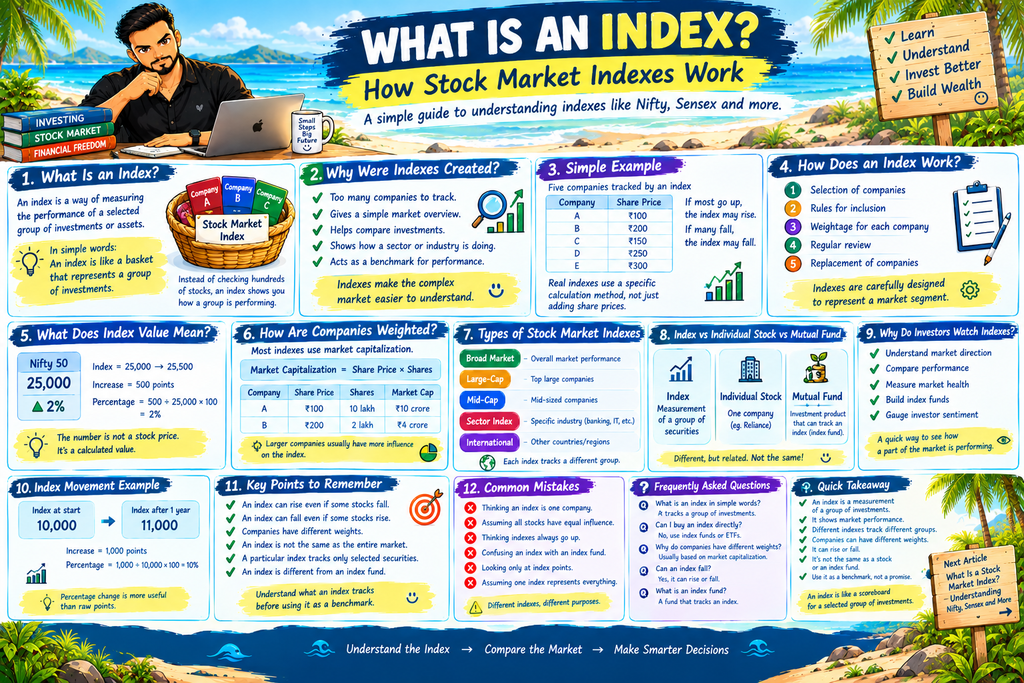
Table of Contents
A simple Example
| Company | Share Price |
|---|---|
| Company A | ₹100 |
| Company B | ₹200 |
| Company C | ₹150 |
| Company D | ₹250 |
| Company E | ₹300 |
Let’s say an imaginary index track these companies.
Instead of checking every company separately, you could look at the index to get a broad idea of how this group is performing.
If most of these companies rise, the index may rise.
If many fall, the index may fall.
Real stck-market indexes are more sophisticated and use specific calculation methods rather than simply adding shares prices.
Why Were Indexes Created?
There are thousands of companies and securities in financial markets.
It would be difficult for investors to track every company individually.
Indexes help simplify the market.
They can help answer qustion such as:
- How is the overall market peerforming?
- How are large companies performing?
- How is a particular sector performing?
- How has a group of companies performed over time?
- how does my investment performance compare with the market?
An index provides a refrence point, often called a benckmark.
How Does a Stock Market Index Work?
A stock market index is created using a specfic set of companies and rules.
The index provider determines:
- Which comapnies are included
- Hoe companies are selected
- How much weight each company recieves
- When the index is reviewed
- What happens when companies no longer meet the rules
Example:
An index may be designed to represent large companies in a particular country.
The companies included can change ove time.
What Does Index Value Mean?
You may see an index quoted as a number.
Example:
Index = 25,000
The number itself is not the price of one stock.
It is claculated value representing the performance of the index according to its methodology.
If the index moves from:
25,000 ➔ =25,500
that represents a 2% increase.
Calculation:
(25,500 – 25,000) ÷ 25,000 x 100 = 2%
So the index increased by 2% during that period.
How Are Companies Weighted in an Index?
Not every company necessarily has the same influence on an index.
Many major indexes use market capitalization-based weighting or variations of it.
What Is Market Capitalization?
Market capitalization is broadly calculated as:
Market capitalization = share price x Number of Oustanding Shares
Example:
Company A:
- Share price = ₹100
- Shares oustanding = 10 lakh
Market Capitalization:
₹100 x 10,00,000 = ₹10 crore
ompany B:
- Share price = ₹100
- Shares oustanding = 10 lakh
Market Capitalization:
₹200 x 2,00,000 = ₹4 crore
Company A would have a larger market capitalization in this example.
In a market-cap-weighted index, larger companies generally have a greater influence on the index.
Why Does Weighting Matter?
Let’s say an index contains 10 companies.
If each company has exactly the same weight, a 10% rise in one company would have a different effect than if that company represented a very large portion of the index.
this why you cannot simply look at how many companies went up or down.
The size and weighting of each company matter.
What Is A Benchmark?
A Benckmark is a standard used to compare performance.
Example:
You invest in a diversiified equity portfolio.
After one year:
Your portfolio return = 12%
The relvent market benckmark returned:
10%
Your portfolio earned a higher return than that benckmark during the period.
This doesn’t autmatically mean your investment strategy is better, because you also need to consider risk, costs, taxes and whether the benckmark is actually appropriate for comparison.
Index vs individual Stock
These are very different.
Individual Stock
Represents ownership in one company.
Example:
You buy shares of company A.
Your investment is directly affected by company A’s performance and other factorss affecting its stock.
Index
Represents a selected group of securities.
Example:
An index tracks multiple companies.
The index’s movement reflects the combined performance of those securiites according oot its methodology.
Index vs Mutual Fund
An Index and mutual fund are not the same thing.
Index
A measurement or calculatio that tracks a groups of securities.
Mutual Fund
An investment product that pools investors’ money and invests according to its stated strategy.
Example:
An Index mutual fund may try to track a particular market index.
The index itself isn’t something you buy directly in the same way you buy a stock or mutual fund.
What Is an Index Fund?
An index fund is an investment fund designed to track the performance of a particular index.
Example:
An index fund may aim to track a broad stock market index.
Instead od a fund manager trying to select individual stocks to outperform the market, the fund henerally attempts to replicate the index’s holding and performance as closely as parctical, after costs.
This is commonly associated with passive investing.
We’ll discuss index funds in more detail later in the Fiancewithbeach series.
Different Types of Stock MArket Indexes
Idnexes can be designed for different purposes.
1. Borad Market Index
Tracks a broad section of the stock market.
It can provide a general picture of market performance.
2. Large-Cap Index
taks relatively large companies according to the index’s rules.
3. Mid-Cap Index
Tracks companies that falls into the relvent mid-cap segment according to the index methodology.
4. Sector Index
Tracks companies from a particular industry.
Example:
- Banking
- Infirmation technology
- Health care’Energy
5. International Index
Tracks companies from a particular country,region or international market.
Why Do Investors Watch Indexes?
Indexes can be useful for several reasons.
1. Understanding Market Direction
Idnexes can provides a quick indication of how a particular market segment is performing.
2. Comparing Investments
Investors can compare portfolio performance gainst an appropriate benchmark.
3. Measuring Market Performance
Indexes provide a standardized way to track market movements over time.
4. Building Index Funds
Many Investment products are designed to track indexes.
5. Understanding Economic Sentiment
Market Indexes are sometimes used as one indicator of investor sentiment, although they don’ t tell you everything about the economy.
Why an Index Can Rise Even When Some Stocks Fall
This is an important point.
An index can rise even if some of its companies fall.
Example:
- 6 companis increase
- 4 companies decrease
The index could still rise.
But even this simple example doen’t tell the full stroy because the companies may have different weights.
If th largest companies rise significantly, they may have a greater impact on the index than smaller companies.
Why an Index Call Fall Even When Many Stocks Rise
The opposite can also happen.
Let’s say sveral smaller companies rise while some of the largest companies fall sharply.
The index could decline because the larger companies have greater weights.
The number of stocks rising or falling isn’t enough to understand an index’s movements.
You also need to consider the index methodology and the weight of its constituents.
What Happens When a Company Leaves an Index?
Indexes are generally reviewed periodically according to their rules.
A company may be removed if it no longer meets the criteria.
Another company may be added.
This helps the index continue to represent the market segment it was designed to track.
Example:
An index designed to represent large companies may replace a company that no longer meets its eligbility requirements.
Are All Indexes the Same?
No. Different indexes can track completely different things.
Example:
- Index A ➔ Large companies
- Index B ➔ Banking Companies
- Index C ➔ Technology Companies
- Index D ➔ International Companies
When someone says:
The index went up.
You Should Ask:
Which Index?
The performance of one index doesn’t necessarily represent the peformance of the entire investment market.
Important: An Index Is Not the Same as the Entire Market
A particular index represent only the securities included in that index.
Example:
- Small Companies
- Certain industries
- Companies outside it market
- Bonds
- GOld
- Real estate
You should understand what an index actually trcaks before using it as benckmark.
Common Beginner Mistakes
1. thinking an Idnex is One company
An Idnex represents a group of securities, not one company.
2. Assuming Every Stock Has Equal Influences
Many indexes use weighting menthods, so companies can have different levels of influence.
3. Thinking Indexes Always Go Up
Idnexes can fall, sometimes significantly.
4. Assuming One Idnex Represents Everything
Different indexes represent different parts of the market.
5. Confusing an index With an Index Fund
An index measures a group of scurities; an index fund is an investment product designed to track an index.
6. Looking Only at Idnex Points
A move from 10,000 to 11,000 means 10%, while a move from 20,000 to 21,000 means 5%.
Perecntage changes are generally more useful for comparsions than raw points.
FAQs
What is an Index in simple words?
An Index is a way of measuring the performance of a selected group of investment or assets.
What is a Stock market Index?
A stock market index is created using a specfic set of companies and rules.
Why do companies have different weights in an index
Many idnexes use weighting methods suchs as market capitalization, meaning larger companies can have a greater influence on the index.
Can an index fall?
Yes. An index can rise or fall depending on the performance od its constitunets securitites and the index methodology.
What is an Index Fund?
An Index fund is an investment fund designed to track a partiuclar index.
Why are Idnexes important for beginners?
They provides a retatively simple way to udnerstand market performance and compare investments against a benckmark.
Yes. Every investment portfolio can experience losses depending on the invetment it contains and market conditions.
Link this article to:
- What is Saving?
- What is Income?
- What is Compound Interest?
- What Is Inflation?
- What is Insurance?
- What is investing?
- Types of Investment?
- What is Budget?
- Saving vs Investing
- What is Net worth?
- What Is Exapenses?
- What is Cash Flow?
- What is Liquidity
- What Is Loans?
- What Is EMI?
- What Is Credit Card?
- What Is Bank Account?
- What Is ATM?
- What Is UPI payment?
- What Is Recurring Deposit?
- What Is a Asset?
- What Is a Dividend?
- Simple Interest and Compound Interest
- What Is a Return on Investment?
- What Is Risk in Investing?
- What Is Diversification
- What Is a Portfolio?
5 thoughts on “What Is an Index? — How Stock Market Indexes Work”