What Is a Government Bond? — How Government Borrowing Works

What Is a Government Bond?

A government bond is a financial instrument through which a government borrows money from investors to fund its expenses, infrastructure porjects and other public needs.

When you purchase a government bond, you are essentially leding money to the government. In return, essentially lending money to the government. In return, the governement agrees topay interest according to the bond’s term, if applicable and repay the principal accroding to its repayment condition.

In India, the Cnetral Governement and state governments issue government securities to borrow money. These are commonly known as G-Secs (Government Securities). Long-term government are often called governement bonds or dated securitites, while short-term Central government securities include Treasury Bills.

In Simple Words:

A government bond allows you to lend money to a government in exchange for interest, if the bond pays interest, and repayments under its time.
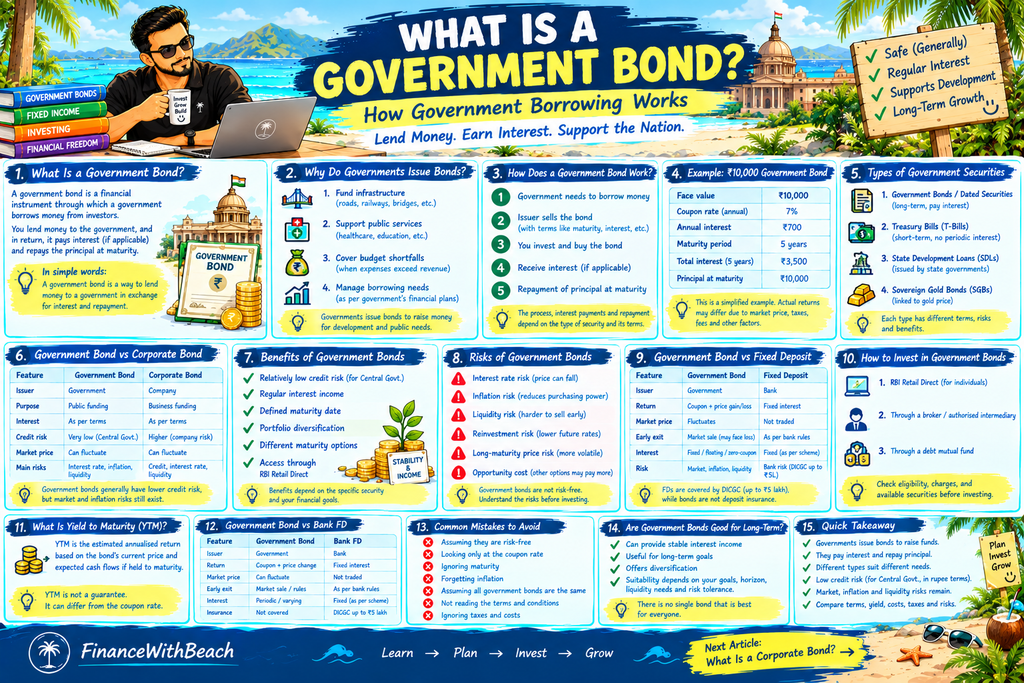
Table of Contents

Why Do Government Issue Bonds?

Governments collect revenue through sources such as taxes, fees and other receipt. However, these fund may not cover every expenses or planned project.

To raise additional money, Government can borrow from investors by issuing securities.

Common reasons include:

  • Infrastructure development: Funding roads, Bridges, railways and public transport.
  • Public Services: Supporting government expenditure on healthcare, education and other services.
  • Budget Financing: Meeting funding requirements when government expenditiure exceeds available receipts.
  • Managing borrowing needs: Raising money according to the government’s financial plans.

Instead of lending money to a [rivate company, an investor buying a government bond lends money to the issuing government.

How Does a Government Bond Work?

Let’s Undertsand the process step by step.

Step 1: The government needs to borrow money

The government determines its borrowing requirements and issues securities according to its funding plans.

Step 2: The bond is issued

The government specifies details such as the bond’s maturityy date, interest terms and other conditions.

Investors can participate in an eligible government securities auction or buy certain securities in the secondary market.

Step 3: Investors purchase the bond

You invest money by purchasing the bond. The amount you pay may be equal to above or below its face value depending on the issue or market price.

Step 4: Interest may be paid

Some government bonds pay interest periodically. Others, such as Tresury bills are genrally issued at a discount and redeemed at face value rather than opaying periodic coupon interest.

Step 5:The security reaches maturity

At maturity, the government repays the amount due under the security’s terms. For a coventional bond held until maturity, this generally means repayment of its face value.

The actual outcome depends on the particular security;s terms and the investor’s purchase price.

What Are the Main Types of Government Securities in India?

Government securitites come indifferent forms and maturities.

1. Government Bonds or dated Government Securities

These are securities issued by the Central Government or state governments with sepcfied maturity dates.

Central government dated securtities often pay interest periodically, commonly every six months, according to their terms.

They can be used investors seeking expsoure to government for a defined Period.

2. Treasury Bills (T-Bills)

Treasury Bill are short-term securities issued by the Government of India.

They generally have original maturities of less than one year and do not pay periodic coupon interest.

Example:

A Treasury Bill may be purchased for less than its face value and redeemed at face value maturity. The difference reperesents the investor’s return before applicable costs and taxes.

3. State Development Loans (SDLs)

State Developments loans are securities issued by issued governements to borrow money.

They are government securities, but they are issued by state government rather than the Cnetral government.

Their terms, yields and market prices may differs from those of Central Government Securities.

4. Sovereign Gold Bonds (SGBs)

Sovereign Gold Bonds are governement securities linked to the price of gold and denominated in grams of gold. They have specific terms, including interest and redemption provisions.

They are different from ordinary governemnt bonds because their value is linked to gold rather than being a conventional fixed- principal bond.

The availability of new SGB issues depends on government announcements. If considering an exisiting SGB, check its terms and market availability.

What Is the Difference Between a Government Bond and a Corporate Bond?

Nothe Government bonds and corporate bonds involve lending money to an issuer. The main difference is who borrows the money.

FeatureGovernment BondCorporate Bond
IssuerCentral or state governmentCompany
PurposeGovernment borrowing and public funding needsBusiness and corporate funding
InterestDepends on the security’s termsDepends on the bond’s terms
Credit riskDepends on the issuing government and securityDepends on the company’s ability to pay
Market priceCan fluctuateCan fluctuate
Main risksInterest-rate, inflation, and liquidity risks, among othersCredit, interest-rate, and liquidity risks, among others

Central governemnt securities issued in India’s domestic market are generally treated as having very low credit risk in rupee terms. However, this does not mean their market prices never falls or that they are free from every investment risk.

Corporate bonds can have greater credit risk because a company may expereience financial difficulties and fail to meet its obligations.

What Are the Benfits of Government Bonds?

Government bonds can offer several potential benefits depending on the security.

1. Relatively low Vredit risk for central Government securities.

Central Government securities in the domestic market are generally considered to have very low credit risk in rupee terms.

However, other risks-particularly market-price and inflation risks-remains relevent.

2. Interest income

Some government bonds pay interest at regular intervals. This may helps investors plan for scheduled income.

The payment frequency and coupon terms depend on the particular security.

3. Defined maturity

Many government secutities have a stated maturuty date. This helps investors understand when the security is secheduled to mature.

4. Portfolio Diversification

Government securities can provide expsoure to an asset class that behaves differently from stocks in some market conditions.

Diversification may helps manage portfolio risk, although it cannot eliminate losses.

5. Different maturity options

Investors can find securites with different matruities, from short-term treasury Bills to longer-term government bonds.

Choosing an appropriate maturity is important because m,arket-price sensitivity can vary cosndierably between securities.

6. Access through RBI Retail Direct

Eligible indiviual investors can use the RBI Retail Direct platform to access certain government securitites directly, subject to the platform’s ruls and the security’s availability.

What Are the Risks of Government Bonds?

Although some government securities have very low credit risk, they are not automatically risk-free investments in every respect.

1. Interest-Rate Risk

Bond prices and market interest rates generally move in opposite directions.

When market interest rates rise, the price of an existing fixed-rate bond may fall. when market interest rates decline, its price may rise.

Example:

If you own a bond paying 6% interest and newly issued comparabale bonds begin offering higher rates, buyers may prefer the newer bonds. Your existing bond may need to trade at a lower price to remain competitive.

If you sell before maturity, you may receive less than you paid.

2. Inflation Risk

Inflation reduces the purchasing power of money over time.

Let’s say pays ₹700 in annual interest. If the prices of goods ans services rise significantly, that ₹700 may buy fewer things than ir did perviously.

An investment can provide positive nominal returns while delivering a much smaller returns after inflation.

3. Liquidity Risk

Liquidity refers to how easily an investment can be brought or sold at a reasonable price.

Some government securities trade more actively than others. If a particular security has limited trading activity selling it quickly ay your desired price may be difficult.

4. Reinvestment Risk

If you recive interest payments, you may not be able to reinvest them at the same interest rate.

Example:

If your bond pays 7% interest but available rates later fall to 5% reinvesting those payments may generate less income.

5. Long-Maturity Price Risk

Longer-term Fixed-rate bonds are generally more sensitive to changes in market interest rates than otherwise comparable shorter-term bonds.

This means a long-term bond-s market price may fluctuate cosniderably when interest rates change.

6. Opportunity Cost

If market rates risk after you buy a fixed-rate bond, your bond may pay less interest than newly available alernatives with comparable risk.

Your scheduled coupon may remain unchanged, but the investment may become less attractive relative to newer securities.

How Can You Invest in Government Bonds in India?

Individual investors have several possible routes depending on the security and their circumstances

Option 1: RBI Retail Direct

The RBI Retail Direct scheme allows eligible individual investors to access certain government securities directly.

The platform provides facilties for purchasing eligible securities through primary issuance processes and for buying or selling eligible securites in the secondary marke, Subject to its rules.

You generally need to complete the rquired registration and identity-vertification process. Check the current eligibility requirements, account conditions and transaction rules on the official website.

Option 2: Through a broker or other authorised intermediary

Dpending on the product, investors may be able to access govenement securities through a broker or another authorised platform.

Before proceeding, check the provider’s regulatory status charges, available securities and transaction conditions.

Option 3: through a debt mutual fund

Some debt mutual fund invest in government securities. This can provide indirect exposure without requiring you to purchase and manage an individual bond yourself.

However, debtmutual fund is not the same as directly holding a government bond. Its value fluctuations, its costs differ and it does not necessarily promise repayment of a fixed amount ona specfic date.

Before investing, check these details

  • The issuer and types of security
  • The maturity date
  • Thge coupon rate and payment schedule, if applicable
  • The purchase price and yield to maturity
  • The security’s liquidity and market- prices risks.
  • Trabsaction charges and appicable taxes
  • Whether the maturity matches your financial goals.

What Is Yield to Maturity (YTM)?

Yield to maturity (YTM) is an estimate of the annualised return assoiciated with a bond’s current pirce, assuming it is held held until maturity and the relevent cash flows occur as expected.

Ytm takes into account factors such as the bond’s purchase price, scheduled interest payments, face value and time remaining until maturity.

Example:

A bond with an 8% coupon rate doe not necessarily provide an 8% YTM.

If you purchase a bond below or above its face value, its YTM may differ from itscoupon rate.

YTMis an estimate, not a guranteed return. The realised outcome can differ if you sell early, reinvestment rates change, cost apply or the issuer does not meet its obigations.

Government Bond vs Fixed Deposit

Governement bonds and bank fixed deposits can both be used by people seeking relatively perdictable financial outcomes, but their structures differ.

FeatureGovernment BondBank Fixed Deposit
IssuerGovernmentBank
Return structureDepends on the security’s termsDepends on the FD’s terms
Market priceCan fluctuate if tradedNormally not traded on an exchange like a bond
Early exitMay require a market sale or follow security-specific rulesDepends on the bank’s premature-withdrawal terms
Interest paymentsDepends on the securityDepends on the FD payout option
Risk considerationsMarket, inflation, liquidity, and issuer-specific risksBank risk, inflation, and early-withdrawal conditions
Deposit insuranceNot applicable as bank-deposit insuranceEligible deposits are insured by DICGC up to the applicable limit and conditions

In India, DICGC deposit insurance genrally covers eligible deposits up to ₹5 lakh per depositor per bank, including principal and interest, in the same right and capacity.

Neither product is autmatically best for everyone. COmpare the return structure, liquidity, risk, time horizon and tax treatment before deciding.

Common Mistakes Beginners Should Avoid

Mistake 1: believing government bonds can never lose value

Some government securites have very low credit risk, but their market prices can fall when interest rates rise.

Mistake 2:

Looking OPnly at the coupon rate

The coupon rate alone does not tell you the total return. Purchase price and maturiy also matter.

Mistake 3: Ignoring maturity

A long-term bond may not suit someone who needs the money soon, parcularly if selling early could results in a loss.

Mistake 4: Foregetting Inflation

A positive payment does not guranteed that your purchasing power will increase.

Mistake 5: Assuming every government security works the same way

treasury bills, conventional government bonds, state development loans and sovereign Gold bonds have different structures and risks

Mistake 6: Confusing a bond with a debt mutual fund

A directly held bond and a fund investing in bonds have different strucutres, costs and returns charcteristcs.

Mistake 7: Investing without reading the terms

Always understand the maturity, interest schedule, purchase price and exit conditions before investing.

Are Government Bonds Suitable for Beginners?

Government bonds may be worth learning about if you want to understand fixed-income investing and how government rasie money.

They may be useful for investors seeking scheduled interest payments or ecposure to government securities, depending on their financial goals and the particular bond.

However, suitability depends on your time horizons, need for liquidty =, tolerance for market-price fluctuations and overall fiancial situation.

If you need money for an emrgency or an expense due soon, do not assume that a long-term gpvernment bond is an appropriate subsititute for readily accessible savings.

The key lesson: Understand the specfic security vefore investing rather than assuming every government bond identical or risk-free.

FAQs

What is a government bond in simple words?

A government bond allows you to lend money to a government in exchange for interest, if the bond pays interest, and repayments under its time.

Are goovernment bodn safe in India?

Central Governemnt securities in the domestic market are generally considered to have very low credit risk in rupee terms. however, their prices can flucutate and inflation and liquidity risks may affects investors.

Can I invest in governement bonds with ₹1,000?

The minmum amount depends on th type of senrity and the method used to invest. Check the current minmum investment requirements on the official platform or with the authorised provider before placing an order.

Do government bonds pay manothy interest?

Not necesarily. Interest payments frequency depends on the security’ s. terms. Many conventional dated government securities pay interest periodically, often every six months, while treasury Bills generally do not pay periodic coupon interest.

Can I Sell a government bond before maturity?

Sme government securities can be sold in the secondary market, subject to availability and transaction rules. The sale price may be higher or lower than your pruchase price.

What is the difference between a government bond and a treasury bill?

Tearsury Bills are short-term Central government securitites, generally with original maturities of less than one year. Government bonds or dated securities usually have linger maturities and may pay periodic interest.

Do I have to pay tax on Government Bond income?

Interest and capitla gains may have tax implication depending on the security, type of income, the investor’s circumstances and current Indian tax rules. Consult current oficial tax guidance or a qualified tax professional for your situation.

What is the difference between a government bond and a government bond mutual fund?

A government bond is a security you hold directly. A government bond mutual fund pools investors’ money and invests in government securities. The fund’s value fluctuates and it does promise the same maturity repayment as an individual bond.

 and Investing

What Is a Bond?

A bond is a financial instrument through which a government, company or other eligible issuer borrows money from investors.

When you buy a bond, you are essentially lending money to the issuer. In return, the agrees to pay interest according to the bond’s terms and repay the principal at maturity, subject to its ability to meet its obligations.

Example:

A company may issue bonds to raise money for expanding its business, purchasing equipment or funding new projects. A government may issue bonds to finance public speaking.

In Simple words:

A bond is a way to lend money to a government or company in exchange for interest and the agreed repayment of the principal.

Bonds are commonly called fixed-income investments, although not every bond pays a fixed interest rate and bond returns are not guaranteed.

Table of Contents

How Does a Bond Work?

Let’s understand the basic process step by step.

Step 1: An issuer needs money

A government or company needs funds to finance its activities or projects.

Step 2: The issuer sells bonds

The issuer offers bonds to investors. Each bond has specfic terms, such as its face value, interest rate and maturity date.

Step 3: Investors provide money

When you purchase a bond, you lend money to the issuer under the bond’s terms.

Step 4: The issuer pays interest

Dpending on the bond, you may recieve interest payments monthly, quarterly, half yearly, annually or at another specfied time. SOme bonds do not make periodic interest payments.

Step 5: The bond reaches maturity

At maturity, the issuer is generally required to repay the principal according to the bond;s terms. However, repayment depends on the issuer fulfilling its obligation; default is possible.

Example: How Does a Bond Work?

Let’s say you buy a bond with these hypothetical terms:

FeatureExample
Face value₹10,000
Annual coupon rate8%
Interest per year₹800
Maturity period5 years
Principal due at maturity₹10,000

If the bond pays an 8% annual coupon on its ₹10,000 face value, the scheduled interet would be ₹800 per year.

Over five years, you would recieive ₹4,000 in total interest if every scheduled payment is made. At maturity, the issuer would repay the ₹10,000 principal according to the bond’s terms.

Your total scheduled receipt would be ₹14,000 over five years, assuming the bond is held for the full term and and payments are made.

This example excludes taxes, fees and any special bond conditions. It also assumes you purchased the bond at face value. Of you a bond for more or less than its face value, your actual return can differ.

What Is the Face Value of a Bond?

The Face value, a;sp called the par value or nominal value, is the pricncipal amount specified for a bond.

Example:

A bond may have a face value of ₹1,000 or ₹10,000.

The face value is imoortant because the coupon payment is often calculated as a percentage of it.

Let’s say A bond has a face value of ₹10,000 and a coupon rate of 7%.

Annual coupon interest:

₹10,000 x 7% = ₹700

If you purchase that bond for ₹9,500 in the market, the coupon is still generally calculated on the face value of ₹10,000 according to the bond’s terms. Your overall return, however, also depends on th price you paid and the amount received at maturity.

What Is a coupon Rate?

The coupon rate is the stated annual interest rate applied to a bond’s face value.

Example:

A bond with a face of ₹20,000 and a 6% annual coupon rate would pay ₹1,200 in annual interest if it pays coupons annually and all payments are made.

Coupon payments may occur at different intervals depending on the bond’s terms.

Some bonds have fixed coupon rates, while others have variable of floating rates. Zero- coupon bonds generally do not pay periodic interest.

What Is the Maturity Date of a Bond?

The maturity date is th date on which a bond is scheduld to reach the end of its term.

On that date, the issuer is genrally expected to repay the outstanding principal according to the bond’s conditions.

Example:

  • A Bond issued for one year has a one-year term.
  • A bond issued for five year has A five-year term.
  • A bond issued for ten year has A ten-year term.

The maturity date matters becuase it helps investors understand when repayments is scheduled and how long their money may remain committed.

However, if you sell a bond before maturity, you may reiceve more or less than the amount you orginally invested.

What Are the Different Types of Bonds?

Bonds differ according to who issues them, how they pay interest and the irsks involved.

1. Government bonds

Government bonds aree issued by governments to borrow money.

India, the Central Governement issues government securities, including longer-term dated securitites. State governments issue State development loans.

Government securitiescarry risks that differ from corporate bonds. Their market prices can still fluctuate, particularly when interest rate changes.

Example:

An investor purchases a government security that pays interest according to its stated terms.

2. Corporate Bonds

Corporate bonds are issued by companies to raise money for business purposes.

A company may use the funds for ecpansion, new equipment, infrastructure or refinancing existing debt.

Corporate bonds involve the risk that the company may not make its scheduled interest payments or repay the principal.

credit ratings can help investors assess credit risk, but a rating is an opinion, not a guarantee of repayment.

3. Municipal Bonds

Municipal bonds are debt instruments issued by egilable local government bodies or municipal entities to fund projects such as water supply, roads or ublic infrastructure.

Their availability, structure and risks depend on the specfic issue and applicable rules.

4. Fixed-rate Bonds

Fixed-rate bonds have a stated interest rate that generally remains unchanged during the relevant term.

Example:

A bond with a 7% annual coupon may continue paying that rate according to its terms, even if market interest rate change.

Its market price may nevertheless rise or fall.

5. Floating-Rate Bonds

Floating-rate bonds have interest payments linked to a reference rate or another specified formula.

Their interest payments may change when the reference rate changes.

6. Zero-coupon Bonds

Zero-coupon bonds generally do not pay regular interest.

They may be issued or purchased at a discount to their maturity value. If the issuer makes the required repayment, the difference between the purchase price and the maturity payment contributes to the investor’s return.

7. Secured and Unsecured Bonds

A secured bond is backed specified collateral, subject to its legal terms.

An unsecured bond does not have the same specific collateral backing. The recovery available in a default depends on the issuer’s financial position, legal arrangements and applicable insilvency rules.

Remember:

The name of a bond oes not tell you its complete risk profile. Review The terms, issuer, repyment obligation and relevent disclosures before investing.

What Are the Benefits of Bonds?

Bonds can play a role in an investment portfolio, depending on the investor’s goals and the bond’s charcheristics.

1. Potential interest income

Many bond pay interest according to schedule, which can help investors plan their expected cash flows.

However, payments depend on he bond’s terms and the issuer meeting its obligations.

2. Different risk options

Governement and coprorate bonds offer different types of exposure. Investors can compare maturity periods credit quality and interest structures.

Different option come with different risks.

3. Portfolio diversification

Bonds cn provide expsoure to adifferent asset class from stocks.

Their returns do not always move in the same way as equity returns, although bonds can also decline in value and diversification cannot eliminate investment risk.

4. Defined maturity

Many bonds have a specfied maturity date, which helps investors understand when principal repyament is scheduled.

This can be useful when matching investments with future financial goals, provided the investors accounts for repayments and market risks.

5. Choice of interest Structures

Investors may find fixed-rate, floating-rate and zero-coupon bonds depending on the market and available products.

Each structure behave differently when interest rates and ecnomic conditions change.

What Are the Risks of Bonds?

Bonds are not automatically safe simply because they pay interest.

1. Credit or Default Risk

The issuer may fail to pay interest or repay the principal as promised.

Example:

A financially troubled company may struggle to meet its bond obligations.

Coprorate bonds with higher credit risk may offer higher yields to compensate investors but a higher uiled does not make the investment better or safer.

2. Interest-Rate Risk

Bodn rpices generally move in the opposite diection to market interest rates, all else being equal.

when markey interest rates rise, existing bonds with lower coupon rates may beomce les attractive, causing their prices to fall. When market fall, existing bonds with higher coupon rates may become more attractive, potentially raising their prices.

3. Liquidity Risk

some bonds are not traded frequently

If you need to sell one before maturity, there may not be enough buyers at a reasonable price. You mighe have to accept a lower price or wait longer to sell.

4. Inflation Risk

Inflation reduces the purchasing power of money over time.

Even if a bond pays interest as cheduled, rising prices can reduce the real value of the income you receive.

5. Reinvestment Risk

if you receive interest payments and want to reinvest them future investment opportunites may offer lower rates than your orginal bond.

This can effecr the total return you earn over time.

6. Call Risk

Some bonds allow the issuer to repay them early under specified conditons.

If a bond is called when market interest rates are lower, you may have difficulty finding another investment with a similar yield.

7. Price Risk Beofre maturity

if you sell a bond before its maturity date, the market price may be above or below what you paid.

Even When a bond has scheduled interest payments, you can still expernience a loss if you sell it an unfavorable price.

What Is the difference Between a Bond and a Stock?

FeatureBondStock
What it representsMoney lent to an issuerOwnership in a company
Investor’s roleCreditor or bondholderShareholder
Potential incomeInterest payments, if specified and paidDividends, if declared
MaturityMany bonds have a maturity dateOrdinary shares generally have no maturity date
Return potentialInterest plus possible price gains or lossesDividends and possible share-price gains or losses
Main risksDefault, interest rates, liquidity, inflationCompany performance and market movements
Repayment priorityBondholders generally rank ahead of shareholders, subject to the law and instrument termsShareholders generally rank behind creditors

Neither investment tyoe is risk free. their suitability depends on your goals, time horizons and tolerence for losses.

What is the Difference Between a Bond and a Fixed Deposits?

Bothe can be used people looking for income, but they are different financial products.

FeatureBondBank Fixed Deposit
Who receives your moneyA government or other bond issuerA bank
ReturnDepends on the bond’s coupon, purchase price, and other termsDepends on the FD’s interest terms
Market priceCan fluctuate if the bond is tradedUsually not quoted like a traded bond; premature withdrawal is subject to the bank’s terms
Credit riskDepends on the issuer and bondDepends on the bank and applicable deposit-protection rules
Early exitMay require selling at the market priceMay involve premature-withdrawal rules or penalties
Interest structureFixed, floating, zero-coupon, or other termsDepends on the chosen deposit scheme

In India, Eligible bank deposits are covered by DICGC insurance up to the applicable limit of ₹5 lakh per depositor per bank, including principal and interest, subject to the insurance rules. THis is different from bond protection and bonds should not be assumed to carry deposit insurance.

How can Beginners Invest in Bonds in India?

The process depends on th type of bond you want to buy.

Step 1: Understand the bond

Identify the issuer, maturity date, coupon rate, repayment terms and risks.

Step 2: Review credit quality

For corporate bonds, examine the credit rating and other infromation about the issuer’s ability to repay its debts. Never rely on a rating alone.

Step 3: Understand the Yield

The coupon rate is not the same as yield to maturity. Yeild to maturity estimates the annualised return implied by the bond’s price and cash flows, assumin the relvent payments occur as expected and the bond is held to maturity.

Step 4: Choose an appropriate route

Dpending on the security, Investors may access bonds thrugh official government-security platform, public issues, registered inetermediearies or the stock exchange.

The account requirements and avilable instruments vary.

Step 5: Check costs and taxes

Review trnsaction charges, applicable taxes and tax treatment of interest income and any capital gains.

Step 6: Consider your financial Goals

Think about when you may need the money, whether you can hold the bond until maturity anfd how much risk you can accept.

What IS Yield to Maturity?

Yield to maturity (YTM) is an estimate of the annualised return implied by a bond’s current price and its expected cash flows if held to maturity.

YTM cosniders factors suchs as the bond’s purchase price, coupon payments, fsce value, and remaining time until maturity.

Example:

A bond purhchased below it face value may have a higher yield to maturity than its coupon rate, assuming the issuer makes all requiredpayments. A bond purchased above face value may have a lower yiled to maturity than its coupon rate.

YTM is an estimate, not gurnateed. The actual outcome may differ if the bond is sold early, oayments are missed or other assumpption do not hold.

Common Beginner Mistakes to Avoid

Mistake 1: Assuming every bond is safe

bonds have different levels odf credit, interest-rate and liqudity risk.

Mistake 2: Choosing only the highest interest rate

A high advestised rate may reflect higher risk. Understand why the bond offers that rate.

Mistake 3: confusing coupon rate with yield

The coupon is based on the bond’s terms, while yield also depends on the price you pay and other factors.

Mistake 4: Ignoring the maturity date

Make sure the inevstment period suits when you expect to need the money.

Mistake 5: Assuming you can always sell at face value

A bond’s market price may change before maturity.

Mistake 6: relying only on credit ratings

Ratings can chnage and do not gurantee repayement. Read the avialable issuer and bond information.

Mistake 7: ignoring taxes and costs

Taxes and transaction charges can reduce your net worth.

Mistake 8: Investing without understanding the issuer

Before invsting, check who owes you the money and howthe issuer is expected to repay it.

Are Bonds Good for Long-Term investing?

Bonds may be useful for investors who want interest incopme, a defined maturity or exposure beyond stocks. However. different bonds have different risks and returns charcterisitcs.

Example:

A governemtn security and a lower-rated corporate bond should not be treated as equivalent investments. Even givernement bonds can flucluate in market price before maturity.

The right coice depends on your financial goals, time horizons, liquidity needs and risk tolerence.

there is no single bond that is best for everyone.

FAQs

What is a bond in simple words?

A bond is a way to lend money to a government or company in exchange for interest and the agreed repayment of the principal as scheduled.

How do bonds make Money

Investors may earn interest payments and may also make a gain igf they sella bond for more than they paid. Theyu can als experience losses.

Are bond risk-free?

No. Bonds can carry default risk, interest-rate risk, liquidty risk, inflation risk and other risks.

What is the difference between a bond and a stock?

A bond rperesnetsa loan to an issuer, while a stock generally represents ownership in a company.

What is the maturity date of a bond?

It is the date on wich the bond is scheduled to mature and the principal is genrally due for repayment according to its terms.

What is a coupon rate?

The coupon rate is the stated annual interest rate applied to the bond’s face value.

Can I Lose money in bonds?

Yes. You may lose money if the issuer defaults or if you sell the bond for less than you paid. The exact risk depend on the bond.

Can beginners invest in bonds in India?

Yes, subject to the eligibility and requirements of the investment route. Beginners should first understand the bond’s terms, risk costs and tax treatment.

Link this article to:

What Is a Bond? — A Beginner’s Guide to Lending and Investing

What Is a Bond?

A bond is a financial instrument through which a government, company or other eligible issuer borrows money from investors.

When you buy a bond, you are essentially lending money to the issuer. In return, the agrees to pay interest according to the bond’s terms and repay the principal at maturity, subject to its ability to meet its obligations.

Example:

A company may issue bonds to raise money for expanding its business, purchasing equipment or funding new projects. A government may issue bonds to finance public speaking.

In Simple words:

A bond is a way to lend money to a government or company in exchange for interest and the agreed repayment of the principal.

Bonds are commonly called fixed-income investments, although not every bond pays a fixed interest rate and bond returns are not guaranteed.
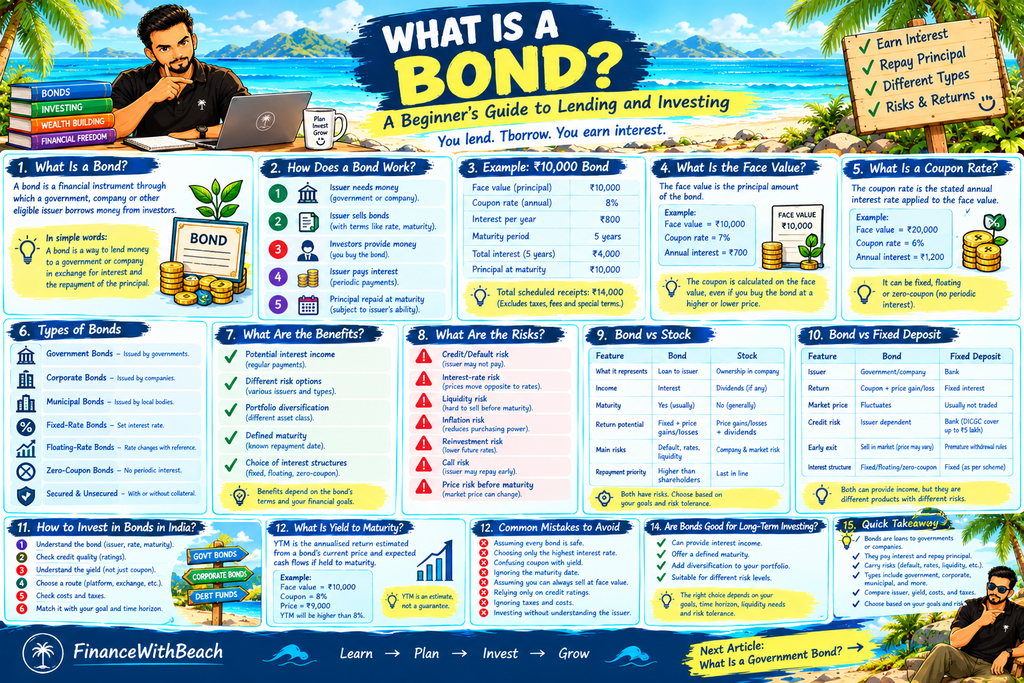
Table of Contents

How Does a Bond Work?

Let’s understand the basic process step by step.

Step 1: An issuer needs money

A government or company needs funds to finance its activities or projects.

Step 2: The issuer sells bonds

The issuer offers bonds to investors. Each bond has specfic terms, such as its face value, interest rate and maturity date.

Step 3: Investors provide money

When you purchase a bond, you lend money to the issuer under the bond’s terms.

Step 4: The issuer pays interest

Dpending on the bond, you may recieve interest payments monthly, quarterly, half yearly, annually or at another specfied time. SOme bonds do not make periodic interest payments.

Step 5: The bond reaches maturity

At maturity, the issuer is generally required to repay the principal according to the bond;s terms. However, repayment depends on the issuer fulfilling its obligation; default is possible.

Example: How Does a Bond Work?

Let’s say you buy a bond with these hypothetical terms:

FeatureExample
Face value₹10,000
Annual coupon rate8%
Interest per year₹800
Maturity period5 years
Principal due at maturity₹10,000

If the bond pays an 8% annual coupon on its ₹10,000 face value, the scheduled interet would be ₹800 per year.

Over five years, you would recieive ₹4,000 in total interest if every scheduled payment is made. At maturity, the issuer would repay the ₹10,000 principal according to the bond’s terms.

Your total scheduled receipt would be ₹14,000 over five years, assuming the bond is held for the full term and and payments are made.

This example excludes taxes, fees and any special bond conditions. It also assumes you purchased the bond at face value. Of you a bond for more or less than its face value, your actual return can differ.

What Is the Face Value of a Bond?

The Face value, a;sp called the par value or nominal value, is the pricncipal amount specified for a bond.

Example:

A bond may have a face value of ₹1,000 or ₹10,000.

The face value is imoortant because the coupon payment is often calculated as a percentage of it.

Let’s say A bond has a face value of ₹10,000 and a coupon rate of 7%.

Annual coupon interest:

₹10,000 x 7% = ₹700

If you purchase that bond for ₹9,500 in the market, the coupon is still generally calculated on the face value of ₹10,000 according to the bond’s terms. Your overall return, however, also depends on th price you paid and the amount received at maturity.

What Is a coupon Rate?

The coupon rate is the stated annual interest rate applied to a bond’s face value.

Example:

A bond with a face of ₹20,000 and a 6% annual coupon rate would pay ₹1,200 in annual interest if it pays coupons annually and all payments are made.

Coupon payments may occur at different intervals depending on the bond’s terms.

Some bonds have fixed coupon rates, while others have variable of floating rates. Zero- coupon bonds generally do not pay periodic interest.

What Is the Maturity Date of a Bond?

The maturity date is th date on which a bond is scheduld to reach the end of its term.

On that date, the issuer is genrally expected to repay the outstanding principal according to the bond’s conditions.

Example:

  • A Bond issued for one year has a one-year term.
  • A bond issued for five year has A five-year term.
  • A bond issued for ten year has A ten-year term.

The maturity date matters becuase it helps investors understand when repayments is scheduled and how long their money may remain committed.

However, if you sell a bond before maturity, you may reiceve more or less than the amount you orginally invested.

What Are the Different Types of Bonds?

Bonds differ according to who issues them, how they pay interest and the irsks involved.

1. Government bonds

Government bonds aree issued by governments to borrow money.

India, the Central Governement issues government securities, including longer-term dated securitites. State governments issue State development loans.

Government securitiescarry risks that differ from corporate bonds. Their market prices can still fluctuate, particularly when interest rate changes.

Example:

An investor purchases a government security that pays interest according to its stated terms.

2. Corporate Bonds

Corporate bonds are issued by companies to raise money for business purposes.

A company may use the funds for ecpansion, new equipment, infrastructure or refinancing existing debt.

Corporate bonds involve the risk that the company may not make its scheduled interest payments or repay the principal.

credit ratings can help investors assess credit risk, but a rating is an opinion, not a guarantee of repayment.

3. Municipal Bonds

Municipal bonds are debt instruments issued by egilable local government bodies or municipal entities to fund projects such as water supply, roads or ublic infrastructure.

Their availability, structure and risks depend on the specfic issue and applicable rules.

4. Fixed-rate Bonds

Fixed-rate bonds have a stated interest rate that generally remains unchanged during the relevant term.

Example:

A bond with a 7% annual coupon may continue paying that rate according to its terms, even if market interest rate change.

Its market price may nevertheless rise or fall.

5. Floating-Rate Bonds

Floating-rate bonds have interest payments linked to a reference rate or another specified formula.

Their interest payments may change when the reference rate changes.

6. Zero-coupon Bonds

Zero-coupon bonds generally do not pay regular interest.

They may be issued or purchased at a discount to their maturity value. If the issuer makes the required repayment, the difference between the purchase price and the maturity payment contributes to the investor’s return.

7. Secured and Unsecured Bonds

A secured bond is backed specified collateral, subject to its legal terms.

An unsecured bond does not have the same specific collateral backing. The recovery available in a default depends on the issuer’s financial position, legal arrangements and applicable insilvency rules.

Remember:

The name of a bond oes not tell you its complete risk profile. Review The terms, issuer, repyment obligation and relevent disclosures before investing.

What Are the Benefits of Bonds?

Bonds can play a role in an investment portfolio, depending on the investor’s goals and the bond’s charcheristics.

1. Potential interest income

Many bond pay interest according to schedule, which can help investors plan their expected cash flows.

However, payments depend on he bond’s terms and the issuer meeting its obligations.

2. Different risk options

Governement and coprorate bonds offer different types of exposure. Investors can compare maturity periods credit quality and interest structures.

Different option come with different risks.

3. Portfolio diversification

Bonds cn provide expsoure to adifferent asset class from stocks.

Their returns do not always move in the same way as equity returns, although bonds can also decline in value and diversification cannot eliminate investment risk.

4. Defined maturity

Many bonds have a specfied maturity date, which helps investors understand when principal repyament is scheduled.

This can be useful when matching investments with future financial goals, provided the investors accounts for repayments and market risks.

5. Choice of interest Structures

Investors may find fixed-rate, floating-rate and zero-coupon bonds depending on the market and available products.

Each structure behave differently when interest rates and ecnomic conditions change.

What Are the Risks of Bonds?

Bonds are not automatically safe simply because they pay interest.

1. Credit or Default Risk

The issuer may fail to pay interest or repay the principal as promised.

Example:

A financially troubled company may struggle to meet its bond obligations.

Coprorate bonds with higher credit risk may offer higher yields to compensate investors but a higher uiled does not make the investment better or safer.

2. Interest-Rate Risk

Bodn rpices generally move in the opposite diection to market interest rates, all else being equal.

when markey interest rates rise, existing bonds with lower coupon rates may beomce les attractive, causing their prices to fall. When market fall, existing bonds with higher coupon rates may become more attractive, potentially raising their prices.

3. Liquidity Risk

some bonds are not traded frequently

If you need to sell one before maturity, there may not be enough buyers at a reasonable price. You mighe have to accept a lower price or wait longer to sell.

4. Inflation Risk

Inflation reduces the purchasing power of money over time.

Even if a bond pays interest as cheduled, rising prices can reduce the real value of the income you receive.

5. Reinvestment Risk

if you receive interest payments and want to reinvest them future investment opportunites may offer lower rates than your orginal bond.

This can effecr the total return you earn over time.

6. Call Risk

Some bonds allow the issuer to repay them early under specified conditons.

If a bond is called when market interest rates are lower, you may have difficulty finding another investment with a similar yield.

7. Price Risk Beofre maturity

if you sell a bond before its maturity date, the market price may be above or below what you paid.

Even When a bond has scheduled interest payments, you can still expernience a loss if you sell it an unfavorable price.

What Is the difference Between a Bond and a Stock?

FeatureBondStock
What it representsMoney lent to an issuerOwnership in a company
Investor’s roleCreditor or bondholderShareholder
Potential incomeInterest payments, if specified and paidDividends, if declared
MaturityMany bonds have a maturity dateOrdinary shares generally have no maturity date
Return potentialInterest plus possible price gains or lossesDividends and possible share-price gains or losses
Main risksDefault, interest rates, liquidity, inflationCompany performance and market movements
Repayment priorityBondholders generally rank ahead of shareholders, subject to the law and instrument termsShareholders generally rank behind creditors

Neither investment tyoe is risk free. their suitability depends on your goals, time horizons and tolerence for losses.

What is the Difference Between a Bond and a Fixed Deposits?

Bothe can be used people looking for income, but they are different financial products.

FeatureBondBank Fixed Deposit
Who receives your moneyA government or other bond issuerA bank
ReturnDepends on the bond’s coupon, purchase price, and other termsDepends on the FD’s interest terms
Market priceCan fluctuate if the bond is tradedUsually not quoted like a traded bond; premature withdrawal is subject to the bank’s terms
Credit riskDepends on the issuer and bondDepends on the bank and applicable deposit-protection rules
Early exitMay require selling at the market priceMay involve premature-withdrawal rules or penalties
Interest structureFixed, floating, zero-coupon, or other termsDepends on the chosen deposit scheme

In India, Eligible bank deposits are covered by DICGC insurance up to the applicable limit of ₹5 lakh per depositor per bank, including principal and interest, subject to the insurance rules. THis is different from bond protection and bonds should not be assumed to carry deposit insurance.

How can Beginners Invest in Bonds in India?

The process depends on th type of bond you want to buy.

Step 1: Understand the bond

Identify the issuer, maturity date, coupon rate, repayment terms and risks.

Step 2: Review credit quality

For corporate bonds, examine the credit rating and other infromation about the issuer’s ability to repay its debts. Never rely on a rating alone.

Step 3: Understand the Yield

The coupon rate is not the same as yield to maturity. Yeild to maturity estimates the annualised return implied by the bond’s price and cash flows, assumin the relvent payments occur as expected and the bond is held to maturity.

Step 4: Choose an appropriate route

Dpending on the security, Investors may access bonds thrugh official government-security platform, public issues, registered inetermediearies or the stock exchange.

The account requirements and avilable instruments vary.

Step 5: Check costs and taxes

Review trnsaction charges, applicable taxes and tax treatment of interest income and any capital gains.

Step 6: Consider your financial Goals

Think about when you may need the money, whether you can hold the bond until maturity anfd how much risk you can accept.

What IS Yield to Maturity?

Yield to maturity (YTM) is an estimate of the annualised return implied by a bond’s current price and its expected cash flows if held to maturity.

YTM cosniders factors suchs as the bond’s purchase price, coupon payments, fsce value, and remaining time until maturity.

Example:

A bond purhchased below it face value may have a higher yield to maturity than its coupon rate, assuming the issuer makes all requiredpayments. A bond purchased above face value may have a lower yiled to maturity than its coupon rate.

YTM is an estimate, not gurnateed. The actual outcome may differ if the bond is sold early, oayments are missed or other assumpption do not hold.

Common Beginner Mistakes to Avoid

Mistake 1: Assuming every bond is safe

bonds have different levels odf credit, interest-rate and liqudity risk.

Mistake 2: Choosing only the highest interest rate

A high advestised rate may reflect higher risk. Understand why the bond offers that rate.

Mistake 3: confusing coupon rate with yield

The coupon is based on the bond’s terms, while yield also depends on the price you pay and other factors.

Mistake 4: Ignoring the maturity date

Make sure the inevstment period suits when you expect to need the money.

Mistake 5: Assuming you can always sell at face value

A bond’s market price may change before maturity.

Mistake 6: relying only on credit ratings

Ratings can chnage and do not gurantee repayement. Read the avialable issuer and bond information.

Mistake 7: ignoring taxes and costs

Taxes and transaction charges can reduce your net worth.

Mistake 8: Investing without understanding the issuer

Before invsting, check who owes you the money and howthe issuer is expected to repay it.

Are Bonds Good for Long-Term investing?

Bonds may be useful for investors who want interest incopme, a defined maturity or exposure beyond stocks. However. different bonds have different risks and returns charcterisitcs.

Example:

A governemtn security and a lower-rated corporate bond should not be treated as equivalent investments. Even givernement bonds can flucluate in market price before maturity.

The right coice depends on your financial goals, time horizons, liquidity needs and risk tolerence.

there is no single bond that is best for everyone.

FAQs

What is a bond in simple words?

A bond is a way to lend money to a government or company in exchange for interest and the agreed repayment of the principal as scheduled.

How do bonds make Money

Investors may earn interest payments and may also make a gain igf they sella bond for more than they paid. Theyu can als experience losses.

Are bond risk-free?

No. Bonds can carry default risk, interest-rate risk, liquidty risk, inflation risk and other risks.

What is the difference between a bond and a stock?

A bond rperesnetsa loan to an issuer, while a stock generally represents ownership in a company.

What is the maturity date of a bond?

It is the date on wich the bond is scheduled to mature and the principal is genrally due for repayment according to its terms.

What is a coupon rate?

The coupon rate is the stated annual interest rate applied to the bond’s face value.

Can I Lose money in bonds?

Yes. You may lose money if the issuer defaults or if you sell the bond for less than you paid. The exact risk depend on the bond.

Can beginners invest in bonds in India?

Yes, subject to the eligibility and requirements of the investment route. Beginners should first understand the bond’s terms, risk costs and tax treatment.

Link this article to:

What Is a Fixed Deposit (FD)? A Simple Guide for Beginners

What Is a Fixed Deposit (FD)?

A Fixed Deposit (FD) is a savings product where you deposits a specfic amount of money with a bank or financial institutions for a fixed period at agreed interest rate.

In simple Words:

A fixed deposits allows you to keep money for specfic period and earn interest according to the FD terms.

Unlike a saving account, whereyou can access your money whenever you need it, an FD is designed for specfic period.

Example

You might deposit ₹1,00,000 for 3 years.

The bank pay you fixed interest rate in that tenure will added into account of FD. At the maturity time, all the orginal deposits and applicable interest with taxes, deduction and agreed terms combined comes to your bank saving accounts.

How Does A Fxed Deposit Work?

The process is retatively simple.

Step 1: Choose an FD

You select a bank or eligable financial istitution and review its avauilable FD options.

Step 2: Choose your Deposit Amount

Example:

₹1,50,000 for 3 years

Step 3: Choose your Tenure

You select how long you want to keep your money into deposits accounts

Example

1 year, 2 year, 3 year, 4 year and goes on.

Step 4 : Check your Interest Rate

The financial institutions provides an interst rate for slected tenure and FD.

Step 5: Deposit your money

You pace your money into your FD.

Step 6: Wait Untill Maturity

The deposit will mature which you slected your tenure and FD agreed terms. Till ten you have to wait till maturity period or tenure gets completes as agreed in FD Terms.

Step 7: Receive the matuirty Amount

At Maturity, you receive the deposit plus applicable deposit, subject to prdouct term’s.

What Is FD Interest?

FD interest is th amount the bank or fiancial insitutions pays you for keeping your money deposited for the agreed period.

Example:

Deposit:₹1,50,000

Insterest rate: 7% for a year

The interest calculate according to the FD term’s.

Some deposits may offers compound interest, whilew others may offers periodic interest payout.

Check the actuall total maturity amount and pay structure.

What Is FD Tenure?

Tenure means the length of uour deposits how much long you can keep your deposits in the FD.

Example:

  • 6 months
  • 1 year
  • 2 year
  • 4 year
  • 3 year
  • 10 years

Teh available option depends on the bank or financial istitutions.

you should choose your tenure according to your need, when i need this money.

If you need very soon, ther may deduction + charge for per matuirty to witdraw your money earlier. choose your tenure wisley your tenure.

What Is FD Maturity?

Maturity is the date on which the agreed Fd tenure ends.

Example:

If you open in 1st january 2026 tenure for 2 years.

the maturity date will be 1st january 2027

At maturity the deposits can genrally be apis according to the terms.

Dpedning on the product, you may have options such as:

  • Renew your FD
  • Total maturity amount to recieved
  • Recive month to month od quartarly if you agree

Always check bank specfic terms.

What Happens If You Withdraw an FD Early?

Sometime somthing happen in life you required sudden money for emergency. So required Fd before matuirty.

Thos is called Permature Withdrawal.

Dpending on your bank and terms of FD, Premature may results into:

  • A lower applicable interest rate
  • A penatly
  • Reduce earing interest
  • Other applicable conditions

Before opening your FD, understand the premature withdrawal rules.

Cumulative vs. Non-cumulative FD

Fixed deposits can have different payout stuctures.

Cumulative FD:

Cumulative FD, interest is generally accumalated and paid along with priccipal at maturity.

This can be useful if you wanted total money in pay to help in your achieve goal of purchases.

Non-Cumulative FD:

Witha Non-cmumulative Fd, you get interest and principal amount in periodically payout structure:

Example:

  • Monthy
  • Yearly
  • Quartarly
  • Half yearly

Teh avaiulable payout vary Fd terms and Conditions with BAd or financial Institutions.

FD vs. Savings Account

Both can be used witha bank, but they serve differently purposes.

FeatureSavings AccountFixed Deposit
Main purposeEveryday saving & bankingFixed-term saving
Access to moneyGenerally easierMay have restrictions
InterestUsually variable according to account termsFixed/known according to FD terms
TenureNo fixed maturityFixed tenure
Premature withdrawalUsually not applicable in the same wayConditions may apply
Suitable forEmergency & everyday fundsMoney you may not need immediately

FD vs. Recurring Deposit

A Fixed deposits and Recurring deposits(RD) are both savings products, but they work differently.

Fixed Deposit

You genraslly deposit a lump sum once.

Example:

₹1,00,00 → FD

Recurring Deposit

You generally deposit a fixed amount regularly.

Example:

₹3,000 every month → RD

FD = Lump sum deposit

RD = Regular deposits

Benefits of Fixed Deposits

1. Simple to Understand

FDs are retatively very simple and straightforward in terms to invest and returns and compared with other investment products.

2. Predictable Returns

For Fixed-rate FD, the interest rate is generally known when you open the deposit, subject to the products terms.

3. Diffferent Tenures

You had different time period of investment options.

4. Useful for short or Medium Term Goals

An FD may be considered for money you expect to need for specfic time period.

5. Can Encourage Disciplined Saving

Because the money is placed for a defined period, it may reduce your immediately spending.

What Are the Risks of an FD?

Athough it is alow risk than a larket linked investment,there are not competely withut cosnerations.

1. Inflation Risk

If the FD’s after tax return is lower than inflation, your money may lose purchasing power over time.

Example:

If your FD earn 6% but inflation is 7% your money is growing in niminal terms but losing Purchasing power over time.

2. Liquidity Risk

You may need to pay a penatly or charges if you withdrwal the money premature.

3. Tax

Inetrest earned on FD may be Taxable according to applicable tax rules.

4. Reinvestment Risk

When you mature Fd, Next FD may be diffrent interest rate.

Is an FD Completely Risk-Free?

It is never be risk free or any other investment products.

It can be minimum risk but never be Risk free investment.

Factors scuh as:

  • The Financial Insituations
  • Applicable deposits insurance
  • Deposits limits
  • Pemature charges and penatlies
  • Tax rules
  • Inflation
  • Terms and conditions

Before putting larger amount of money deposits check your terms and safety to secure your investment before misfortune happens.

Should You Put Your Emergency Fund in an FD?

An emergency fund should be easily accessible at any time.

Because premature withdrawal may have charges or involves conditions ot reduced interest, you do not want your emrgencies fund lock gor long term.

A possible approcah should highly accessible with same day payout with very low deduction and taxes also nominal.

Your fiancial situation and conditions defines your approach.

How to Choose a Fixed Deposit?

Before Opening FD, compare more than the interest rate.

Check:

1. Interest Rate

Compare the rate offeres to your desried value.

2. Tenure

Choose your period that matches your financial goals.

3. Maturity Amount

Check how much you got at the time of maturity.

4. Premature Withdrawal Rules

Understand what happen when you needed your early.

5. Payout Option

Check whethewr interest is paid periodically or at maturity.

6. Tax Treatment

Udnerstand how the interest wiil be treated udner applicable tax rules.

7. Deposit Protection

Check the aplicable deposit isnurance coverage and limits.

Whan Can an FD Be USeful?

An FD may cosnsidered when you:

  • Have specfic amount of money
  • Knwo your won’t money immediately
  • Have a short and medium term financial goals
  • Pefer simple Saving product

You Might compare an FD with ther suitable saving or investment option based on:

Safety +Liquidity + Return + Tax + Time horizon

FAQs

What is a Fixed Deposit?

A Fixed Deposit (FD) is a savings product where you deposits a specfic amount of money with a bank or financial institutions for a fixed period at agreed interest rate.

What does FD stand For?

FD stand for Fixed Deposit.

How does an FD Work?

You choose to deposit specfic amount, choose the tenure and earn interest according to your FD’s terms. At maturity, you generally recieve the principal plus Applicable interest.

Can I with draw my FD before Matuirty.

Many FD allows you to premature withdrawal but odnitions, penalties or rduced interest rate may apply. Check your bank’s terms before with drawing.

Is FD interest Taxable?

FD interest may be taxable dpending on your indivdual income tax slab and applicable tax rules.

What is FD Maturity?

Maturity is the date when the Selected FD Tenure ends and deposits become payable according to your bank term’s.

What is the difference between Cumulative and non-cumulative FD?

With cumulative FD, Interest is generally accumalated and paid along with priccipal at maturity.Witha Non-cmumulative FD, you get interest and principal amount in periodically payout structure.

For Standard bank account UPI payment, you generally required to registration details.

Link this article to:

What Is a Credit Score? A Beginner’s Guide to Understanding Your Credit Score is good or bad

What Is a Credit Score?

If you have ever applied for loan or credit card, you had listen term credit score.

A credit score is number that is calculated from information in your credit history. It helps lender get your past credit behaviour and level of risk you had taken beofre apply this loan.

In SImple Word:

A credit score is a number that helps show your how you managed your past credit.

Your credit score is important in such loan like, personal, vehicle loan, house loan.

What Is a Credit Score in Simple Words?

Imagine you borrow money from someone.

If you regularly repay on time what you owe, that person may have more confidence to take again loan.

Credit scores work in similar ways.

Your credit history shows your about your borrowing and repayment behaviour. Credit bureaus use credit information to calculate a credit score according to the sacoring models.

In India,CIBIL scores are commonly expressed on the scale of 300 to 900.

However, the exact scoring system and criteria can vary between credit bureaus and scoring models.

Why Is a Credit Score Important?

A credit score can be one of the factors lenders consider when evaluting a credit application.

Dpending on the lender and product, your credit information may influence:

  • Wheather your application get approved
  • The interest rate pr the temr offered
  • The amount you applied you are egiable or not.
  • Credit Limit offeres some product

A credit score is not the only factor lender include.

They may also for your income, expenses, saving, employment, credit capacity, credit history and their own lending policies.

How Does a Credit Score Work?

Your credit score is based on your information related to your credit history.

Example:

Your credit report may contain information about:

  • Credit cards
  • loans
  • Repayment history
  • Oustanding balances
  • Credit inquiries
  • Credit accounts

This information is used by credit brreaus to genrate a score according to their scoring mehtodology.

The exact formula used to calculate to score there is not such universal formula claculate credit scores.

What Afffects Your Credit Score?

Svseral aspects of your credit behaviour cn affect your credit profile.

1. Payment History

Making loan and repayment on time is important.

Rpeated late or misssed payments can affect negatively your credit history.

Example:

If you regularly make your repyaments accroding to your agrred schedule, you are building a redord of repsosnible repayment behaviour.

Simple habits: Pay your bills and Loan EMIs by their due dates.

2. Credit utilisation

Credit utislisation genrally refers to hwo much of your available credit you are using.

For example:

Suppose your credit card limit is:

₹1,00,000

And your outstanding balance is:

₹30,000

Your utilisation would be:

₹30,000 ÷ ₹1,00,000 × 100 = 30%

Higher utilisation can be viewed as sign og greater dpendence on the available credit.

3. Length of Credit History

The age and history of your credit account can also matter.

A longer period of respsnsibl managed credit score can provide more information about your borrowing behaviour.

Thgis is one reason you should not automatically close an older credit account withoust considering how doing so could affect your overall credit score and financial needs.

4. Credit Mix

Your creedit depends on differen types of credit:

  • Credit cards
  • Personal Loan
  • Vehicle loan
  • Home loans

Having different types of loan may considered in some scoring models.

You should not tak aloan simply to create a credit mix.

Borrowing money only when you genuine needed credit .

5. New Credit Applications

When you apply for credit, lender may makes a credit inquiry.

A larger number of credit applications within short period can affect your credit profile, dpending on the types of enquiry and scoring models.

This is why it can be useful to compare loan options carefullu isntead of applying for many products without a clear reasons.

What Is a Good Credit Score?

There is no single worldwide definition of a “good” credit score because credit socre ranges andinterpretation vary country by country, bureau and scoring model.

In India, CIBIL scors ranges of 300 to 900.

A stornger credit score may indicate your repayment and credit history are responsbily, but lender may required more information your past credit and other information.

So, don’t think too much credit score gives guarantee that a loan or credit card get approved.

Credit Score vs Credit Report

These two terms are sound similar but there different.

Credit Score

A credir score is a numerial summary genrated form information in your credit history.

Credit report

A Credit report conatain more detailed information about your credit accountrs and repayments history.

Crdit Report = Detailed credit history

Credit Score = Number based on relevent credit Information

Checking your credit report can help you to identify incorrect information or unfamiliar account.

How Can You Improve Your Credit Score?

Building a healthy credit profile usually takes time.

Here are some basic habits that can help:

1. Pay EMIs and Bills on Time

Late payment can hurt your credit history.

Ste reminders or automated your EMI So you don’t miss any Pay dates.

2. Keep Credit Card Balances Under Control

Avoid unnecessary that much of loan just you have more credit history.

Paying your balances according top the card termscan help you manage your credit managable.

3. Avoid unnecessary Credit Applications

Don’ apply unnecessary for multiple loan or credit card that you not required or just get have more credit limit.

Apply when genuie loan is required and checked the terms.

4. Check Your Credit Report

Review your vredit report periodically for:

  • Incorrect personal information
  • Unexpected inqueries
  • Incorrect paymnets records
  • Accounts don’t get Recognised

5. Give it Time

There is no instant mehtod that can guarantee a higher credit score.

Cosnistent and responsibly credit behaviour overtime is important.

Does Having No Credit Mean Having a Bad Credit Score?

NOt Neccessary.

Someone who has never used credit may not have credit history or limited past credit history.

This is different from having a poor credit repayment history.

If you have never borrow money or used credit card, a lender may have less information available to evuluate your past credit behaviour.

Does Checking Your Own Credit Score Lower It?

Checking your own credit information is different from a lender makinga credit enquiry when you apply for credit.

Checking your own score is not same as repeatwdly applying for loan or credit card.

Refularly checking or reviewing your own credit information can help out you spot errors or unfamiliar activity.

How Long Does It Take to Improve a Credit Score?

There is no such fixed tiem or months that everyone’s credit score improved after that time or month.

It dpends on such as:

  • Your existing credit history
  • payment behaviour
  • Oustanding balance
  • Credit ustilisation
  • New credit activity
  • Errors and negative Information on your report

The best way is to focus on your consistent financial behaviour rather than improve your score quickly.

Does a Credit Score Affect Loan Approval?

A Credit score can be important part of lender assessment but it not the nly factors.

A lender may factor includes:

  • Income
  • Employment
  • Credit repayment history
  • Credit ustilization
  • Loan purpose
  • Loan amount required
  • Existing Debt
  • Loan Purpose
  • Internal lending policies

Having stronger credit score doesn’t mean you guarantee loan approval.

Simple Example of a Credit Score

Imagine two people apply for a loan.

Person A

  • Pays credit-card bills on time
  • Makes loan payments on schedule
  • Keeps credit balances under control
  • Has a longer credit history

Person B

  • Has several late payments
  • Frequently uses a large portion of available credit
  • Has recently made several credit applications

Their credit profiles may look different to a lender.

This is why your everyday credit habits can matter over time.

FAQs

What is a credit score in simple words?

A credit score is a number that helps show your how you managed your past credit.

What is the CIBIL score range in India?

In India,CIBIL scores are commonly expressed on the scale of 300 to 900.

What is Considered a good credit score?

The good credit score can be vary among between lender’s and credit products.

In genral, Stronger credit score may indicate your hsitory of responsible credit managment, but lender also cosnider other information before making a decision.

Does Paying an EMI on Time Improve my Credit History?

Making on Time can contribute towrds good repayments history. However, overall credit score depnds many other factors also.

Does using a credit card affect my credit score?

Yes. Credit card activity is part of your credit history. Factors such as repayment behaviour and how much of your available credit you use be relevent.

Does having no credit history mean I have a bad Credit score?

No. Having little or no credit history cansimple mean there is not enough information to access your credit behaviour. This is different from having a hsitory of missed payments

Link this article to:

What Is EMI? A Simple Guide to Understanding Monthly Loan Payments

What Is EMI?

If you have taken any home loan, car loan, personal loan, or education loan, you may have heard the term EMI

EMI stands for Equalled Monthy Installments.

In Simple Words, An EMI is the regular amount you pay every moneth lowards repay for loan.

An EMI generally includes two parts:

  • Principal – the amount that orginially borrowed
  • Interest – The cost of borrowing money

Example :

If you take a loan buy a car, instead of paying entire amount loan at once, you pay in monthy EMI over agreed period.

What Does EMI Mean?

EMI = Equalled monthy installment

The word “Equaled” means that under fixed rate EMI structure, the scheduled payment amount fixed every month is genrally the same.

The Portion of payment towards principal and interest can chang over period of time.

At the begining of loan, larger portion of the EMI goes towards to interest.

As the oustanding Principal decreases, a larger portion generally goes towards the principal.

How Does EMI Work?

let say you Borrow money:

  • Loan Amount: ₹5,00,000
  • Interest Rate: 10% per year
  • Loan Tenure: 5 year

Instead of fully ₹5,00,000 imediately, you make monthy payment according to the loan agreed.

Each EMI contrbutes toward reducing the oustanding loan and applicable interest.

Over Time:

Oustanding Loan decreases – Interest portion genrally decreases – Principal Portion genrally increases

EMI Formula

A commonly used formula for calculating the EMI on a standard reducing-balance loan is:

EMI = P × r × (1 + r)ⁿ ÷ [(1 + r)ⁿ − 1]

Where:

  • P = Principal loan amount
  • r = Monthly interest rate
  • n = Number of monthly payments

If the annual interest rate is 12%, the monthly rate is generally:

12% ÷ 12 = 1% per month

The formula may look complicated, which is why many people use an EMI calculator instead of calculating it manually.

Simple EMI Example

Suppose you borrow ₹1,00,000 at an annual interest rate of 10% for 2 years.

Using the standard EMI formula, the approximate monthly EMI would be ₹4,615.

You would make 24 monthly payments.

The total amount paid would be approximately:

₹4,615 × 24 = ₹1,10,760

So, approximately:

Principal = ₹1,00,000
Total interest = ₹10,760

The exact figures can vary slightly because of rounding and the lender’s repayment schedule.

What Affects Your EMI?

Several Factors determine your monthy EMIs.

1. Loan Amount

Borrowing money more thr higher EMI, Assuming the interest rate and tenrure reamisns same.

2. Interest Rate

A Higher interest rate genrally increases the EMI and total interest costs.

3. Loan Tenure

Loan Tenure means the length of time you have to repay the loan.

A longer tenure can rduce monthy EMI, but may become longer item interest period.

A shorter tenure can increases you monthy EMI. but it may reduces your interest cost in loan.

4. Types of loan

Home loan, education loan, Personal loan and vehicle loand can have different interest rate, loan tenure and repayment plan, stucture and terms.

Shorter vs Longer Loan Tenure

Consider two loan with the same principal and interest rate.

Shorter Tenure

  • Higher monthy EMI
  • Lan get paid off sooner
  • Less total interest

Longer Tenure

  • Lower Monthy EMI
  • More time to repay
  • More total interest

Always try to choose less interest paid in loan. paid off loan as soon as possible.

What Is the Difference Between EMI and Interest?

EMI and Interest is not a same thing.

EMI is a regular loan payment.

Interest is cost of borrowing money.

Example:

If your monthy EMI is ₹10,000:

  • 6,500 – Principal amount
  • 3,500 – Interest

As loan balances decreases the split may changes.

The exact amount dpends on the loan’s term agreed.

What Happen to EMI Over Time?

For a Standard fixed rate loan with a fixed EMI structure, your schedule EMi genrally reamisns same.

Early in the loan

A larger portion may go toward interest.

Later in the Loan

Larger portion to wards to reducing your principal amount.

Loan StagePrincipal PortionInterest Portion
BeginningLowerHigher
MiddleIncreasingDecreasing
LaterHigherLower

EMI and Your Monthy Budget

Before taking a loan, consider whether the EMI comfortaably fits into your monthy budget.

Example :

Let say your monthy income is ₹50,000.

Your existing total expenses is ₹25,000.

If you take a new loan with a ₹15,000 EMI, YOu have only ₹5,000 will left for saving and other financial goals.

So before Borrowing consider:

  • Income
  • Expenses
  • Existing loan repayment(if any)
  • Emergency savings
  • NEW EMI
  • Future financial Goals

An EMI should not be consider as affordablesimply because lender approved the loan.

EMI vs Loan Amount

It is important understand that the amount you borrow is nit necessary same you repay.

Example:

Loan borrowed: ₹5,00,000.

You may repay more than₹5,00,000 because of interest and other loan charges.

Therefore before taking loan calculate total amount of a loan.

Loan Amount + Interest + Applicalble charges = Overall total Amount loan cost

How Can You Reduce Your EMI?

There are several ways that reduce your onthy EMI, depending on the loan terms.

Increase Your Down Payment

For loans where a down payment applies, putting more money upfronty can reduce your EMIs or need to borrow.

Choose a longer Tenure

A longer tenure can reduce your monthy EMI, although it may increase the total loan interest paid.

Compare Interest Rates

Comparing available loan offers can help you to find other good interest rate and terms.

Improve Your Credit Score

A stronger credit score may help some borrowers qualify for better lending term, depending on the lender and product.

Make Eligible Prepayments

Some loans allow you partial perpayments that reduce the outstanding principal amount.

Check lender rules and term any applicable charges for pre payments.

Is a Lower EMI Always Better?

No.

A lower Monthy EMi may make monthy EMI Easier, but it may come with longer period and higher total interest cost.

Example:

  • Option A: Higher EMI + Shorter Tenure
  • Option B: Lower EMI + Longer Tenure

Instead of asking:

“Which loan has the loweest EMI?”

Asl yourself:

“How much will I pay In total?”

This gives you a better undrstanding of the actual cost of borrowing.

Common Types of Loans

There are many such types of loans and each designed for different purposes.

1. Home Loan

A Home loan is genrally used to purchase, renovate a property or construct a properties.

This loans is larger amount and repayment tenure is longer, so undeerstanding your loans tenrure, repayment stucture , interest are all important factor included.

2. Personal loan

A Personal loans is genrally an unsecured loan that can be used for varoius purposes.

Depending on the lender and temrs, you may not need to provide any asset for collateral.

This loans may have retatively higher interest rate. due to unsecured loan.

3. Vehicle loan

A vehicle loan is used to purchase vehicle like motorcycle, car truck and other vehicle.

It can be purchase of new one or older car both comes in this loans.

This loans also depending on your how much you can afford that vehicle this calculted form income and saving capacity.

4. Education Loan

An Education loan used for helping covering higher education tutition fees and other expenses.

This may includes tution fees and other essential expenses that incvolved in appproval.

5. Business loan

A Business loan can provide for egible business purposes such as expansion, equipment, working capital or other busiiness expenses.

If you want know about loan go and cheak this article.

WHAT IS LOAN?

FAQs

What is EMI in Simple words?

An EMI is the regular amount you pay every moneth lowards repay for loan.

What is the full form of EMI?

EMI stands for Equalled Monthy Installments.

How is EMI calculated?

A commonly used formula for calculating the EMI on a standard reducing-balance loan is:

EMI = P × r × (1 + r)ⁿ ÷ [(1 + r)ⁿ − 1]

Where:

  • P = Principal loan amount
  • r = Monthly interest rate
  • n = Number of monthly payments

Does a higher loan amiount increase EMI?

YES. If the inetrest rate and loan tenure remain the same, borrowing a larger amount generally results in a higher EMI.

Does EMI Include Interest?

Yes. Under a standard amortizing loan, the Loan generally includes both principal amount and interest.

Does a longer tenure reduce EMI?

Yes. A longer period repayment period can reduce the monethy EMI, but it may increase in total interest paid over life of loan.

Link this article to:

What Is Simple Interest: Formula, Examples & How It Works

What Is Simple Interest: What Is It & How Does It Works

When you borrow money ot put money into financial product, you may hear the word interest.

Interest is the extra paid or earned on your orginal amount of money.

there are differen \t ways to calculate interest. One of the easiest way to understand is simple interest.

You don’t required to be mathematics genuis to understand simple interest. With a basic formula and few example, you can understand how its works.

In this article, we will explain what simple interest is, how its Simple interest works, and difference between SImple Interest and Compound Interest.

What IS Simple Interest?

Simple interest is the interest earned or calculated only on your orginal amount of money.

Example:

Suppose You have ₹10,000 and earn 6% simple interest per year.

The interest will be always calculated on orginal ₹10,000 amount of money.

It does no matter wheather you have already interest earned in pervious years. Ther pervious years interest will not added on your principal amount of money whean caluclating in next years.

Simple Interest:

Suppose you have

  • Principal = ₹10,000
  • Interest = 6% per year
  • Time 4 years

At 6% per year you can,

₹10,000 x 6% = ₹1,800

So, your total interest is ₹1,800.

₹10,000 + ₹1,800 = ₹11,800.

Simple Interest = (P × R × T) ÷ 100

Where:

  • P = Principal amount
  • R = Rate of interest per year
  • T = Time period in years

The formula may look mathematical at first, but it is actually very simple.

You just multiply the original amount by the interest rate and the number of years, then divide by 100.

How to Calculate Simple Interest

Let’s understand the calculation step by step.

Suppose you invest ₹20,000 at 8% simple interest per year for 4 years.

Step 1: Identify the principal

The principal is:

₹20,000

Step 2: Identify the interest rate

The rate is:

8% per year

Step 3: Identify the time

The time is:

4 years

Step 4: Apply the formula

Simple Interest = (20,000 × 8 × 4) ÷ 100

Simple Interest = ₹6,400

Therefore, you earn ₹6,400 in interest.

Step 5: Calculate the total amount

Total Amount = Principal + Interest

Total Amount = ₹20,000 + ₹6,400

Total Amount = ₹26,400

So, after 4 years, the total amount would be ₹26,400, assuming the stated simple-interest terms remain unchanged.

What Happen If the Interest Rate Changes?

The interest rate directly effect on your orginal amount of interest you earned.

let suppose you have ₹10,000 for 3 years.

At 5% simple interest:

Interest = ₹1,500

At 8% per year

Interest = ₹2,400

At 10% per interest

Interest = ₹3,000

So, when the interest rate increases, the interest amount also increases, assuming same princial amount.

This is why you should understand when you comparing financial products.

What Happens If You Keep the Money for Longer?

Time is another important part of the simple interest formula.

suppose you have ₹10,000 at 5% simple interest.

For 1 year:

Interest = ₹500

For 2 years:

Interest = ₹1,000

For 5 years:

Interest = ₹2,500

For 10 years:

Interest = ₹5,000

With simple interest, Interest calculated on principal amount and will remain same if you not added any money.

Simple Interest on Loans

Simple interest is not 0 only about earning money.

Interest also works on borrowing money.

Example,

suppose you borrow ₹50,000 at 6% simple interest for 2 years.

Using the formula:

Simple Interest = (50,000 × 6 × 2) ÷ 100

Simple Interest = ₹6,000

So the interest cost would be ₹6,000.

If there are no other charges and the loan uses exactly this simple-interest method, the total repayment would be:

₹50,000 + ₹6,000 = ₹56,000

In real world processing fees, taxes, penalties, reducing balance and other charges.

Always checks the actual terms of a loans.

Simple Interest Vs Compound Interest

Simple interest and compound two different methods to calculate interest of it.

Simple Interest

Simple interest is just simply calculated on your principal amount.

If the principal is ₹10,000, calculation continues on ₹10,000.

Compound Interest

With compund interest, Pervious accumalated interest also added to use the calculation for future value.

Compound interest the amount grow as interest is added to calculated in future interest can be calculated on larger amount.

It is also known as “Interest on interest.”

Why Is Simple Interest Important?

The reason is simple to understanding the calculation helps you to understand what your money work on.

Learning simple interest helps you to:

  • understand how interest works
  • estimate interest on the basic finance
  • understanding potential earning
  • compare basic financial products
  • Build a foundation of learning compound interest

Common Mistakes When Calculating Simple Interest

There are some common mistakes people makes:

1. Using thw wrong principal

The principal is orginal amount.

If you have ₹25,000. ₹25,000 is your principal amount start with this.

2. Forgetting the Time Period

Generally, Intersts are calculated on yearly bases. you had convert into monthy or quaterly as per required.

3. Confusing Interest with Total Amount

Interest, total amount and principal are different .

Example:

  • Principal : ₹10,000
  • Interest : ₹1,500
  • Total Amount : ₹11,500

4. Assuming Every financial Product Uses Simple Interest

This important to avoid this type of mistakes.

Banks, lender, credit card, FDs and other financial products may use different methods to use.

Always read terms and rules to calculated interest in every financial products.

Can Simple Interest Help You Make Better Money Decision?

Understanding simple interest does not make you a better in financial, but it easy to understand you finance.

when you understand simple interest, fiancial terms less confusing.

Whenever, you comparing any financial products do see interest only. Real world there other really important to calculated like charges, penalties, taxes etc.

Do research and gain knowledge before you enter to invest in any Financial product. Read documents carefully before investing.

You will understand time period, amount borrow and interest rate.

FAQs

What is simple interest in simple interest?

Simple interest is the interest earned or calculated only on your orginal amount of money.

What is simple interest Formula?

The formula is:

SI = (P × R × T) ÷ 100

What is principal in simple interest?

Principal is the orginial amount that you invest, borrow lend and save.

Does simple interest include interest on interest?

No. Simple interest only owrks on principal amount of your money.

Is Simple Interest better than compound Interest?

There are different methods and diiferent purposes are there uses thsi two interest. It is depend on financial products is better or worse.

Can simple interest be calculated for months?

Yes. when using the standard yearly formula. Later on you can convert into months or quarterly.

Why is simple interest easy to calculate?

Because the interest is calculated on same principal money, instead of cahnging the principal after every interest period.

Link this article to:

What Are Expenses? A Simple Guide to Understanding Where Your Money Goes

What Are Expenses?

Expenses are the money you spend to pay your bills, good , services, rents and daily spending.

In simple Words:

Income is incoming to your pocket. Expenses is that goes out of the pocket.

Example:

Let assume, your income around ₹50,000 per month and you spend around ₹25,000 on your bills, rent, food, transportation and other things, that ₹25,000 is your every monthy expenses.

Understanding your expenses help out where your money is actually going.

Why Should You Understand Your Expenses?

Many of people know there monthy income but don’t know how much they are spending on monthy basis.

This can create problems in future.

If your expenses are consitiently higher than your income, that a create problems by taking borrowing money from friend or taking debt from financial instituational.

Undrstanding your expenses help you to:

  • Create a realistic budget
  • Reduce unnecessary spending
  • Increase savings
  • Avoid debts
  • Prepare for future goals
  • Find a way to invest

Types of Expenses

Expenses is divided into two catgeories:

1. Fixed Expenses

Fixed expenses is expenses that become same from every month to month basis.

Example:

  • Rent
  • EMIs
  • Insurance premium
  • yearly house mainteance

If your rent is ₹15,000 every month is fixed expenses that you have cleasr every month to month. not matter how much tide your financial situation for that time period.

2. Variable Expenses

Variables expenses that may change from month to month basis.

Example:

  • Fuel
  • Groceries
  • Electricity
  • Enterainment
  • Shopping
  • Subscriptions

Example:

you might spend on food and enterainment one month ₹7,000 and next month you spend around ₹11,000.

In simple chanages in your spending every month it may be less or more it is depends on your spending habits.

Needs vs Wants

This is very useful concept in our personal finance. This will give you understanding your spending habits, what is essential and non essential spending.

Needs

Needs are those things that you required every month for day to day life basis.

  • Food
  • housing
  • basic transportation
  • essential healthcare
  • utilities

Wants

Wnats are those things that make your life enjoyable and happy but it is not essential for daily basis.

  • Buy or upgades your gadgets
  • Restaurant meals
  • Enterainment
  • luxury purchases
  • unnecessary subscriptions

This is doesn’t not mean you have to not to spend money your wnats and not to eanjoy your life.

The goals is to enjoy your life and money but without damaging your financial future goals and life.

How to Control Your Expenses?

You don’t need to stop spending your spending money completely.

Track your spending

Write down your your expenses or use a budgeting apps or use a spreedsheet.

you may discover that unwanted and avoidable small purchased.

Separate Needs and Wants

SImply ask before buying something:

“Is i really needed or just want it.”

you don’t always have to choose “no.”

the question helps you to make consious decision.

Review Subscriptions

Check your rerpeating payements

You may be some payments of your service that you rarely use in your life.

Set Spending Limits

Give yourself a realistic and budget friendly limits to spend in such such catgeories like entairnment, dinner out, hobbies luxury purchase and shopping etc.

Avoid Lifestyle Inflation

When your Income increase, stop increase your expenses too.

Instead, try to those increase income into some increase towards investment or saving.

Expenses Are Not Always Bad

Spending money isn’t automatically a bad thing.

You need spending to live your life.

The problems is arise when you keep spending consistently excees your afford limit or preventing you froma chieving your fianncial goals.

Good money managment is not always least spending, but is to put it in mind financial pirorities that helps you to achieve future financial goals.

Spending according to your pirorities. affordability should be in your mind as per your financial situation.

Income and Expenses Work Together

Simple Equation keep in mind:

Income – Expenses = Available money remains for loan repayments, Saving and Investing.

If your Expenses are in keep in control and income higher than your expenses, so you may more money available for your financial goals.

If your expenses are more than your income, it may create problems for your future fiancial goals.

That why understanding both sides is important.

FAQs

What are expenses?

Expenses are the money you spend to pay your bills, good , services, rents and daily spending.

What are Fixed Expenses?

Fixed expenses is expenses that become same from every month to month basis. Example EMIs, Rent etc.

What are Variables Expenses?

Variables expenses that may change from month to month basis. Examples: foods, Outing, enteraiment, subscriptions and shopping etc.

What is the difference between a Need and a Want?

A need is basically you required in your day to day life expenses, and wnats are those you desire to have but it not important into your life.

How can I reduce my expenses?

Tracking your spending, review repeating costs, avoid unnecessary wants and purchased ans set purchased limits.

Link this article to:

Step- Up SIP Calculator

📈 SMART INVESTING TOOL

Step-Up SIP Calculator

Calculate how increasing your SIP investment every year can help you build a larger investment corpus.

Currency conversion will appear here. Ready
Total Investment ₹0
Estimated Returns ₹0
Final Value ₹0

Investment Breakdown

Final Value ₹0
Investment
Returns

Year-by-Year Growth

Year Monthly SIP Invested Returns Final Value
Disclaimer: This calculator is for educational and illustrative purposes only. The expected return is an assumption and is not guaranteed. Actual investment performance may vary. Currency exchange rates fluctuate and may affect the converted value. This calculator does not constitute financial, investment, tax, or legal advice.

Types of Investments: Stocks, Mutual Funds, Bonds, Gold & More

What are the Different Types of Investments?

Once you unserstand what investing is your next question arise:

“Where I am suppose to investing like in which assest or instrument?”

There are differment types of investment option available. Each one have there own risk level, Potential Returns, Liquidity and purposes.

You don’t need to invest in every Instrument or assets.

The Goal is to Understand the investment option and choose as per your financial goal, responsbilities, and risk tolerence.

Let look into common types of investment available in simple word.

1. Stocks

When you buy shares of a company you are buying small ownership stake in company.

Example:

If buy shares of listed company shares from market, you become a small part owner of that company.

How can you make money?

  • Increase in share price
  • Dividends, if company pays

Advantages:

  • Start with small amount in stocks
  • High potential in long term growth
  • Eay to buy or sell in market hours

Risks:

Stock price fluctuation every day price fall and rise.

Stocks is best for those who have patience for longer time period and risk tolerence is better.

2. Mutuals Funds

A mutual funs collect money from many investor and invest that money a portfolio of assets according to its investment strategy.

Example:

Buying individual companies shares, Euity mutual fund may invest in shares of multiple companies. According to the fund strategy.

Advantages:

  • Professional managment
  • Diversification
  • Many diiferent fund to invest
  • SIPs make easier to invest regularly

Risks:

Mutual funs are not risk free. There risk depends on the assets and strategy of the particular fund.

Bets suited for: Investors who want diversification and don’t necessarily wan tot select individual stocks.

3. Bonds

A bond is essentially a form of borrowing.

When you purchase a bond, you are lending money to a brorrow such government or a company, according to a bond terms.

In return, the bond may provide interest payments and repayment od principal according to bond terms.

Advantages:

  • Can provide predictable income
  • Can play role in portifolio diversification
  • Some bonds are very low risky than stocks.

Risks:

Bonds still carry some risks, includes credit riaks, market pricefluctuation and interest rate risk also.

Best Suite for:

Investor who looking for diversification and regular income other than salaries.

4. Fixed Desposits

Fixed deposits Commonly called as FDs, allow you to desposit money with bank or institution for specfic period ot time and earn interest.

Advantages:

  • Simple to understand
  • Fixed return to guarntee
  • predictable interest
  • Generally lower risk than market linked investment

Risk:

Returns are generally lower risk than potential long term returns of higher risk assets.

You can withdrawn after fixed term pass.

You should aslo consider taxation, inflation and term for premayure withdrawal.

Best suited for:

Investors who looking dor stability and fixed returns.

5. Gold

Gold has been used as a store of value for centuries.

People can gain exposure to gold in many forms like in physical, digtial form and Certain fiancial insturment linked to gold.

Advantages:

  • Can diversify in portfolio
  • Globally recognized as a assets.
  • May provide safety in bad economic in personal or country.

Risks:

Gold prices also fluctuate.

Physical goals can also sotage, security, making charges and other cost depending on the form pruchases.

Best suited for:

Investors who wants gold in their portfolio.

6. Real Estate

Real estate include such as residential property, commerical building and land.

Investor may can make money:

  • Appreication in property value
  • Rental income

Advantages

  • Rental income
  • Long term apperication potential
  • Physicl asset
  • land value appericated more

Risks:

Real estate required good amount o capital.

It is difficult to seel quickly and investor faces maintenance, legal and other costs.

Best suited for:

Investors who have good capital and long term investment.

7. Government securities

Government issue securities to borrow money.

Dpendign on the countryand security these include treasury bills and govrnement bonds.

This bonds are very lower risks than equity investment and many corporate, but they are not completey free from risk.

Best suited for:

Investor who want to predictable reurn and lower risk investment.

8. Exchange-traded Fund(ETFs)

Which Investment Is Best?

There is no single best investment for everyone.

Your Goal:

  • A House
  • Retierment
  • Education
  • Wealth creation
  • Future business
  • Another long term goals

Your Risk Horizon

Money needed in the next year is very difficult to grow.

Money you won’t need over 20 year period.

Longer time horizons can give investor ability to tolerate fluctuations.

Your Risk Tolerence:

Your tolerence depends on your family responsilitibies, income, expenses and savings.

Don’t put All Your Money in One Place

One Important investing to be done by everyone is diversification.

Diversification means spreading your investment across different assets rather than put it in one place.

Example:

You have 1000 rupees at your hand . instead of putting in one asset you smal amount in different asset like 200 in gold, 300 in mutual fund and 250 in ETF remaining ion government bonds.

Diversification can reduce your risk of losing your money by putting into at one asset place.

Investment Risk vs Potential Return

A useful beginner concept is that risk and potential retuens are connected.

Investment with greater potential are can experience great looser sometimes.

Example:

Stocks – Higher growth potential + Higher volatility

Bonds – Genrally lower volatility than stocks, risk remains.

Fixed Deposits – Predictable returns, generally low risk and regularly income.

They serve different purposes.

FAQs

1. What are main types of investments?

Common Investment types includes stocks, mutual funds, bond, fixed deposits, gold, real estate, government bonds.

2. Which Investment has the highest return?

There is no such investment that consistently provides return every year without any risks. higher potential returns may have higher risk.

3. Are Fixed deposits an investment?

Yes. Fixed deposits is an investment products that provides interest according to its terms.

4. Are mutual funds safer than stocks?

Not necessary. mutual funds can be diversified, which may reduced risk but their investment can still lose value.

5. Should beginners invest in multiple assets?

Diversification can be useful, but the mix appropiate dpends on your goals risk tolerence and financial situation.

Link this article to:

What Is Investing? A Beginner’s Guide to Growing Your Money

What Is Investing?

Investing means Putting money into fiancial produect with a goal of growing over time.

Insted to keeping all your money unused , you some money into asset that may increase in valye and generate income.

Example:

  • Stocks
  • Mutuals Fund
  • Bonds
  • Golds
  • Real Estate
  • Fixed Desposit
  • Other Investment assets

The main idea:

Save money for safety.Invest money for future growth.

Investing is not same as simply puttuing into account and expecting to grow. Investing involve different level of risks, returns and time commitment.

Why Do People Invest?

One major reason people invest si to help their money grow faster than it.

Let say you have ₹ 1,00,000.

If you cash out this all ₹1,00,000 remain or may be lost just keep it Unless added more money into it.

But if you put it into some asset for long term there will generate returns to increase value over period of time.

Remember:

Investment Rteurns are not guaranteed and actual can be higher or lower.

Saving Vs Investing: What’s The Difference

Saving and Investing are Both Important, but they have different purposes>

SavingInvesting
Usually focused on safetyFocused on long-term growth
Generally lower riskRisk varies by investment
Useful for short-term needsOften better suited to long-term goals
Easier access to moneySome investments may take time to sell
Usually lower potential returnsPotentially higher returns, with higher risk

Example:

  • money you may need in emergency or unexpected events so you can put it easy accessible saving products.
  • When money are not required for longer period time you can put it in investment without any disturbing this money for growth over period of time.

How Does Investing Make Money?

There are several ways of investment can generate returns:

1. Capital Appreciation

An asset can increase in value.

Example:

Your house value at time of buying is ₹25,00,000 and after 10 years to hold this house its value grow upto ₹50,00,000.

This potential growth this appreciation of ₹25,00,000 if you sell at that price.

2. Interest

Some investemtn pay interest.

Fixed and bonds are pay in interest of yours returns.

3 Dividend

Some companies shared there to shareholder in form of dividends.

Dividends aren’t guranteed for every company.

4. Compounding

Compunding happens when your investment returns begin generating returns in their own.

This is the one reason time can be extremely valuable for long term investor.

What Can Beginners Invest In?

There isn’t one investment that is perfect for everyone.

Differment investment have differment level of risks and potenetial return.

Stocks:

When you buy stock of a company, you become part-owner of a company.

Stock can provide long term groeth potential, but hteir prices can also rise and fall.

Mutual Funds

Mutual funds collect money from the investor and invest it in market accordingly to fund strategy.

They provide diversification and are available in different categories.

Bonds:

Bonds are genrally debt instrument where investor money to a goverment , toa company or brorrow in reutn it return and repayment according to the terms.

Fixed Deposits

Fixed deposits allow you to deposit money iwth in bank for specified period of time and earn interest.

There are generally consider as low risk than market linket instrument although the exact risk and term depend on the insitiuation or product.

Gold

Gold can be purchased in form of digital, Physical and Invest in gold account through jewellers.

Gold gives balance in your protfolio and diverified.

Real Estate

Property can potentially genrate rantal income and appreciate in value.

Reals estate reqires large amount of Capital in beginners and can be less liquided than fiancial instrument.

What Is Investment Risk?

One of the most important thing beginner keep in mind:

Every investment does not provide guaranteed returns.

Investment with higher potential returns can be also involve higher risks.

Example.

Stock Price changes every day to day because of company depends Performance, growth, investor sentiment and many others factor.

This does not mean you should avoid investing.

It means you should understand what is investing and how much risk you are taking.

Why Is Starting Early Important?

Time can be Investor’s biggest Advantages.

Let say two people started investing

Person A start investing at age of 25.

Person B Start Investing at age of 35.

Even if they invest similar amounts, Person A has additional Decade for their money to potential grow and compound.

That’s why you do not need high amount of money to begin learn about investing.

The bigger investing is just start as early as you can.

Can You Start Investing With a Small Amount?

YES.

You don’t need lakhs or thousand money to start investing.

Depending on the investment product, people can start investing with smaller amount of money.

Example:

Best way to start with early and lower amount SIP Systematic Investment Plan a fixed amount regularly into egible mutual Fund.

The Important thing is not invest that required immediately for emergencies and essential expenses.

A Simple Beginner Investing Process

If you compelty new to investing , you can follow tih this step to step:

Step 1: Understand your income and expenses.

Step 2: Build a Emergency Funds

Step 3: Understand your financial goals

Step 4: Learn about different investemtn options.

Step 5: Understand the risks before investing.

Step 6: Start with invest with smaller amount as you comfortable.

Step 7: Invest consistently

You don’t required to learn everything before learn.

You should understand an investment before putting investing money into it.

Common Investing Mistakes Beginners Make

Investing without understanding

Don’t invest simply just seening from social media somone saying this make you get rich.

Chasing Quick Profits

Investing long term process, not a guarntee shortcut to becoming rich quickly.

Putting Everything Into one Investment

Putiing all eggs into one basket become risky. Same as Putting all money into one assets make your protfolio risky.

Diversification is best ways minmize your risk by putting into different asset.

Investing Money You Need Soon

Plan separately for those money you required in short term goals purchurse. Investing is long term journey.

Ignoring Risk

Don’t look only on returns.

Investment are mostly from market-link product it may go up always and may goes into negative.

FAQs

What is Investing in simple words?

Investing means Putting your money into an assets with the expectation that it may grow in value or genrate income over the time.

Is Investing the same as saving?

No. Saving genrally focus to keep safe and accessable money.

While Investing is focus to grow money on long term and create wealth with risk involve.

Can Beginners Start investing with little money?

Yes. Some investment products allows people to start with small amount money but it is depends on product rules and regulations.

Is Investing Risky?

Yes. The level of risk depend on the investment. market-linked investment can lose value and return is not Guaranteed.

What is best Investment for beginners?

There is no single best investment for everyone. The appropiate choice depends on your goals, income, expense, risk tolerence and financial situation.

Id dpends on your goals and investment. Long term investing is genraly good when you keep remains invested at as long as time period.

Link this article to: