
What Is a Government Bond?
A government bond is a financial instrument through which a government borrows money from investors to fund its expenses, infrastructure porjects and other public needs.
When you purchase a government bond, you are essentially leding money to the government. In return, essentially lending money to the government. In return, the governement agrees topay interest according to the bond’s term, if applicable and repay the principal accroding to its repayment condition.
In India, the Cnetral Governement and state governments issue government securities to borrow money. These are commonly known as G-Secs (Government Securities). Long-term government are often called governement bonds or dated securitites, while short-term Central government securities include Treasury Bills.
In Simple Words:
A government bond allows you to lend money to a government in exchange for interest, if the bond pays interest, and repayments under its time.
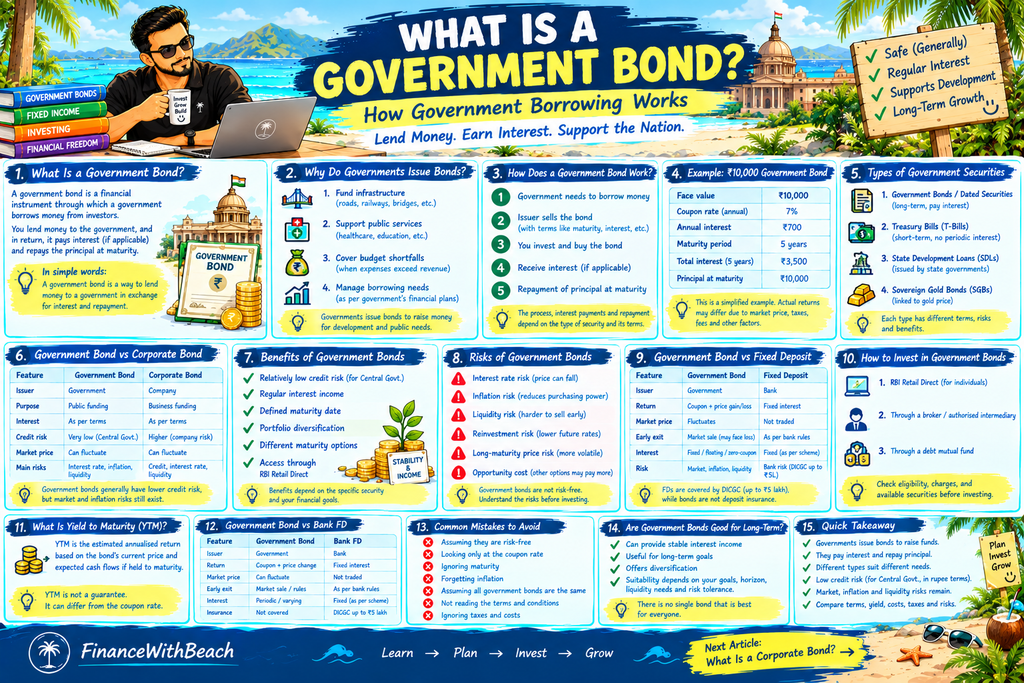
Table of Contents
Why Do Government Issue Bonds?
Governments collect revenue through sources such as taxes, fees and other receipt. However, these fund may not cover every expenses or planned project.
To raise additional money, Government can borrow from investors by issuing securities.
Common reasons include:
- Infrastructure development: Funding roads, Bridges, railways and public transport.
- Public Services: Supporting government expenditure on healthcare, education and other services.
- Budget Financing: Meeting funding requirements when government expenditiure exceeds available receipts.
- Managing borrowing needs: Raising money according to the government’s financial plans.
Instead of lending money to a [rivate company, an investor buying a government bond lends money to the issuing government.
How Does a Government Bond Work?
Let’s Undertsand the process step by step.
Step 1: The government needs to borrow money
The government determines its borrowing requirements and issues securities according to its funding plans.
Step 2: The bond is issued
The government specifies details such as the bond’s maturityy date, interest terms and other conditions.
Investors can participate in an eligible government securities auction or buy certain securities in the secondary market.
Step 3: Investors purchase the bond
You invest money by purchasing the bond. The amount you pay may be equal to above or below its face value depending on the issue or market price.
Step 4: Interest may be paid
Some government bonds pay interest periodically. Others, such as Tresury bills are genrally issued at a discount and redeemed at face value rather than opaying periodic coupon interest.
Step 5:The security reaches maturity
At maturity, the government repays the amount due under the security’s terms. For a coventional bond held until maturity, this generally means repayment of its face value.
The actual outcome depends on the particular security;s terms and the investor’s purchase price.
What Are the Main Types of Government Securities in India?
Government securitites come indifferent forms and maturities.
1. Government Bonds or dated Government Securities
These are securities issued by the Central Government or state governments with sepcfied maturity dates.
Central government dated securtities often pay interest periodically, commonly every six months, according to their terms.
They can be used investors seeking expsoure to government for a defined Period.
2. Treasury Bills (T-Bills)
Treasury Bill are short-term securities issued by the Government of India.
They generally have original maturities of less than one year and do not pay periodic coupon interest.
Example:
A Treasury Bill may be purchased for less than its face value and redeemed at face value maturity. The difference reperesents the investor’s return before applicable costs and taxes.
3. State Development Loans (SDLs)
State Developments loans are securities issued by issued governements to borrow money.
They are government securities, but they are issued by state government rather than the Cnetral government.
Their terms, yields and market prices may differs from those of Central Government Securities.
4. Sovereign Gold Bonds (SGBs)
Sovereign Gold Bonds are governement securities linked to the price of gold and denominated in grams of gold. They have specific terms, including interest and redemption provisions.
They are different from ordinary governemnt bonds because their value is linked to gold rather than being a conventional fixed- principal bond.
The availability of new SGB issues depends on government announcements. If considering an exisiting SGB, check its terms and market availability.
What Is the Difference Between a Government Bond and a Corporate Bond?
Nothe Government bonds and corporate bonds involve lending money to an issuer. The main difference is who borrows the money.
| Feature | Government Bond | Corporate Bond |
|---|---|---|
| Issuer | Central or state government | Company |
| Purpose | Government borrowing and public funding needs | Business and corporate funding |
| Interest | Depends on the security’s terms | Depends on the bond’s terms |
| Credit risk | Depends on the issuing government and security | Depends on the company’s ability to pay |
| Market price | Can fluctuate | Can fluctuate |
| Main risks | Interest-rate, inflation, and liquidity risks, among others | Credit, interest-rate, and liquidity risks, among others |
Central governemnt securities issued in India’s domestic market are generally treated as having very low credit risk in rupee terms. However, this does not mean their market prices never falls or that they are free from every investment risk.
Corporate bonds can have greater credit risk because a company may expereience financial difficulties and fail to meet its obligations.
What Are the Benfits of Government Bonds?
Government bonds can offer several potential benefits depending on the security.
1. Relatively low Vredit risk for central Government securities.
Central Government securities in the domestic market are generally considered to have very low credit risk in rupee terms.
However, other risks-particularly market-price and inflation risks-remains relevent.
2. Interest income
Some government bonds pay interest at regular intervals. This may helps investors plan for scheduled income.
The payment frequency and coupon terms depend on the particular security.
3. Defined maturity
Many government secutities have a stated maturuty date. This helps investors understand when the security is secheduled to mature.
4. Portfolio Diversification
Government securities can provide expsoure to an asset class that behaves differently from stocks in some market conditions.
Diversification may helps manage portfolio risk, although it cannot eliminate losses.
5. Different maturity options
Investors can find securites with different matruities, from short-term treasury Bills to longer-term government bonds.
Choosing an appropriate maturity is important because m,arket-price sensitivity can vary cosndierably between securities.
6. Access through RBI Retail Direct
Eligible indiviual investors can use the RBI Retail Direct platform to access certain government securitites directly, subject to the platform’s ruls and the security’s availability.
What Are the Risks of Government Bonds?
Although some government securities have very low credit risk, they are not automatically risk-free investments in every respect.
1. Interest-Rate Risk
Bond prices and market interest rates generally move in opposite directions.
When market interest rates rise, the price of an existing fixed-rate bond may fall. when market interest rates decline, its price may rise.
Example:
If you own a bond paying 6% interest and newly issued comparabale bonds begin offering higher rates, buyers may prefer the newer bonds. Your existing bond may need to trade at a lower price to remain competitive.
If you sell before maturity, you may receive less than you paid.
2. Inflation Risk
Inflation reduces the purchasing power of money over time.
Let’s say pays ₹700 in annual interest. If the prices of goods ans services rise significantly, that ₹700 may buy fewer things than ir did perviously.
An investment can provide positive nominal returns while delivering a much smaller returns after inflation.
3. Liquidity Risk
Liquidity refers to how easily an investment can be brought or sold at a reasonable price.
Some government securities trade more actively than others. If a particular security has limited trading activity selling it quickly ay your desired price may be difficult.
4. Reinvestment Risk
If you recive interest payments, you may not be able to reinvest them at the same interest rate.
Example:
If your bond pays 7% interest but available rates later fall to 5% reinvesting those payments may generate less income.
5. Long-Maturity Price Risk
Longer-term Fixed-rate bonds are generally more sensitive to changes in market interest rates than otherwise comparable shorter-term bonds.
This means a long-term bond-s market price may fluctuate cosniderably when interest rates change.
6. Opportunity Cost
If market rates risk after you buy a fixed-rate bond, your bond may pay less interest than newly available alernatives with comparable risk.
Your scheduled coupon may remain unchanged, but the investment may become less attractive relative to newer securities.
How Can You Invest in Government Bonds in India?
Individual investors have several possible routes depending on the security and their circumstances
Option 1: RBI Retail Direct
The RBI Retail Direct scheme allows eligible individual investors to access certain government securities directly.
The platform provides facilties for purchasing eligible securities through primary issuance processes and for buying or selling eligible securites in the secondary marke, Subject to its rules.
You generally need to complete the rquired registration and identity-vertification process. Check the current eligibility requirements, account conditions and transaction rules on the official website.
Option 2: Through a broker or other authorised intermediary
Dpending on the product, investors may be able to access govenement securities through a broker or another authorised platform.
Before proceeding, check the provider’s regulatory status charges, available securities and transaction conditions.
Option 3: through a debt mutual fund
Some debt mutual fund invest in government securities. This can provide indirect exposure without requiring you to purchase and manage an individual bond yourself.
However, debtmutual fund is not the same as directly holding a government bond. Its value fluctuations, its costs differ and it does not necessarily promise repayment of a fixed amount ona specfic date.
Before investing, check these details
- The issuer and types of security
- The maturity date
- Thge coupon rate and payment schedule, if applicable
- The purchase price and yield to maturity
- The security’s liquidity and market- prices risks.
- Trabsaction charges and appicable taxes
- Whether the maturity matches your financial goals.
What Is Yield to Maturity (YTM)?
Yield to maturity (YTM) is an estimate of the annualised return assoiciated with a bond’s current pirce, assuming it is held held until maturity and the relevent cash flows occur as expected.
Ytm takes into account factors such as the bond’s purchase price, scheduled interest payments, face value and time remaining until maturity.
Example:
A bond with an 8% coupon rate doe not necessarily provide an 8% YTM.
If you purchase a bond below or above its face value, its YTM may differ from itscoupon rate.
YTMis an estimate, not a guranteed return. The realised outcome can differ if you sell early, reinvestment rates change, cost apply or the issuer does not meet its obigations.
Government Bond vs Fixed Deposit
Governement bonds and bank fixed deposits can both be used by people seeking relatively perdictable financial outcomes, but their structures differ.
| Feature | Government Bond | Bank Fixed Deposit |
|---|---|---|
| Issuer | Government | Bank |
| Return structure | Depends on the security’s terms | Depends on the FD’s terms |
| Market price | Can fluctuate if traded | Normally not traded on an exchange like a bond |
| Early exit | May require a market sale or follow security-specific rules | Depends on the bank’s premature-withdrawal terms |
| Interest payments | Depends on the security | Depends on the FD payout option |
| Risk considerations | Market, inflation, liquidity, and issuer-specific risks | Bank risk, inflation, and early-withdrawal conditions |
| Deposit insurance | Not applicable as bank-deposit insurance | Eligible deposits are insured by DICGC up to the applicable limit and conditions |
In India, DICGC deposit insurance genrally covers eligible deposits up to ₹5 lakh per depositor per bank, including principal and interest, in the same right and capacity.
Neither product is autmatically best for everyone. COmpare the return structure, liquidity, risk, time horizon and tax treatment before deciding.
Common Mistakes Beginners Should Avoid
Mistake 1: believing government bonds can never lose value
Some government securites have very low credit risk, but their market prices can fall when interest rates rise.
Mistake 2:
Looking OPnly at the coupon rate
The coupon rate alone does not tell you the total return. Purchase price and maturiy also matter.
Mistake 3: Ignoring maturity
A long-term bond may not suit someone who needs the money soon, parcularly if selling early could results in a loss.
Mistake 4: Foregetting Inflation
A positive payment does not guranteed that your purchasing power will increase.
Mistake 5: Assuming every government security works the same way
treasury bills, conventional government bonds, state development loans and sovereign Gold bonds have different structures and risks
Mistake 6: Confusing a bond with a debt mutual fund
A directly held bond and a fund investing in bonds have different strucutres, costs and returns charcteristcs.
Mistake 7: Investing without reading the terms
Always understand the maturity, interest schedule, purchase price and exit conditions before investing.
Are Government Bonds Suitable for Beginners?
Government bonds may be worth learning about if you want to understand fixed-income investing and how government rasie money.
They may be useful for investors seeking scheduled interest payments or ecposure to government securities, depending on their financial goals and the particular bond.
However, suitability depends on your time horizons, need for liquidty =, tolerance for market-price fluctuations and overall fiancial situation.
If you need money for an emrgency or an expense due soon, do not assume that a long-term gpvernment bond is an appropriate subsititute for readily accessible savings.
The key lesson: Understand the specfic security vefore investing rather than assuming every government bond identical or risk-free.
FAQs
What is a government bond in simple words?
A government bond allows you to lend money to a government in exchange for interest, if the bond pays interest, and repayments under its time.
Are goovernment bodn safe in India?
Central Governemnt securities in the domestic market are generally considered to have very low credit risk in rupee terms. however, their prices can flucutate and inflation and liquidity risks may affects investors.
Can I invest in governement bonds with ₹1,000?
The minmum amount depends on th type of senrity and the method used to invest. Check the current minmum investment requirements on the official platform or with the authorised provider before placing an order.
Do government bonds pay manothy interest?
Not necesarily. Interest payments frequency depends on the security’ s. terms. Many conventional dated government securities pay interest periodically, often every six months, while treasury Bills generally do not pay periodic coupon interest.
Can I Sell a government bond before maturity?
Sme government securities can be sold in the secondary market, subject to availability and transaction rules. The sale price may be higher or lower than your pruchase price.
What is the difference between a government bond and a treasury bill?
Tearsury Bills are short-term Central government securitites, generally with original maturities of less than one year. Government bonds or dated securities usually have linger maturities and may pay periodic interest.
Do I have to pay tax on Government Bond income?
Interest and capitla gains may have tax implication depending on the security, type of income, the investor’s circumstances and current Indian tax rules. Consult current oficial tax guidance or a qualified tax professional for your situation.
What is the difference between a government bond and a government bond mutual fund?
A government bond is a security you hold directly. A government bond mutual fund pools investors’ money and invests in government securities. The fund’s value fluctuates and it does promise the same maturity repayment as an individual bond.
and Investing
What Is a Bond?
A bond is a financial instrument through which a government, company or other eligible issuer borrows money from investors.
When you buy a bond, you are essentially lending money to the issuer. In return, the agrees to pay interest according to the bond’s terms and repay the principal at maturity, subject to its ability to meet its obligations.
Example:
A company may issue bonds to raise money for expanding its business, purchasing equipment or funding new projects. A government may issue bonds to finance public speaking.
In Simple words:
A bond is a way to lend money to a government or company in exchange for interest and the agreed repayment of the principal.
Bonds are commonly called fixed-income investments, although not every bond pays a fixed interest rate and bond returns are not guaranteed.
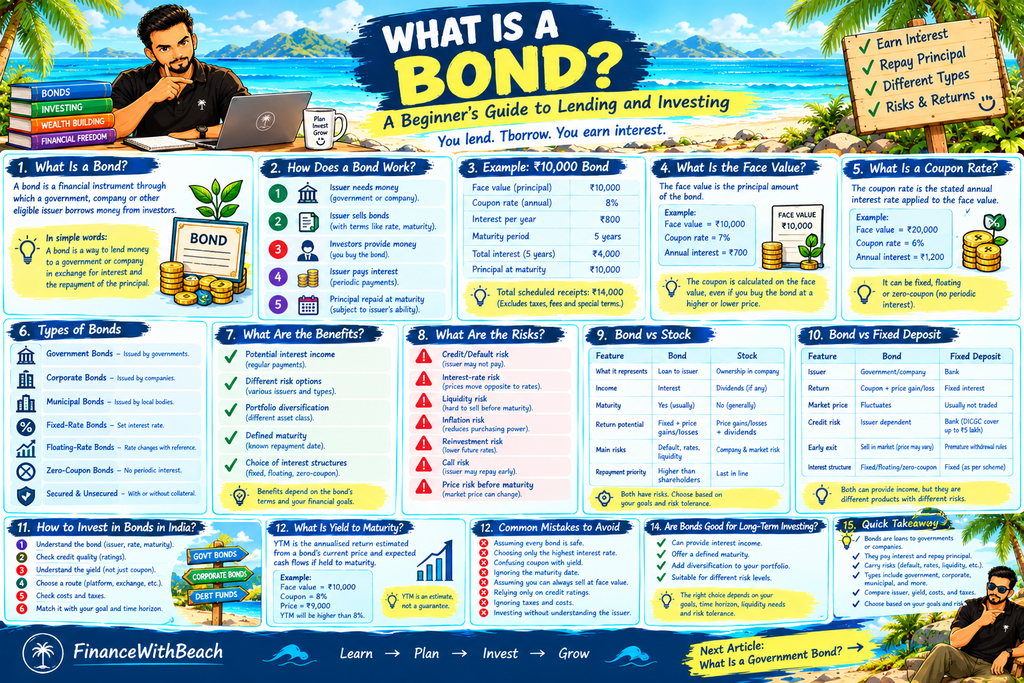
Table of Contents
- What Is a Bond?
- How Does a Bond Work?
- Example: How Does a Bond Work?
- What Is the Face Value of a Bond?
- What Is a coupon Rate?
- What Is the Maturity Date of a Bond?
- What Are the Different Types of Bonds?
- What Are the Benefits of Bonds?
- What Are the Risks of Bonds?
- What Is the difference Between a Bond and a Stock?
- What is the Difference Between a Bond and a Fixed Deposits?
- How can Beginners Invest in Bonds in India?
- What IS Yield to Maturity?
- Common Beginner Mistakes to Avoid
- Mistake 1: Assuming every bond is safe
- Mistake 2: Choosing only the highest interest rate
- Mistake 3: confusing coupon rate with yield
- Mistake 4: Ignoring the maturity date
- Mistake 5: Assuming you can always sell at face value
- Mistake 6: relying only on credit ratings
- Mistake 7: ignoring taxes and costs
- Mistake 8: Investing without understanding the issuer
- Are Bonds Good for Long-Term investing?
- FAQs
- Link this article to:
How Does a Bond Work?
Let’s understand the basic process step by step.
Step 1: An issuer needs money
A government or company needs funds to finance its activities or projects.
Step 2: The issuer sells bonds
The issuer offers bonds to investors. Each bond has specfic terms, such as its face value, interest rate and maturity date.
Step 3: Investors provide money
When you purchase a bond, you lend money to the issuer under the bond’s terms.
Step 4: The issuer pays interest
Dpending on the bond, you may recieve interest payments monthly, quarterly, half yearly, annually or at another specfied time. SOme bonds do not make periodic interest payments.
Step 5: The bond reaches maturity
At maturity, the issuer is generally required to repay the principal according to the bond;s terms. However, repayment depends on the issuer fulfilling its obligation; default is possible.
Example: How Does a Bond Work?
Let’s say you buy a bond with these hypothetical terms:
| Feature | Example |
|---|---|
| Face value | ₹10,000 |
| Annual coupon rate | 8% |
| Interest per year | ₹800 |
| Maturity period | 5 years |
| Principal due at maturity | ₹10,000 |
If the bond pays an 8% annual coupon on its ₹10,000 face value, the scheduled interet would be ₹800 per year.
Over five years, you would recieive ₹4,000 in total interest if every scheduled payment is made. At maturity, the issuer would repay the ₹10,000 principal according to the bond’s terms.
Your total scheduled receipt would be ₹14,000 over five years, assuming the bond is held for the full term and and payments are made.
This example excludes taxes, fees and any special bond conditions. It also assumes you purchased the bond at face value. Of you a bond for more or less than its face value, your actual return can differ.
What Is the Face Value of a Bond?
The Face value, a;sp called the par value or nominal value, is the pricncipal amount specified for a bond.
Example:
A bond may have a face value of ₹1,000 or ₹10,000.
The face value is imoortant because the coupon payment is often calculated as a percentage of it.
Let’s say A bond has a face value of ₹10,000 and a coupon rate of 7%.
Annual coupon interest:
₹10,000 x 7% = ₹700
If you purchase that bond for ₹9,500 in the market, the coupon is still generally calculated on the face value of ₹10,000 according to the bond’s terms. Your overall return, however, also depends on th price you paid and the amount received at maturity.
What Is a coupon Rate?
The coupon rate is the stated annual interest rate applied to a bond’s face value.
Example:
A bond with a face of ₹20,000 and a 6% annual coupon rate would pay ₹1,200 in annual interest if it pays coupons annually and all payments are made.
Coupon payments may occur at different intervals depending on the bond’s terms.
Some bonds have fixed coupon rates, while others have variable of floating rates. Zero- coupon bonds generally do not pay periodic interest.
What Is the Maturity Date of a Bond?
The maturity date is th date on which a bond is scheduld to reach the end of its term.
On that date, the issuer is genrally expected to repay the outstanding principal according to the bond’s conditions.
Example:
- A Bond issued for one year has a one-year term.
- A bond issued for five year has A five-year term.
- A bond issued for ten year has A ten-year term.
The maturity date matters becuase it helps investors understand when repayments is scheduled and how long their money may remain committed.
However, if you sell a bond before maturity, you may reiceve more or less than the amount you orginally invested.
What Are the Different Types of Bonds?
Bonds differ according to who issues them, how they pay interest and the irsks involved.
1. Government bonds
Government bonds aree issued by governments to borrow money.
India, the Central Governement issues government securities, including longer-term dated securitites. State governments issue State development loans.
Government securitiescarry risks that differ from corporate bonds. Their market prices can still fluctuate, particularly when interest rate changes.
Example:
An investor purchases a government security that pays interest according to its stated terms.
2. Corporate Bonds
Corporate bonds are issued by companies to raise money for business purposes.
A company may use the funds for ecpansion, new equipment, infrastructure or refinancing existing debt.
Corporate bonds involve the risk that the company may not make its scheduled interest payments or repay the principal.
credit ratings can help investors assess credit risk, but a rating is an opinion, not a guarantee of repayment.
3. Municipal Bonds
Municipal bonds are debt instruments issued by egilable local government bodies or municipal entities to fund projects such as water supply, roads or ublic infrastructure.
Their availability, structure and risks depend on the specfic issue and applicable rules.
4. Fixed-rate Bonds
Fixed-rate bonds have a stated interest rate that generally remains unchanged during the relevant term.
Example:
A bond with a 7% annual coupon may continue paying that rate according to its terms, even if market interest rate change.
Its market price may nevertheless rise or fall.
5. Floating-Rate Bonds
Floating-rate bonds have interest payments linked to a reference rate or another specified formula.
Their interest payments may change when the reference rate changes.
6. Zero-coupon Bonds
Zero-coupon bonds generally do not pay regular interest.
They may be issued or purchased at a discount to their maturity value. If the issuer makes the required repayment, the difference between the purchase price and the maturity payment contributes to the investor’s return.
7. Secured and Unsecured Bonds
A secured bond is backed specified collateral, subject to its legal terms.
An unsecured bond does not have the same specific collateral backing. The recovery available in a default depends on the issuer’s financial position, legal arrangements and applicable insilvency rules.
Remember:
The name of a bond oes not tell you its complete risk profile. Review The terms, issuer, repyment obligation and relevent disclosures before investing.
What Are the Benefits of Bonds?
Bonds can play a role in an investment portfolio, depending on the investor’s goals and the bond’s charcheristics.
1. Potential interest income
Many bond pay interest according to schedule, which can help investors plan their expected cash flows.
However, payments depend on he bond’s terms and the issuer meeting its obligations.
2. Different risk options
Governement and coprorate bonds offer different types of exposure. Investors can compare maturity periods credit quality and interest structures.
Different option come with different risks.
3. Portfolio diversification
Bonds cn provide expsoure to adifferent asset class from stocks.
Their returns do not always move in the same way as equity returns, although bonds can also decline in value and diversification cannot eliminate investment risk.
4. Defined maturity
Many bonds have a specfied maturity date, which helps investors understand when principal repyament is scheduled.
This can be useful when matching investments with future financial goals, provided the investors accounts for repayments and market risks.
5. Choice of interest Structures
Investors may find fixed-rate, floating-rate and zero-coupon bonds depending on the market and available products.
Each structure behave differently when interest rates and ecnomic conditions change.
What Are the Risks of Bonds?
Bonds are not automatically safe simply because they pay interest.
1. Credit or Default Risk
The issuer may fail to pay interest or repay the principal as promised.
Example:
A financially troubled company may struggle to meet its bond obligations.
Coprorate bonds with higher credit risk may offer higher yields to compensate investors but a higher uiled does not make the investment better or safer.
2. Interest-Rate Risk
Bodn rpices generally move in the opposite diection to market interest rates, all else being equal.
when markey interest rates rise, existing bonds with lower coupon rates may beomce les attractive, causing their prices to fall. When market fall, existing bonds with higher coupon rates may become more attractive, potentially raising their prices.
3. Liquidity Risk
some bonds are not traded frequently
If you need to sell one before maturity, there may not be enough buyers at a reasonable price. You mighe have to accept a lower price or wait longer to sell.
4. Inflation Risk
Inflation reduces the purchasing power of money over time.
Even if a bond pays interest as cheduled, rising prices can reduce the real value of the income you receive.
5. Reinvestment Risk
if you receive interest payments and want to reinvest them future investment opportunites may offer lower rates than your orginal bond.
This can effecr the total return you earn over time.
6. Call Risk
Some bonds allow the issuer to repay them early under specified conditons.
If a bond is called when market interest rates are lower, you may have difficulty finding another investment with a similar yield.
7. Price Risk Beofre maturity
if you sell a bond before its maturity date, the market price may be above or below what you paid.
Even When a bond has scheduled interest payments, you can still expernience a loss if you sell it an unfavorable price.
What Is the difference Between a Bond and a Stock?
| Feature | Bond | Stock |
|---|---|---|
| What it represents | Money lent to an issuer | Ownership in a company |
| Investor’s role | Creditor or bondholder | Shareholder |
| Potential income | Interest payments, if specified and paid | Dividends, if declared |
| Maturity | Many bonds have a maturity date | Ordinary shares generally have no maturity date |
| Return potential | Interest plus possible price gains or losses | Dividends and possible share-price gains or losses |
| Main risks | Default, interest rates, liquidity, inflation | Company performance and market movements |
| Repayment priority | Bondholders generally rank ahead of shareholders, subject to the law and instrument terms | Shareholders generally rank behind creditors |
Neither investment tyoe is risk free. their suitability depends on your goals, time horizons and tolerence for losses.
What is the Difference Between a Bond and a Fixed Deposits?
Bothe can be used people looking for income, but they are different financial products.
| Feature | Bond | Bank Fixed Deposit |
|---|---|---|
| Who receives your money | A government or other bond issuer | A bank |
| Return | Depends on the bond’s coupon, purchase price, and other terms | Depends on the FD’s interest terms |
| Market price | Can fluctuate if the bond is traded | Usually not quoted like a traded bond; premature withdrawal is subject to the bank’s terms |
| Credit risk | Depends on the issuer and bond | Depends on the bank and applicable deposit-protection rules |
| Early exit | May require selling at the market price | May involve premature-withdrawal rules or penalties |
| Interest structure | Fixed, floating, zero-coupon, or other terms | Depends on the chosen deposit scheme |
In India, Eligible bank deposits are covered by DICGC insurance up to the applicable limit of ₹5 lakh per depositor per bank, including principal and interest, subject to the insurance rules. THis is different from bond protection and bonds should not be assumed to carry deposit insurance.
How can Beginners Invest in Bonds in India?
The process depends on th type of bond you want to buy.
Step 1: Understand the bond
Identify the issuer, maturity date, coupon rate, repayment terms and risks.
Step 2: Review credit quality
For corporate bonds, examine the credit rating and other infromation about the issuer’s ability to repay its debts. Never rely on a rating alone.
Step 3: Understand the Yield
The coupon rate is not the same as yield to maturity. Yeild to maturity estimates the annualised return implied by the bond’s price and cash flows, assumin the relvent payments occur as expected and the bond is held to maturity.
Step 4: Choose an appropriate route
Dpending on the security, Investors may access bonds thrugh official government-security platform, public issues, registered inetermediearies or the stock exchange.
The account requirements and avilable instruments vary.
Step 5: Check costs and taxes
Review trnsaction charges, applicable taxes and tax treatment of interest income and any capital gains.
Step 6: Consider your financial Goals
Think about when you may need the money, whether you can hold the bond until maturity anfd how much risk you can accept.
What IS Yield to Maturity?
Yield to maturity (YTM) is an estimate of the annualised return implied by a bond’s current price and its expected cash flows if held to maturity.
YTM cosniders factors suchs as the bond’s purchase price, coupon payments, fsce value, and remaining time until maturity.
Example:
A bond purhchased below it face value may have a higher yield to maturity than its coupon rate, assuming the issuer makes all requiredpayments. A bond purchased above face value may have a lower yiled to maturity than its coupon rate.
YTM is an estimate, not gurnateed. The actual outcome may differ if the bond is sold early, oayments are missed or other assumpption do not hold.
Common Beginner Mistakes to Avoid
Mistake 1: Assuming every bond is safe
bonds have different levels odf credit, interest-rate and liqudity risk.
Mistake 2: Choosing only the highest interest rate
A high advestised rate may reflect higher risk. Understand why the bond offers that rate.
Mistake 3: confusing coupon rate with yield
The coupon is based on the bond’s terms, while yield also depends on the price you pay and other factors.
Mistake 4: Ignoring the maturity date
Make sure the inevstment period suits when you expect to need the money.
Mistake 5: Assuming you can always sell at face value
A bond’s market price may change before maturity.
Mistake 6: relying only on credit ratings
Ratings can chnage and do not gurantee repayement. Read the avialable issuer and bond information.
Mistake 7: ignoring taxes and costs
Taxes and transaction charges can reduce your net worth.
Mistake 8: Investing without understanding the issuer
Before invsting, check who owes you the money and howthe issuer is expected to repay it.
Are Bonds Good for Long-Term investing?
Bonds may be useful for investors who want interest incopme, a defined maturity or exposure beyond stocks. However. different bonds have different risks and returns charcterisitcs.
Example:
A governemtn security and a lower-rated corporate bond should not be treated as equivalent investments. Even givernement bonds can flucluate in market price before maturity.
The right coice depends on your financial goals, time horizons, liquidity needs and risk tolerence.
there is no single bond that is best for everyone.
FAQs
What is a bond in simple words?
A bond is a way to lend money to a government or company in exchange for interest and the agreed repayment of the principal as scheduled.
How do bonds make Money
Investors may earn interest payments and may also make a gain igf they sella bond for more than they paid. Theyu can als experience losses.
Are bond risk-free?
No. Bonds can carry default risk, interest-rate risk, liquidty risk, inflation risk and other risks.
What is the difference between a bond and a stock?
A bond rperesnetsa loan to an issuer, while a stock generally represents ownership in a company.
What is the maturity date of a bond?
It is the date on wich the bond is scheduled to mature and the principal is genrally due for repayment according to its terms.
What is a coupon rate?
The coupon rate is the stated annual interest rate applied to the bond’s face value.
Can I Lose money in bonds?
Yes. You may lose money if the issuer defaults or if you sell the bond for less than you paid. The exact risk depend on the bond.
Can beginners invest in bonds in India?
Yes, subject to the eligibility and requirements of the investment route. Beginners should first understand the bond’s terms, risk costs and tax treatment.
Link this article to:
- What Is Bank Account?
- What Is ATM?
- What Is UPI payment?
- What Is Recurring Deposit?
- What Is a Asset?
- What Is a Dividend?
- Simple Interest and Compound Interest
- What Is a Return on Investment?
- What Is Risk in Investing?
- What Is Diversification
- What Is a Portfolio?
- What Is an Index?
- What Is an Stock MArket Index?
- What Is an Mutual Fund?
- What Is an SIP?
- What Is an Index Fund?
- What Is an ETF?
- What Is a Bond?