What Is a Budget? Meaning, Types & How to Create One

What Is a Budget? A Beginner’s Guide

Have you ever wondered where your money went by end of the month.

You may start month with enough money, but after essential expenses, paying bills and spending in shopping every month and end of month left like nothing.

One simple tool that help you understand and plan your money is budget.

A budget is a plan that tells you how to use your money.

It helps you to how much money you can spend, save and use for financial.

Budget is not about stopping from spending money.

Deciding where your money should go before you spend it.

What Does a Budget Mean?

A budget is plan for you income and expenses for short duration like month.

Example

₹50,000 per month

  • rent
  • food
  • bills
  • Transportation
  • Saving
  • Personal expenses
  • insurance

there is no such sibgle budget for everyone.

The purpose is to give your money clear way.

Why Is Budgeting Important?

Budget gives you clearity using of your money.

1. A Budget Shows where Your Money Goes

without a budget you do not know your monthy salary where get spend.

When you create a budget, every spend have it own categories.

  • Food
  • Online Shopping
  • Subscriptions
  • Wants

Once you figure it out you get your number where you could less spend on it.

2. A Budget Helps You Priortize Expense

Not every expense has have same improtance.

budget helps you priotize you expense.

Higher Priority

  • Rent
  • food
  • bills
  • Transportation
  • Loan EMIs

Lower Priority

  • Enterainment
  • Personal wants
  • Subscription
  • Eating out

It simply means you should prioritize your expense first and after rest of it.

3. A Budget Can Help You Save

Saving become easier when you create a budget and include in it.

Example:

Income: ₹50,000

Spending the enire amount and saving whatever remains you can includes

Planned saving: ₹5,000

saving part of your financial plan.

the amount you save should be realistic as per personal situation.

4. A Budget Can Helps You Avoid Overspending

Lets say you plan to spend ₹7,000 for dinning out, shopping and enterainment, etc.

Once you reach this amount you automatically stop spend in this category.

this creates a simple boundary for uour money.

A Budget helps you become more aware before spending.

5. A Budget Helps You Plan Ahead

Budget isn’t only helps for today’s expense.

It’s also helps to prepaare for future expense.

Example

let say you have annually isnurance perminum every year

In three months you have to pay in full payment. So one timw wholly payment will shake your financial situation.

So you keep it in budget in advance before payment date come you keep aside some amount for insurance plan.

Preparing you today for tomorrow’s financial situation is budget.

What Are the Different Types of Budget

There is no such single budget types.

Common bduget plan:

1. Monthy Budget

This is simplest budget for beginner.

Create a Plan for single month of income and expense.

monthy salary person create easy by this types of budget to understand and maintain.

2. Zero Based Budget

In zero based Budget, every money of income for planned budget.

Example:

Income: ₹50,000

You allocation all money ₹50,000 like:

  • Rent
  • Expense
  • Debt EMIs
  • Enterainment
  • Subscription

Money Allocated to saving and EMIs repayment is also purpose.

3. Percentage -Based Budget

Budget divided into percentage based from income.

Categories:

  • Need
  • Wants
  • Saving or Invest

Very Popular and famous Framework 50/30/20 rule in budget.

Genrally

  • 50% Needs
  • 30% Wants
  • 20% Saving and Invest

This may change in Categories based on income, expense, debt and financial situation.

Don’t force your life into a budgeting rule that suit you financial situation.

Fixed Vs Variables Expenses

Understand your fixed and variable expenses

Fixed Expenses

This expense is fix and can’t change every month to month and can’t change in this expense.

Example:

  • Rent
  • EMIs
  • Fixed Transportation
  • Groceries

Rent= ₹12,000 every month

Variable Expense

These expense is change time to time.

Example:

  • Dinner out
  • Subscription
  • Fuel
  • Shopping

Example:

  • January Outing = ₹2,000
  • Febuary Outing = ₹2,750
  • March Outing =₹3,000

Create a Budget with types of expense in mind with realistic way.

How to Create a Budget Step to Step

You can use spreadsheet, note book. You don’t require of apps or software for it.

Step 1: Write Down Your Income

Start with your expected income.

Example:

Salary = ₹50,000

If your Income change every month assume it like lesser amount so if less money comes to your account you adjust in your budget plan.

Step 2: List Your Expenses

Write down all your expenses includes all fixed and variables expenses.

Example:

  • EMIs
  • Rent Food
  • Transport
  • Bills
  • Shopping
  • Outting and Enterainment

Tiny expense also to included into it.

Separate your Wants and Needs

Divide into Needs and wants

NEEDS

  • Rent
  • Food
  • EMIs repayments
  • Transportation

This are important and non-neogotiable every month.

WANTS

  • Subscription
  • Dinning out
  • Shopping

These are unimportant can be ignore and set into next month budget.

By this approach you get flexibility in your budget and piroritize.

Step 4: Add Savings to Your Budget

Decide your realistic amount of saving.

Example:

Monthy Income = ₹50,000

Saving = ₹5,000 with purpose

This is low but realistic amount you to save every month.

  • Emergency fund
  • Short-term goals
  • Long-term goals

Step 5 Compare Your Income and Expenses

Income – expense = Remaining Money

Example

₹50,000 – ₹5,000 = ₹45,000

If you have money left, you can decide use in saving, Loan repayment and other financial goals.

If your expense cross than income, then you has to reconsider your budget and chsnge into it.

  • Reduce unimportant spending
  • adjust your plan
  • review your loan
  • reduce unwanted purchase

Budget gives you visvible problem in your financial plan.

Step 6: Track Your Actual Spending

Beginning is to create a Budget.

you need to compare your planned and actual spending.

CategoryPlannedActual
Food₹6,000₹6,750
Dinning Out₹5,000₹6,550
Transport₹4,500₹5,250
Shopping₹6,000₹8,000

Now easily it visible that you has spend more or less than planned.

this simple gives idea to create a budget next time better.

Step 7: Review Your Budget

At end month, ask yourself:

  • did i stay with my budget?
  • where I spend more than planned?
  • Which expense I can Reduce?
  • Did I save Some money?
  • which Unwanted purchased I made?

Budget and financial journey continous and learning process.

first budget is not your final budget and it should not be perfect.

A Simple Monthy Budget for Beginners

let’s say someone income is ₹50,000

CategoryAmount
Essential expense₹20,000
Saving₹6,000
Debt Repayment₹10,000
Personal expense₹5,000
other expenses₹9,000
Total₹50,000

this just a example.

Everyone life is different from others.

so, rent may increase need to vary change in budget.

Someone living with parents there expense also low.

Your budget gives reflection of your actual life.

What If You Cannot Save Money?

Sometimes your income may just enough to cover your important expnese.

In that situation, you had create unreal budget without any certain percentage allocate in your budget.

First look into budget

Where is my budget going?

look for realistic opportunity

  • Reduce unnecessary Expenses
  • stop unwanted subscription
  • Campare your bills
  • Avoid impulse buying
  • look to increase your income

Build saving habit with small amoutn intially.

Common Budgeting Mistakes

Making a Budget and Never Checking It

A budget only become useful when start compare your expected expense with actual expense.

Forgetting Small expense

Small Purchase later added.

Making Budget too Strict

A budget with cut to cut allocate money is too difficult keep on track.

Copying someone’s Budget

Your income and expense is different from someone life. Create you own budget according to your cricumstances.

Giving Up Afte One Bad Month

Overspending is not mean that you has bad budget or fail in your financial journey.

Learn from it and review recreate with new budget.

Budget Vs Money Management

these Term are connected to each other but not exactly same meaning.

Budget

Budget is a plan for how to use your money.

Money Management

Money Management is a process to handle your income, expense, saving, Budgeting and managing debt.

Simple way

Budget = your money plan

Money managment = how to manage your money overall

FAQs

What is Budget?

A budget is a plan that tells you how to use your income for expense, saving and other fincial purchases.

Is budgeting only for People with Low Income?

No. Budgeting cane be useful at any income level because everyone needs to decide how use your money effective way.

How often shoul I make a Budget?

A Monthy budget is simle starting point for many people, who recieve salary monthy.

Can I change my Budget?

Yes. Budget should be flexible. so that you can adjust your unexpected expense can fit into it.

What is the easiest way to start budgeting?

Start with three things

  1. income
  2. list your expense
  3. decide where to save

Track and review your budget with actual spending.

Link this article to:

What Is Saving? Meaning, Importance, Types & How to Start | Article #9

What Is Saving? A Beginner’s Guide.

Saving is one of the simplest and most important financial habit you can develop.

you earn money for today, but you may need money for future may be for unexpected expense or emergency, planned purchase or important financial goals.

Instead of spend your recieve money you had keep focus on to keep aside money for future use.

this is called saving.

In simple words:

Saving means to keep aside small amount of money for future use instead of spend immediately.

Example:

if your income is about 35,000 per month. you has to immediately keep 5,000 month aside before spending on any penny from it.

Saving do not start with huge amount of money it may be start with very small amount of money.

For beginner, the Most important thing is to develop the habit of saving regularly.

Why Is Saving Money Important?

Saving Can gives financial safety net and help to prepare your future needs.

Some Important Reason to develop saving habits.

1. Saving Helps You prepare for Unexpected Expenses

LIfe is a full of unexpected moments.

For Example:

  • Vehicle Repairs
  • Unplanned Travels
  • unexpected bills
  • job lay offs
  • Home repairs

If you keep lumpsum amount of money aside for something unexpected events or emergency events.

this is why we called emergency fund and it is starting point.

2. Saving Helps You Reach Financial Goals

Many Goals Require Money.

Example:

Goal: Let’s say want to buy ₹50,000 worth PS5.

it is not save in one time directly one time money comes I will buy it.

Keep it simple way, Put a Side money Every month let say ₹5,000.

₹5000 X 10 months = ₹60,000

now go and buy it.

The amount amount may change as per your income, expense and goal time horizons.

The important is to start your saving towards your goal with smaller and regularly steps.

3. Saving can Reduce the need of borrow

let say you required urgent 15,000 for any important payment.

Car break down and you have tmororrow important meeting at your job. to attend meeting at right time. Car repair should done by today so that you go to office tomorrow on time.

In this situation you have no saving, first ideas comes to your mind is to borrow money from relative or friends.

If keep aside saving for this type of situation you have to just tap and transfer to service account without taking any new debt,

saving gives you this type Financial Flexibility.

saving willgive you this financial relaxation and without financial debt and keep you been prepared for future substances.

4. Savings Helps You Build Financial Discipline

Saving is not just one time amount gather and doing nothing after achieve this amount.

Example

someone just achieve amount of saving ₹35,000 and stop it from next pay month but other side somone regularly save ₹1,500 evem after achieve saving goals after ward also.

Consistency matters.

You can increase you saving over peroid of time to improves situation.

5. Saving Gives You More Financial Choices

Having money gives you more choices in life in nevery situation.

Example:

  • Planned purchase for your wants
  • Pay your important expenses
  • work toward your financial goals

Without saving, even smallest amount goes to unexpected expense feels lot of pressure.

Saving gives great sense of financial choices and flexibility.

What Are the Different Types Of Saving

All Saving not go for one purpose at a time.

For Beginner, give purpose to your saving to keep going it:

1. Emergency Savings

Emergency saving are money that kept aside for emergency situation.

Example:

  • Urgent medical bills
  • car repairs
  • home repair
  • loss job
  • urgent family financial situation

Purpose of saving should be stronger that even you get good discount any shopping still stick to your saving.

clear goals is to use for emergencies on;ly.

2. Short Term Saving

Short Term saving is for goals to achieve in next month to three months. Require this types purchase very soon.

Example:

  • Buying phone
  • starting a paid courses
  • planned trip
  • uncoming expenses
  • buy a laptop

3. Medium Term Saving

These types of saving goals required some more time to achieve goals.

Example

  • Buying Vehicle
  • Large planned purchase
  • International Trips
  • upgrade skill courses

these may take some ltime to achive but stick to it gives you money you get target.

4. Long Term Goals

Some saving requires longer time period.

Example

  • Buying Home
  • Education Aboard
  • Retirement

Long term goals, Keeping money aside may not enough

This types of goals requires invest in asset and work on assetto achieve long terms goals.

Saving and investing are not same thing.

Saving Vs Investing: What Is the Difference

Beginners often get confuse saving and investing.

Basic Difference:

Saving

Money is generally set aside for future use and emergency or planned goals.

Investing

Money is put into asset with expectation of growth over time.

Example

If you are planning for a goal for long term goals with many years away, just by saving that long term goals cannot achieve it.

Investment will comes in a way growth your money over period of long period time.

In Simple word investment will helps you grow your money with time for long period.

Investment can be done with your understanding of risk tolerence, income, saving and nature of investing risk.

How Much should You Save?

There is no amount that is perfectt for everyone.

Your saving capacity factor depends on:

  • Your Income
  • Your Saving
  • Your Expense
  • Your Debt
  • Your Financial Goals

People only able to save 10% of their Income.

Example:

Monthy Income: ₹50,000

₹50,000 of 10% is ₹5,000 only. start smaller amount for saving habit and later increase it.

How Can Beginner Start Saving Money?

New to saving, keep the process simple.

Step 1: Choose a Saving Goal

Give your saving purpose

example:

I want to Build ₹50,000 for a emergency fund

specfic target of saving makes saving easy.

Step 2: Decide on Regular Amount

Choose a amount realistically save on regular base.

Example:

5,000 for 50,000 salaried person is small amount to save.

Consistency is more important than choosing unreal amount to save.

Step 3: Save Soon After Receiving Income

Instead of waiting untill end of month and keep saving whats remains end of month, keep saving soon after receiving your income.

keep a saving early as income comes.

in simple words, pay yourself first

And than rest of it goes to your essential expense and personal.

Step 4: Keep Saving Separate

Keep saving money aside from regular expense money.

Put money in another bank saving account so that you can not touch or spend in daily money expense.

If you cutoff easy access this account and untouchable this account. It is easy to save the money easily.

Step 5: Track your Progress

Check your saving regularly

Example

Monthmonthy savingtotal saving
january₹5,ooo₹5,ooo
Febuary₹5,ooo₹10,ooo
March₹5,ooo₹15,ooo
April₹5,ooo₹20,ooo
May₹5,ooo₹25,ooo
June₹5,ooo₹30,ooo

Consistency is a key of saving habit.

Common Saving Mistakes Beginners Should Avoid

Saving Without a Goal

If you do not know the goal saving, after some amount saving you spend immediately.

Setting an Unrealistic Goal

tsarget should be suitable and realistic with your income, expense and saving capacity.

Using Saving for every wants

saving is for emergency not for every normal spending like shopping.

Ignoring Emergency Saving

Before focusing on long term goals, be prepared for enough emergency fund for unexpected situation or needs.

Camparing Your Saving with Others

Evryone have different income, expenses and situation in their life.

Your Financial Progress should measured in your own situation.

A Simple Saving Strategy For Beginners

You can start with three simple catgeories:

1. Emergency Funds

Money for unexpected situation.

2. Short-Term Goals

Money for planned spending for very soon for next or next to next month.

3. Long Term Goals

these money are for longer period time and it’s may takes around years and years.

Investing may helps you to grow your time over period time with higher returns.

These simple step simply say that without purpose for saving is just collecing money for dust.

FAQs

Whats is saving?

Saving means Keeping some amount of money aside every month for futre unexpected expense, futre financial goals and Needs.

Why Should I save Money?

It is Preparation of unexpected expenses, achieve future financial goals and reduce dpends of borrowing money.

Is Saving the same as investing?

No. Saving is to put money aside for future needs or wants. investing is for putting money into asset for long term period to growth of money and risk will be there.

How much money should a beginner save?

there is no such fixed amount that beginner should start. It depends on your income, expenses, saving and financial reponsibility but try to consistency keep saving regularly.

Where should I keep my savings?

There is no such fixed place to keep your saving. It’s all about in emergency how easily accessible your money without any delay or fine.

Link this article to:

What Is Money Management? A Beginner’s Guide | Article #7

What Is Money Management? A Beginner’s Guide

This is a common question everyone ask

“Where does all my money goes?“

You Earn money, Pay bill, buy things, save some money and make financial decisions throughout the month.

Simply earning money does not automatically mean that you know how to manage it.

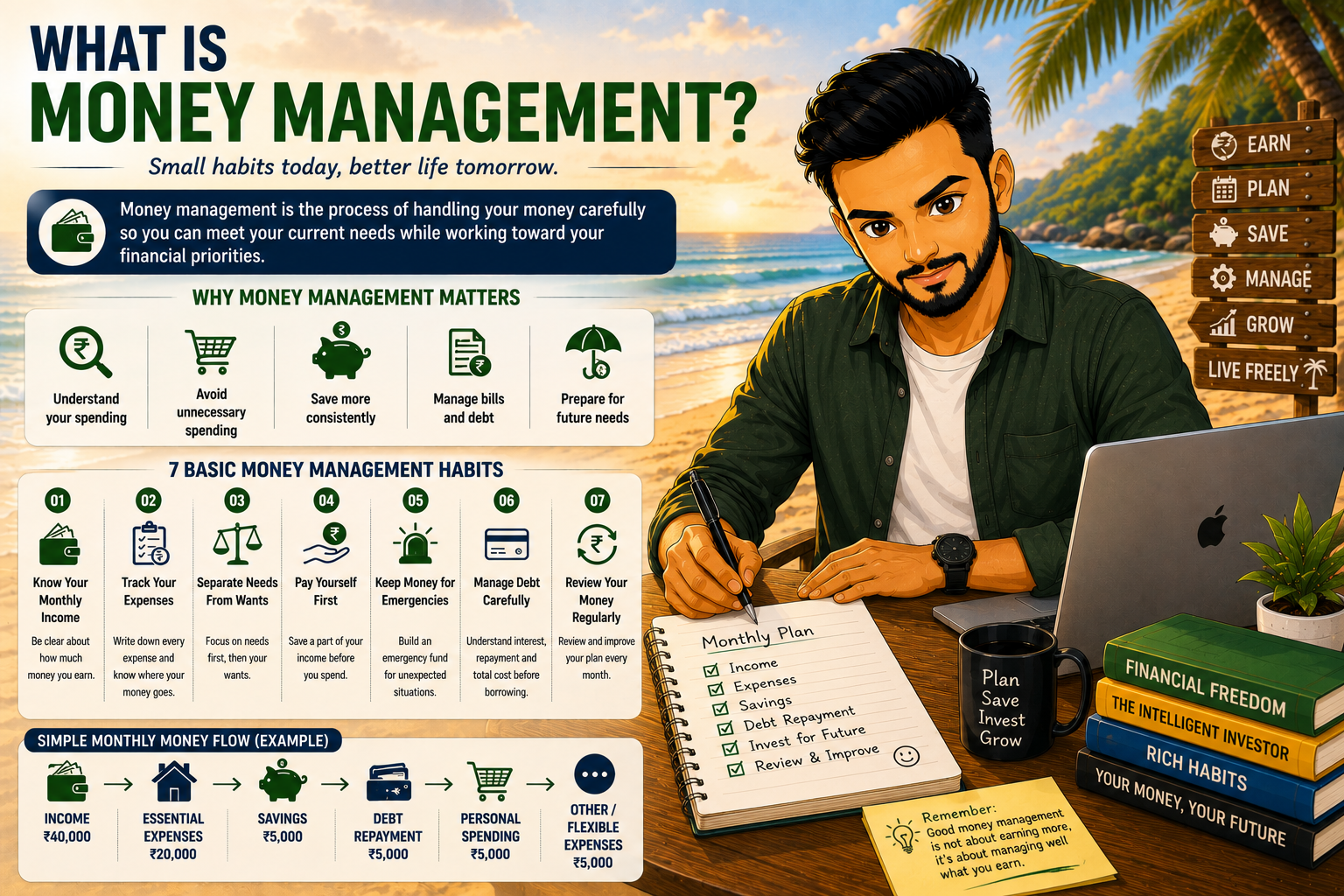
Money Management is the process your handling of money carefully so you meet your current need with working on future financial goals.

It Includes everyday Activity :

  • Managing Expense
  • track your Expense
  • Saving Money
  • Managing Debt
  • Preparing your future needs
  • Planning your cashflow

You can start with simple steps.

What Does Money Management Mean?

In Simple Mean

Money Managment means to understanding how much your earning, where to spend goes and how want to use it.

Imagine You Receive a monthy income of ₹50,000

  • Paying your essential expenses
  • Buying thing you want
  • Save money
  • repay money
  • Protection finance
  • money toward future goals

Money management helps you how to spend and save the money wisely insteady of spending it without knowing how much you have left.

A Simple Formula

Income → Plan → Spend → Save → Review

Simple cycle can help keep you on track of your money.

Why Is Money Management Important?

Food Money Mangement can make financial life more organized and better.

It can helps you:

1. Understand Your Spending

You can see actually watch where the money goes.

2. Avoid Unnecessary Spending

Tracking expenses can reveal purchase that may not important.

3. Save More Consistently

when you plan your money, saving should be regular every month.

4. Manage bills and debt

Panicking in last minute, make a plan for repayment of debt every monthy.

5. Prepare for Future needs

Managing today’s money can help your future financial goals.

7 Basic Money Management Habits for Beginners

you don’t need complicated financial plan to begin.

here is a seven simple habits.

1. Know your Monthy Income

Start with the money that comes to your account.

For someone with salary and small amount comes from bonds or FD.

For someone wigh freelance or business income, that income may change every monthy.

Example

Monthy Income = ₹35,000

Starting point of your monthy plan we got it.

2. Track your Expenses

Understanding your where it’s goes every monthy.

to track your money use like:

  • simple notebook
  • spreadsheet
  • track or apps
  • banking apps
ExpenseAmount
Rent8,000
Bill2,000
Food5,000
transportation3,000
shopping2,000
Enterainment2,000
other expense4,500

Goal is to just become aware of where money goes.

once you know your money goes, you get better with financial decision.

3. Separate Needs From Wants

Understanding the difference betweens needs and wants is simplest way of money management.

Needs

Expense that are important and can’t be chnage every monthy. This expense require every month atleast minimum.

  • Rent
  • Food
  • Bills
  • Transportation

Wants

This Expense is we wish to spend but it is not important.

  • buy a clothes
  • extra shopping
  • app subsription
  • expensive gadgets

The Important thing you get exact amount of every monthy required and how much you needed in your wants purchased.

4. Pay Yourself First

Most Easily or without doubt just put money aside from income before spending single penny .

Example

Income comes every 2nd of every month. Put aside on same day that can’t be touch even if you want.

Income: 35,000

Saving: 5,000

Saving first is more effectively than save in later on.

5. Keep Money for Unexpected Expenses

Not every expense is planned.

some expense come in unplanned way.

example:

repairs of vehicles

medical bill for family members

Unexpected bill or travelling expense comes sometimes.

This is why Emergency fund is very important part of money managment.

Emergency fund is for unexpected but important of that situation like opreation deposit, foreseen etc.

Using your emergency fund in enterainment, shopping or luxury shopping should not be done. it is for unexpected finnancial needs only.

6. Carefully manage debt

Debt is a another part of money mangment.

If you know your debt or credit balance:

  • how much money you owe
  • at what rate of interest
  • Your Monthy EMIs
  • Your Repayment
  • Total no. of loans or Total amount

Example

Loan should be managable with every month expense.

Before taking loan you should know your current debt status your repayment plan.

Borrowing money should be done in very decisive way so you can manage every time without regret.

7. Review Your Money Regularly

Money managment is not something done once and automatic goes every month or years.

You may get to change in:

  • chnage in income
  • changhe in expense
  • higher rent
  • new fianncial goals
  • new family responsibility

it is useful to review you monthy money.

this helps to know:

  • how much money spended?
  • how much money in income change?
  • how much money required in new financial goals?
  • How much money required in wants and needs?
  • Where am I can save more?

THis is a continous habits. it is a long journey of your life.

Money Managment Vs Financial Planning

These two terms sound same and closely related, but they are not exactly same.

Money Managment

Focus on handling your money effectively in everyday life.

Example

  • Track expense
  • paying bills
  • save regularly
  • manage debt
  • finance protection

Finance Planning

Focus on create an plan towards future financial goals.

Examplw

  • Puchase a house
  • children higher education
  • Setting Short-medium-long terms goals
  • Preparing retirement

A simple way to remenber it

Money Managment = Managing today’s money

Financial Planning = Managing today’s money toward future financial goals

How To Start Managing Money Today

Today:

Write down your monthy Income

This week:

Track your expense.

This Month:

Create a Simple spending Plan.

Going Forward:

Set aside save money regularly and review progress.

this not change your financial journey overnight. It’s takes time to reach to certain point og financial goals.

FAQs

What is Money Management?

Money Management means manage and controlling your income expenses, saving and debt so you can use it effectively.

What is the First Step in Money Managment?

A First step for money managment is to know your income expenses and saving.

How can I Manage my money better?

Starting tracking your expense, understanding needs from wants, create financial plan, saving regularly every month and pay off debt effectively.

Is Money management the same as budgeting?

Not exactly. Budgetting is a important part of money managment. Money managment also includes like income, expense, debt, saving and money protection from unexpected situation.

Can I manage money even if my income is low?

Yes. Money managment can be useful in different level of income. Just amount of needs, wants and saving may change but principle will be same. steps to track expense, start saving, pay off debt first aare same in every level of income.

ink this article to:

What Is Financial Planning? A Beginner’s Guide

Most People have financial goals. You may want to buy a car, Builds a Emergency fund, nut a home, start side hustle or business and prepare for retirement.

Having a goal is first step. you also need a think how to achieve that goal.

here is financial planning is important.

In Simple word, Financial planning is the process of creating a plan for your money to achicve your financial goals.

It includes understanding your current situation, what step taken over time to reach a future goals.

Financial Planning is not only for high income or wealthy person . Anyone with normal salry can do financial planning for there future financial goals in life.

let dive into article of financial planning with beginner friendly. to easily you can create your own Simple and understand financial planning.

What Is Financial Planning?

Financial Planning is a process of managing your money for future purpose or goals.

For example, you want a build your emergency funds let say 1 lakh for safe fund.

now you have give yourself target or identify how much i can save montnhy basic so that i can reach my target over peroid of time.

keep the smaller steps for easily to do without compromise in other expense or life of living.

I think ₹5000 every month is good amount and track your progress and review it if it is necessary with your situation.

Main purpose fo financial planning is to have clear direction of your money and use without any guilt in spending life.

Why Is Financial Planning Important?

Every one knows money is solve many problems of our life. but without planning of your money is like you running behind something that not have any direction where to go.

Here there some financial planning way to gives you help create it.

  1. Give Your money a Purpose

When you receive a salary or big payment from selling a asset anything like this you have many choices to spend it.

You can spend online or invest MFs and repay your debt or alloacate for future goals.

Example

  • Part of your money on your monthy expense
  • Repay of your debt
  • Build a emergency funds
  • Invest in Stockmarket or bonds.
  • allocate in sparate account for future financial goals.

2. It Helps You Set Clear Financial Goals

Financial Goals is something to do, expirence or buy thing which require of money.

Example:

  • Build a Emergency fund
  • Buy a Car
  • set child education fund
  • Buying home
  • Retirement fund

Financial planning have clear and exact goals.

I want some money in my saving. there is no define of “some money”.

I want ₹1 lakh money for emergency fund. I will save ₹5000 every to achieve this goals.

3. It Helps You Understand Your Current You Financial Situation

Before a Create financial planning you have understand your current situation of your financial.

Example:

  • Your Income
  • Your Expense
  • Your short term goals
  • How much saving do have right now
  • Your debt situation
  • Your financial Responsibiliity

Current situation is your foundation of your financial planning.

The 5 Basic Steps of Financial Planning

Financial Planning does not nee to be complecated.

Beginner Cand start with this 5 simple steps:

Step 1: Udnerstand Your Current Financial Situation

write down your basic financial situation.

Example

Income

How much money do you earn every month?

Expenses

How much money goes to necessary or personal expenses?

Saving

How much Money do i have in my saving?

Debt

what amount of debt i have in total and which interest have in my every loan and how much EMIs i have pay every monthy?

Step 2: Set Your Financial Goals

Your Financial goals divided into different Time Periods

Short-Term Goals

Goals that requires want in next month or before next 6 month

  • buying phone
  • build emergency fund
  • Pay off your tiny debt

Medium-Term Goals

Goal to completes in 6 -12 months of your planning period of time.

  • Starting a business
  • Paying tuition Fees
  • Buying a Vehicle

Long-Term Goals

Goal requires more than years like 2- 10 years.

  • Buying a House
  • Children Education
  • Retirement planning

Step 3: Calculate What You Need

Once you decided your goals, estimated your goals money how much it required to achive this money.

Example

let say You required a Emregency Fund of 1 Lakhs for a year.

Now tell yourself and decide how much money you can keep a aside without any change in your other expense.

Start with with small amount like 5000 every month before spending on other essential or personal expenses.

Your Every month plan can change as per income circumstance of very month. Just by create a plan is not right direction but excueate every month save regularly is more important to have it.

Step 4: Create an Action Plan

Now it’s time to do it in action regularly

Example

Build a Emergency Plan of 1 lakh

Action Plan:

  • Save Regular amount every month
  • Track of Progress
  • Save more if get extra money like bonus, or money from parents grandparents.
  • Avoid spending from save for emergency fund
  • avoid unnecessary purchase

Every person have different exact plan to achieve it.

Important thing is to move from

I want to save some day

rather than say

i will save small amount every month work for it.

Step 5: Review and Update Your Plan

Financial Plan is not something you just create it and not looking at again for action.

situation may change over peroid of time.

Example

  • Increase in income
  • Increase in expense
  • Add a new respinsibility
  • You may achive first goal and another requires more money than last one.

Financial Plan shouls be flexible enough to contiue your financial goal as change in your life.

Review your plan regulary can help to adjustment of with your life.

What Areas can Be Included in financial Plan?

Income Planning

How much money comes to your pocket every money and plan your income before it’s comes to your pocket.

Expense Planning

Understanding and mange your regulary expenses.

Saving Planning

Automate your saving by automaticaly transfer saving into your saving account or cash out and put it give it to your mother for future emergency situation.

Debt Planning

Identify your current debt,EMIs and plan your repayment of every month.

Investment Planning

Learning about investing to where invest instrument like MFs, stock market, golds and bonds.

Financial Protection

Thinking about Financial risk, emergency portection and good insurance needs.

Goal Planning

Goal clear planned into short-term,medium-term and long-term goals planning.

Financial Planning Is Personal

There is no such same financial plan for everyone.

Example

Two People have same salary and may have different situation.

First Person have:

  • Have family repsonsilbilty
  • Pay Rent
  • Having multiple loan EMIs
  • Sned money to home

Second Person Have:

  • Live with family
  • Lower expense
  • Fewer financial repsonsbility

Financial planning may change by situation

Financial Planning should be consider like:

  • income
  • expense
  • saving
  • insuarance
  • parent dpendence
  • goals
  • debts
  • time peroid

this is called Personal Financial Planning.

Common Mistakes to Avoid When Financial Planning

Beginners may make common Mistakes.

  1. Having no Clear Goal

It is difficult to plan or take action that you do not know how much money to have achieve your goals.

2. Create a Uncrealistic Plan

Plan your current situation of financial.

saving should be realistic so that you can save regularly and consistently and easy to maintain.

3. Ignoring Unexpected Expenses

Life can change, create a financial planning with flexible so it can adjust by money and you still stick to your plan that you created you planning.

4. Trying to achieve Everything at Once

You may have many financial goals

Start with most important priorties trying into action to achieve toward goals.

5. Never Reviewing your Plan

Your fiancial Situation required review your plan regular or required may change to achive it.

FAQs

What is Financial Planning?

Financial planning is the process of creating a plan for your money to achicve your financial goals.

What is the first step in Financial planning?

The First step to undertanding your financial Situation,including your income,expense and debt financial repsonsilbity.

Is Financial Planning Only For Wealthy People?

NO. Financial Planning is for everyperson with lower income to higher income. Mainly understanding your money and setting goals as per income level.

How Often should I review my financial Plan?

you can review regular time and when you may major change in income,expense, financial goals.

Do I need to Know about investing to start financial Planning?

No. Beginner can start with basic concept likr income, expense,budgeting and manage debt. Investment is knowledge can be learn gradually.

ink this article to:

What Are The 5 Main Areas of Personal Finance?

What Are The 5 Main Areas of Personal Finance?

Personal Fiance is very vasy topic. It Include much more than simply saving and investing in stock markey

To manage money effectively it helps to understand different areas of financial life.

In this article we will divided into 5 Main Part of Personal finance.

  • Income
  • Spending
  • Saving
  • Investing
  • Financial Protection and Planning

All these 5 Parts are connected to each other. Undersatand and related to it gives clear and helps to manage your money effectively.

Think of your financial life like a journey

Earn money →Spend on needs → Save for Future → Invest for long-term goals → Protect your finances from uncommon situation

Let understand simple finance terms:

1. Income:The money you earn

Income is the money come to your bank account in every month

It can be single stream of income or it can be more than One stream of income evry month.

  • Salaried job
  • Rental Income
  • Freelancing income
  • Interest income

Why is Income Important

Income is the starting point of Personal Financial Journey.

It helps your detremined how much money we talking about:

  • Saving
  • Daily expense
  • Investment
  • Loan Payment
  • Financial Goal

Example:

Suppose your salary is around 40k Inr.

It is a net pay that comes to your account every month.

Next Question how to use it?

Key Lesson

Understand your income before spending and investing your money.

Articles: What is Income? Types of Income explained.

2. Spending: The Money you use

Spending means it is about money that use to pay good and services.

Common Expenses

  • Rent
  • Groceries
  • Food and Vegetables
  • Education
  • Enterainment
  • Mobile
  • Transportation

Spending is necessary and important part of life.

Types of Spending

Spending mainly divided into two types

Essential Spending

These important spending without this we can’t live without it.

  • Food
  • Rent
  • Food and vegetables
  • Basic Transportation
  • Necessary Bills

Personal or Optional Spending

  • Entertainment
  • Lunch or dinning out
  • App Subsribption
  • Shopping

Both are part of life. But essential can’t reduce in spending it is fixed but in option spending we can change as per require.

Key Lesson

Spending with understand you know where your money goes.

Article: WHat is Expenses? Fixed Vs Variables Expenses

3. Saving: Money kept for better Future

Saving is small portion that kept aside before spending it.

Saving useful for:

  • Emergency
  • Short term goals
  • Planned Purchase
  • Unexpected expense

Example

As above we taken 40k this time same here and putting 5k before you spend or paid bill of month.

This amount may variable accordingly to your income, fixed expense and medicial bills etc.

Why is Saving Important?

Saving gives you freedom of stress free living and time to thinking about major decision in life like job change, loss job and pay bills for medicial Expense.

It help mostly when you need important time Emergency for unexpected financial decision.

Key Lesson

Saving Helps prepare for future needs and unexpected expenses

Article: What is Saving and what is it important?

4. Investing: Money for Long Term Growth

Investing mean Putting money into asset with the goal of Growing your wealth over time.

Common investment option like:

  • Mutual funds
  • debt fund
  • bonds
  • stocks
  • FD/RD
  • Post Office Deposits
  • Gold
  • Silver

Investing Is differen from saving money.

Saving may focus more keeping for future needs while investing is for long term period of time and different of risk factor.

Why investment is important?

People invest for long term goals:

  • Higher Education
  • Retirement
  • Buying house
  • Future Financial Goals

Example:

One father of two children start investing when both children was born for just 5K for both children. Fast Forward After 20 Year for higher education father get good lumpsum of money by doing nothing just sit and keep patience to grow money over peroid of time.

Investment Return are not Guaranteed.

Key Lesson

Learn about your goals and risks Before making investment decision.

Articles: What is Investing?A simple Guide For Begineers.

5. Financial Protection and Planning

This fifth area focus on preparing for future goals and financial risky.

good income and saving can be affected by just a one unexpected spending.

Financial Protection and Planning includes:

  • Building a Emergency Fund
  • Buy personal and family insurance
  • Debt managment
  • Planning for major purchase
  • Prepare of retirement corplus

Financial Protection

Financial Protection is reducing the financial impart of certain risks.

For Example:

Unexpected Medical expenses or major events can affects your financial life.

Depending Family members and your own insurance should be cover all your expense for medical in your city expensive hospital.

Understanding your risk and take step for them is good signal of financial life.

Financial Planning

Financial Planning is proces of Planning and thinking of long term and future financial Goals. Create a Plan Work toward them.

Your Goals Like:

  • Buying a Home
  • Education
  • Retirement
  • Start a Business

Key Lesson

Protect your Finance from major Risky and Planning toward your finacial Goals.

Article:

What Is a Emergency Fund?

What Is insurance?

What Is Financial Planning?

How the 5 Areas of Personal Finances Work Together

The five Areas are not separate to each other. they work together.

Example:

Step 1: You earn income

You receive ₹40,000 Per month

Step 2: you manage your spending

You used in necessary and Personal Finance

Step 3: You Save

Before spend you keep small amount of portion aside from income before expense.

Step 4: Investing

You may have a Long term financial goal to explore investment based on your risk tolerence and need.

Step 5: Protect and plan

You prepare for unexpected emergency that can affected your financial life and planning for long term goals like buy a house, higher education for children, retirement.

This is complete approach to managing your personal finances.

Simple Personal Finance Framework

Five step simple Framework

Income → Spend → Save → Invest → Protect & Plan

This doesn’t mean to use same framework you can change step as your suitable ways.

Personal Finances decision depends upto many factors

  • Income
  • Saving
  • Investment
  • Debt
  • Financial goals
  • Risk tolerence
  • Family Responsibility

The goal is to understand all five areas and improve your financial goals.

Which Area Should beginners Focus on first?

IF you are complelty new in Personal Finances, You do not need to learn everything at once:

Do it in this order:

  1. Your income:

Know how much you earn per month.

2. Your Expenses:

Know your money goes out.

3. Basic Budgeting:

Spread it for needs, wants, and saving with plan as per income.

4. Start Saving:

Keep aside small amount of money every month.

5. Protect money and Planning

Learn basic insurance and debt managment to protect unwanted situation.

6. Keep learning more:

Above basic done with it now keep learning for bigger risk and investing.

FAQs

What are the 5 main areas of personal finance?

  • Income
  • Spending
  • Saving
  • Investing
  • Financial Protection and Planning

Is Budgeting one the main areas of personal finances?

Budgeting is an important money manage tool help to manage income and expense. It support sevral areas of personal finance,in spending and saving.

Is insurance part of peronal finance?

Yes. Insurance is part of personal income. it’s protect your saving from emergency or unexpected expense. it is not ruin your saving and investing.

Which area of Personal Finance should I learn first?

Beginners should start with from income and expense of your monthy pay. Goes on after saving, investing and insurance and keep learning.

Do I need Higher slary to start this Personal Finance Framework?

No. This is a Beauty of personal finance frame work it can be you from lower to higher Salary. Go with step by step and tick to it plans.

Financial Literacy Vs Financial Education : What Is the Difference?

Many People thinks that Financial Literacy Vs Financial Education is like sound similar with each other. Concept are may same but it is not exactly same meaning.

Now let’s understand both terms for beginner to get concept clearly in mind

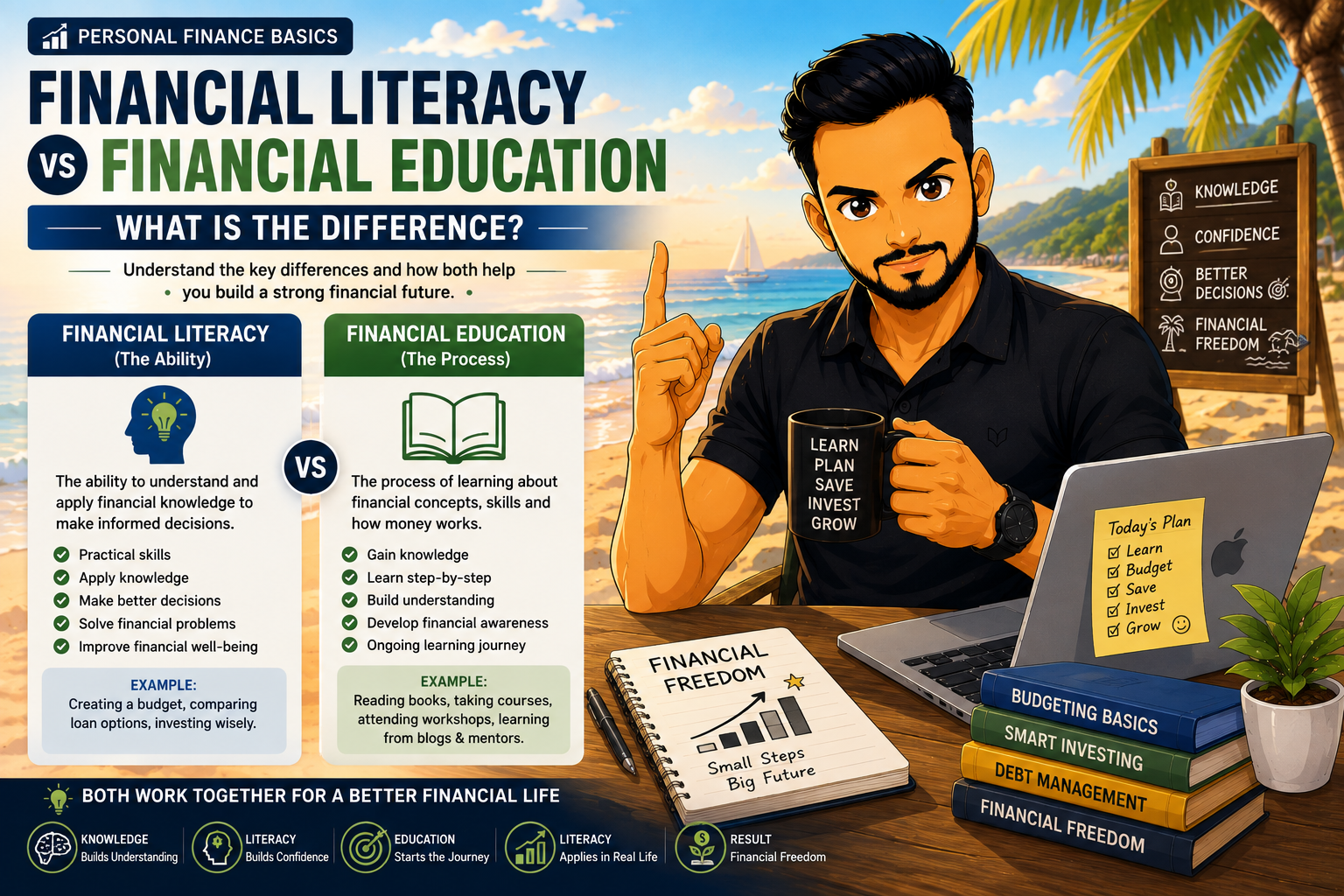
Financial Education means is process of learning about money.

Financial Literacy means is ability to understand and use knowledge in mostly practical way in real life.

For example

To read any article about budget is a Financial Education.

To understand and knowledge of budget create and following a strict to plan is financial Literacy.

What is Financial Education?

Financial Education is process of learning about money relate to like Financial Skills, knowledge and know about how money works.

it is journey of gaining knowledge about money.

Financial Education may includes like:

  • Budget
  • Saving
  • Income
  • Debt and loans
  • Interest rate
  • Rate of Returns
  • Insaurance
  • Financial Planing
  • Investing

Resource for this knowledge is:

For example

let say you read a book on money or financial one basic topic on budgetting like 50/30/30 rule of budget is simplest form of budgetting to divides into 3 parts of Needs, wants and saving.

By this way you get learning about money in Financial Education.

What Is financial Literacy?

Financial Literacy means to abiltiy to financial information and use in make informed in every money decision.

It is to knowledge use in real life.

A Financial Literacy understand terms like:

  • Understand income and expense
  • Create a budget
  • Understand basic terms
  • Set financial Goals
  • Mange debt Reposible
  • Understand the asset and risk
  • Campare financial Options

Example of financial Literacy

Let say budget of simple form is 50/30/20 divided into categeries like Need, want and saving or invest. Create a budget in own income and apply this knowledge for your personal finance.

Differance between Financial Education and financial Literacy

Financial EducationFinancial Literacy
Process Of Learningunderstand and apply
Builds knowledge about moneyUse financial knowledge
Focus on Reading and educationFocus on doing Practical ways
Ex. Learning about investingEx. Apply investment as par you can take a risk ability.

Simple Formula

Financial Education → Knowledge →Understanding → Financial Literacy → Better Financial Decision

In different words, Financial Education can helps builds knowledge and skills that help to financial literacy

Why Both are important?

Financial Education and financial Literacy is very important role is to maintain good relationship with money.

Before Investing, Understanding about Rate of Interest and Risk that investment may not provide guarantee Results.

Financial Education is foundation of Learning.

Fianancial Literacy Helps You use That Knowledge

Learning about money is useful, And apply in Practical way is gain moew knowledge.

Foe example

Financial Education: learn about EMergency fund

FInancial Literacy: Understand a your Personal Income and expense putting and build own ememrgency fund as par required your circumstance.

Financial Education without Financial Literacy

A Person read Good books and understand financial terms but still he can stuggle relationship with money.

For example:

  • How Strict to a Budget?
  • What is Compound and how it’s works?
  • What is diverstification and it’s benefits?

But there are some can’t track their expense or cannot set a financial goal for future.

Just Knowledge cannot gives gaurantree apply of financial successfull.

Can You Be Financially Literate Without Formal Financial Education?

Yes. Financial Education don’t requires formal study, course or degree. It’s upto you to proper understand from trusted organization.

  • Personal Experience
  • Books
  • Personal Finance Blogs
  • Course
  • Family Dicisions
  • Professional Guideness

But it is doesn’t mean by reading and gaining knowledge you became a expert in financial field.

The Important thing is to ability clear understanding and apply it responsibly.

However Most important it should be learn from trusted educational source, especially when you make financial decision.

How a Beginner Can Develop Both?

you in personal Finance, focus on learn and apply on it.

Step 1: Learn the Basic

Start with easy sand simple concept:

  • What is income?
  • What is expense?
  • How much to go to saving?
  • How to create budget?
  • What is saving?
  • WHat is debt?

Step 2: Understanding your own situation

look at own Personal finances

Ask yourself

  • How much do I earn?
  • How much do I Spend?
  • What are my Biggest Expense?
  • Do i have saving?
  • Do I have Debt?

Think helps to Connect Financial Planing and knowldege in your life.

Step 3: Help with Small Finance Skills

Start with small action like:

  • Track your expense
  • small amount of saving
  • Setting a Financial goal
  • Start a SIPs (Single)

Step 4: Keep Learning

It is continuous process of keep learrning.

As your age changes, your income, Responsilbity will change with time and you need more learning and knowledge of investing, insurance, tax and Financial Planning.

FAQs

Is Financial Literacy same as Financial education?

NO. Financial Education is process of Learning and financial is to understanding and ability to apply in your personal with reponsibly in real life.

What comes first: Financial Education or Financial Literacy?

Financial Education comes first because first come process of learning and gain knowledge to be apply into it wisely.

Why is financial Literacy Important?

Financial Literacy can help Understand Financial Information, manage money and make decision about money like saving, invest and borrowing.

Can anyone improve their Financial literacy?

Yes. Beginners can improves financial concept and apply into daily financial decision.

Do you need a Formal Fiance degree to become Financial literate?

No. You do not need a degree. Financial with basic concept like income, expense, saving, debt and investing clear understanfing gives strong foundation.

More to Learn improve your Financial journey

What is Financial Literacy? Meaning, Importance and Benefits

Most people work hard to earn money, but not all people manage there people effectively. You earn more than enough for your need wants and essential but you don’t know how to save, spend and fund for unexpected forseen or debt management.

This is where financial literacy comes in and plays very important role in your life.

In Simple Word, financial literacy is a learning to understand the money and use financial Knowledge into your daily small financial decision about money.

It includes to getting knowledge of earn, save, spend, budget, Invest and protectyour money.

Finance Literacy does not mean you need to be expert and have depth knowledge about money like read a quartarly reports, tax filing and daily stock market understand. It is started with simple finacial term like

  • How much money did i earn every month?
  • How much money did spend every month?
  • How much money did i borrow from bank or lender?
  • how can i built my budget and stick to it?
  • how can i plan for my future?
  • what is difference between saving and investing?

this is begineer guide, let’s understand the financial literacy its meaning, importance and benefits.

What is Financial Literacy?

Financial Literacy means having a skill or knowledge needed to manage the money wisely.

Financial Literacy person required some basic concept terms to learn firstly.

  1. Income
  2. Expense
  3. Budgeting
  4. Saving
  5. Invest
  6. Emergency fund
  7. Debt
  8. Interest
  9. Insurance

Just by knowing this words is not enough it is apply in your Financial decision daily.

For Example

let said two friend salary have ₹30,000/month same salary.

Friend 1: spend all money without seeing any price tags, understand it is required or not and max out credit card without knowing any thing.

Friend 2: It start with saving first, track expense, keep list for needs and wants and avoid unnecessary small debt.

Both people has same salary with different habits may results different over a time.

This is why financial literacy comes into it how much money you earn is equally important to manage your money wisely.

Why is Financial Literacy is important?

Financial literacy is help take decision throughout their life relate dto money.

  1. Understand your money

Its means how much money you earn and how much money you save.

Financial Literacy encourage to look into;

  • Income
  • Needs
  • Wants
  • Spending
  • loan and EMIs

When you understand the money, you take much more clear decision from it.

2. Create a Budget

Budget is planning of your money how to use it wisely

  • rent and bills
  • loan and EMIs
  • shopping
  • saving investing Insaurance

Without a plan, it is just watching money disappear from your account before next payday comes.

3. Build a Saving habit

Financy Literate Pesron will understand the importance of saving for common and uncommon situation in life.

Situation like

  • Medical Expense
  • job loss
  • car or house repair
  • Higher education
  • Important Financial goals

Every penny goes saving gives a good direction of your money journey.

4. Understand your Debt

Understanding your debt will solve your financial problems many of them is like how much the loan and interest will i pay, how manys loans and there time remaining is there.

Financial Literacy helps go through to this kind of question before borrow money:

  • how much money i need to borrowing?
  • how much interest and repay will have do it?
  • do i really want this loan?
  • how much rate of interest is good or bad?
  • Is my monthy EMIs easily i can afford?
  • Planing of reapayment?

Understaning your debt helps to avoid borrowing and manage the debt easily.

5. Better Investment Decision

Investing is plays important role in wealth creation and long term Financial planing, but without knowledge it is risky.

Basic invest terms for understanding like

  • rate of returns
  • Inflation
  • Compounding
  • Diversification
  • Risk of asset

this terms will you knowledge and helping your financial life healthy.

What are the main componentsof Financial Literacy?

Financial Literacy includes some important components of Personal Finance:

  1. Budgeting

It is simple to helps to track your income and expense.

A basuc budget helps to saving and prioritize you financial goals.

2. Saving

Saving Means to keep small portion of money aside for your future financial goals like planned trips,pruchase house and short financial goals.

3. Investing

Investing is helps to grow your money with peroid of time without working for it.

Investing may have risk and understand your goals working for it accordingly.

4. Debt Managment

It helps to understand the handling borrowing money responibly.

  • Interest Rate
  • Loan EMIs
  • Repayments

5. Financial Protection

Financial Literacy also Includes understand your asset risk and maintain it by protect appropriate insaurance for certain situation.

How Can Financial Literacy Improve your Life?

Financial Literacy not gives guarentee of wealth but its gives you informed financial decision

Possible benefits

  1. Better financial Decision

You start take better where to spend, borrow and invest.

2. Reduced Financial Stress

Saving and grow your money gives time to manage in your certain situation. And make easier to manage.

3. Improved Confidence

Understanding the money helps you to gain confidence in Financial decision. Even other parts of life get improved by financial decision.

4. Better Preparation of Future

Financial knowledge gives good life ahead in education , retirements, etc.

How can Beginner Improves Financial Literacy?

Start with basics

Step 1: Understand you money

know your how much comes in every month

Step 2: Track Your expense

Tracking of where the money is going.

Step 3: learn basic budgeting

create a plan for saving, spending and investing.

Step 4: Build a Emergency Fund

Start a Fund For emrgency by putting small amount of keep aside every month.

Step 5: Learn Saving and investing

Keep saving for short term goals and rest invest for long terms goal for future.

Step 6: Keep learning

Keep education yourself by doing reading books. it is continune process and keep track it may change in saving, income and for different responsibility.

Financial Literacy does not require a High Income

It is a common misunderstanding that it is for only wealthy people.

A person with small salry can do good with money:

  • track your money
  • budget
  • saving andinvest
  • set financialy goals

Amount of money is very small but basic principle will same thoughout this process. By this process it is easy to used to everyone.

FAQs

What is Financial Literacy?

Financial literacy is a learning to understand the money and use financial Knowledge into your daily small financial decision about money.

Why is Financial Literacy is important?

It’s helps people understand to manage money better, avoid unnecessary debt, Invest for better financial goals.

What are the basic of financial Literacy?

The basic pf financial leiteracy like Income, expense, saving, investing, manage debt, and Financial Protection

Can I learn Financial literacy by myself?

Yes. Beginners can start by doing learning from free resources like blogs website, youtube,etc. And keep doing in real life to improve in real life financial decision.

Is Financial literacy the same as being rich?

NO. Financial Lteracy is to manage uour money wisely. a High Income does not means you get rich quicky. it is building of good habit and knowledge of Personal finance.

What is Personal Finance? A Complete Beginner’s Guide

Name itself start with Personal finance means our own money in our life. money matter every stage of our life. To Earn, to save for emergency, Invest for better future and mainly secure our family with Insurances.Later use it in our achieve life goals. But just to earn money you get financial security. how to save, invest, leverage is equally important.

this is where Personal finance come in our life.

In simple words, Personal Finance is the process of managing your money with your basic need currect requirement and achieve your future goal in your later life years.

Personal Finances have many topics to cover under like saving, investing, earning, budgeting, spending portecting with insurance and managing debt.

What is Personal Finance?

Personal Finance is includes your all financial desicion which you take every day-to-day.

Example:

Your earning capacity

Your spending habits

Your saving per month

Your saving for emergency

Your insurance planning

Your vacation planning

and many more..

Personal Finance motives behind just to keep you less debt, improve your financial situation with live your life carefree in every stage of your life.

Why is Personal Finance Important?

Personal Finance is very important beacuse it’s helps to take control of your money before it’s getting disappearing without your known in every month. And end month you have nothing in your pocket. Your wait for next payday.

It is also very important every one have there different responsibility, circumstance, family background and work with money accordingly.

  1. Manage your Expense

manage expense is watching out where your money goes out and in.

  • Essential needs
  • unused subscription
  • Which expense can be reduce
  • which EMi gets quicker paid off
  • how much you spend freely

this is where Budgeting comes into your life as a life saver.

2. Build your saving habits

Saving gives you financial stress free live and not to pannick during unseen situation.

  • Medicial Expenses
  • Sudden Job Loss
  • Emergency Car Breakdown
  • Unplanned Travelling

Saving and emergency fund is the safety nets for future life goals and for your family. Reduce the need of borrow money from high rate finance apps or family relatives and friends.

3. Achieve Financial Goals

Every need of current or future life require money.

  • buying a house
  • buying a car
  • paying for education or foreign education
  • side hustle
  • getting married
  • paning for healthy retirements

Personal finance gives clear mind and plan to your life goal with good financial situation.

4. To Avoid unnecessary Debt

Personal Finance gives very important in debt situation to say no without hesitation. without planning of return debt get into financial trap long peroid of time

  • Pay EMI on time
  • avoid Unnecessary debts
  • avoid high interest rate debts
  • Avoid borrow from bad peoples

What are the main areas of Personal Finance?

Personal finance has several important part.

  1. Income :

Income is money that comes into you pocket every month. The main source of income for mostly is salary form full- time job. Income have many types like from business, investment, freelance work or other sources.

2. Expense

Expense give ideas of your money is where you spend

Common expenses :

  • rent,
  • EMis,
  • School Fees,
  • Gorieces,
  • trnasportation,
  • car mainteance,
  • mobille bills,
  • electricity etc.

Tracking Expenses gives ideas where money goes out of your pocket with you known about it.

3. Budgeting

Budget is a Planning of every Money. Main Objective Budgeting is to make your money goes in Right place and Direction in everytime.

  • Needs
  • Wants
  • Saving
  • Investments
  • Insuance,etc.

Simple budget helps avoid unwanted spending and overspending.

4. Saving

Saving is a small amount of money from paycheck for future use.

  • Planned big purchase
  • future education
  • short-term goals

Building goal based saving and emergency gives boost for saving habits.

5. Investing

Investing means Putting regular base money into assets with goal of growing your wealth with peroid of time

  • Stocks
  • Mutual fund
  • ETFS
  • FD
  • Real Estates
  • Gold

Every invest money gives a wealth creation with your risk capacity and put in process financial goal of your life.

6. Insurance and Financial Protection

Insurance can helps to protect from uncertain financial situation

  • Medical insurance
  • life insurance
  • Vehicle insurance

7. Debt Management

Debt Management include borrowed and how to repay the debt on time without any late interest or charges.

  • Home Loans
  • Education loan
  • Personal loan
  • Credit card Loan

Personal Finance is Different for every person

There is not a single proven planning for growth in Personal Finance

Example

For Middle age Person focus to keep Investing, buy a properties, reduce debt by paiding off early as possible, Building a emergency fund, Education planning for children, .

For Old person Focus on to retire with good enough corplus to live retire Happly with minimum risk or risk free assest to invest.

For Young Early 20s person focus to paid off early education, Try trendy product to invest or return, Start a business, Invest Early.

Your Personal Finance Journey should be make plan on your depend

  • Income
  • Expense
  • Budgeting
  • Risk tolerence
  • Financial Goal
  • Time Duration

Personal Finance is doesn’t mean don’t enjoy Life

Build Personal Finance is not means to stop spending just earn save and invest and do nothing do in life.

Personal Finance is there to balance of your current life financial situation and for future financial situation. with enjoyment and thinking before of your future. It’s means that enjoy your life with saving, invest and insurance for good future for you amd your Family.

Simple Personal Finance Beginner’s Guide

  1. Earn
  2. Track
  3. Budget
  4. Save
  5. Protect
  6. Invest
  7. Review
  1. Earn

Watch out how much your Income you het every month

2. Track

Track your money where their get spended

3. Budget

Make a budget of every money and putting in accordingly like needs, wants and insurnces etc.

4. Save

Keep first Small porotion away before spending on your monthy ouflows. Build a fund for emergency and forseen situation.

5. Protect

Keep yourself and dear ones protect from financial risk.

6. Invest

Keep Putting small amount of money in your asset class as your risk capacity to grow and match up your life goals.

7. Review

Reviewing your money to get to know where you standing with your planned. Change if it is necessary.

FAQs

What is Personal Finance?

Personal Finance is includes your all financial desicion which you take every day-to-day. Manage your finance like saving, income expense, investment, debt and financial goals.

Why is Personal Finance Important?

Personal Finance is very important beacuse it’s helps to take control of your money before it’s getting disappearing without your known in every month. And end month you have nothing in your pocket. Your wait for next payday.

What are the main Parts in Personal Finance?

The Main parts like income, expense, saving, insurance, and debt managements.

Can Beginners do in Personal Finance?

Yes, Of course BY start with small habits and easy step towards financial goals and financial security.

Do You need high amount of salary?

No. Even small salaried person can do with consistently effort and strict to plan and excute it very well. manage spending habits and daily decision of Personal finance.

What Is Money? Meaning and Importance of Money blog #1

Money Is an important paert of our everyday lives. we use it ot buy food, Water, Electricity, Travel, Save and invest for better future. But have you ever think of money actually and why it is very important of our daily life and help live a life with normal human being.

In Simple Word, Money is anything Widely Accepted as a means of payments for and services for day to day basis life.

So let’s understand meaning of money, Function and it’s Importance.

What is Money?

Money Is medium that Peoples use to buy and sell good and services.

In early time, in 1900s before money came into existed there is a system callled barter system for exchange of good and service.

Example: If you have gold or silver coins any other rare thing valuable in return you get food like rice, wheat or clothes, etc.

when money replaces the old method like barter system it is easy to do trade of goods and services.Every process of exchange become very low risky and transparently.

Nowadays, you don’t have carry physical money with you. Now, Everything done online without any physical Money Paper. Online Payment done within seconds in on your smartphone without any interupt into it.

So in simple word, it is an medium of exchange to provide service and trade for buy and sell.

what are the main functions of money?

Money plays important role in everywhere in our personal life as well as Economy of our country.

1.Medium of Exchange

The most importnat function of money is that it is allow us to buy and sell thing easily

Example :

you go for hair cut in saloon and charge for haircut and trimming around 100 rupees in exchange you get good looking haircut services just sitting on chair front of mirrors.

Money Makes exchange easily without any doubt getting less valuue to each other.

2. Unit of Account

Money Gives You exact Value of good service.

For Example

a. Price of 1kg Rice is 120 Rupees

b. Price of T-shirt and pant is 1500 Rupees.

c. Laptop cost around 50,000 Rupees

3. Store of Value

Money Can be saved and used in the future

For Example

if you save money life 3500 per month for 2 years or 24 months straight without any touch this money for anything. Over a peroid of time this money generated earns more value with more money which we called interest .(interest meaning in other blog). Suppose this over 2 years period of time give money returns 92000 after 2 year for your future or emercyency.

4. Standard For future Paymments

Money Aloows us to Plan Payments That will happen in Future

For Example:

  • EMI Payments
  • Rent
  • Returns
  • Insurance

Money make easy to calculate and plan accordingly future requirements to be meants.

Why Money is important?

Money Is Important it helps us to meet our basic needs and achive our Financial goals.

  • House
  • Investment
  • Dream vacation
  • Marriage
  • Education
  • Healthcare
  • Wishes

Provide Financial Safety

Money gives you power to see, feel and vision in our life. To dream big in life and it gives sense of freedom. This freedom gives more Quality live, Gives more choice in like careers option, choice of materialistic thing like car, bike cloths etc. gives more family time which very important in this time peroid.

Most important in time peroid of emrgencies like non cure disease treatment, major illness or accident, sudden misfortunte etc. Emergency Money will helps you to take care of near ones in your family. Personal Finance comes into this place properly prepared for this type of situation to deal with it in our life.

Frequently Asked Question

What is th simple Definition of Money?

Money Is medium that Peoples use to buy and sell good and services.

What are main function of Money?

The main Function include:

  1. MEdium of Exhange
  2. Unit Account
  3. Store Value
  4. Standard for Future

Why is Money important in Personal Finances

Money is important because it helps you manage expenses, build savings, invest and achieveing financial goals.

Is Digital Payee also money?

Digital payments are very trendy thing nowadays it is transaction online without any physical money and doing just online by using apps with secure pin on mobile iwht help of internet.