What Is a Trading Account? — How Buying and Selling Shares Works

What Is a Trading Account?

A trading account is an account that allows you to place buy and sell orders for securities in the financial markets thorugh a stockbroker.

In India, investors commonly use trading accounts to buy ans sell shares listed on the stock exchanges such as the National Stock Exchange(NSE) and Bombay STock Exchange(BSE).

Example:

Let’s say you want to buy shares of a company listed on the NSE. You use your trading account to place an order> If the order is excuted and the transaction is settled, h purchased hsares are generally credited to your demat account.

A trading account acts as a connection between you and the market. It lets you place orders, view prices, check order status and monitor trading activity thorugh the broker’s platform.

In Simple Words:

A trading account help you buy and sell securities, while a Demat account holds eligible securities electronically.

A trading account does not guranteed profits. The outcome depends on the securities you trade, market movements, transaction costs and your decisions.
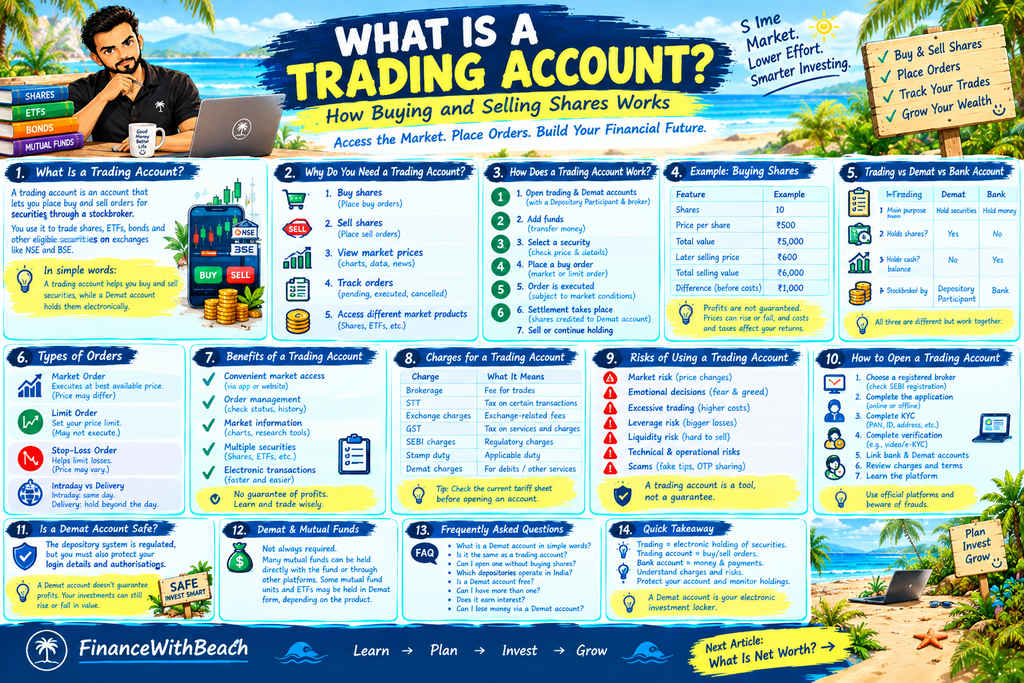
Table of Contents

Why Do You Need a Trading Account?

If you want to buy and sell excahnge-listed shares through a stockbroker, you generally need a trading account.

Here are comes of its main purposes.

1. Buy Shares

You can place orders to purchase shares of eligible companies listed on a supported stock exchange.

2. Sell Shares

You can place orders to sell securities you own, Subject to the relevent trading, holding and settlement reqirements.

3. View Market Prices

Most trading platform provide market-price information, charts and other tools. Some information may be delayed or require a paid subscription.

4. Track Orders

You can check whether an ordewre is pending, excecuted, partially executed, rejected or cancelled.

5. Access Different Market Products

Depending on the broker, your eligibility and the applicable rules, a trading account may provide access to porducts such as shares, ETFs and other permitted market instruments.

Important: Not every product is suitable for beginners. Derivates and leveraged trading can create substantial losses and require a separate inderstanding of their risks.

How Does a Trading Account Work?

The process with a simple example.

Let say you want to purchase shares worth ₹5,000.

Step 1: Open the required Accounts

You generally open a trading account with a stockbroker and a demat account with a registed depository participant,. A bank account is used for payments and withdrawals.

Some providers offer linked services to mke the process easier.

Step 2: Add Funds

Transfer money through the supported payment method so you have sufficient fund for your intended purchase and applicable charges.

Step 3: Slect a Security

Search for the company or security you want to trade. Check its name, exchange, price and other relevent information before proceeding.

Step 4: Place a Buy Order

Enter the quantity and select the ordeer type. You May use a market order or a limit order, depending on the available options and your needs.

Step 5: The Order Is Executed

An order is executed only when it can be matched according to market conditions and exchange rules. An order may remain pending,be partially filled or not execute at all.

Step 6: Settlement Takes Place

After the trade is executed, the application settlemen process takes place. For a ref=gular settled purchase, the securities are credited to your demat account according to the relevent settlement rules.

Step 7: Sell or continue Holding

You can continue holding the shares or place a sell order later. Your eventual profit or loss depends on the sale price, purchase price, costs and applicable taxes.

Example: Buying Shares Through a Trading Account

Let’say Want to buy 10 shares of a company.

FeatureExample
Number of shares10
Purchase price per share₹500
Total purchase value₹5,000
Later selling price per share₹600
Total selling value₹6,000
Difference before costs and taxes₹1,000

In this hypothetical example, you buy 10 shares at ₹500 each, giving a purchase value of ₹5,000.

Later, you sell all 10 shares at ₹600 each, giving a selling value of ₹6,000.

Your difference before transaction costs and taxes is ₹1,000.

However, if the selling pice falls to ₹400 per share, your selling value would be ₹4,000, resulting in a ₹1,000 loss or fall, and a profit is never guranteed.

What Is the Difference Between a Trading Account, Demat Account and Bank Account?

These accounts work together but have different purposes.

FeatureTrading AccountDemat AccountBank Account
Main purposePlaces buy and sell ordersHolds eligible securities electronicallyHolds money and processes payments
ExampleOrders 10 sharesRecords the 10 shares after settlementProvides funds for the purchase
Holds shares?No, not as the primary securities-holding accountYes, for eligible securitiesNo
Holds bank deposits?Not like a regular savings accountNoYes
Usually provided byStockbrokerDepository ParticipantBank

A Simple Way to remmeber

  • Bank account: Your money
  • Trading account: Your market orders.
  • Demat account: Your electronic securities.

The accounts may be linked, but they are not interchangeable.

What Are the Main Types od Orders in a Trading Account?

When Placing an order, it is important to understand how to order will be handled.

The exact options available may vary by broker, Market segement and security.

1. Market Order

a market order instructs the broker to buy or sell at the best available price under the applicable market rules.

Example:

A share is currently quoted near ₹500 and you place a market but order.

The execution price may differ from ₹500 because prices can change and the available quantity may be limited.

Main consideration: A market order priorities execution, but it does not guranteed a specfic price.

2. Limit Order

A limit order specifies the maximum pirce you are willing to pay when buying or the minmum price you are willing to accept when selling.

Example:

A share is trading near ₹500, but you set a buy limit of ₹480.

Your order may excute at ₹480 or better if matching market conditions allows it. If the share never reaches a suitable price, your order may remain unexecuted.

Main Consideration: A limit order controls your price limit, but execution is not guranteed.

3. Stop-loss Order

A Stop-loss order is designed to help manage potential losses by triggering an order whena specified trigger condition is reached.

The precise operation depends on the order type and the broker’s supported features.

Example:

A trader holding a share may set a trigger below the purchase price to initiate a sell order if the price falls.

main Consideration: A stop-loss does not guranteed the final selling price. Gaps,volatility,Liquidity and other execution can lead to a different outcome.

4. Day trading and Delivery-Based Trading

Theses terms describe different approaches to tradin rather than just order types.

  • Intraday trading: Position are opened and closed within the same trading day under the relevent rules.
  • Delivery-based trading: Shares are purchased for holding beyond the trading session and are settled into the investor’s Demat account according to applicable procedures.

Intraday trading can involve rapid price movements and may be paticularly risk for inexperienced traders.

What Are the Benefits of a Trading Account?

1. Convenient Market Access

A trading account lets you place orders through a broker’s website, app or supported platfrom.

2. Order Managements

You can view orders and monitors their status without handing physicall papaerworks.

3. Market Information

Depending on the platform, you may have access to cahrts, prices, company information and research tools.

4. Multiple Securities

A broker may support trading in different eligible securities and market segments through the same account.

5. Electronic Transactions

Trading and settement processes are largely electronic, making transaction more convenient than older paper-based methods.

Convenience does not remove market risk. You still need to understand what you are buying or selling.

What are the Charges for a trading Account?

Trading costs vary between broker, products and transaction types.

ChargeWhat It Means
BrokerageThe fee charged by the broker for eligible transactions
Securities Transaction Tax (STT)A tax applicable to specified securities transactions
Exchange transaction chargesCharges associated with exchange transactions
GSTApplicable tax on specified services and charges
SEBI-related chargesApplicable regulatory charges under current rules
Stamp dutyApplicable duty on specified transactions
Demat-related chargesCertain charges may apply when securities are debited or when other depository services are used

Not every charge applies in the same way to every product or tasnaction. The amount can depend on the market segment, transaction value and current rules.

Example: Why Trading Costs Matter

Let’s say a trader makes several small trades and earns ₹500 in gross gains.

If brokerage and other applicable charges total ₹200, the amount remaining before other costs and taxes would be ₹300.

This simplified shows why it is important to consider costs rather than looking only at gross profits.

Check the broker’s current traiff sheet and applicable official rules before trading.

What Are the Risks of Using a Trading Account?

A trading account provides market access, but trading itself involves risks.

1. Market Risk

Prices can fall because of company-specfic developments, economic conditions, interest rates, investor sentiment or other factors.

You may lose some or all of the money invested in a particular security.

2. Emotional Decisions

Fear,greed and the desire to recover losses quickly can lead to impulsive trades.

A written plan and a clear understanding of your risk limits can help you avoid see emotional mistakes.

3. Excessive Trading

Frequent trading can increase costs and encourage unneceassary decisions.

More trades do nto automatically lead to higher profits.

4. Leverage Risk

Some products allows traders to take positions larger than the fund they initally commit.

Leverage can magnify gains, but it can also magnify losses. Certains products may require additonl funds or reults in losses beyond the amount initally expected.

Beginners shoul;d understand these risks fully beofre using leveraged products.

5. liquidity Risk

A security may have limited buyers or sellers. you may be unable to execute an order at your preferred price or at the time you want.

6. techanical and operational Risks

Connectivity problems, Platform disruption, incorrect order details or unauthorised account access can cause difficultes.

Use official platforms, portect your credentials and review ordeer details before submitting them.

7. Misleading Tips and Scams

Be cautions of people promising guaranteed porfits, secret trading strategies or assured terms.

Do not share passwords,PINs, or OTPs with people claiming they can trade on your behalf.

How to Open a Trading Account in India

Opening a trading account is often possible online through an eligible broker.

Step 1: Choose a Registered broker

Check the broker’s registration and available services. Compare the fees, customer support, security features and product offered.

You can use official resoruces from SEBI to learn about regulated market intermediairies.

Step 2: Complete the Application

Enter the required details on the broker’s official website or app.

Step 3: Complete KYC

KYC means Know Your Customer. Dpending on the applicable requirements, you may need PAN, identity and address infromation, bank details and other documentation.

Step 4: Complete Vertification

Follow the provider’s official verfication process. Never share your OTP or password with anyone who contacts you ynexpectedly.

Follow the Broker’s instructions for linking yur bank account and demat account or opening the required services where offered.

Step 6: review the Charges and Agreements

Read the account terms,fee schedule and relevant risk disclosures before accepting them.

Step 7: Learn the Platform Before trading

understand how to search for securities, choose an order types, check order status and review charges.

Ypu do not need to start trading immediately after opeing an account.

trading vs investing: What Is the Difference?

Trading an dinvesting both involve buying and selling financial assets, but they often have different objectives and time horizons.

FeatureTradingInvesting
Typical time horizonMay range from minutes to monthsOften years or longer
Main focusPrice movements and trading opportunitiesLong-term financial goals and asset growth
Activity levelCan involve frequent transactionsMay involve fewer transactions
CostsFrequent trades may increase costsCosts depend on the investments and activity
Main risksMarket movements, timing, costs, and executionMarket movements, business performance, inflation, and other risks

These are general distinction, not strict definitions. Some traders hold positions for months and some investors make changes more frequently.

Neiher approach gurantees a profits. Choose an approach based on your know;edge, goals, time and ability to handle losses.

Common Mistakes Beginners Should Avoid

Mistake 1: trading without understanding the ordwer type

Know the difference between market orders and limit orders before placing a trade.

Mistake 2: Confusing a trading account with a Demat Account

one places orders; the other holds eligible securities electronically.

Mistake 3: Ignoring fees and taxes

Review the total cost of a transaction, not just the share price.

Mistake 4: trading beased on rumours

Check reliable information instead of blindly following social-media tipes or messages from strangers.

Mistake 5: Using borrowed money without understanding the risks

Borrowing to trade can increase financial pressure and magnify losses.

Mistake 6: Expecting quick profits

Markets aare uncertain and repeated can results in losses.

Mistake 7: Sharing account credentials

Keep passwords, PINs and OTPs private and use the broker’s offical security features.

Mistake 8: Starting with complex product too early

Learn the basics of shares,market orders,costs and risk before cosndiering derivatves or leveraged trading.

Is a Trading Account Suitable for Beginners?

A trading account can be useful if you want to access the stock market, but opening one does not mean you must trade frequently.

Beginners should first learn how markets works, understand the difference between trading investing and become familiar with risk and costs.

If your goals is long term wealth building, compare different approaches and avoid assuming that frequent trading is necessary.

The Key lesson: Learn the system before risking your money. A rading account is a tool for placing market orders, not a shortcut to guranteed income.

FAQs

What is trading account in simple words?

A trading account is an account that allows you to place buy and sell orders for securities in the financial markets thorugh a stockbroker.

Is a trading account the same as a Demat account?

No. A trading account is used to place orders, while a Demat account holds eligible securities electronically.

Can I open a trading account without a Demat Account?

Rquirements depend on the product and market segemnt. For regular delvery-based share investing, a Demat account is genrally required. Some trading product may operate under different arranagemnts.

How much money do I need to open a trading account?

The amount depends on the broker’s reuqiremnts and the products you intend to trade. Account opening may be free, but other charges and minmum funding requiremnts may apply.

Does a trading account guaranteed profits?

No. market Prices can move against you, and costs can reduce returns. You can lose money when trading.

Can I use a trading account on my phone?

Many broker provide mobile apps as wells as websites. Download apps on from official sources and secure your account.

What is the difference between trading and investing?

Trading often focuses on shorter-term price movements, while investing commonly focuses on longer-term finacial goals. Bothe involve risk.

Is intraday trading suitable for beginners?

intraday trading can be risky because prices may change quickly and costs can accumulate. Beginners should learn the risks carefully before considering it.

Link this article to:

What Is a Demat Account? — How Investors Hold Shares and Securities Electronically

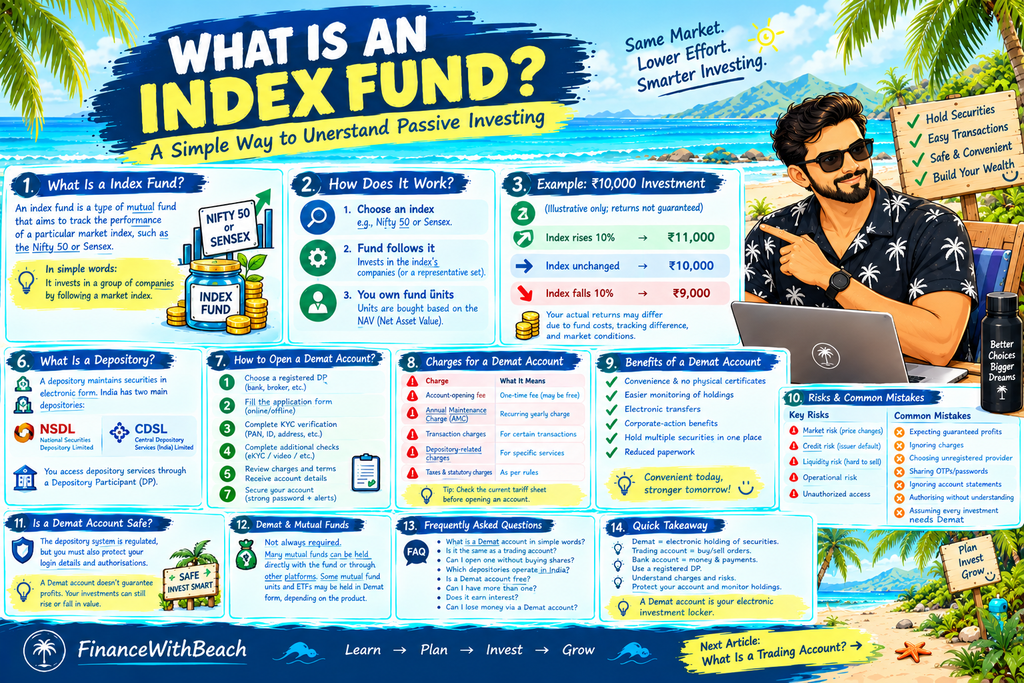
What Is a Demat Account?

A Demat account is an account used to hold financial securities in electronic form. The word Dmat comes from dematerialisation, which means converting physical securities into electronic records.

In India, investors commonly use demat accounts to hold shares,exchanges-traded fund (ETFs), bonds and other eligible securities electronically.

Think of a demat account as digital locker for your investments. Instead of keeping physical share certificates, your securities are recorded electronically through India’s depository system.

Example:

Let’s suppose you buy 10 shares of a company through a stockbroker. Once the transaction is completed and settled the shares are credited to your Demat account according to the settlement porcess.

You can then view your holding thorugh the services provided by your Depository Participart(DP).

In Simple Words:

A demat account holds your investments electronically, while a trading account helps you buy and sell securitites in the market.

According to SEBI Investor, Investor generally need a Demat account , a trading account and a bank account to participate in securities-market transactions.

Table of Contents

Why Do You Need a Demat Account?

When securities were hed as physical certificates, Investors had to manage paperwork and deal with risks such as loss, theft, damage and forgery.

electronic Holding makes many investment-related processes easier.

Here are some important reasons Demat accounts are useful.

1. Hold Shares Electronically

A Demat account records eligible shares in electonic form, eliminating the need to store physical share certficates for those holdings.

2. Hold Differeent Types of Securities

Dpending on eligibility and the services offered, a Dmeat account can hold various securities, including shares, ETFs, Bonds and certains mutual fund units.

3. Make Transfer Easier

Eligible securities can be transfered electronically under the applicable procedures, reducing the need for physical paperwork.

4. Receive Corporate Benefits

Eligible corporate actions, such as bonus shares and stock splits can be reflected in your demat Holdings Through the relevent processes.

Dividends are generally paid through the applicable payment arrangements rather than stored as securities in the Demat account.

5. View Your Investment Holdings

You can check your holding and trasnaction records thorugh the services offered by your Depositiory participant or depository.

6. Reduce Physical-Cerificate Risks

Electronic records reduce the risks associated with lost, gamaged or forged physical certificates.

However, you still need to protect your account credentials and authorisations.

How Does a Demat Account Work?

Let’s Understand the process using a simple example.

You want to purchase shares worth ₹5,000.

Step 1: Open the required Accounts

You open a demat account with a registered depository Participart and a trading account with an eligible stockbroker. Your bank account is used to make or receive payments.

Some providers offer linked account-opening services, but the accounts perform different functions.

Step 2: Add Money to your Trading Account

You transfer money thorugh the supported banking method to fund your purchase.

Step 3: Place a Buy Order

You are the trading platform to place an order for the shares you want to buy.

The order is subject to market availability, execution and settlement rules.

Step 4: The Trade Is Settled

After the trade is executed, the relvent settlement process takes place.

Once settlement is completed, the purchased securities are credited to your demat account, subject to the applicable rules and timelines.

Step 5: View Your Holdings

You can check the shares held in your account through your broker’s platform or the services offered by your Depository Participant.

Step 6: Sell When You Choose

if you to sell the shares later, you place a sell order through your trading account. The securities are transfered through the applicable settlement process and the sale proceeds are credited according to the broker’s and market’s procedures.

What Is the Difference Between a Demat Account Trading Account and bank Account?

These three accounts serve different purposes.

FeatureDemat AccountTrading AccountBank Account
Main purposeHolds eligible securities electronicallyPlaces buy and sell ordersHolds money and processes payments
What it handlesShares, ETFs, bonds, and other eligible securitiesMarket transactionsMoney deposits, withdrawals, and transfers
Used to buy shares?Holds the shares after settlementUsed to place the orderProvides or receives money
Holds cash like a bank deposit?No, not like a bank accountUsually handles trading-related balances through the broker’s arrangementsYes
Opened withA Depository ParticipantA stockbrokerA bank
ExampleRecords 10 shares you ownPlaces an order to buy 10 sharesProvides funds to pay for the purchase

What Can You Hold in a Demat Account?

The eligible securites depend on the account and the applicable rules.

Common example includes:

1. Shares

Shares represent ownership in a company. If you buy shares and the transaction settles, eligible shares are recorded in your Demat account.

2. Exchanged-Traded Funds(ETFs)

ETFs are investment funds whose units trade on stocks excahnges. Eligible ETF units can be held electronically in a Dmeat account.

3. Bonds and Debentures

Certains bonds and debentures can be held in electronic form. Their interest payments, maturity and risks depend on the specific security.

4. Certain Mutual Fund Units

Eligible mutual fund units may be held in Demat form when the relevent facility and arrangements are available. Many invstors also hold mutual fund units directly with the mutual fund or thorugh other permitted arrangements.

5. Other Eligible Securities

Additional securities may be held depending on thr product, the depository system and the account’s facilities.

Remember: A Demat acount is way to hold eligible investments electronically. it is not itself an investment product and opening one does not require you to [urchase securities immediately.

What Is a Depository?

A depository is an institution that maintains securities in electronic from and supports their transfer through the securities-market system.

India has two main securities depositories:

  • Nationl Securities Depository Limited (NSDL)
  • Central Depository Services (India) Limited (CDSL)

Both operate within India’s securities-market regulatory framework.

A depository maintains the electronic records of securities, while invstors generally access depository services through a Depository Participant.

What Is Depository Participant(DP)?

A Depository Participant (DP) acts as the link between an investor and a depository.

A DP may be a bank, broker, financial institution, or another eligible entity registered to provide depository services.

You generally open a Demat account through a DP rather than opening it directly with NDSL or CDSL.

The DP may help you with:

  • Opening and maintaining your demat account.
  • Comparing the required vertifcation process.
  • Providing statements of holdings and transactions.
  • Processing eligible transfer and other instructions.
  • Providing services related to securities pleding and other permitted activities.

Before choosing a DP, verify its registration and review its charges, customer support, security features and available services.

How to Open a Demat Accounts in India?

Opening a Demat Account can often be completed online, although the exact process depends on the providers.

Step 1: Choose a Registered Depository Participant

Compare eligible providers, including banks, brokers and other registered participant.

checking their services, charges, security features and account conditions.

Step 2: Complete the application

Fill in the required details through the provider’s official website or app.

Step 3: Complete KYC Vertification

KYC means Know Your Customer. You may need to provide isentity, address, PAN,bank and other information as reuired under current rules.

The exact documents and vertification steps depends in your circumstances and the provider.

Step 4: Complete Any Required Vertification

The provider may require electronic verifcation, a video-based vertification step or other checks.

Follow the official instruction and do not share your passowrds or one-time passwords with anyone claiming to help you.

Step 5: Review the charges and terms

Read the account-opening documents and the sechdule of charges before accepting them.

Step 6: Receive Your Acccount Details

After the application is approved, the provider will give you your account details and access instructions.

Step 7: Secure Your Account

Use Strong, unique password, enable available security features and monitors transaction alerts and statements.

What Are the Charges for a Demat Account?

Demat accounts may involve different charges depending on the provider, servicees used and account type.

ChargeWhat It Means
Account-opening feeA fee that may be charged to open the account
Annual Maintenance Charge (AMC)A recurring charge for maintaining the account
Transaction chargesFees that may apply to certain debit or other transactions
Depository-related chargesCharges associated with certain services or instructions
Taxes and statutory chargesApplicable taxes or other charges under current rules

Some provider advertise zero account-opening fees or reduced maintenance charges. However that does not mean every service is free.

Always read the current traiff sheet before opening an account.

What Is a Basic Services Demat Account (BSDA)?

Basic Services Demat Account (BSDA) is a category of demat account intended to make securities holding more accessible to eligible indvidual investors, with specfiied service and charge conditions.

Eligibility and applicable maintenance charges depend on current SEBI rules and value and types of securites Held.

If you are a beginner with relatively small holdings, check whether you qualify for a BSDA and compare its condtitons with a regular Demat account.

What Are the Benefits of a Demat Account?

1. Convenience

You can hold eligible securities electronically without managing physical certificates.

2. Easier Monitoring

You can review your holding and transaction records using the services provided by your DP or depository.

3. Electronic Transfers

Eligible securities can be transfered electronically through the relevent procedures.

4. Corporate-Action Processing

Eligible Bonus shares, stock splits and other coprate actions can be reflected in your holdingd thorugh the applicable processes.

5. Muiltiple Securities in one Place

Depending on eligibility, you may be able to hold different types of securities in a single account.

6. Reduced paperwork

Electronic holding reduces many of the administrative tasks associated with physical certficates.

However, convenience does not remove investment risk. The value of your haolding can still rise or fall.

What Are the Risks and Common Mistakes?

A Demat account is an account Facility, not a guaranteed of investment safety or returns.

Beginners should avoid these common mistakes.

Mistake 1: Believing a Demat Account guranteed Profits

Your returns depends on the investments you choice. You can lose money if the maket value of your holding declines.

Mistake 2:Ignoring account charges

Small recurring or transaction-related charges may affect your overall. review the traiff sheetcarefully.

Mistake 3: Choosing an Unregistered provider

Open accounts through appropriately registered and authorised entities. Verify the provider’s registration using official sources.

Mistake 4: Sharing OTPs and Passwords

Never discloses your password, PIN or one-time password to strangers or people prmising guaranteed returns or trading profits.

Mistake 5: ignoring account statements

review your holding and transaction records regualry. report unauthorised transaction or disrepancies promptly.

Mistake 6: Authorising transactions without understanding them

Read the instruction carefully before authorising transfers, Pledges or other actons involving your securities.

Mistake 7: Assuming every investment must be held in demat form

Different investment products have different holding arranagements.Check the available options for each product.

Mistake 8: Forgetting account administration

Keep your contact information and KYC details updated, review nominee arrangements where applicable and follo current account requirements.

Is a Demat Account Safe?

A demat account provides electronic record-keeping for eligible securities and India’s depository system operates within a regulatory framework.

However, there are two separate issues to undeerstand:

  • Account security: Porctecting your login credentials transaction authorisation and personal information.
  • Investment risk: Understanding that the market value of shares, bond ETF and other investments can fluctuate.

A secure account does not make a risky investment safe.

Use official apps and website, enable available security features, check alerts and contact your provider promplty if you notice an unfamiliar transaction.

Do you Need a Demat Account to Invest in Mutual Funds?

Not Always.

Many mutual fund investors hold units directly with the mutual fund or through permitted investment platforms without using a Demat account.

However, certain mutual fund units may be held in Demat form and ETFs generally trade on stock exchanges and are held electronically through a Demat Account.

The appropriate arranagements depends on the investment product and how you choose to hold it.

FAQs

What is Demat account in simple account?

A demat account holds your investments electronically, while a trading account helps you buy and sell securitites in the market.

Is a Demat account the same as a trading account?

No. A demat account holds securities electroniclly, while a trading account is used to place buy and sell orders in the market.

Can I open a Demat account without buying Shares?

Yes. Opening a Demat account does not automatically require you to buy shares. you can open the account and decide whether and when to invest, subject to the provider’s terms.

Is a Demat account free?

Some providers offer free account opening, but maintebnance or transaction-related charges may apply. Check the current fee schdule before opening an account.

Can I have more than one dmat account?

Investors may have mulitple Demat accounts, subject to applicable rules amd prviders requirements. Cosnider the additional administration and potential charges before opening mulitple accounts.

Which Companies operate India’s main Depositories?

India’s two main securities depositories are NDSL and CDSL. Investors generally access their services through registered Depository Participant.

What documents are required to open a Demat account in India?

Requirements depend on current rules and your circumstances. Common reuirements may include PAN, Identity and address infrmation, bank details and KYC verfications.

Link this article to:

What Is an ETF? — How Exchange-Traded Funds Work

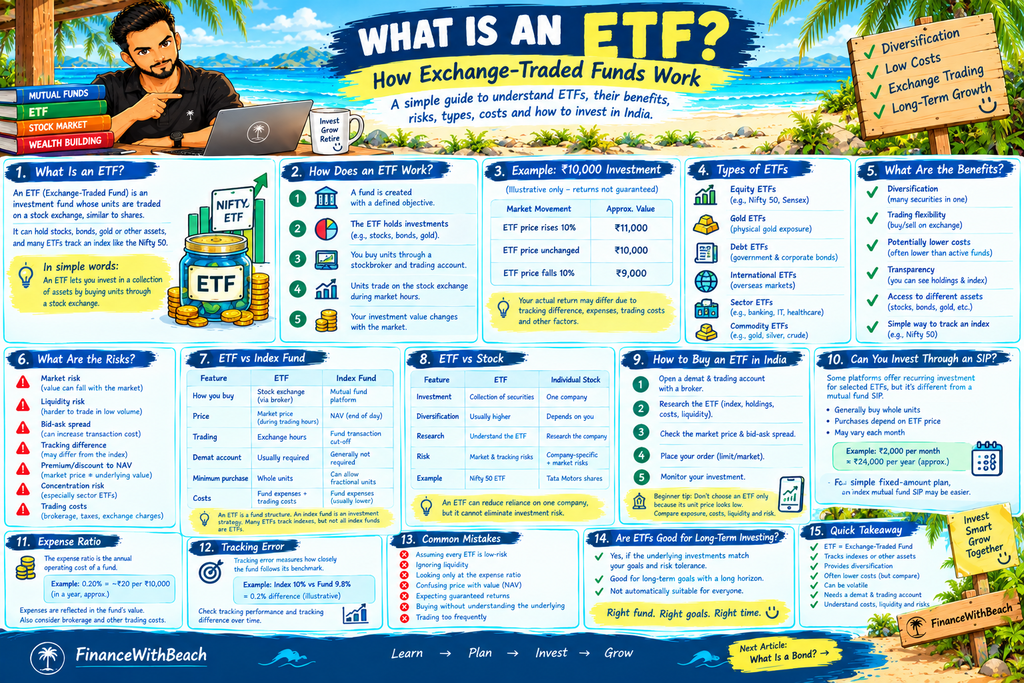
What Is an ETF?

An ETF (Exhange-Traded Fund) is an investment fund whose units are traded on a stock exhange, similar to how shares of a company are bought and sold.

An ETF can hold a collection of investments, such as stocks, bonds or gold-related assets, depending on its investment objective. Many ETFs are designed to track an index, such as the nifty 50 or Sensex.

Example:

A nifty 50 ETF aims to track the performance of the Nifty 50 index by investing in securites that represent the index.

In Simple Words:

An ETF allows you to invest in a collection of assets by buying units of a fund thorugh a stock exchange.

Unlike a typical index mutual fund, an ETF’s market price changes throughout the trading day as buyers and sellers trade its units. It price may be Slightly different from the value of its underlying assets.

Table of Contents

How Does an ETF Work?

Let’s ynderstand how an ETF works step by step.

Step 1: A fund is created

A fund provider creates an ETF with a defined investment objective . For example, it may aim to track a stock market index or provide exposure to gold.

Step 2: The ETF holds investments

Dpending on its objective, the ETF holds a collection of securties or other eligible assets.

Example:

A Nifty 50 ETF aims to mirror the composition of the Nifty 50 Index.

Step 3: Investors buy ETF units

A retail Investors generally buy and sell ETF units through a stocknroker using a trading account. A demat account is used to hold the units electonically.

Step 4: The ETF trades on the stock exchange

ETF units can be bought or sold during exchange trading hours. Their market prices change according to supply an demand and the value of the underlying assets.

Step 5: Your Investment value changes

I fth ETFs market price rises, the value of your holding may increase. If its price falls, your holding may lose value.

Important: ETFs do not guranteed profits. Your returnss depend on the ETF’s onvestment, expneses, Trading price, and other relevent factors.

Example: Investing ₹10,000 in an ETF

Lety’s say you buy ETf units worth ₹10,000. Imagine the ETFs’s market price changes by 10%.

Hypothetical price movementApproximate investment value
ETF price rises 10%₹11,000
ETF price remains unchanged₹10,000
ETF price falls 10%₹9,000

These figures are simplied inllustrations before brokerage, applicable Taxes, other charges and any difference between the ETF’s market price and the value of its underlying assets.

Your actual return may differ from the return of the index or asset the ETF tracks.

What Are the Different Types of ETFs?

ETFs can provide exposure to different markets and asset classes.

1. Equity ETFs

Example:

A Nifty 50 ETF aims to track the nifty 50 inde, providing exposure to a group of major Indian companies through one investment.

Main Risk: The ETF can lose value when the stock market declines.

2. Gold ETFs

Gold ETFs aim to provide exposure to Gold prices thorugh a fund structure.

They can be an alternative to holding physical gold, although they involve fund expenses and market-related risks.

Main risk: The value of your investment can fall if gold prices decline.

3. Debt ETFs

Debt ETFs invest in fixed-income securties, such as government securities or other bonds, accroding to their investment objectives.

Main risk: Their prices can be affected by Interest-rate changes, credit risk and other market conditions.

4. International ETFs

International ETFs provide exposure to overseas markets or securities.

Example:

An ETf may aim to track an index representing companies in another country.

Main risk: Your investment may be affected by overseas market movements, currency fluctuatiopn and other international risks. Avilability and access can vary.

5. Sector ETFs

Sector ETFs focus on a particular industry, such as banking, information technology or healthcare.

They may offer targeted exposure, but concentrating on one setor can increase risk.

6. Commodity ETFs

Commodity-related ETFs aim to provide exposure to paticular commoditites or commodity-related investment, depending on their structure.

Investors should understand exactly what the fund holds and how it racks the relevent commodity.

Remember: An ETF’s name alone does not tell you everything about its risk. Always review its investment objective, underlying holdings and scheme documents.

What Are the Benefits of ETFs?

ETFs can offer several advantages, depending on the types of fund.

1. Diversification

An Etf holding multiple securities can give exposure to several companies or investments through a single purchase.

However, diversification does not eliminate market risk and sector-soecfic ETFs be concentrated.

2. Trading Flexibility

ETF units generally be brought and sold during stock exchange trading hours, unlike ordinary mutual fund transactions that use the applicable NAV-based proces.

This gives investors more control over the timing and price of their trades.

3. Potentially lower expenses

Many ETFs have relatively low fund-management costs, particularly those that track broad indexes.How ever, expenses ratios differ and brokerage and other trading costs can affect your total cost.

4. Price visibility

You can see the ETF’s market price during trading hours and place orders thorugh your broker.

The market price may differ from the ETF’s underlying net asset value.

5. Acccess to different assets

Depending on availability, ETFs can help investors access stock indexes, bonds, gold-relate investments and international markets thorugh an exchnage- traded product.

6. Simple Acces to a market Index

Instead of buying every share in an index spearately, youn can purchase units of an ETF that aims to track that Index.

What Are the Risks of ETFs?

ETFs are investment, not guaranteed savings products.

1. Market Risk

If the ETF’s underlying investments decline in vlaue, the ETF’s price can also fall.

Example:

An equity ETF may lose value during a stock market downturn.

2. Liquidity risk

Some ETFs have limited trading actviy. You may find it harder to buy or sell at your preferred price, especially when trading volumes are low.

3. Bid-ask spread

The Bid price is what buyers are willing to pay, while the ask price is what sellers are asking.

The difference between themis called the bid-ask spread. A wider spread can increase the cost increase the cost of buying or selling an ETF.

4. Tracking difference

An ETF designed to track an index may not deliver exactly the same return as that index. Expenses, trading costs, cash holdings and other factors can cause differences.

5. Premium or discount to NAV

An ETF’s market price can be higher or lower than its net asset value per unit.

This means you should not assume the market price always exactly equals the value of the ETF’s underlying assets.

6. Concentration risk

An ETF focused on one sector or a narrow group of investments may be more edxposed to particular risks than a broad- market ETF.

7. Trading costs

Brokerage, applicable taxes, exhange-relate charges and pther costs may apply. These costs depend on the broker, transaction and current rules.

Beofre investing investing, understand the ETF’s structure, trading liquidity, underlying investments and total costs.

What Is the Difference Between an ETF and an Index Fund?

An ETF and an index fund are related concepts, but they are not identical.

An index fund follows a partcular index as its investment strategy. An ETF is a fund structure that trades on a stock exchange.

Many ETFs track indexes and some index mutual funds track those same indexes without trading on the exchange like shares.

FeatureETFIndex Mutual Fund
How you buyThrough a stock exchange and brokerThrough the mutual fund’s transaction process
PriceMarket price changes during trading hoursTransaction price based on the applicable NAV
TradingDuring exchange trading hoursAccording to mutual fund transaction rules
Demat accountGenerally required for ordinary exchange-traded purchasesGenerally not required for direct mutual fund transactions
CostsFund expenses plus applicable trading costsFund expenses and any applicable transaction costs
Minimum purchaseUsually whole units on the exchangeMay allow fractional units based on the amount invested and scheme rules
LiquidityDepends on exchange trading activity and market conditionsDepends on the fund’s redemption terms

Niether option is automatically better. Your choice dpends on how you prefer to invest, the costs involved and the partcular fund.

What Is the Difference Between an ETF and a STock?

A stock represents ownershi in an individual company. An ETF represents units in a fund that holds investments according to its stated objectives.

FeatureETFIndividual Stock
What you ownUnits of an investment fundShares of a company
Underlying exposureMay include many securities or assetsOne company
DiversificationCan provide diversification through one purchaseDepends on your other investments
Main risksFund, market, tracking, and liquidity risksCompany-specific and market risks
ExampleNifty 50 ETFShares of one listed company

An ETF may reduce reliance on the performance of a single company, but it cannot eliminate the risk of losing money.

How Do You Buy an ETF in India?

For a ordinary retail investor, buying and ETF typically involves a demat account and trading account.

Here are the basic steps.

Step 1: Open an account with a broker

Choose a registered stockbroder and complete the rquired account-opening and identity- vertification process.

step 2: Research the ETF

Understand what the ETF tracks, What it holds, it risk level, expenses ratio and trading actvity.

Step 3: Check the market price

Look at the current bid and ask prices, trading volumes and the difference between the market price and NAV wehere relvent.

Step 4: Place your order

use your broker’s platformto place an order for the number of units you want to buy.

A limit order can help you specify the maximum price you are willing to pay, athough execution is not guaranteed.

Step 5: Monitor your Investment

Review the ETF’s peerformance, costs and continued uitability for your financial goals.

Beginner Tip: Avoid choosing an ETF only because it unit price looks low. COmpare its underlying exposure, costs, Liquidity and risks instead.

Can You Invest in ETFs Through an SIP?

Some brokers and investment platforms offer recurring investment facilities for slected ETFs. However, this process may differ from a mutual fund SIP.

with an ETF, units are generally purchased on the stock exchange at market prices and purchases usually involve whole units. The amount invested each time can thereforevary depending on the ETF’s’s price and the platform’s features.

Example:

Let’s say you plan to invest approximately ₹2,000 every month in an ETF.

  • Monethy target: ₹2,000
  • Number of purchases: 12 per year
  • Approximate yearly contribution: ₹24,000

This represents the amount you plan to contribute, not a guranteed future value. Actual purchases depend on the ETF price, available units and applicable costs.

If you prefer an automatic fixed-amount monthy investment, an index Mutual fund with a regular SIP facility may be simpler to operate.

What Is the Expense Ratio of an ETF?

The Expense ratio is the annual operating expense of a fund expressed as perecntage of its assets.

Let say An ETF has an expense ratio of 0.20%.

At that rate, the annual fund expense is equivalent to approximately ₹20 per ₹10,000 invested, based on tht percentage.

This is an Illustration, not a separate bill for exactly ₹20. Fund expesnes are reflected in the fund’s value over time and your actual cost depends on the fund and the amount invested.

Remember that the expense ratioo is not necessarily your only cost. Brokerage and other applicable transaction charges can also affect your net return.

How Should Beginners Choose an ETF?

Before buying an ETF, consider these points.

  1. Understand the underlying asset: know whether the ETF track an Equity index, bnds, gold or another investment.
  2. CHeck rhe Investment objectives: Make sure the ETF’s strategy matches yopur goals.
  3. Compare expense ratios: Lower costs can help, but they should not be your only slection criterion.
  4. Review liquidity: Look at Trading volume and the bid-ask spread.
  5. Check tracking peeformance : for Index ETFs, compare how closely the ETF follows its benckmarks.
  6. Understand all costs: Consider brokerage, applicable taxes, and other charges.
  7. Read the scheme documents: Review the holding, risks and investm,ent terms.
  8. Consider your time horizons: Don’t invest money needed for essential expesnses or near-term goals in a product whose value may fluactuate signifantoly.

Common Beginner Mistakes to Avoid

Mistake 1: Assuming every ETF is low-risk

An ETF that tracks a volatile market or focuses on one sector can carry subsantial risk.

Mistake 2: Ignoring Liquidity

An ETF with low trading actvity may have a wider bid-ask spread.

Mistake 3: Looking only at the expense ratio

Trading costs and tracking performance also matter.

Mistake 4: Confusing an ETF’s price with its value

The market price can differ from NAV.

Mistake 5: Expecting guaranteed returns

ETf prices can rise or fall and losses are possible.

Mistake 6: Buying without understanding the underlying investment

Always fiund out what you are imvesting in beofre placing an order.

Mistake 7: Trading too frequently

Frequent buying and selling cn increase costs and encourage inpulsive decision. Make investment decisions based on your plan rather than every shor-term market movement.

Are ETFs Good for Long-Term Investing?

ETFs can be useful for long-term investing when their underlying investments match your goals and risk tolerence.

Example:

A brad- market equity ETF may offer diversified expsoure to a stock index. A gold ETF, however, provides a different kind od exposure and has different risks.

The right choice depends on the asset class, your financial objectives, your investment horizon and your ability to tolerate losses.

These is no sinle ETF that is Best for everyone.

FAQs

1. What is an ETF in simple words?

An ETf is an investment fund whose units trade on a stock exchange. It may hold a collection od shares, bonds or other assets.

2. What Does ETf stand for?

ETF stands for exhange-Traded Fund.

3. Is an ETF a Mutual Fund?

An ETF is a type of investment fund. In India, ETFs are structured as mutual fund schemes but their units trade on stock exchanges, unlike ordinary open-ended mutual fund transactions.

4. Can I lose money in an ETF?

Yes. If the underlying investments decline in value, the ETF’s price can fall and you may lose some or all of your invested money.

5. Do I neededa Demat account to buy an ETF in India?

For ordinary retail purchases of ETFs on stock exchange, you generally need a demat account and a trading account.

6. Are ETFs Suitable for Beginners?

They can be, provided ou understand the underlying investments, market risks, lquidity and costs. Beginners should research a fund before investing.

7. Do ETFs pay dividends?

Some ETFs may distribute income if thier structure ans scheme terms allow it. Other may retain income or reflect it in the fund’s value. Check he particular ETF’s scheme documents.

8. Are ETFs guaranteed to make money?

No. ETFs returns depend on their underlying investments and market conditions. Returns are not guaranteed.

Link this article to:

What Is an SIP? — Investing a Fixed Amount Regularly

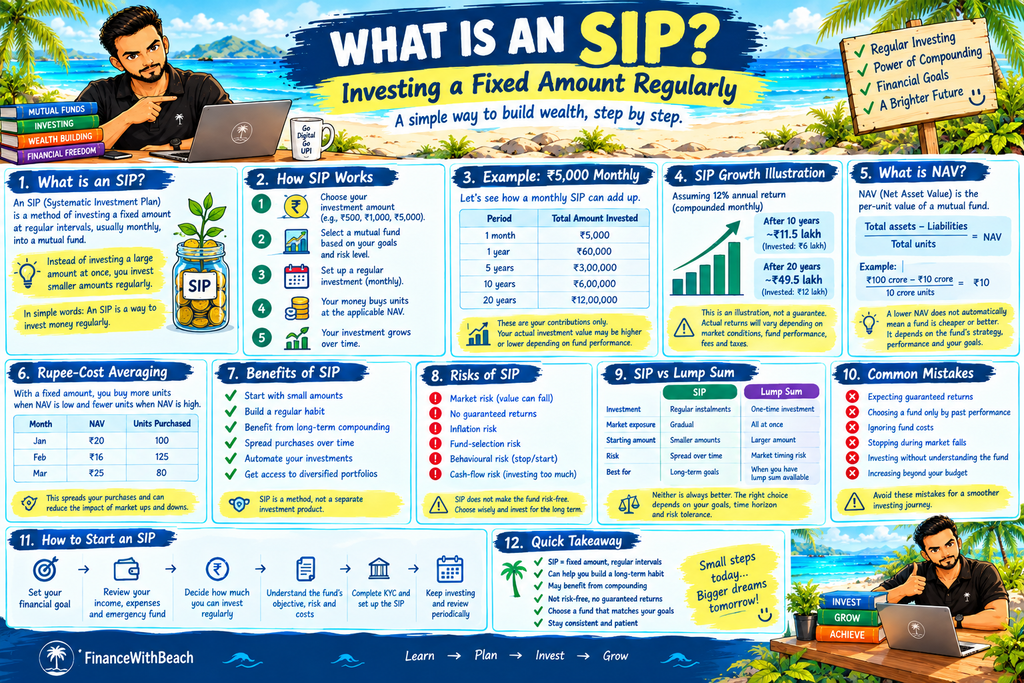
What Is an SIP?

An SIP(Systematic Investment Plan) is method of investing a fixed amount of money at regular intervals, usually monthy, into a mutual fund.

Instead of investing a large amount all at once, you can invest smaller amounts regularly, This makes investing easieer to organise and helps build a consistent investing habits.

Example

Let’s say you decide to invest ₹2,000 every month ina mutual fund.

  • Month 1: ₹2,000
  • Month 2: ₹2,000
  • Month 3: ₹2,000
  • Month 4: ₹2,000

After four months, you would have invested ₹8,000 in total.

Over time, regular investments may help you build wealth, depending on the performance of the mutual fund and the length of time you remain invested.

In simple Words:

An SIP is a way to invest money regularly instead of investing everything at once.

How Does an SIP Work?

An SIP makes investing systematic. You choose an amount, selecta mutual fund and set a regular investment schedule.

Step 1: Decide your investment amount

Choose an amount that fits your income nd expenses, suchs, ₹500,₹1000 or ₹1,500 per month, subject to the fund’s minimum.

Step 2: Select a mutual fund

Choose a fund based on your financial goals, time horizons, risk tolerence and the fund’s investment strategy.

Step 3: Invest regularly

Your SIP is scheduled at your chosen frequency. Monthy SIPs are common and payment arrangements depend on the platform and fund.

step 4: Continue and review

Your money buys mutual fund units at the applicable NAV. Review your investment periodically to check that it still suits your goals.

Example: Investing ₹5,000 Every Month

Let’s understnad how regulaar investing works with a simple example.

You invest ₹5000 every month.

PeriodTotal amount invested
1 month₹5,000
1 year₹60,000
5 years₹3,00,000
10 years₹6,00,000
20 years₹12,00,000

These figures show your contributions only. Your actual investment value may be higher or lower depending on return, fess and taxes.

The important ideas is that investing a managable amount regularly can help you build a long-term investment habits.

What Is Rupee Cost Averaging in an SIP?

One portential bebfits of investing regularly is rupee cost averaging.

When the NAV os lower, your fixed investment amount buys more units.

When the NAV is higher, it buys fewer units.

Example:

Let’s say uou invest ₹2,000 in a mutual fund each month.

MonthNAVUnits purchased
January₹20100
February₹16125
March₹2580
Total—305 units

Your Investment is ₹6,000 and you own 305 units. Your average purchase cost os approximately ₹19.67 per unit.

What Are the Benefits of SIP Investing?

1. Start with mangable amounts

You may be able to start with a relatively small amount, depending on the mutual fund’s minimum investment rules.

2. Build a Regular Habit

A recurring investment can help you make investing part of your monthy financial routine.

3. Benefit from long -term compounding

If your investment earns positive returns and those returns remain invested growth can build over time.

4. Avoid needinmg a large Lump Sum

You don’t have to wait until you have a large amount of moneu before beginning to invest.

5. Spread purchases over time

Regular investing means you buy units at different NAV levels instead of making all your purchases at one point in time.

6. Automate Contributions

Automatic payments can make ir easier to stay consistent, Provided your account has sufficient funds and the payment instruction remains active.

What Are the Risks of SIP Investing?

SIP is only an investment method. It does not make the mutual fund iitself safe.

  • Market Risk: The underlying investment can fall in value.
  • No guaranteed returns: A SIP does not guarantee porfit.
  • Inflation Risk: Your future money may buy less than expected.
  • Fund-slection risk: A poorly suited fund may not matchn your goals or risk tolerance.
  • Behavioural risk: Stopping or changing your plan in reponse to every market movement can disrupt your strategy.
  • Cash-Flow risk: Investing too much may leave you short of money for regular expenses or emergencies.

Before investing, consider your emergency savings, expensive debt, fianncial goals and ability to handle losses.

SIP vs Lump Sum: What Is the Difference?

FeatureSIPLump Sum
Investment methodRegular instalmentsOne larger investment
TimingMoney enters at different timesMost money is invested at once
Starting amountOften more manageableRequires a larger amount
Market exposureBuilds graduallyBegins on the investment date
Return guaranteeNoneNone

Niether approach is alwys better. The choice depends on your available money, investment objective, time horizons and comfort with market fluctuations.

Is an SIP Better Than a Recurruing Deposits(RD)?

An SIP and an RD are different financial Products.

FeatureSIPRecurring Deposit
ProductInvestment method into a mutual fundBank deposit product
ReturnsMarket-linked, depending on the fundInterest rate set under deposit terms
RiskDepends on underlying investmentsDepends on the institution and applicable deposit protection
ValueCan rise or fallPrincipal and interest generally follow the deposit contract, subject to its terms
Suitable forInvestment goals based on risk and time horizonPlanned savings with defined deposit terms

Choose based on the purpose of the money, how soon you need it, and the risks you can accept.

Common SIP Mistakes Beginners Should Avoid

  • Expecting Guaranteed Returns: Mutual Fund investments can lose money.
  • Choosing a fund only because of recent performance: Past Performance does not guranteed future results.
  • Investing before planning essential Expenses: Keep Money available for emergencies and near-term needs
  • Stopping every time the market falls: Reassess your goals and fund rather than reacting automatically.
  • ignoring fund costs: Expenses and taxes can reduce your final outcome.
  • Assuming every SIP is Long-term: Select a fund and time horizon that match the goal.
  • Increasing contribution beyond your budget: A sustainable amount is better than one that creates financial stress.

How Can A Beginner Start an SIP in India?

here is a simple checklist:

  • Set a Clear Financial Goal.
  • review your income, expense,mergency savings and debt.
  • decide how much you can invest regularly
  • Understand the fund’s invetment objective and risk level
  • Review the expense ration and other applicable costs.
  • Complete hthe required account and identity-vertfication porcess through a legitmate investment platform or fund provider.
  • Set the SIP schedule and make sure the money is available.
  • Review your plan periodically rather than judging it by short-term market movements.

Do not select a mutual fund merely because someone promises high returns.

FAQs

1. What does SIP stand For?

SIP stands for Systematic Investment Plan. It is a way to invest a fixed amount regualrly into a mutual fund.

2. Can I start an SIP with ₹500?

Some mutual fund Permit SIPs starting at ₹500 or less, while others require more. Check the minmum amount for the specfic fund.

3. Can I lose money in an SIP?

Yes. If the underlying fund investment fall in value, your SIP investment can also lose value.

4. Is SIP suitable for beginners?

It can be a convenient way to build e regular investment habit, but neginners should first understand the fund, it risks, and their own financial needs.

5. is an SIP suitable Guranteed to make money?

No. Nither SIP investing nor mutual fund returns are guaranteed.

Link this article to:

What Is a Mutual Fund? — A Beginner’s Guide

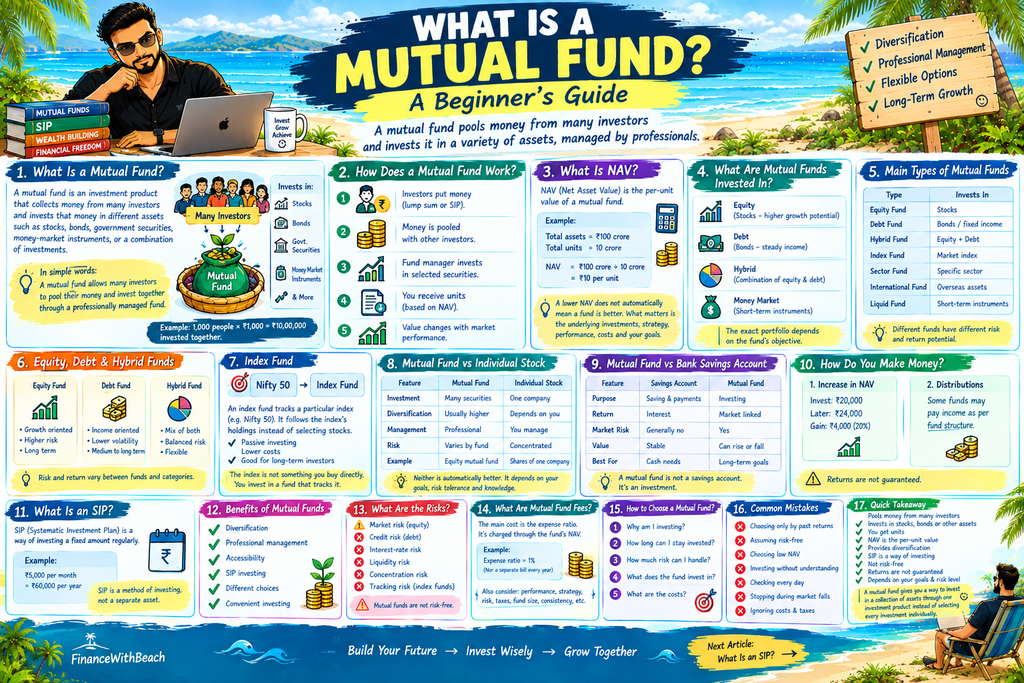
What Is a Mutual Fund?

A mutual fund is aninvestment product that collects money from many invetorsand invests that money in different assets such as stocks, government securities, money-market instruments ora combination of investments.

Instead of choosing and buying every investment yourself, you invest in mutual fund and the fund invests the pooled money according to its stated objective.

Simple Example:

let’s say 1,000 people each invest ₹1,000.

TOgether, they provide:

1,000 x ₹1000 = ₹10,00,000

The mutual fund can then use this ₹10 Lakh to invest across a collection of securities.

So, i simple words:

A mutual fund allows many investors to pool their money and invest together thriugh a professionally managed fund.

Table of Contents

How Does a Mutual Fund Work?

The process is relatively simple.

Step 1: Investors put money into the fund

You invest mony into mutual fund, either as lump sum or thriugh regular investmnet such as an SIP.

Step 2: Money is pooled

Your Money is combined with money from other investors.

Example:

  • Investor A ➔ ₹5,000
  • Investor B ➔ ₹10,000
  • Investor C ➔ ₹25,000
  • Investor D ➔ ₹10,000

together, the fund may have a much larger amount to invest.

Step 3: The Fund invests the money

The fund follows its invetsmnet objective and invests in slected securities.

Example:

An equity mutual fund may invest in shares of mulitple companies.

Step 4: You receive units

When you invest, you receive units of the mutual fund.
The number of units you receive depends on the fund’s NAV, or Net Asset Value.

Step 5: The value of your investment changes

As the value of the underlying investment changes, the value of your mutual fund investment can also increases or decrease.

What Is NAV?

NAV stands for Net Asset value.

It represents the per unit value of a mutual fund.

Example

Let’s say mutual fund has:

  • Total assets after applicable liabilities: ₹100 crore
  • Total units: 10 crore

The NAV would be:

₹100 crore ÷ 10 crore units = ₹10 per unit

If you invest ₹5,000 at an NAV of ₹10:

₹5,000 ÷ ₹10 = 500 units

Your investment value will then change as the NAV changes.

Important point

A lower NAV does not automatically mean that a mutual fund is cheaper or better.

A higher NAV does not automatically mean that a fund is expensive.

What matters is the underlying Investment, fund objective, costs, risk, performance and suitability for your goals.

What Are Mutual Fund Invested In?

Different mutual fund invest in different types of assets.

1. Equity

Equity mutual fund primarily invest in company shares.

They generally have higher growth potential but can also experience significant price fluctations.

2. Debt

Debt funds invest in instruments such as bonds and other fixed-income securities.

Their risk and return potential differ from equity funds.

3. Hybrid

Hybrid funds invest combine different asset classes, such as equity and debt.

The exact portfolio depends on the fund’s stated strategy.

Main types of Mutual Funds

There are many categories of mutual fund.

For a beginner, it is useful to understand the broad groups first.

TypeGenerally invests inBasic idea
Equity FundStocksGrowth-oriented investing
Debt FundBonds/fixed-income securitiesIncome and relatively lower volatility than equity in some categories
Hybrid FundEquity + DebtCombination of asset classes
Index FundMarket indexAttempts to track an index
Sector FundSpecific sectorFocused investment in one sector
International FundOverseas assetsExposure to markets outside India
Liquid/Short-term FundsShort-duration instrumentsDesigned around short-term objectives

The actual risk varies significantly between individual funds and categories.

What Is an Equity Mutual Fund?

An Equity mutual fund invests primarily in stocks.

Example:

A fund might invest in shares of companies from different industries suchs as:

  • Banking
  • Indromation Tachnology
  • HEalthcare
  • COnsumer goods
  • Automobile
  • Energy

Instead of buying shares of only one company, the fund may hold shares of many companies.

This can provide diversification , although diversification does not eliminate investment risk.

What Is a Debt Mutual Fund?

A debt mutual fund invests primarily in fixed-income securities.

Depending on the fund, these may include different types of bonds and other debt instruments.

Example:

A debt fund could invest across securities with different:

  • Issuers
  • Maturities
  • Credit qualities
  • Interest-rate charcheristics

Debt fund are not risk-free, their claue can be affected by factors such as interest rates and credit risk.

What Is a Hybrid Mutual Fund?

A hybrid fund combines different asset classes.

Example:

A hypothetical portfolio could contain:

60% Equity + 40% Debt

The exact allocation depends on the fund.

The purposes of combining assets can be to create a portfolio with a different balance between growth potential and risk.

What Is an Index Mutual Fund?

An index fund is a mutual fund designed to track a [articular market index.

Example:

An index fund may aim to track the nifty 50.

If the index contains companies, the fund attempts to provide returns that broadly follow the performance of that index, after applicable costs and tracking differences.

This is generally calle passive investing because the fund isn’t trying to continously select individual stocks to outperform the index.

Mutual Fund vs Individual Stock

These are are very different.

FeatureMutual FundIndividual Stock
InvestmentCollection of securitiesOne company’s shares
DiversificationUsually higherDepends on your portfolio
ManagementDepends on fund typeYou manage your own investment
RiskDepends on fundCan be concentrated in one company
ExampleEquity mutual fundShares of one company

Simple Example:

Let’s say you have ₹10,000.

You could invest the entire amount in shares of the one company.

Alternatively, you could invest in a diversified mutual fund that holds many companies.

Neither option is automatically better. The right choice depends on the Goals, risk tolerence, knowledge, time horizon an investment strategy.

Mutual Fund vs Bank Saving Accounts

A mjutual fund is not the same as a saving accounts.

FeatureSavings AccountMutual Fund
PurposeSaving and accessing moneyInvesting
ReturnUsually interestDepends on investments
Market riskGenerally not market-linkedCan have market/investment risk
ValueGenerally stableCan rise or fall
Best suited forCash needs and short-term liquidityInvestment goals, depending on fund

You should avoid treating a market-linked mutual fund as if it were cash sitting in a bank accounts.

How Do You MAke Money From a Mutual Fund

Your Investment can potentially grow in two broad ways.

1. Increase in NAV

if the underlying investment increase in value, the fund’s NAV may increase.

Example:

You invest

₹20,000

the investment later becomes:

24,000

Your gain is:

₹4,000

That’s a 20% gain before considering applicable costs, taxes, and other factors.

2. Distrubutions

Some Mutual Fund structures may distibute income to investors under applicable rules.

However, investors should not assume that a distributio is automatically as additional return on top of the fund’s NAV growth.

Always understand the fund’s structure and spplicable taxation before investing.

What Is an SIP in a Mutual Fund?

An SIP(Systematic investment Plan) is a method of investing a fixed amount at regular intervals into a mutual fund.

Example

₹5000 every month

Instead of investing ₹60,000 at once, you invest.

₹5,000 x 12 months = ₹60,000 per year

SIP is simply a way of investing. It is not itself a separate investment asset.

You can learn more about this in the next article in this series:

“What is an SIP? – Investing a Fixed Amount Regularly“

Example: Investing ₹5,000 Per Month

Suppose you Invest:

₹5,000 per month

For one year:

₹5,000 x 12 = ₹60,000

If the mututal fund’s investments perform well, your account value could eventually be more than your total contributions.

But if markets fall , your investment value could temporarily be below the amount you invested.

This is why mutual funds should not be viewed as guaranteed- return products.

Benefits of mutual Funds

Mutual funds can offer several advantages.

1. Diversification

A fund can hold many securitites instead of putting all your money into one investment.

2. Professional management

Many actively managed funds have professional fund managers who make investment decisions according to the fund’s startegy.

3. Accessibility

Mutual Fund allow investors to gain exposure to a portfolio without personally buying every security.

4. SIP investing

Many investors use SIPs to invest regularly.

5. Different Choices

There are mutual fund designed for different investment objectives, asset classes and risk levels.

6. Convenient Investing

Once your account and investment process are set up investing can be relatively straightforword.

What Are the Risks of Mutual Funds?

Mutual FUnd are not Guranteed investments.

SOme Important risks includes:

Market risk

Equity investments can rise and fall with market conditions.

Credit Risk

Debt investments can be affected if an issuer has difficulty meeting its obigations.

Interest-rate risk

Changes in interest rates can affect certain debt investments.

Liquidity risk

Some securities may be harder to buy or sell quickly at an expected price.

Concentration risk

A fund focused heavily on one secot or theme can be more exposed to that area.

Tracking risk

Index funds may not perfectly match their underlying index because of costs and other factors.

How Should a Beginner Choose a Mutual Fund?

Don’t choose a mutual fund simply because it recently produced the highest return.

Instead, start with your Objecive.

Ask yourself:

  1. Why am I investing?

Example:

  • Emergency savings
  • Education
  • Home
  • Retirements
  • Long -term wealth creation

2. How Long can I Stay invested?

Your time horizon matters.

3. How much risk can I handle?

Can you stay invested if your ₹1 lakh investment temporarily falls to ₹80,000?

4. What does the fund actually invest in?

Read the fund’s objective and portfolio.

5. What are the costs?

Cheack the applicable expense ratio and other charges.

Common Beginner Mistakes

Mistake 1: Choosing only by past returns

A fund that performed well recently may not continue doing so.

Mistake 2: assuming mutual funds are risk-free

They are investments and investments can lose value.

Mistake 3: Choosing a FUnd just because its NAV is Low

NAV alone doen’t tell you wheather a fund is attractive.

Mistake 4: Onvesting without understanding the fund

Always jnow what you are buying.

Mistake 5: Checking the investment every day

Long term investing usually requires patience.

Mistake 6: Stopping an investment because of every market fall

MArket movements are normal. Wheather you should continue, reduce or change and investment depends on your plans and circumstances.

Mistakes 7: Ignoring costs and taxes

Your actual results can differ from the headline return because of expenses, taxes and other applicable charges.

Are Mutual Funds Good for Beginners?

Mutual Funds can be useful for beginneers because they provide access to diversified portfolios and different investment startegies.

However, “good” depends on the investors and the fund.

A mutal fund should match your:

  • financial goal
  • Time horizons
  • Risk tolerence
  • Risk capacity
  • Investment knwledge
  • Overall financial plan.

There is no single mutual fund that is best for everyone.

FAQs

Is a mutual fund Safe?

Mutual fund are not risk-free, the level of risk depends on what the fund invest in.

Can I lose money in a mutual fund?

Yes. The value of your investment can fall, especially over shorter periods or during market declines.

What is NAV in a Mutual Fund?

NAV or Net Asset Value, represents the per-unit value of a mutual fund.

Can I invest ₹500 in a mutual fund?

SOme Mutual fund and investment platforms may allow relatively small investments, subject to thier applicable minmum investment requirements.

Is SIP a Mutual Fund?

No. SIP is a Method of investing regularly, while a mutual fund is the investment product.

Are mutual fund returns guaranteed?

No. Mutual fund returns are generally not guaranteed.

Can I withdraw money from a Mutual Fund?

Many mutual fund allow investors to redeem units, but the eaxact rules, processing time, exit loads and restrictions depend on the fund.

What is the difference between an Index fund and a Mutual Fund?

An index fund is types of mutual fund designed to track a particular index. Mutual Fund can also use many other investment startegies.

Link this article to:

What Is an Index? — How Stock Market Indexes Work

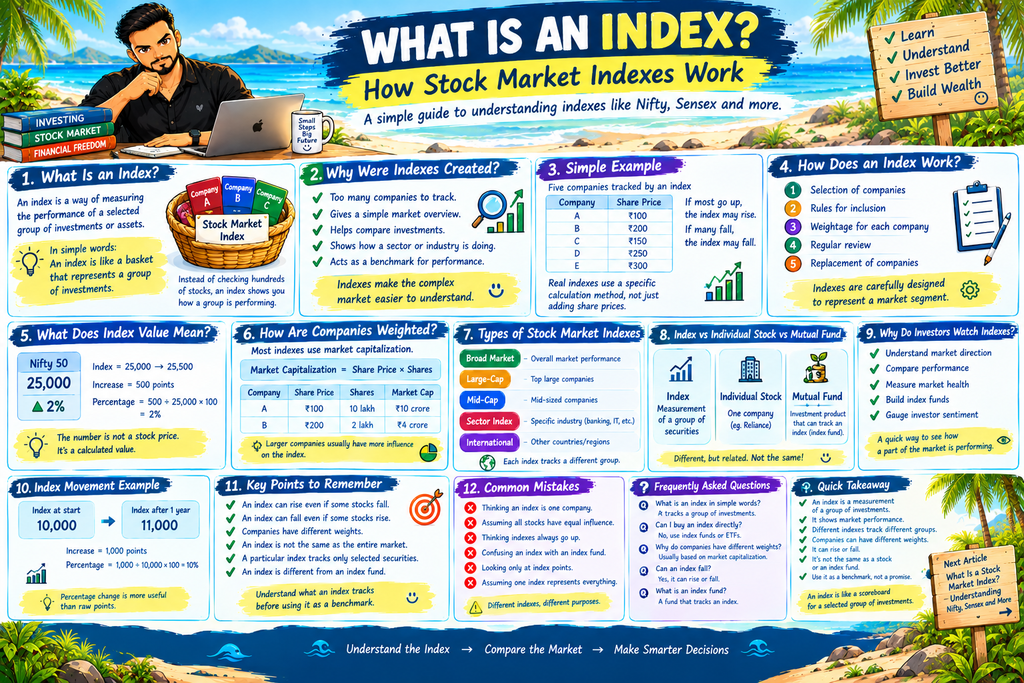
What Is an Index?

An Index is a way of measuring the performance of a selected group of investment or assets.

In the Stock Market, an index tracks a particular group of companies accroding to specfic rules.

Instead of looking at hundreds or thousands of individual stocks one by one, an index gives investors a simpler way to understand how a particular part of the market is performing.

In simple Word:

An index is like a basket that represents a selected group of investments.

Example:

A stock market index may contain shares of several large companies.

If the overall index rises, it generally means the companies represented by that index performed positively as a group, based on the index’s clalculation method.

If the index falls, the opposite is genrally true.

A simple Example

CompanyShare Price
Company A₹100
Company B₹200
Company C₹150
Company D₹250
Company E₹300

Let’s say an imaginary index track these companies.

Instead of checking every company separately, you could look at the index to get a broad idea of how this group is performing.

If most of these companies rise, the index may rise.

If many fall, the index may fall.

Real stck-market indexes are more sophisticated and use specific calculation methods rather than simply adding shares prices.

Why Were Indexes Created?

There are thousands of companies and securities in financial markets.

It would be difficult for investors to track every company individually.

Indexes help simplify the market.

They can help answer qustion such as:

  • How is the overall market peerforming?
  • How are large companies performing?
  • How is a particular sector performing?
  • How has a group of companies performed over time?
  • how does my investment performance compare with the market?

An index provides a refrence point, often called a benckmark.

How Does a Stock Market Index Work?

A stock market index is created using a specfic set of companies and rules.

The index provider determines:

  1. Which comapnies are included
  2. Hoe companies are selected
  3. How much weight each company recieves
  4. When the index is reviewed
  5. What happens when companies no longer meet the rules

Example:

An index may be designed to represent large companies in a particular country.

The companies included can change ove time.

What Does Index Value Mean?

You may see an index quoted as a number.

Example:

Index = 25,000

The number itself is not the price of one stock.

It is claculated value representing the performance of the index according to its methodology.

If the index moves from:

25,000 ➔ =25,500

that represents a 2% increase.

Calculation:

(25,500 – 25,000) ÷ 25,000 x 100 = 2%

So the index increased by 2% during that period.

How Are Companies Weighted in an Index?

Not every company necessarily has the same influence on an index.

Many major indexes use market capitalization-based weighting or variations of it.

What Is Market Capitalization?

Market capitalization is broadly calculated as:

Market capitalization = share price x Number of Oustanding Shares

Example:

Company A:

  • Share price = ₹100
  • Shares oustanding = 10 lakh

Market Capitalization:

₹100 x 10,00,000 = ₹10 crore

ompany B:

  • Share price = ₹100
  • Shares oustanding = 10 lakh

Market Capitalization:

₹200 x 2,00,000 = ₹4 crore

Company A would have a larger market capitalization in this example.

In a market-cap-weighted index, larger companies generally have a greater influence on the index.

Why Does Weighting Matter?

Let’s say an index contains 10 companies.

If each company has exactly the same weight, a 10% rise in one company would have a different effect than if that company represented a very large portion of the index.

this why you cannot simply look at how many companies went up or down.

The size and weighting of each company matter.

What Is A Benchmark?

A Benckmark is a standard used to compare performance.

Example:

You invest in a diversiified equity portfolio.

After one year:

Your portfolio return = 12%

The relvent market benckmark returned:

10%

Your portfolio earned a higher return than that benckmark during the period.

This doesn’t autmatically mean your investment strategy is better, because you also need to consider risk, costs, taxes and whether the benckmark is actually appropriate for comparison.

Index vs individual Stock

These are very different.

Individual Stock

Represents ownership in one company.

Example:

You buy shares of company A.

Your investment is directly affected by company A’s performance and other factorss affecting its stock.

Index

Represents a selected group of securities.

Example:

An index tracks multiple companies.

The index’s movement reflects the combined performance of those securiites according oot its methodology.

Index vs Mutual Fund

An Index and mutual fund are not the same thing.

Index

A measurement or calculatio that tracks a groups of securities.

Mutual Fund

An investment product that pools investors’ money and invests according to its stated strategy.

Example:

An Index mutual fund may try to track a particular market index.

The index itself isn’t something you buy directly in the same way you buy a stock or mutual fund.

What Is an Index Fund?

An index fund is an investment fund designed to track the performance of a particular index.

Example:

An index fund may aim to track a broad stock market index.

Instead od a fund manager trying to select individual stocks to outperform the market, the fund henerally attempts to replicate the index’s holding and performance as closely as parctical, after costs.

This is commonly associated with passive investing.

We’ll discuss index funds in more detail later in the Fiancewithbeach series.

Different Types of Stock MArket Indexes

Idnexes can be designed for different purposes.

1. Borad Market Index

Tracks a broad section of the stock market.

It can provide a general picture of market performance.

2. Large-Cap Index

taks relatively large companies according to the index’s rules.

3. Mid-Cap Index

Tracks companies that falls into the relvent mid-cap segment according to the index methodology.

4. Sector Index

Tracks companies from a particular industry.

Example:

  • Banking
  • Infirmation technology
  • Health care’Energy

5. International Index

Tracks companies from a particular country,region or international market.

Why Do Investors Watch Indexes?

Indexes can be useful for several reasons.

1. Understanding Market Direction

Idnexes can provides a quick indication of how a particular market segment is performing.

2. Comparing Investments

Investors can compare portfolio performance gainst an appropriate benchmark.

3. Measuring Market Performance

Indexes provide a standardized way to track market movements over time.

4. Building Index Funds

Many Investment products are designed to track indexes.

5. Understanding Economic Sentiment

Market Indexes are sometimes used as one indicator of investor sentiment, although they don’ t tell you everything about the economy.

Why an Index Can Rise Even When Some Stocks Fall

This is an important point.

An index can rise even if some of its companies fall.

Example:

  • 6 companis increase
  • 4 companies decrease

The index could still rise.

But even this simple example doen’t tell the full stroy because the companies may have different weights.

If th largest companies rise significantly, they may have a greater impact on the index than smaller companies.

Why an Index Call Fall Even When Many Stocks Rise

The opposite can also happen.

Let’s say sveral smaller companies rise while some of the largest companies fall sharply.

The index could decline because the larger companies have greater weights.

The number of stocks rising or falling isn’t enough to understand an index’s movements.

You also need to consider the index methodology and the weight of its constituents.

What Happens When a Company Leaves an Index?

Indexes are generally reviewed periodically according to their rules.

A company may be removed if it no longer meets the criteria.

Another company may be added.

This helps the index continue to represent the market segment it was designed to track.

Example:

An index designed to represent large companies may replace a company that no longer meets its eligbility requirements.

Are All Indexes the Same?

No. Different indexes can track completely different things.

Example:

  • Index A ➔ Large companies
  • Index B ➔ Banking Companies
  • Index C ➔ Technology Companies
  • Index D ➔ International Companies

When someone says:

The index went up.

You Should Ask:

Which Index?

The performance of one index doesn’t necessarily represent the peformance of the entire investment market.

Important: An Index Is Not the Same as the Entire Market

A particular index represent only the securities included in that index.

Example:

  • Small Companies
  • Certain industries
  • Companies outside it market
  • Bonds
  • GOld
  • Real estate

You should understand what an index actually trcaks before using it as benckmark.

Common Beginner Mistakes

1. thinking an Idnex is One company

An Idnex represents a group of securities, not one company.

2. Assuming Every Stock Has Equal Influences

Many indexes use weighting menthods, so companies can have different levels of influence.

3. Thinking Indexes Always Go Up

Idnexes can fall, sometimes significantly.

4. Assuming One Idnex Represents Everything

Different indexes represent different parts of the market.

5. Confusing an index With an Index Fund

An index measures a group of scurities; an index fund is an investment product designed to track an index.

6. Looking Only at Idnex Points

A move from 10,000 to 11,000 means 10%, while a move from 20,000 to 21,000 means 5%.

Perecntage changes are generally more useful for comparsions than raw points.

FAQs

What is an Index in simple words?

An Index is a way of measuring the performance of a selected group of investment or assets.

What is a Stock market Index?

A stock market index is created using a specfic set of companies and rules.

Why do companies have different weights in an index

Many idnexes use weighting methods suchs as market capitalization, meaning larger companies can have a greater influence on the index.

Can an index fall?

Yes. An index can rise or fall depending on the performance od its constitunets securitites and the index methodology.

What is an Index Fund?

An Index fund is an investment fund designed to track a partiuclar index.

Why are Idnexes important for beginners?

They provides a retatively simple way to udnerstand market performance and compare investments against a benckmark.

Yes. Every investment portfolio can experience losses depending on the invetment it contains and market conditions.

Link this article to:

What Is a Portfolio? — Understanding Your Collection of Investments

What Is a Portfolio?

An investment Portfolio is the collection of investments you own.

These investments can include different types of assets.

Sych as:

  • Stocks
  • Mutual Funds
  • ETFs
  • Bonds
  • Fixed deposits
  • Gold
  • Real Estate
  • Cash or cash equivalent
  • Other investment

In simple Words:

Your investmnet portfolio is everythingyou own as investments, considered together.

Example:

  • ₹50,000 in stocks
  • ₹30,000 in mutual funds
  • ₹20,000 in bonds

Together,these investments make up your investment portfolio 0f ₹1,00,000.

Why Is a Portfolio Important?

Looking at each investment separately can make it difficult stocks and think you are diversified.

A portfolio gives you a bigger picture.

Example:

You may own five different stocks and think you are diversified.

But if all five companies belong to the same industry, your portfolio may still have significant exposure to that industry.

By looking at yourentire portfolio, you can understand:

  • Where your money is invested?
  • How much risk you are taking?
  • whether you are diversifiied?
  • Whether your investment match your goals?
  • How your overall investments are performing?

A simple Portfolio Example

Let say you have ₹2,00,000 to invest.

You decide to divide it among different investments.

InvestmentAmountPercentage
Stocks₹80,00040%
Mutual Funds₹50,00025%
Bonds₹30,00015%
Gold₹20,00010%
Cash/Reserve₹20,00010%
Total₹2,00,000100%

Togeher these investment form your protfolio.

This is only an example, not a recommended investment allocation.

Portfolio vs Individual Investment

These are two terms are different.

Individual Investment

One investment that you own.

Example:

₹20,000 invested in one company’s stock.

Portfolio

Alll the invetsment considered together.

Example

stocks + Mutual fund + Bonds + gold + other investment

An investment is one piece. Your portfolio is the entire collection.

What Can Be Included in a Portfolio?

1. stocks

Stocks represent ownership in companies.

They can provid potwential capital growth and in some cases dividends. However, stocks prices can fluctuate signifantly.

2. Mutual Fund

A mutual Fund Pools money frominvestors and invests according to its stated strategy.

A mutual fund can provide exposure to mutliple securities through one investment product.

Different mutual funds have different objectives and risk levels.

3. ETFs

An Exachanged-traded Fund(ETF) is a fund whose units trade on a stock exchange.

Many ETFs track an index or particular group of assets.

The levels of diversification dpedns on what the ETF Holds.

4. Bonds

A bodn generally represents lending money to an issuer in exchange for interest and repayment according to the bond’s term.

Bond can be issued by governements, companies and other entities.

They also involve risk including interest-rate and credit risk.

5. Fixed Deposits

A fixed deposits or Fd allows you do deposits money with a bank for specfied period under agreed terms.

FDs can be part od somone’s overall financil assets, although whether they belong in an investment portfolio dpends on the person’s financial plan.

6. Gold

Gold can also form part of an investment Porfolio.

Investors may gain exposure ot gold in different ways, including physical gold and financial products linked to gold.

Like othe rinvestment, gold prices can rise and fall.

What Id Portfolio Diversification?

Portfolio diversification means spreading your invetsments across differents assets, companies, industries or market.

Example

Portfolio A

₹1,00,000 ➔ One Stock

This is highy concentrated.

Portfolio B

₹1,00,000 ➔ Mutliple invetsments

This spreads the money across different sources of risk.

As discussed in the pervious article, diversification can help reduce concentration risk, but it cannot eliminate investment risk.

Why Should You Track Your Portfolio?

Creating a protfolio isn’t enough.

You should also understand what you own.

Regularly reviewing your portfolio can help you identify:

  • Investment that have become too large a percentage of your portfolio.
  • Excessive concentration
  • Changes in your financial goals
  • Unnecessary fees
  • Investments that no longer fit your plan
  • Whether your assets allocation has changed siginfantly

This doen’t mean you need to track your investment every day.

For many long term investors, constantly watching daily price movemnts can create unnecessary stress and encourage emotional decisions.

Portfolio Allocation

Portfolio allocation refers to how your money is distributed among different investments or assets classes.

Example:

  • 60% ➔ Equity
  • 20% ➔ Bonds/debts
  • 10% ➔ Gold
  • 10% ➔ Cash or oher assets

This is called an assets allocation.

The appropriate allocation varies from person to person.

Why Does Asset Allocation Matter?

Different investment behave differently.

Example:

Stocks can experience significant price movement,while some lower risk assets may have different return and risk charcteristics.

By combing different asset clsasses, investors can create a protfolio that reflects their objectives and risk tolerence.

Example

Long-Term Growth Investor

May be comfortable with greaterexposure to growth-oriented assets because the investment horizin is longer.

Short-Term Goal

Someone who needs the money soon may have less ability to tolerate large fluctuations.

There is no single portfolio that is right for everyone.

Portfolio and Risk

Your protfolio’s risk isn’t deteremined by just one investment.

It depends on the combination of investment you own.

Let’s Say:

  • Stock A = high Volatility
  • Stock B = high Volatility
  • Stock C = high Volatility
  • Stock D = high Volatility
  • Even though you own four stocks, your portfolio could still be highly exposed to euity-market risk.

Now Let’s say a portfolio containing different types of assets.

The overall a porfolio containing different types of assets.

The overall risk profile may be different.

This is why investors should look at thier porfolio as a whole.

A ₹5 lakh Porfolio Example

An investor ₹5,00,o00 for long term investing.

A hypthetical portfoliomightlook like:

AssetAmountAllocation
Equity investments₹2,50,00050%
Debt/bonds₹1,00,00020%
Gold₹50,00010%
Other investments₹50,00010%
Cash/reserve₹50,00010%
Total₹5,00,000100%

This is only an example, not a recommended personal investment advice.

Portfolio Rebalancning

Over time your portfolio allocation can changes.

Let say you originally have:

60% stocks + 40% bonds

if stocks performs strongly, your portfolio could eventually become

75% stocks + 25% Bonds

Your portfolio is now taking a different level of exposure than you originally planned.

Rebalancing means bringing the portfolio back toward your intended allocation.

The exact approach dpends on the investor’s plan and circumstances.

Portfolio vs Bank Account

A bank account and an investment portfolio are not the same thing.

Bank Account

Primarily used for:

  • Receiving Money
  • Making payments
  • Keeping accessible cash
  • Everyday financial needs

Investment portfolio

Contains investment intended to help meet longer-term financial goals.

A person can have boths.

Example:

Bank account ➔ Emergency savings

Investment Portfolio ➔ Long-Term wealth building

Keeping thes purposes separate can amke fiancial planning easier.

Portfolio and financial Goals

A portfolio should have a purpose

Example:

Goal: Buying a House

You may need money for a future down payments.

Goal: Retirements

you may be investing over sevral decades.

Goal: Education

You may need money at a specfic future date.

Goal: Wealth Building

You may be investing for long term growth.

Your goal influences:

  • How long you can invest?
  • How much risk you can portentially take?
  • How much liquidity you need?
  • Wht types of investment may be appropriate?

Common Portfolio Mistakes

1. Investing Without a Goal

Buying random investment doesn’t automatically create a good portfolio.

2. Too Much Concentration

Putting a very large percentage of your money into one investment can increase concentration risk.

3. Owning Too Many Similar Investments

Five different funds may still hold many of the same companies.

4. Constnly Buying and Selling

freuent decisions can increase costs and make it harder to follow a long term plan.

5. Ignoring Risk

A portfolio should match your abitity and willingness to handle losses.

6. NeverReviewing Your Portfolio

Your goals and financial situation can change over time.

7. Chasing Past Winners

An Investment that performed well in the past isn’t gurnteed to continue doing so.

How Beginners Can Start Understanding Their Portfolio

You don’t need a complicated spreadsheet to begin.

Start with these five questions:

  1. What do I own?

List all your investment

2. How Much is each investment worth?

Claculate the current value.

3. What percentage does each investment represent?

this helps identify concentration.

4. What is th purpose of each Investment?

Connect investments to financial goals.

5. Does the protfolio match my risk level?

make sure your investment are consistent with your ablity o handle losses and your time horizons.

Portfolio Return

You can also calculate how your portfolio has performed.

Let’s say your protfolio was worth:

₹2,00,000

and later becomes:

₹2,20,000

Your gain is:

₹20,000

Simple ROI:

₹20,000 + ₹2,00,000 x 100 = 10%

But remember that protfolio performance can be more complicated when you add or withdraw money during the period.

For a Proper performance analysis, timing of contribution and withdrawals matters.

Portfolio Does Not Mean Guranteed Profit

Having a Diversified portfolio doen’t guranteed that you will make money.

Market can fall.

Individual investments can lose value.

Different asset classes can decline at the same time.

A portfolio is simply a structure for organizing and managing your investments.

The goal is to build a protfolio that is appropriate for your financial objective and risk consideration–not one that guranteed a particular return.

FAQs

What is an invest ment portfolio in simple words?

An investment portfolio is the complete collection of investment you own.

What can a portfolio contain?

It can contain stocks, mutual fund,ETFs, Bonds,Fixed deposists,Gold, cash, real estate and other investment.

Is Portfolio the same as diverification?

No. A portfolio is your collection of investments. Diversification is th process of spreading investments to reduce concentration risk.

Should Beginners have a diversified portfolio?

Diversification can help reduce concentration risk, but the right porfolio dpends on the individual’s circumstances and goals.

Should I check my porfolio every day?

Not necessarily. Daily monitoring can encourage emotional decision, especially forlong term-term investors. Periodic reviews may be more useful.

Can a Portfolio Lose Money?

Yes. Every investment portfolio can experience losses depending on the invetment it contains and market conditions.

Link this article to:

What Is Diversification? — Why You Shouldn’t Put All Your Money in One Place

What Is Diversification?

Diversitfication mean spreading your money across different investment inbsted of putting all your money into one investment.

The basic idea is simple:

Don’t Pull all your eaggs in one baskets.

In investing, this means you don’t necessarily want your entire portfoilio to depend on one company, one asset, one industry or one types of investment.

Example:

Instead of investing ₹1,00,000 ebtirely in one company’s stock, an investor could spread money across different investment based on their goals, risk level and time horizon.

Diversification can help reuce concentration risk,although it cannot eliminate investment risk completely.

Table of Contents

Why Is Diversification Important?

Let’s say you have ₹1,00,000.

You Invest the entire amount in one company.

IF that company’s share price falls sharply, a large portion of your investment could fall at the same time.

Let say Imagine that the ₹1,00,000 us spread across several different investment.

If one investment performs poorly, the impact on the entire portfolio may be smaller, depending on how the other investment perform.

This is the basic purpose of diversification.

In Simple Words:

One investment ➔ One Major source of risk

Several different investments ➔ Risk can be spread across multiple sources

However, diversification does not guarantee profits or prevent losses.

A Simple Example of Diversification

Let say you have ₹1,00,000.

Example 1: No diversification

You put:

₹1,00,000 ➔ One stock

If that stock falls 30%:

₹1,00,000 ➔ ₹70,000

You have ₹30,000 decline.

Example 2: Diversified Investments

You divide the money across several investments:

  • ₹25,000 ➔ Stock A
  • ₹20,000 ➔ Stock B
  • ₹25,000 ➔ Bond Investment
  • ₹15,000 ➔ Another Asset
  • ₹15,000 ➔ Other diversified investment

Let’s say stock A falls Significantly.

The entire ₹1,00,000 isn’t dependnent on stock A.

The other investment may perform differently.

This can reduce the impact of a single investment performing poorly.

Diversification Doesn’t Mean Owning Everything

A common Misunderstanding is:

If I own many investments, I am Automatically diversified.

Nto Necessarily.

You could 20 stock different stocks but still have sigificnt exposure to the same industry.

Example:

If most of your investmenbt are companies from the same sector, they may react similarly to the same ecnomic events.

Good diversification consider how investment behave, not simply how many investments you own.

Different Ways to Diversify

There are several ways investors can diversify.

1. Diversifcation Across Companies

Instead of investing all your money in one company, you can spread exposure across multiple companies.

Example:

  • Company A
  • Company B
  • Company C
  • Company D

If any one company experineces problems, the entire protfolio may not be affected to the same extent.

2. Divertification Across Industries

You can also spread investments across different industries.

Example:

  • Banking
  • Technology
  • Healthcare
  • Consumer goods
  • Energy

Different industries can respond diffierently to ecnomic conditions.

3. Divertification Across Asset Classes

Investors can also diversify across different asset classes.

Example:

  • Stocks
  • Bonds
  • Cash
  • Real Estate
  • Other Investment assets

Each Assets class has different charcheristics and risks.

4. Diversification Acros Countries

Some Investors may also invest inm companies or assets from different countries.

Example:

  • India
  • United states
  • Europe
  • Othe International investment Markets

This can provide exposure to different ecnomices andd markets. Howeevr, International investing can introduces additonal risk, includiong currency risk and country specfic risks.

5. Diversification Across Time

Diversification Isn’t only about where you invest.

It can also involve when you invest.

Example

Someone making regular investment over time may avoid [utting all thier money into the market on partcular day.

Regular investing can help spread purchase points across different, market conditions.

However, strategy you use should dpend on your financial situation and investment Plan.

Diversification Through Mutual Funds

Mutual Funds are one way investors can obtains exposure to multiple securitiesthrough a single investment product.

Example:

Instead of individually buying shares of many companie, a mutual fund may hold a portfolio of securities according to its investment strategy.

This can make diversificatin more accessible to some investors.

A Mutual Fund is not automatically well diversified.

A fund may be concentrated in a particular secotr, asset clas, geography or types of security.

Therefore, investors should understand what a fund actually owns.

Diversification Through ETFs

Exchange-traded funds or ETFs can also provide exposure toa group of securities.

Example

An ETF that tracks a board marketindex may provide exposure to many companies through one investment.

This can reduce the need to indvidually purchase every security.

However, the level of diversification dpends on what the ETF tracks.

A narrowly focused ETF may still have signifcant concentration.

Diversification Example: ₹5 Lakh

Someone has ₹5,00,000 avialable for long term investing

Instead of putting the entire amount into one company they might create a divdisified allocation based on their financial goals and risk profile.

Example:

Hypothetically:

Investment CategoryAmount
Equity investments₹2,50,000
Bonds/debt investments₹1,00,000
Other diversified investments₹75,000
Cash/reserve₹75,000
Total₹5,00,000

This is only an Illustration, not a recommended allocation.

The appropriate allocation dpends on factors such as:

  • Financial goals
  • Time horizons
  • Risk tolerence
  • Risk capacity
  • Income
  • Existing investments
  • Liquidity Reuqirements

Diversification vs Concentration

These wo iedeas are opposites.

Concentration

A large percentage of your money depends on small number of investment.

Example:

₹1,00,000 ➔ One stock

This creates siginficant dependence on that investment.

Diversification

Money is spread across different investments.

Example:

₹1,00,000 ➔ Multiple Investments

This can reduce independence on one particluar investment.

Does Diversification Reduce Risk?

It can rduce certain types of risk, Particularly concentration risk.

Let say, you own only one company’s stock.

If that company experiences major problem, your investment could be heavily affected.

If you own investment that are not pertfectly correlated with one another, the poor performance of one may have a smaller effect on the overall portfolio.

But diversification cannot eliminate all risks.

Example:

During a Broad market decline, many investments can fall together.

What Is Correlation?

Correlation Decscribes how investments tend to move in relation to one aonther.

If two investments frequently move in the same direction, they have higher positive correlation.

If thay behave differently, diversification between them may provide greate risk sreading benefits.

Example:

Investment A falls 10%.

If investment B also tends to fall at the same time, owning both may provide less diversification benfits than if investment B tends to behave differently.

This si simply counting the number of investment isn’t enough.

The Problem With Over Diversification

Diversification can be useful, but more investment aren’t alwats better.

Let say you own 100 different investments but don’t understand what they are.

You may find difficults to:

  • Track Them
  • Understand their risks
  • Monitor their costs
  • Revire your protfolio
  • Decide when changes are necessary

This can lead to unnnecessary complexity.

The Goal is generally appropriate diversification, not owning as many investment as possible.

Diversififcation and Risk vs Return

In the pervoius article, we discused RIsk vs Return

Diversification fits directly into that idea.

Different investments can have different levels of risk and potential return.

By combining investments, an investors can conduct a portfolio that matches their objectives and risk considerations.

Example:

Higher risk assets +Lower risk assests

may create a different overall portfolio risk profile than investing entirely in higher-risk assets.

The reults depends on the assets, their proportions and how they behave relative to one another.

Diversification Does Not Guarantee Profits

This is extremely important.

Diversification does not mean:

  • You cannot lose money
  • Your protfolio will always increase.
  • Every investment will preforms well.
  • Your protfolio will outperform the market

A diversified portfolio can still lose value.

Example:

During a Broad market Downturn, many different investment mat decline simultaneously.

Diversification is a risk- managements approach, not a gurantee of returns.

Common Diversification Mistakes

1. putting Too Much Money Into One Stock

This creates concenration risk.

2. Owning Many InvestmentFrom the Same Sector

Ten Technology srocks may still leave you heavily exposed to technology sector risks.

3. Buying Investments You Don’t Understand

DIversification Shouldn’t be an excuse to buy random assests.

4. Ignoring Costs

Holding many Investment can somtimes create additional transaction or managment costs.

5. Foregetting About Your Overall Portfolio

You should Look at all you rinvestment together rather than cosnidering ach investment spearately.

6. Thinking Diversification Eliminates Risk

It doesn’t.

How Beginners Can Think About Diversification

Before Investing Ask Yourself:

Question 1: Am I too dependent on one Investment?

If one investment represents a very large part of your portfolio, connsider whether that concentration is intentional.

Question 2: Am I concentrated in one industry?

Several investments may still be exposed to the same ecnomic risks.

Question 3: Do I have different types of assets?

Depending on your goals, you may consider whether your portfolio needs exposure to different asset classes.

Question 4: Do I understand what I own?

Don’t diversify simply for the sake of having more investments.

Question 5: Does my Portfolio match my goals?

Your Investment mix Should make snese for your time horizons and financial objectives.

FAQs

What does diversification mean in simple words?

Diversitfication mean spreading your money across different investment inbstead of putting all your money into one investment.

Why is diversification important?

It can concentration risk and limit the impact that one poorly performing investment has on the overall portfolio.

Does diversification Gurantee profits?

No. A diversified portfolio can still lose money.

How many investments Should I own?

There are no universal number. The appropriate level of diversification depends on your protfolio, goals, risk profile and investment you hold.

Can Diversiifcation reduce all investment risk?

No. It can help manage certain risk, partucularly concentration risk, but markt wide and other risks can still affect a diversified protfolio.

Can mutual funds provide diversification?

Many mutual fund hld multiple securities, which can provide diversification. However, level of diversification depends on the particlulat fund.

Link this article to:

What Is Risk vs Return? — Understanding the Relationship

What Is Risk vs Return?

when you invest money, two important ideas you should understand are risk and return.

  • Risk means the possibility that your investment may lose money or perform differently than expected.
  • Return means the money you gain or lose from an investment over period of time.

Risk vs return describes the relationship between the amount of risk you take and the potential return you may receive.

In simple Words:

Investments with higher potential returns often come with higher levels of risk.

However, Higher risk does not guarantee higher returns.

Understanding this relation ship can help beginners make informed investment decisions.

Risk and return: The Basic Idea

Let’s say you have ₹10,000 to invest.

You have several possible choices.

Investment TypePotential ReturnRisk
Savings accountLowerLow
Fixed depositLower to moderateRelatively low
Government bondsLow to moderateRelatively low
Mutual fundsModerate to highModerate
StocksModerate to highHigher
Speculative investmentsVery high potentialVery high

Actual risk and returns vary dpending on the specfic Investment, tim period market conditions and products.

The important idea is that you generally cannot expect high potential returns without accepting some possibility of loss or uncertainty.

What Is Risk?

Investment risk is the possibility that your investment may not produce the results you expected.

Example:

You invest ₹10,000 in stock.

Later, its value falls to ₹8,500.

Your investment has decreased by ₹1,500.

That is an example of investment risk.

Risk can come form many sources including:

  • Market movment
  • business problems
  • inflation
  • inetrest rate changes
  • default or credit problems
  • Lack og liquidity
  • Currency movemnts
  • Concentrationm in one investment

We discussed these different types of investment risk in the pervious article,”What Is Risk in Investing?“

What Is Returns?

Returns is th gain or loss you recieve from an investment.

Example:

You invest ₹10,000

After sometime, your investment becomes ₹11,500.

Your gain is:

₹11,500 – ₹10,000 = ₹1,500

Your return is:

₹1,500 ÷ ₹10,000 x 100 = 15%

So, your investment produced a 15%n return before considering applicable costs, taxe or other factors.

Returns can be:

Positive Return

you make money

  • ₹10,000 ➔ ₹12,000
  • Return = 20%

Zero Return

You neither gain or loss.

  • ₹10,000 ➔ ₹10,000
  • Return = 0%

Negative return

You lose money.

  • ₹10,000 ➔ ₹9,000
  • Return = -10%

The basic relationship can be undrstood like this:

Higher potential return ➔ Usually higher potential risk

Lower potential return ➔ Usually lower risk

But this is not guarantee.

Example

Let say Investment A has a potential return of 6%, while Investment B could Potentially earn 12%.

This means an investor seeking the possinility of higher returns may have to acdcept greater uncertainty.

Does Higher Risk Always Men Higher Return?

NO.

This is one of the most importan things beginners should understand.

Taking more risk does not guarantee that you will make more money.

Consider two investments:

  • Investment A has moderate risk and eventually earns 10%.
  • Investment B has high risk but eventually loses 20%.

Investment B involved more risk, but it produced a negative return.

Higher risk = Higher potential return, nit guranteed higher return.

The word potential is important.

Why Do Investors Accept More Risk?

Investors may accept greater risk because they want the possibility od achieving higher returns.

Example:

Someone investing for a lonf term financial goal may consider investment with higher potential frowth than atraditional savings product.

But beofre taking additional risk, an investor should cosnsider.

  • Fiancial Goals
  • Investment time horizons
  • Ability to handle losses
  • Emergency savings
  • Existing investments
  • Income Stability
  • Investment Knowledge

Risk should not be taken simply because an investment promises a higher return.

Risk vs Return and Time Horizon

Your time horizon can also affect how you think about risk.

A time horizon is the length of time you expect to keep your money invested.

Short Term Goals

Let’s say you need ₹2 lakh for an expense next year.

A large loss shortly before you need the money could create a problems.

Long Term Goal

Let’s say are investing for a goal many years away.

You may have more time to deal with market fluctuations,athough losses are still possible.

This does not mean long term investments are automatically safe.

It means the amount of time available can effect how much short term volatility you may be able to tolerate.

Risk Tolerance vs Risk Capacity

Two Term are useful for beginners:

Risk Tolerence

This refers to how confortable you are with investment losses and price fluctuations.

Example:

If you seeing your investment fall 20% would make you panic and sell immediately, you may have lower tolerance for large fluctuations.

Risk Capacity

This refers to how much financial loss you can actually afford.

Example:

Someone with an emergency fund, stable income and a long investment horizon may have greater financial cpacity to withstand temporary losses than someone who needs the money soon.

These are different concept.

You ight be emotionally comfortable with high risk but financially unable to afford a large loss.

Risk vs Return Example in Real Life

Let’s say three Hypothetical investors.

Investor A – Low Risk Preference

Invest mostly in reltively lower risky-risk products.

Potential returns may be lower but large fluctuationsmay also be less likely

Investor B – Moderate Risk

Uses a mixture of idfferent investments.

The protfolio may have a balance between growth potential and risk.

Investor C – Higher Risk

Invests a Larger portion in assets with significant price fluctuations.

There may be greater potential form growth, but also greater potential losses.

None of these approches automatically produces a better results.

The appropriate level of risk depends on the person’s fiancial situation, goals, time Horizon and ability to handle losses.

Risk vs Return in Stocks

Stocks are a common example of the risk return relationship.

A stock’s price can rise signifantly.

But it can also fall signifcantly.

Example:

You invest ₹50,000

If the investment rises by 20%.

₹50,000 ➔ ₹60,000

Gain = ₹10,000

But if it falls by 20%:

₹50,000 ➔ ₹40,000

Loss = ₹10,000

The same investment can produce very different outcomes.

This is why potential return should al;ways be considered longside risk.

Risk vs Return in Mutual Funds

Mutual funds invest in a collection of securities according to their investment strategy.

Different types of mutual funds can have different levels of risks.

Example:

  • Some funds focus on equities.
  • Some focus on bonds
  • Some combine different types of assets.

A fund’s historical return does not gurantee its future returns.

Therefore beginners should look at more than just the return percentage.

The Role of diversification

One way investors can manage certain types of risk is through Diversification.

Diversification means spreding money across different investmebnt insted of putting everything into one investment.

Example:

Instead of investing your entire ₹1,00,000 in one stock, an investor may spread money across different assets.

Diversification cannot eliminate investment risk, but it can help reduce the impact of apoor performance from one particular investment.

Our nect article will explain diversification in detail.

Risk, Return, and Inflation

There is another factor beginners should remember:

Let say your investment earns 6% per years, but inflations is 5%.

Your money has grown in nominal terms, but its puchasing power not have not have increased by the same amount.

Therefore, when thinking about returns, investors should consider:

Return + Risk + Inflation + Costs + Time

Looking at the return percentage alone may not give you the comlete picture.

Risk vs Return vs ROI

These concept are related but differently

ConceptMeaning
RiskPossibility of loss or uncertainty
ReturnGain or loss from an investment
ROIA percentage measure comparing gain or loss with the original investment
Risk vs ReturnRelationship between potential returns and the level of risk involved

Example:

You invest ₹10,000 and recieve ₹12,000.

Your gain is ₹2,000.

Your ROI is:

₹2,000 ÷ ₹10,000 x 100 = 20%

But ROI Alone doesn’t tell you how much risk was invilved or how long it took to acieve that returns.

Common Beginner Mistakes

1. Chasing the Highest Return

A high expected return can come with significant risk.

2. Assuming High Risk Gurantees High Returns

It doesn’t

Higher risk means greater uncertainly, not guranteed profit.

3. Ignoring Time

A 20% return over one year is different from a 20% return over ten years

4. Looking Only at past Peformance

Past Performance does not gurantee future results.

5. Investing Without an Emergency Fund

Money Needed for emergencies generally shouldn’t depend on risky investment.

6. Putting Everything Into One Investment

Concentration can increase the impact of a single invesment performing poorly.

FAQs

Is Higher risk Always better?

No Higher risk simply means greater unceertainly and potential downside. Whether a particular level of risk is appropiate depdns on the investor’s circumstances and goals.

Can a low risk investment lose money?

Yes.”Lower risk” does not mean “zero risk.”

Does higher return mean a better investment?

Not necessarily. You Should also consider risk, time period, costs, taxes, inflation, anmd your financial goals.

What is the main idea of risk vs return?

The basic idea is that investment offering higher potential returns generally ivolve greater uncertainly and potential losses.

Can Diversification reduce risk?

Diversification can reduce certain concertration related risks, but it cannot eliminate all investment risk.

Should Beginners always choose low risk investments?

Not necessaril;y. The appropriate level of risk depends on factors such as financial goals, time horizons, financial capacity and riskl tolerences.

Link this article to:

What Is Risk in Investing? — Why Every Investment Has Some Risk

What Is Risk in Investing?

When people start lesarning about investing, they often focus on one question.

“How much money can I make?”

But there is another question that is just as important:

“How much could I lose?”

This is where investment risk comes into the picture.

Investment risk is the possibility that an investment may not perform as expected, You could receive a lower return that expected, lose part of your original money or in some cases lose most or all of the amount invested.

Different investment have different types and levels of risk.

Udnerstnding risk does not mean avoiding investing completely. It mean understanding what could happen to your money before you invest.

What Does Risk Mean in Investing?

In simple words:

Investment risk is the possibility that the actual results of an investment will be differently from what you expected.

Example

Let say you have ₹10,000 in an investment expecting it ot grow.

Instead ts value falls to ₹9,000.

You have have potential loss of:

₹10,000 – ₹9,000 = ₹1,000

Teh investment therefore carried the risk pf losing value.

Risk can also mean something other than losing money.

Example an investment may perserve your money but grow too slawly to keep up with inflation.

Why Does Every Investment Have Some Risk?

There is no investment that can guarantee the exact outcome of every future situation.

Different risks can come from:

  • Chanmges in market prices
  • Inflation
  • Interest rated
  • Economic codnitins
  • Company performance
  • Governament policies
  • Currency movements
  • Liquidity problems
  • Changes in demand
  • Unexpected events

The amount and type of rsik vary significantly between investments.

Example:

The risk associated with a bank deposits can be vary different from the risk associated with an individual stock.

A Simple Example of Investment Risk

Suppose you have ₹50,000.

You invest it in a stock.

After some time, the stock price increases and your investment becomes:

₹60,000

Your gain is:

₹10,000

But the stock price could also fall.

If your investment becomes:

₹40,000

your loss is:

₹10,000

This uncertainty is one form of investment risk.

The important point is that market-based investments can move both upward and downward.

Different Types of Investment Risk

Investment risk is not just one thing.

there are several different types of risk that investors should understand.

1. Market Risk

Market risk is a possibility that an investment will lose value because the overall market or market codnitions change.

Example

Stock prices fall because of

  • Econcomic concerns
  • Interest rate change
  • Investor sentiments
  • Company or industry news

A stock was worth ₹500 could later trade at ₹450 or ₹400.

Market prices can change frequently.

2. Business Risk

When you invest in a company, you are exposed to the possibility that the company mat perform poorly.

A business could face:

  • Falling Saless
  • Increasing costs
  • Strong Competition
  • Poor managment decisions
  • regulartory changes
  • Technologicial disruption

If the company’s performance deteriorates it share price may also decline.

This is known as business risk.

3. Inflation Risk

Inflation means that the rpices of goods and services generallyincreases over time.

prices rise the purchasing power of money can decrease.

Example

Let say you have ₹10,00 todays.

If prices rise significantly over several years, ₹10,000 in the future may not but same amount of goods and service.

Thgis creates inflation risk.

An investment can increase in value while still providing limited growth in real purchasing power if inflation is high.

4. Interest Rate Risk

Interest rates affect different investment in diferent ways.

Example

Changes in interest rates can influence the price of bands.

When the interest rates change,existing bonds with fixed interest payments can become more or less attractive compared with newly issued bonds.

Interest rates can also affect businesses because borrowing costs may increases or decreases.

Therefore, investors should understand how interest rate changes can affect the types of investment they own.

5. Credit or default Risk

Credit risk is particularly relevent when you lend money through an investment such as a bond.

The borrower may have difficulty making interest payments or repaying the principal.

Example:

You lend a company ₹50,000 through a bond.

The company is expected to pay interest and eventually return your ₹50,000.

If the company experiences serious financial problems, there may be e risk that payments are delayed or not fully made.

This is called credit or default risk.

6. Liquidity Risk

Liquidity refers to how easily can buy or sell an investment without signifcantly affecting its price.

An investment may be difficult to sell quickly.

Example

Let’s may have to wait to find buyer or accept a lower price to sell quickly.

That is liquidity risk.

7. Currency Risk

Currency risk can affect people who invest in assets denominated in another currency.

Let say an indian investor invests in an asset priced in UD Dollars.

Even if the investment’s dollar value stays unchanged, changes in the USD/INR Exchange rate can affect the investment’s value when converted back into rupees.

This is known as currrency risk.

Risk and Return

There is an important relationship between risk and potential return.

Generally investment with greater uncertaintymay offer the posibility of higher returns, while investments with lower risk may offer lower potential returns.

But this does not mean:

Higher Risk = Guranteed higher returns.

It doesn’t A risky investment can produce a high return or a loss.

InvestmentPotential RiskPossible Outcome
Savings/deposit productsGenerally lowerLower potential return
Government securitiesGenerally lower, depending on the securityRelatively predictable payments if held under applicable terms
BondsVariesInterest income and possible price changes
Mutual fundsVaries by fundReturns can rise or fall
StocksCan be highSignificant gains or losses are possible
Speculative assetsCan be very highLarge gains or losses are possible

Teh exact risk depends on the specfic product not simply its category.

Can You Avoid Investment Risk Completely?

You generally cannot eliminate all investment risk.

However, you can understand and manage risk.

Some common approaches includes:

Diversification

Spread investment across different assests rather than relying heavily on one investment.

Understanding What You Buy

Learn how an investment works before putting your money onto it.

Considering Your TIme Horizon

An investment may behave differently over a few months compared with several years.

Maintaining an Emergency Fund

Money needed fo unexpected expenses genrally should not depend on selling a volatile investment at an inconvenient time.

Avoiding Unnecessary Concentration

Putting too much money into one company, sctor or assest can increase concentration risk.

Reviewing Costs

Fees and other Costs can reduce investment returns.

Risk Tolerance vs Risk Capacity

Two People can have the same investment but very different abilities to handle ot risks.

Risk Tolerence

This is about how comfortable you are wuth investment fluctuations and potential losses.

Somone may be uncomfortable seeing their investment fall 20%.

Another person may be mire comfortable with signifant fluctuations.

Risk Capacity

This is about your financial ability to handle a loss.

Someone with stable income, adequate savings and along investment horizon nay have a different financial capacity for risk than somone who needs the oney soon.

Both concept are important when thinking about investments.

Wht Time Horizon Matters?

Yor Time Horizon is how long you expect to keep your money invested.

let’s say you need ₹2 lakh in three months.

Putting that money into a highly volatile investment could expose you to the possibility of needing to sell after a market deline.

Now consider money that you don’t expect to need for many years.

You my have more time to expernience and portentially recover from matket fluctuations, although recovery is never guaranteed.

Therefore, your investment time horizon is an important part of understanding risk.

What Happens When You Take TOO Much Risk

Taking more risk than you can finacially or emotonally handle can create problems.

Example:

You invest ₹5 lakh in a highly volatile investment.

The value falls to ₹3.5 lakh.

If you need the money immedtiatelly you may feel forced to sell during the decline.

This casn turn a temporacy declineinto permanent realized loss.

That’s why investment should genrally be matched with your financial goals, time horizonsand ability to handle losses.

Risk Does Not Mean an Investment IS Bad?

An Investment having risk does not automatically make it a bad insvestment.

Risk is simply a charcteristic that needs to be understood.

Example:

Stocks can experience significant price movements,but they are also commonly used by investors seeking long term growth.

Smilaarlylower risky investments may provide greater atavility but may have lower growth potential.

The important question is not simply:

“Does this investment have risk?“

Instead consider:

“What risks does this investment have, and can I handle Them?“

A Simple Risk Checklist for Beginners

Before investing, ask yourself:

1. What am I in vesting in?

do you understand the investment?

2. How can I make money?

Understand where the potential return comes from.

3. How can I Losemoney?

Identify the major risks.

4. How long can I keep my money Invested?

Think about your time horizon.

5. How easily can I access my money?

Cosnider liquidity.

6. What Happens if the investment falls?

Think about Whether you could financially handle a decline.

7. Are there fees or taxes?

These can effect your actual returns.

8. Is my moey diversified?

Avoid unncessary concentration in one Investment.

Common Mistakes Beginners Make

Mistake 1: Looking Only at Potential Returns

A high potential return can come with high uncertainly.

Always consider both potentialreturn and risk.

Mistake 2: Believing Past Performance is Guaranteed

An Investment that performed well in the past may not perform the same way in the future.

Mistake 3: Investing Money You Need Soon

Short Term Financial Needs and long term investments sholud be Considered Separately.

Mistake 4: Putting Everything Into One Investment

Concentration can increase the impact of an singl;e investment performing poorly.

Mistake 5: Following Others Without Undrstanding the Investment

Someone else’s investment choice may not match your fianncial situation, goal or risk tolerence.

A negative ROI means the investment lost value relative to the Original Investment.

Link this article to: