What Is a Trading Account?
A trading account is an account that allows you to place buy and sell orders for securities in the financial markets thorugh a stockbroker.
In India, investors commonly use trading accounts to buy ans sell shares listed on the stock exchanges such as the National Stock Exchange(NSE) and Bombay STock Exchange(BSE).
Example:
Let’s say you want to buy shares of a company listed on the NSE. You use your trading account to place an order> If the order is excuted and the transaction is settled, h purchased hsares are generally credited to your demat account.
A trading account acts as a connection between you and the market. It lets you place orders, view prices, check order status and monitor trading activity thorugh the broker’s platform.
In Simple Words:
A trading account help you buy and sell securities, while a Demat account holds eligible securities electronically.
A trading account does not guranteed profits. The outcome depends on the securities you trade, market movements, transaction costs and your decisions.
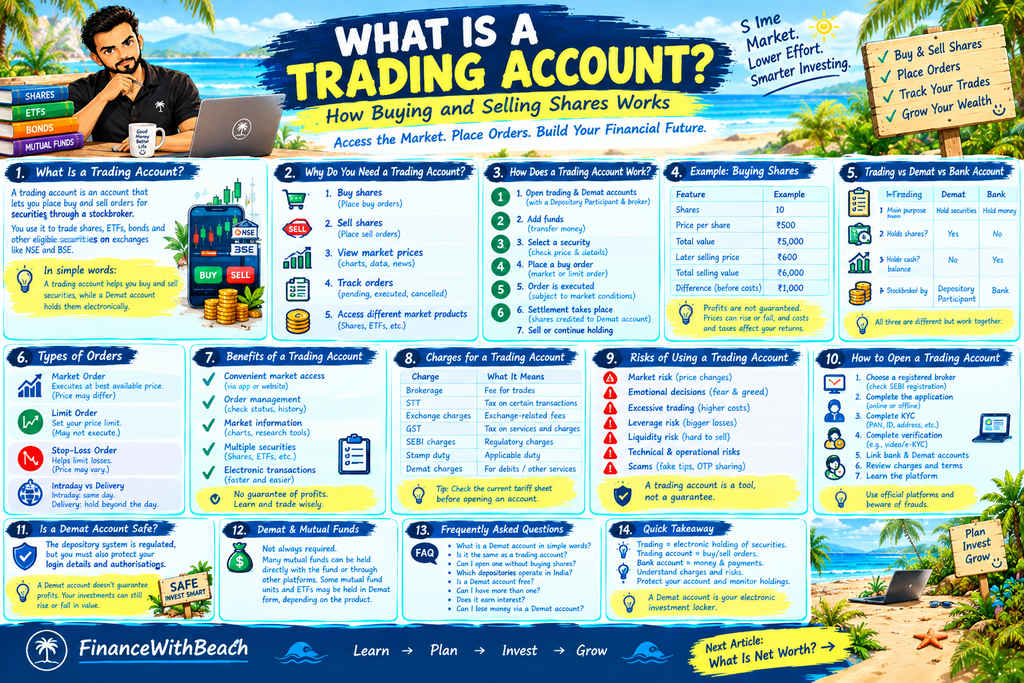
Table of Contents
Why Do You Need a Trading Account?
If you want to buy and sell excahnge-listed shares through a stockbroker, you generally need a trading account.
Here are comes of its main purposes.
1. Buy Shares
You can place orders to purchase shares of eligible companies listed on a supported stock exchange.
2. Sell Shares
You can place orders to sell securities you own, Subject to the relevent trading, holding and settlement reqirements.
3. View Market Prices
Most trading platform provide market-price information, charts and other tools. Some information may be delayed or require a paid subscription.
4. Track Orders
You can check whether an ordewre is pending, excecuted, partially executed, rejected or cancelled.
5. Access Different Market Products
Depending on the broker, your eligibility and the applicable rules, a trading account may provide access to porducts such as shares, ETFs and other permitted market instruments.
Important: Not every product is suitable for beginners. Derivates and leveraged trading can create substantial losses and require a separate inderstanding of their risks.
How Does a Trading Account Work?
The process with a simple example.
Let say you want to purchase shares worth ₹5,000.
Step 1: Open the required Accounts
You generally open a trading account with a stockbroker and a demat account with a registed depository participant,. A bank account is used for payments and withdrawals.
Some providers offer linked services to mke the process easier.
Step 2: Add Funds
Transfer money through the supported payment method so you have sufficient fund for your intended purchase and applicable charges.
Step 3: Slect a Security
Search for the company or security you want to trade. Check its name, exchange, price and other relevent information before proceeding.
Step 4: Place a Buy Order
Enter the quantity and select the ordeer type. You May use a market order or a limit order, depending on the available options and your needs.
Step 5: The Order Is Executed
An order is executed only when it can be matched according to market conditions and exchange rules. An order may remain pending,be partially filled or not execute at all.
Step 6: Settlement Takes Place
After the trade is executed, the application settlemen process takes place. For a ref=gular settled purchase, the securities are credited to your demat account according to the relevent settlement rules.
Step 7: Sell or continue Holding
You can continue holding the shares or place a sell order later. Your eventual profit or loss depends on the sale price, purchase price, costs and applicable taxes.
Example: Buying Shares Through a Trading Account
Let’say Want to buy 10 shares of a company.
| Feature | Example |
|---|---|
| Number of shares | 10 |
| Purchase price per share | ₹500 |
| Total purchase value | ₹5,000 |
| Later selling price per share | ₹600 |
| Total selling value | ₹6,000 |
| Difference before costs and taxes | ₹1,000 |
In this hypothetical example, you buy 10 shares at ₹500 each, giving a purchase value of ₹5,000.
Later, you sell all 10 shares at ₹600 each, giving a selling value of ₹6,000.
Your difference before transaction costs and taxes is ₹1,000.
However, if the selling pice falls to ₹400 per share, your selling value would be ₹4,000, resulting in a ₹1,000 loss or fall, and a profit is never guranteed.
What Is the Difference Between a Trading Account, Demat Account and Bank Account?
These accounts work together but have different purposes.
| Feature | Trading Account | Demat Account | Bank Account |
|---|---|---|---|
| Main purpose | Places buy and sell orders | Holds eligible securities electronically | Holds money and processes payments |
| Example | Orders 10 shares | Records the 10 shares after settlement | Provides funds for the purchase |
| Holds shares? | No, not as the primary securities-holding account | Yes, for eligible securities | No |
| Holds bank deposits? | Not like a regular savings account | No | Yes |
| Usually provided by | Stockbroker | Depository Participant | Bank |
A Simple Way to remmeber
- Bank account: Your money
- Trading account: Your market orders.
- Demat account: Your electronic securities.
The accounts may be linked, but they are not interchangeable.
What Are the Main Types od Orders in a Trading Account?
When Placing an order, it is important to understand how to order will be handled.
The exact options available may vary by broker, Market segement and security.
1. Market Order
a market order instructs the broker to buy or sell at the best available price under the applicable market rules.
Example:
A share is currently quoted near ₹500 and you place a market but order.
The execution price may differ from ₹500 because prices can change and the available quantity may be limited.
Main consideration: A market order priorities execution, but it does not guranteed a specfic price.
2. Limit Order
A limit order specifies the maximum pirce you are willing to pay when buying or the minmum price you are willing to accept when selling.
Example:
A share is trading near ₹500, but you set a buy limit of ₹480.
Your order may excute at ₹480 or better if matching market conditions allows it. If the share never reaches a suitable price, your order may remain unexecuted.
Main Consideration: A limit order controls your price limit, but execution is not guranteed.
3. Stop-loss Order
A Stop-loss order is designed to help manage potential losses by triggering an order whena specified trigger condition is reached.
The precise operation depends on the order type and the broker’s supported features.
Example:
A trader holding a share may set a trigger below the purchase price to initiate a sell order if the price falls.
main Consideration: A stop-loss does not guranteed the final selling price. Gaps,volatility,Liquidity and other execution can lead to a different outcome.
4. Day trading and Delivery-Based Trading
Theses terms describe different approaches to tradin rather than just order types.
- Intraday trading: Position are opened and closed within the same trading day under the relevent rules.
- Delivery-based trading: Shares are purchased for holding beyond the trading session and are settled into the investor’s Demat account according to applicable procedures.
Intraday trading can involve rapid price movements and may be paticularly risk for inexperienced traders.
What Are the Benefits of a Trading Account?
1. Convenient Market Access
A trading account lets you place orders through a broker’s website, app or supported platfrom.
2. Order Managements
You can view orders and monitors their status without handing physicall papaerworks.
3. Market Information
Depending on the platform, you may have access to cahrts, prices, company information and research tools.
4. Multiple Securities
A broker may support trading in different eligible securities and market segments through the same account.
5. Electronic Transactions
Trading and settement processes are largely electronic, making transaction more convenient than older paper-based methods.
Convenience does not remove market risk. You still need to understand what you are buying or selling.
What are the Charges for a trading Account?
Trading costs vary between broker, products and transaction types.
| Charge | What It Means |
|---|---|
| Brokerage | The fee charged by the broker for eligible transactions |
| Securities Transaction Tax (STT) | A tax applicable to specified securities transactions |
| Exchange transaction charges | Charges associated with exchange transactions |
| GST | Applicable tax on specified services and charges |
| SEBI-related charges | Applicable regulatory charges under current rules |
| Stamp duty | Applicable duty on specified transactions |
| Demat-related charges | Certain charges may apply when securities are debited or when other depository services are used |
Not every charge applies in the same way to every product or tasnaction. The amount can depend on the market segment, transaction value and current rules.
Example: Why Trading Costs Matter
Let’s say a trader makes several small trades and earns ₹500 in gross gains.
If brokerage and other applicable charges total ₹200, the amount remaining before other costs and taxes would be ₹300.
This simplified shows why it is important to consider costs rather than looking only at gross profits.
Check the broker’s current traiff sheet and applicable official rules before trading.
What Are the Risks of Using a Trading Account?
A trading account provides market access, but trading itself involves risks.
1. Market Risk
Prices can fall because of company-specfic developments, economic conditions, interest rates, investor sentiment or other factors.
You may lose some or all of the money invested in a particular security.
2. Emotional Decisions
Fear,greed and the desire to recover losses quickly can lead to impulsive trades.
A written plan and a clear understanding of your risk limits can help you avoid see emotional mistakes.
3. Excessive Trading
Frequent trading can increase costs and encourage unneceassary decisions.
More trades do nto automatically lead to higher profits.
4. Leverage Risk
Some products allows traders to take positions larger than the fund they initally commit.
Leverage can magnify gains, but it can also magnify losses. Certains products may require additonl funds or reults in losses beyond the amount initally expected.
Beginners shoul;d understand these risks fully beofre using leveraged products.
5. liquidity Risk
A security may have limited buyers or sellers. you may be unable to execute an order at your preferred price or at the time you want.
6. techanical and operational Risks
Connectivity problems, Platform disruption, incorrect order details or unauthorised account access can cause difficultes.
Use official platforms, portect your credentials and review ordeer details before submitting them.
7. Misleading Tips and Scams
Be cautions of people promising guaranteed porfits, secret trading strategies or assured terms.
Do not share passwords,PINs, or OTPs with people claiming they can trade on your behalf.
How to Open a Trading Account in India
Opening a trading account is often possible online through an eligible broker.
Step 1: Choose a Registered broker
Check the broker’s registration and available services. Compare the fees, customer support, security features and product offered.
You can use official resoruces from SEBI to learn about regulated market intermediairies.
Step 2: Complete the Application
Enter the required details on the broker’s official website or app.
Step 3: Complete KYC
KYC means Know Your Customer. Dpending on the applicable requirements, you may need PAN, identity and address infromation, bank details and other documentation.
Step 4: Complete Vertification
Follow the provider’s official verfication process. Never share your OTP or password with anyone who contacts you ynexpectedly.
Step 5: Link the Required Accounts
Follow the Broker’s instructions for linking yur bank account and demat account or opening the required services where offered.
Step 6: review the Charges and Agreements
Read the account terms,fee schedule and relevant risk disclosures before accepting them.
Step 7: Learn the Platform Before trading
understand how to search for securities, choose an order types, check order status and review charges.
Ypu do not need to start trading immediately after opeing an account.
trading vs investing: What Is the Difference?
Trading an dinvesting both involve buying and selling financial assets, but they often have different objectives and time horizons.
| Feature | Trading | Investing |
|---|---|---|
| Typical time horizon | May range from minutes to months | Often years or longer |
| Main focus | Price movements and trading opportunities | Long-term financial goals and asset growth |
| Activity level | Can involve frequent transactions | May involve fewer transactions |
| Costs | Frequent trades may increase costs | Costs depend on the investments and activity |
| Main risks | Market movements, timing, costs, and execution | Market movements, business performance, inflation, and other risks |
These are general distinction, not strict definitions. Some traders hold positions for months and some investors make changes more frequently.
Neiher approach gurantees a profits. Choose an approach based on your know;edge, goals, time and ability to handle losses.
Common Mistakes Beginners Should Avoid
Mistake 1: trading without understanding the ordwer type
Know the difference between market orders and limit orders before placing a trade.
Mistake 2: Confusing a trading account with a Demat Account
one places orders; the other holds eligible securities electronically.
Mistake 3: Ignoring fees and taxes
Review the total cost of a transaction, not just the share price.
Mistake 4: trading beased on rumours
Check reliable information instead of blindly following social-media tipes or messages from strangers.
Mistake 5: Using borrowed money without understanding the risks
Borrowing to trade can increase financial pressure and magnify losses.
Mistake 6: Expecting quick profits
Markets aare uncertain and repeated can results in losses.
Mistake 7: Sharing account credentials
Keep passwords, PINs and OTPs private and use the broker’s offical security features.
Mistake 8: Starting with complex product too early
Learn the basics of shares,market orders,costs and risk before cosndiering derivatves or leveraged trading.
Is a Trading Account Suitable for Beginners?
A trading account can be useful if you want to access the stock market, but opening one does not mean you must trade frequently.
Beginners should first learn how markets works, understand the difference between trading investing and become familiar with risk and costs.
If your goals is long term wealth building, compare different approaches and avoid assuming that frequent trading is necessary.
The Key lesson: Learn the system before risking your money. A rading account is a tool for placing market orders, not a shortcut to guranteed income.
FAQs
What is trading account in simple words?
A trading account is an account that allows you to place buy and sell orders for securities in the financial markets thorugh a stockbroker.
Is a trading account the same as a Demat account?
No. A trading account is used to place orders, while a Demat account holds eligible securities electronically.
Can I open a trading account without a Demat Account?
Rquirements depend on the product and market segemnt. For regular delvery-based share investing, a Demat account is genrally required. Some trading product may operate under different arranagemnts.
How much money do I need to open a trading account?
The amount depends on the broker’s reuqiremnts and the products you intend to trade. Account opening may be free, but other charges and minmum funding requiremnts may apply.
Does a trading account guaranteed profits?
No. market Prices can move against you, and costs can reduce returns. You can lose money when trading.
Can I use a trading account on my phone?
Many broker provide mobile apps as wells as websites. Download apps on from official sources and secure your account.
What is the difference between trading and investing?
Trading often focuses on shorter-term price movements, while investing commonly focuses on longer-term finacial goals. Bothe involve risk.
Is intraday trading suitable for beginners?
intraday trading can be risky because prices may change quickly and costs can accumulate. Beginners should learn the risks carefully before considering it.
Link this article to:
- What Is Bank Account?
- What Is ATM?
- What Is UPI payment?
- What Is Recurring Deposit?
- What Is a Asset?
- What Is a Dividend?
- Simple Interest and Compound Interest
- What Is a Return on Investment?
- What Is Risk in Investing?
- What Is Diversification
- What Is a Portfolio?
- What Is an Index?
- What Is an Stock MArket Index?
- What Is an Mutual Fund?
- What Is an SIP?
- What Is an Index Fund?
- What Is an ETF?
- What Is a Bond?
- What Is a Goverment Bond?
- What Is a Demat Account?