
What Is an SIP?
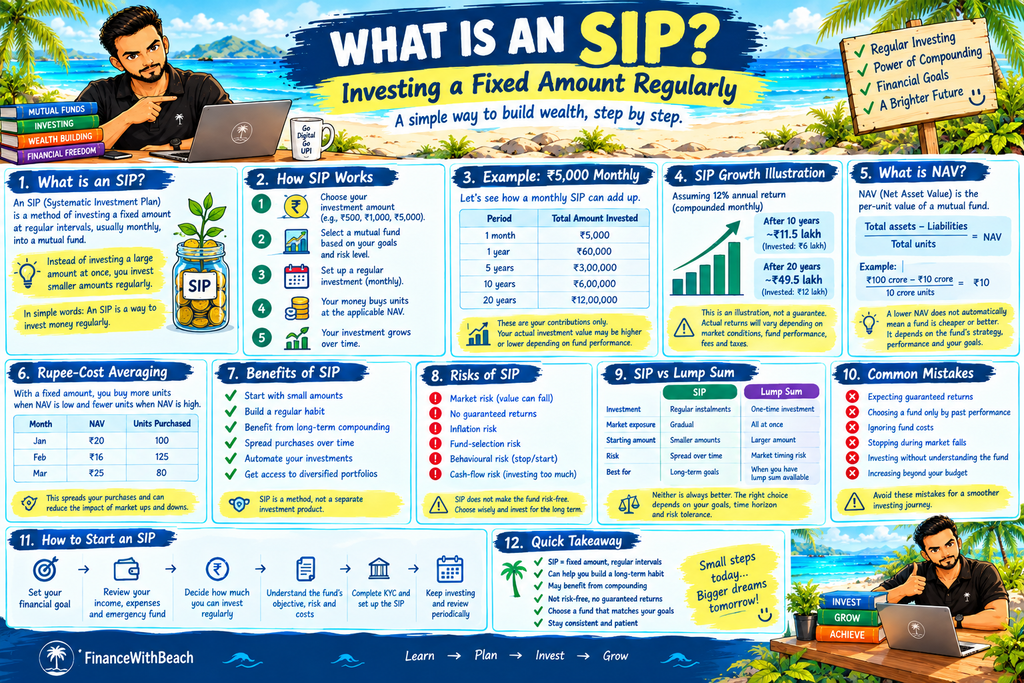
An SIP(Systematic Investment Plan) is method of investing a fixed amount of money at regular intervals, usually monthy, into a mutual fund.
Instead of investing a large amount all at once, you can invest smaller amounts regularly, This makes investing easieer to organise and helps build a consistent investing habits.
Example
Let’s say you decide to invest ₹2,000 every month ina mutual fund.
- Month 1: ₹2,000
- Month 2: ₹2,000
- Month 3: ₹2,000
- Month 4: ₹2,000
After four months, you would have invested ₹8,000 in total.
Over time, regular investments may help you build wealth, depending on the performance of the mutual fund and the length of time you remain invested.
In simple Words:
An SIP is a way to invest money regularly instead of investing everything at once.
Table of Contents
How Does an SIP Work?
An SIP makes investing systematic. You choose an amount, selecta mutual fund and set a regular investment schedule.
Step 1: Decide your investment amount
Choose an amount that fits your income nd expenses, suchs, ₹500,₹1000 or ₹1,500 per month, subject to the fund’s minimum.
Step 2: Select a mutual fund
Choose a fund based on your financial goals, time horizons, risk tolerence and the fund’s investment strategy.
Step 3: Invest regularly
Your SIP is scheduled at your chosen frequency. Monthy SIPs are common and payment arrangements depend on the platform and fund.
step 4: Continue and review
Your money buys mutual fund units at the applicable NAV. Review your investment periodically to check that it still suits your goals.
Example: Investing ₹5,000 Every Month
Let’s understnad how regulaar investing works with a simple example.
You invest ₹5000 every month.
| Period | Total amount invested |
|---|---|
| 1 month | ₹5,000 |
| 1 year | ₹60,000 |
| 5 years | ₹3,00,000 |
| 10 years | ₹6,00,000 |
| 20 years | ₹12,00,000 |
These figures show your contributions only. Your actual investment value may be higher or lower depending on return, fess and taxes.
The important ideas is that investing a managable amount regularly can help you build a long-term investment habits.
What Is Rupee Cost Averaging in an SIP?
One portential bebfits of investing regularly is rupee cost averaging.
When the NAV os lower, your fixed investment amount buys more units.
When the NAV is higher, it buys fewer units.
Example:
Let’s say uou invest ₹2,000 in a mutual fund each month.
| Month | NAV | Units purchased |
|---|---|---|
| January | ₹20 | 100 |
| February | ₹16 | 125 |
| March | ₹25 | 80 |
| Total | — | 305 units |
Your Investment is ₹6,000 and you own 305 units. Your average purchase cost os approximately ₹19.67 per unit.
What Are the Benefits of SIP Investing?
1. Start with mangable amounts
You may be able to start with a relatively small amount, depending on the mutual fund’s minimum investment rules.
2. Build a Regular Habit
A recurring investment can help you make investing part of your monthy financial routine.
3. Benefit from long -term compounding
If your investment earns positive returns and those returns remain invested growth can build over time.
4. Avoid needinmg a large Lump Sum
You don’t have to wait until you have a large amount of moneu before beginning to invest.
5. Spread purchases over time
Regular investing means you buy units at different NAV levels instead of making all your purchases at one point in time.
6. Automate Contributions
Automatic payments can make ir easier to stay consistent, Provided your account has sufficient funds and the payment instruction remains active.
What Are the Risks of SIP Investing?
SIP is only an investment method. It does not make the mutual fund iitself safe.
- Market Risk: The underlying investment can fall in value.
- No guaranteed returns: A SIP does not guarantee porfit.
- Inflation Risk: Your future money may buy less than expected.
- Fund-slection risk: A poorly suited fund may not matchn your goals or risk tolerance.
- Behavioural risk: Stopping or changing your plan in reponse to every market movement can disrupt your strategy.
- Cash-Flow risk: Investing too much may leave you short of money for regular expenses or emergencies.
Before investing, consider your emergency savings, expensive debt, fianncial goals and ability to handle losses.
SIP vs Lump Sum: What Is the Difference?
| Feature | SIP | Lump Sum |
|---|---|---|
| Investment method | Regular instalments | One larger investment |
| Timing | Money enters at different times | Most money is invested at once |
| Starting amount | Often more manageable | Requires a larger amount |
| Market exposure | Builds gradually | Begins on the investment date |
| Return guarantee | None | None |
Niether approach is alwys better. The choice depends on your available money, investment objective, time horizons and comfort with market fluctuations.
Is an SIP Better Than a Recurruing Deposits(RD)?
An SIP and an RD are different financial Products.
| Feature | SIP | Recurring Deposit |
|---|---|---|
| Product | Investment method into a mutual fund | Bank deposit product |
| Returns | Market-linked, depending on the fund | Interest rate set under deposit terms |
| Risk | Depends on underlying investments | Depends on the institution and applicable deposit protection |
| Value | Can rise or fall | Principal and interest generally follow the deposit contract, subject to its terms |
| Suitable for | Investment goals based on risk and time horizon | Planned savings with defined deposit terms |
Choose based on the purpose of the money, how soon you need it, and the risks you can accept.
Common SIP Mistakes Beginners Should Avoid
- Expecting Guaranteed Returns: Mutual Fund investments can lose money.
- Choosing a fund only because of recent performance: Past Performance does not guranteed future results.
- Investing before planning essential Expenses: Keep Money available for emergencies and near-term needs
- Stopping every time the market falls: Reassess your goals and fund rather than reacting automatically.
- ignoring fund costs: Expenses and taxes can reduce your final outcome.
- Assuming every SIP is Long-term: Select a fund and time horizon that match the goal.
- Increasing contribution beyond your budget: A sustainable amount is better than one that creates financial stress.
How Can A Beginner Start an SIP in India?
here is a simple checklist:
- Set a Clear Financial Goal.
- review your income, expense,mergency savings and debt.
- decide how much you can invest regularly
- Understand the fund’s invetment objective and risk level
- Review the expense ration and other applicable costs.
- Complete hthe required account and identity-vertfication porcess through a legitmate investment platform or fund provider.
- Set the SIP schedule and make sure the money is available.
- Review your plan periodically rather than judging it by short-term market movements.
Do not select a mutual fund merely because someone promises high returns.
FAQs
1. What does SIP stand For?
SIP stands for Systematic Investment Plan. It is a way to invest a fixed amount regualrly into a mutual fund.
2. Can I start an SIP with ₹500?
Some mutual fund Permit SIPs starting at ₹500 or less, while others require more. Check the minmum amount for the specfic fund.
3. Can I lose money in an SIP?
Yes. If the underlying fund investment fall in value, your SIP investment can also lose value.
4. Is SIP suitable for beginners?
It can be a convenient way to build e regular investment habit, but neginners should first understand the fund, it risks, and their own financial needs.
5. is an SIP suitable Guranteed to make money?
No. Nither SIP investing nor mutual fund returns are guaranteed.
Link this article to:
- What is Saving?
- What is Income?
- What is Compound Interest?
- What Is Inflation?
- What is Insurance?
- What is investing?
- Types of Investment?
- What is Budget?
- Saving vs Investing
- What is Net worth?
- What Is Exapenses?
- What is Cash Flow?
- What is Liquidity
- What Is Loans?
- What Is EMI?
- What Is Credit Card?
- What Is Bank Account?
- What Is ATM?
- What Is UPI payment?
- What Is Recurring Deposit?
- What Is a Asset?
- What Is a Dividend?
- Simple Interest and Compound Interest
- What Is a Return on Investment?
- What Is Risk in Investing?
- What Is Diversification
- What Is a Portfolio?
- What Is an Index?
- What Is an Stock MArket Index?
- What Is an Mutual Fund?
2 thoughts on “What Is an SIP? — Investing a Fixed Amount Regularly”