
What Is a Return on Investment (ROI)?
When you invest your money one of the first question you may have is:
“How much did I actually make from this investment?”
This is where Return On Investment, commonly called ROI becomes useful.
ROI is a simple way to measure the gain or loss from an investment compared with the amount of money you orginally invested.
In simple Words:
ROI tells you how much you gained or lost compared with that you invested.
Understanding ROI can help beginners compare diferent investments and understand whether an investment produced a profit or loss.
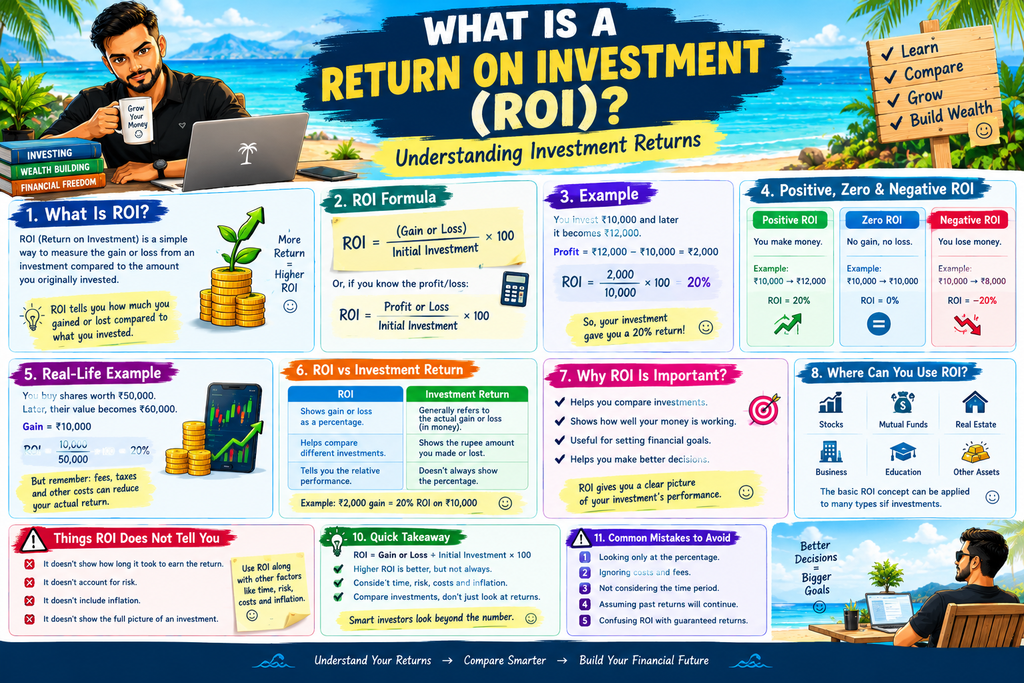
Table of Contents
What Does ROI mean?
ROI stands for Return on Investment.
It measures the return generated by an investment relative to its original cost.
Example
Let say you invested ₹10,000 in something and later sell at ₹12,000.
Your profits on
₹12,000 – ₹10,000 = ₹2,000
Your ROI is:
₹2,000 ÷ ₹10,000 x 100 = 20%
So your investment produced a 20% ROI.
ROI Formula
The basic formula is:
ROI = (Investment Gain – Investment Cost) ÷ Investmetn Cost x 100
or if you already know the profit or loss
ROI = Profit or loss ÷ Initial Investment x 100
Example
You Invest ₹20,000.
After some time, your investment becomes ₹24,000.
Your gain is:
₹24,000 – ₹20,000 = ₹4,000.
Therefore:
ROI = ₹4,000 ÷ ₹20,000 x 100
ROI = 20%
Your ROI is 20%.
Understanding Positive and Negative ROI
ROI can be positive,zero or Negative.
Positive ROI
If you make money, your ROI is positive.
Example:
Investment = ₹10,000
Final value = ₹12,000
ROI = +20%
Zero ROI
If you neither gain nor lose money, your ROI is Zero.
Example:
Investment = ₹10,000
Final value = ₹10,000
ROI = 0%
Negative ROI
If you lose money, your ROI is negative.
Example:
Investment = ₹10,000
Final value = ₹8,000
Loss:
₹8,000 – ₹10,000 x 100 = -20%
ROI = -20%
ROI vs Investment Return
These terms are related but should not always be treated as exactly the same thing.
Investment rteurn generally refers to th gain or loss genrated by an investment.
ROI expresses that gain or loss relative to the amount invested usually as percentage.
Example:
- Investment: ₹10,000
- Gain: ₹2,000
- ROI: 20%
The ₹2,000 is th gain.
The 20% is th ROI.
Why is ROI Important.
ROI provides a simple way to understand invetment performance.
Let say have two investments:
Investment A
- Investment: ₹10,000
- Gain: ₹1,000
- ROI: 10%
Investment B
- Investment: ₹10,000
- Gain: ₹2,000
- ROI: 20%
Looking only at the rupee profit shows that Investment B Genrated More Profits.
ROI also Puts the returns into percentage terms, making it easier to compare investments with diferent amounts.
Can ROI Be Used for Different Investments?
YES.
The baisc ROI concept can be applied to many Situations.
Example:
Stocks
You can claculate the gain or loss compared with the amount invested.
Mutual Funds
You can Campare your investment amount with its current or final value.
Real Estate
You can compare the gain from selling a property with the amount invested, athough a complete property analysis may need to include expenses such as maintenance, taxes, financing cost5s and transaction costs.
Business
A business owner can compare the profit generated by a project with amount spend on it.
Education
People sometimes use ROI as framework for thinking about education by comparing its costs with potential financial benefits, although many non-financial factors also matter.
ROI Does Not Tell the WHole Story
ROI is useful, but it hase an important Limitation:
It doen’t automatically tell you how long it took to earn the return.
Investment A
You invest ₹10,000 and make a 20% return in 1 year.
Investment B
You invest ₹10,000 and make a 20% return in 5 year.
Both have ROI 20% total ROI.
But the time period is very different.
This is why you should consider time when comparing investment returns.
ROI vs Annualized Return
If two investment have different time periods, a simple ROI comparison may not be enough.
Example:
Investment A: 20% ROI in 1 Year
Investment B: 20% ROI in 5 Year
The total ROI is the same, but the investment periods are not.
Measures such as annualized return can help provide a time adjusted view investment performance.
For investment that compared, the annualized return of often more informative than simply dividing total ROI by the number of years.
ROI and Compound Growth
ROI and Compound growth are coonnected, but they are not the same concept.
ROI tells you the overall percentage gain or loss relative to the original investment.
Compounding describes how reurns hat remain invested can contribute to futre growth.
Example: Let say ₹10,000 grows at a hypothetical 10% annual rate:
- Year 1 – ₹11,000
- Year 2 – ₹12,100
- Year 3 – ₹13,310
The total gain after three years is ₹3,310 giving a total ROI of 33.1%
This example assumes the same return every year and is purely for illustration.
ROI Example With a Loss
ROI isn’t only about profits.
Let say you invest ₹25,000 i n an investment.
Later, its value falls to ₹22,500.
Your loss is:
₹22,500 − ₹25,000 = −₹2,500
ROI:
−₹2,500 ÷ ₹25,000 × 100 = −10%
Your ROI is therefore −10%.
This is why investments should not be judged only by the possibility of making money. Investment values can also decline.
What Can Affect Your Actual ROI?
The simple ROI formula does not automatically account for every cost.
Dpedning on the investment you may need ot consider:
- Brokerage fees
- Transaction charges
- Taxes
- Managment fess
- Maintenance costs
- Pruchase and selling costs
- Loan interest
- Other investment related expenses
Simple Example
Suppose:
Investment = ₹10,000
Final value = ₹12,000
Before costs, your profit is ₹2,000.
But suppose you paid ₹200 in relevant costs.
Your net gain becomes:
₹2,000 − ₹200 = ₹1,800
Your net ROI would then be:
₹1,800 ÷ ₹10,000 × 100 = 18%
So the return after costs can be lower than the headline ROI.
ROI IS NOt teh Same as Risk
A high ROI does not automatically mean an investment is suitable for everyone.
Two investment could produce different returns while also having very different levels of risks.
Example:
- Investment A may have a lower potential return and lower risk.
- Investment B may have a higher potential return but greater uncertainly.
ROI measueres the return, not the complete risk profile of an investment.
This is why investors should cosnider both risk and returns.
Common Mistakes Beginnerss Make With ROI
1. Looking onaly at percentage
A 50% ROI sound large, but you should also understand the amount invested and the time time involved.
2. Ignoring Costs
Fees, Taxes and other expenses can reduce your actual return.
3. Ignoring the time period
A 20% return over one year is different from a 20% return over five years.
4. Assuming past ROI will continue
A pervious return does mot guarantee that the sam return will happen in the future.
5. Confusing ROI with Guaranteed returns
ROI can be positive or Negative. Investment involving market risk do not guarantee a particular ROI.
ROI and Inflation
Another Important consideration is Inflation.
Let’s your investment grows by 6% over a period while prices increase significantly during the same period.
Your money may have have increased in nominal valu but its purchasing power may not have increased by the same amount.
Therefore, when evaluating long term investment, it can be useful to think about both:
Investment return + Inflation
rather than looking only ROI alone.
FAQs
What does ROI stand For?
ROI stands for Return on Investment.
What is a good ROI?
There is no sim=ngle ROI percentage that is automatically “good” for ecery investment. it’s all dpends on time horizon, fees , taxes, costs and market conditions.
How do you calculate ROI?
ROI = Profit or loss ÷ Initial Investment x 100
Is ROI the same as profit?
No.
Profit is usally expressed as money amount while ROI expresses the gain or loss relative to the investment as a perecentage.
Can ROI be Negative?
Yes.
A negative ROI means the investment lost value relative to the Original Investment.
Link this article to:
- What is Saving?
- What is Income?
- What is Compound Interest?
- What Is Inflation?
- What is Insurance?
- What is investing?
- Types of Investment?
- What is Budget?
- Saving vs Investing
- What is Net worth?
- What Is Exapenses?
- What is Cash Flow?
- What is Liquidity
- What Is Loans?
- What Is EMI?
- What Is Credit Card?
- What Is Bank Account?
- What Is ATM?
- What Is UPI payment?
- What Is Recurring Deposit?
- What Is a Asset?
- What Is a Dividend?
- Simple Interest and Compound Interest