
Simple Interest vs Compound Interest — What’s the Difference?
When you saver, or invest money you will often come across the word interest.
Interest is the extra money earned on savings or investments or the extra money paid when norrowing money.
There two ways to caluclated the interest:
- Simple Interest
- Compound Interest
Athough boyh include interest, they work diffrently. understadning the difference is important because is can affect how quickly your money grows or how much you eventually pay on a loan.
In this article, we will explain simple and compund interest using easy example.
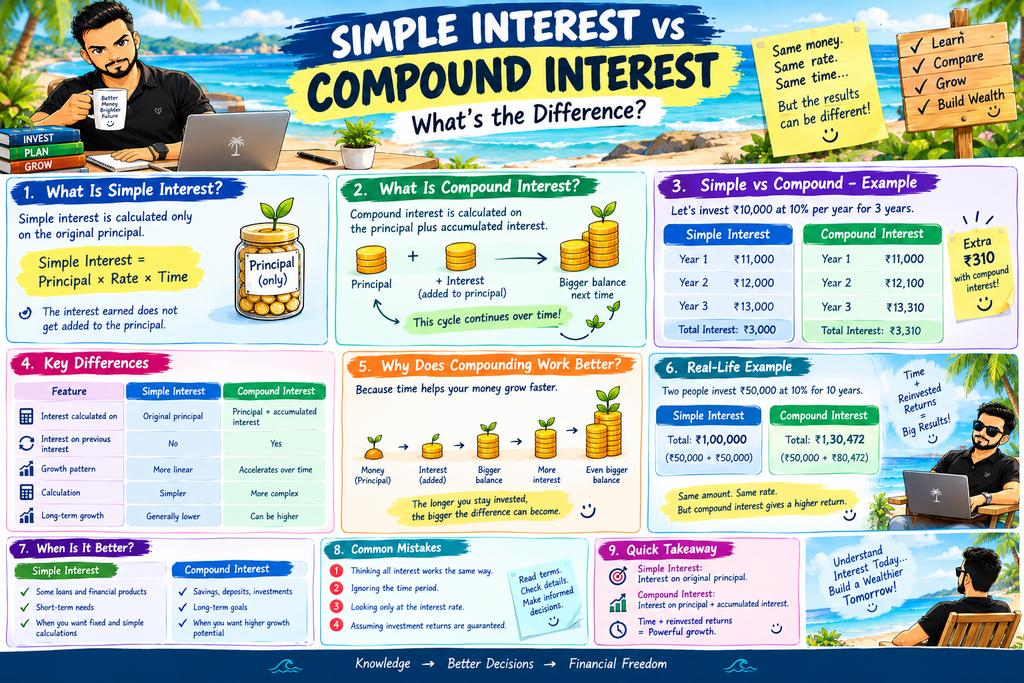
Table of Contents
What is Simple Interest?
Simple Interest is calculated only on the original amount of money, called Principal.
The interest earned does not get added to the principal when calculating interest for the next period.
Simple Interest Formula
Simple Interest = Principal x Rate x Time
Example:
Let’s say you invests ₹10,000 at 10% simple interest per year for 3 years.
- Principal = ₹10,000
- Interest Rate = 10%
- Time = 3 years
Interest Earned:
₹10,000 z 10% x 3 = ₹3,000
So after 3 years:
Total = ₹10,000 + ₹3,000 = ₹13,000
The interest is calculated on the original ₹10,000 eavet year.
What Is Compound Interest?
Compound Interest is different because the inetrest you earn can be added to your original money.
Then, Future interest can be calculated on both:
Original Money + Previously earned money
This is often described as “interest on interest.”
Example:
Let’s say you invests ₹10,000 at 10% simple interest per year for 3 years.
Year 1
₹10,000 earns ₹1,000 interest
Balance = ₹11,000
Year 2
Now the 10% interest is claculated on ₹11,000.
Interest = ₹1,100
Balance = ₹12,100
Year 3
Interest is calculated on ₹12,100.
Interest = ₹1,210
Balance = ₹13,310
So after 3 years:
Total = ₹13,310
This is higher than the ₹13,000 produced by simple interest.
Simple Interest Vs Compound Interest:
Example
Let’s compare noth using the same starting amount.
Suppose:
- Intial amount = ₹10,000
- Interest rate = 10% per year
- Period = 3 years
| Year | Simple Interest Balance | Compound Interest Balance |
|---|---|---|
| Start | ₹10,000 | ₹10,000 |
| Year 1 | ₹11,000 | ₹11,000 |
| Year 2 | ₹12,000 | ₹12,100 |
| Year 3 | ₹13,000 | ₹13,310 |
Difference
After 3 years:
Simple Interest = ₹13,000
Compound Interest = ₹13,310
The difference is ₹310.
The difference may look small over small year, but it can become much larger when money compounds for many years.
Key Difference Between Simple and Compound Interest
The easiest way to remember the difference is:
Simple Interest works on the original Principal. Compound interest works can be calculated on the principal plus accumlated interest.
Simple Interest
You earn interest on the original amount.
Compound Interest
You can earn interst on the original amount and perviously earned interest.
Simple Interest vs Compound Interest
| Feature | Simple Interest | Compound Interest |
|---|---|---|
| Interest calculated on | Original principal | Principal + accumulated interest |
| Interest on previous interest | No | Yes |
| Growth | More linear | Can accelerate over time |
| Calculation | Simpler | More complex |
| Long-term growth | Generally lower | Can be higher at the same rate |
| Common use | Certain loans and financial calculations | Savings, deposits, investments and some loans |
The exact way interest is applied depends on the financial product ans its terms.
Why Does Coompound Interest Become Powerful Over Time?
The biggest difference between the two becomes visible over a longer period.
With simple interest, the interest amount remains based on the principal original princicpal.
With compound interest, the base used to calculate future interest can keep investing.
Example:
Your investment earn interest and you leave that interest invested instaed of taking it out.
Your money can follow a cycle lile this:
Money ➔ Interest ➔ Larger Balance ➔ More Interest ➔ Even Larger balance
This is why is an important part of compounding.
The longer money remains invetsed and compounds, the greater the potential difference can become.
Is Compound Interest Always Better?
Nit necessarily.
It depends on whether you earning interest or paying it.
When you are earning interest
Compound interest can help your money grow because previously earned interest can generate additional interest.
When you are brorrowing money
Compound interest can increase amount you owe when unpaid interest is added to the balance and subsequently acruese more interest.
That’s why very important to understanding the temr sof loans, credit products, deposits and investment before making financial decisions.
Simple Interest vs Compound Interest In Everyday Finance
You may encounter these concept in different areas of personal finance.
Savings
Some savings products may pay interest according to specfic compounding rules.
Fixed Deposits
Interest may be calculated and compounded according to the terms of the deposits.
Loans
Some loans use interest clalculations that can involve compounding while others use different methods.
Investments
Compounding is an important mathematical concept behind long term investment growth when returns remains invested.
Always check the specfic product’s terms rather than asuming that every financial product uses the same interest method.
Why Started Early Matters?
One of the important lessons from compound interest is the value of time.
Supppose two investors eventually invest the sme amount of money, but one starts several years earlier.
The earlier investor has more time for returns to portentially generate additional returns.
Example:
₹10,000 ➔ Returns ➔ Larger Returns ➔ more returns ➔ Larger balance
Over a long period, this repested process can have a signifcant effect.
This is ine reason compound interest is often discussed when learning about long-term investing and wealth building.
Simple Interest vs Compound Interest:Which Formula Should You Know?
For Simple Interest:
Simple Interest = P x R x T
Where
- P = Principal
- R = Interest rate
- T = Time
For Compound Growth, a commonly used annual-compounding formula is:
A = P(1 + r)ⁿ
where:
- A = Final amount
- P = Principal
- r = Annual interest rate expressed as decimal
- n = Number of years
the actual calulation can differ when interest compund monthy, quarterly or at another frequency.
Common Mistakes Beginners Make
1. Thinking all interest works the same way
Different financial products can use different interest calculations.
2. Ignoring the time period
A rate tht looks attractive overa shor period may have a very different effect over period a long period.
3. Looking only at the interest rate
Fees, taxation,inflation, compunding freuqency and prdsouct terms can also affect the actual outcome.
4. Assuming investment returns are guaranteed
Compound growth examples often use a fixed rate for simplicity. Real market investments can rise and fall and actual returns may differ.
FAQs
Is Compound intereet better than simple interest?
When you are earning interest, compound interest can produce more growth than simple interest at the same rate and over the same period because perviously earned interest can also genenrate interest.
What is the main difference between simple and compound interest?
Simple Interest works on the original Principal. Compound interest works can be calculated on the principal plus accumlated interest.
Does Compound Interest Help investment Grow?
Compounding can cintrubute to long term growth when returns remains invested, However, market investment do not guarantee a fixed returns.
Can compound Interest increase Debt?
Yes. Depending on the product’s terms, unpaid interest can become part of the balance on which future returns is calulated.
Why is compound interest important?
it helps explain why money can gorw increasingly faster over long periods when reurns remain invested.
Link this article to:
- What is Saving?
- What is Income?
- What is Compound Interest?
- What Is Inflation?
- What is Insurance?
- What is investing?
- Types of Investment?
- What is Budget?
- Saving vs Investing
- What is Net worth?
- What Is Exapenses?
- What is Cash Flow?
- What is Liquidity
- What Is Loans?
- What Is EMI?
- What Is Credit Card?
- What Is Bank Account?
- What Is ATM?
- What Is UPI payment?
- What Is Recurring Deposit?
- What Is a Asset?
- What Is a Dividend?
4 thoughts on “Simple Interest vs Compound Interest — What’s the Difference?”