
What Is EMI?
If you have taken any home loan, car loan, personal loan, or education loan, you may have heard the term EMI
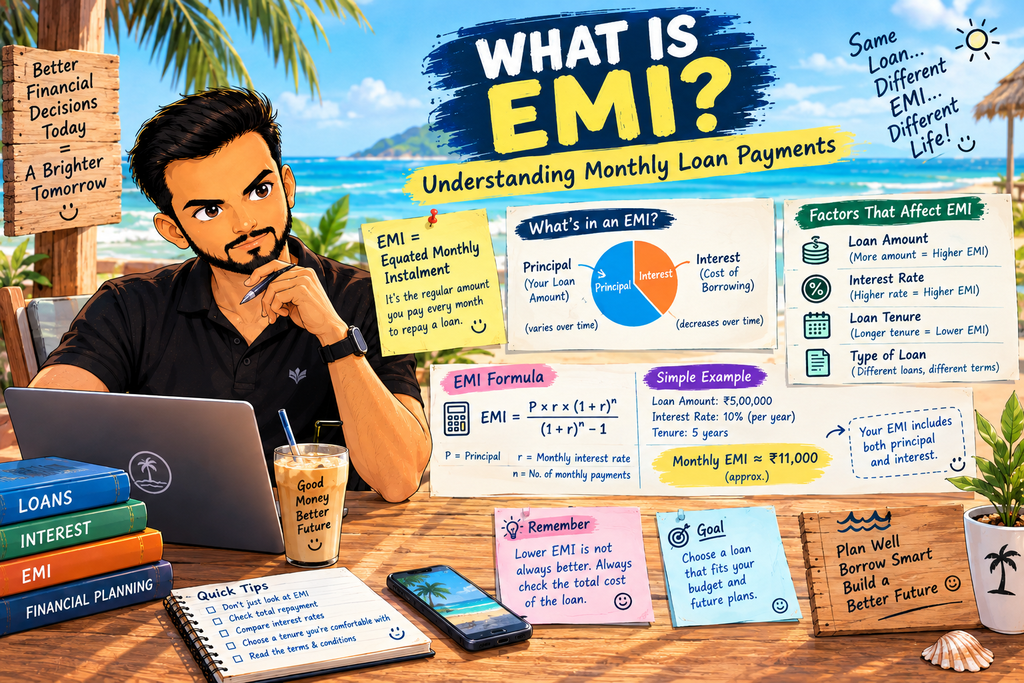
EMI stands for Equalled Monthy Installments.
In Simple Words, An EMI is the regular amount you pay every moneth lowards repay for loan.
An EMI generally includes two parts:
- Principal – the amount that orginially borrowed
- Interest – The cost of borrowing money
Example :
If you take a loan buy a car, instead of paying entire amount loan at once, you pay in monthy EMI over agreed period.
Table of Contents
What Does EMI Mean?
EMI = Equalled monthy installment
The word “Equaled” means that under fixed rate EMI structure, the scheduled payment amount fixed every month is genrally the same.
The Portion of payment towards principal and interest can chang over period of time.
At the begining of loan, larger portion of the EMI goes towards to interest.
As the oustanding Principal decreases, a larger portion generally goes towards the principal.
How Does EMI Work?
let say you Borrow money:
- Loan Amount: ₹5,00,000
- Interest Rate: 10% per year
- Loan Tenure: 5 year
Instead of fully ₹5,00,000 imediately, you make monthy payment according to the loan agreed.
Each EMI contrbutes toward reducing the oustanding loan and applicable interest.
Over Time:
Oustanding Loan decreases – Interest portion genrally decreases – Principal Portion genrally increases
EMI Formula
A commonly used formula for calculating the EMI on a standard reducing-balance loan is:
EMI = P × r × (1 + r)ⁿ ÷ [(1 + r)ⁿ − 1]
Where:
- P = Principal loan amount
- r = Monthly interest rate
- n = Number of monthly payments
If the annual interest rate is 12%, the monthly rate is generally:
12% ÷ 12 = 1% per month
The formula may look complicated, which is why many people use an EMI calculator instead of calculating it manually.
Simple EMI Example
Suppose you borrow ₹1,00,000 at an annual interest rate of 10% for 2 years.
Using the standard EMI formula, the approximate monthly EMI would be ₹4,615.
You would make 24 monthly payments.
The total amount paid would be approximately:
₹4,615 × 24 = ₹1,10,760
So, approximately:
Principal = ₹1,00,000
Total interest = ₹10,760
The exact figures can vary slightly because of rounding and the lender’s repayment schedule.
What Affects Your EMI?
Several Factors determine your monthy EMIs.
1. Loan Amount
Borrowing money more thr higher EMI, Assuming the interest rate and tenrure reamisns same.
2. Interest Rate
A Higher interest rate genrally increases the EMI and total interest costs.
3. Loan Tenure
Loan Tenure means the length of time you have to repay the loan.
A longer tenure can rduce monthy EMI, but may become longer item interest period.
A shorter tenure can increases you monthy EMI. but it may reduces your interest cost in loan.
4. Types of loan
Home loan, education loan, Personal loan and vehicle loand can have different interest rate, loan tenure and repayment plan, stucture and terms.
Shorter vs Longer Loan Tenure
Consider two loan with the same principal and interest rate.
Shorter Tenure
- Higher monthy EMI
- Lan get paid off sooner
- Less total interest
Longer Tenure
- Lower Monthy EMI
- More time to repay
- More total interest
Always try to choose less interest paid in loan. paid off loan as soon as possible.
What Is the Difference Between EMI and Interest?
EMI and Interest is not a same thing.
EMI is a regular loan payment.
Interest is cost of borrowing money.
Example:
If your monthy EMI is ₹10,000:
- 6,500 – Principal amount
- 3,500 – Interest
As loan balances decreases the split may changes.
The exact amount dpends on the loan’s term agreed.
What Happen to EMI Over Time?
For a Standard fixed rate loan with a fixed EMI structure, your schedule EMi genrally reamisns same.
Early in the loan
A larger portion may go toward interest.
Later in the Loan
Larger portion to wards to reducing your principal amount.
| Loan Stage | Principal Portion | Interest Portion |
|---|---|---|
| Beginning | Lower | Higher |
| Middle | Increasing | Decreasing |
| Later | Higher | Lower |
EMI and Your Monthy Budget
Before taking a loan, consider whether the EMI comfortaably fits into your monthy budget.
Example :
Let say your monthy income is ₹50,000.
Your existing total expenses is ₹25,000.
If you take a new loan with a ₹15,000 EMI, YOu have only ₹5,000 will left for saving and other financial goals.
So before Borrowing consider:
- Income
- Expenses
- Existing loan repayment(if any)
- Emergency savings
- NEW EMI
- Future financial Goals
An EMI should not be consider as affordablesimply because lender approved the loan.
EMI vs Loan Amount
It is important understand that the amount you borrow is nit necessary same you repay.
Example:
Loan borrowed: ₹5,00,000.
You may repay more than₹5,00,000 because of interest and other loan charges.
Therefore before taking loan calculate total amount of a loan.
Loan Amount + Interest + Applicalble charges = Overall total Amount loan cost
How Can You Reduce Your EMI?
There are several ways that reduce your onthy EMI, depending on the loan terms.
Increase Your Down Payment
For loans where a down payment applies, putting more money upfronty can reduce your EMIs or need to borrow.
Choose a longer Tenure
A longer tenure can reduce your monthy EMI, although it may increase the total loan interest paid.
Compare Interest Rates
Comparing available loan offers can help you to find other good interest rate and terms.
Improve Your Credit Score
A stronger credit score may help some borrowers qualify for better lending term, depending on the lender and product.
Make Eligible Prepayments
Some loans allow you partial perpayments that reduce the outstanding principal amount.
Check lender rules and term any applicable charges for pre payments.
Is a Lower EMI Always Better?
No.
A lower Monthy EMi may make monthy EMI Easier, but it may come with longer period and higher total interest cost.
Example:
- Option A: Higher EMI + Shorter Tenure
- Option B: Lower EMI + Longer Tenure
Instead of asking:
“Which loan has the loweest EMI?”
Asl yourself:
“How much will I pay In total?”
This gives you a better undrstanding of the actual cost of borrowing.
Common Types of Loans
There are many such types of loans and each designed for different purposes.
1. Home Loan
A Home loan is genrally used to purchase, renovate a property or construct a properties.
This loans is larger amount and repayment tenure is longer, so undeerstanding your loans tenrure, repayment stucture , interest are all important factor included.
2. Personal loan
A Personal loans is genrally an unsecured loan that can be used for varoius purposes.
Depending on the lender and temrs, you may not need to provide any asset for collateral.
This loans may have retatively higher interest rate. due to unsecured loan.
3. Vehicle loan
A vehicle loan is used to purchase vehicle like motorcycle, car truck and other vehicle.
It can be purchase of new one or older car both comes in this loans.
This loans also depending on your how much you can afford that vehicle this calculted form income and saving capacity.
4. Education Loan
An Education loan used for helping covering higher education tutition fees and other expenses.
This may includes tution fees and other essential expenses that incvolved in appproval.
5. Business loan
A Business loan can provide for egible business purposes such as expansion, equipment, working capital or other busiiness expenses.
If you want know about loan go and cheak this article.
FAQs
What is EMI in Simple words?
An EMI is the regular amount you pay every moneth lowards repay for loan.
What is the full form of EMI?
EMI stands for Equalled Monthy Installments.
How is EMI calculated?
A commonly used formula for calculating the EMI on a standard reducing-balance loan is:
EMI = P × r × (1 + r)ⁿ ÷ [(1 + r)ⁿ − 1]
Where:
- P = Principal loan amount
- r = Monthly interest rate
- n = Number of monthly payments
Does a higher loan amiount increase EMI?
YES. If the inetrest rate and loan tenure remain the same, borrowing a larger amount generally results in a higher EMI.
Does EMI Include Interest?
Yes. Under a standard amortizing loan, the Loan generally includes both principal amount and interest.
Does a longer tenure reduce EMI?
Yes. A longer period repayment period can reduce the monethy EMI, but it may increase in total interest paid over life of loan.
One thought on “What Is EMI? A Simple Guide to Understanding Monthly Loan Payments”