What Is Insurance? How Insurance Protects Your Financial Future

What Is Insurance? How Insurance Protects Your Financial Future

Spending years building your savings, investment and weath, suddenly emergency medicial, accident or family crises create big financial impact in your life.

Without any protection of your financial only one medicial or one unexpected emergency amaay to wipe out enitre saving and your investment.

This is where insurance is important.

Insurance helps you to portect your money from crisis or financial unnecessary debts on you.

You pay permium to a company and company provide financial coverages according to your terms.

Insurance cannot prevent every problems, but minimize your fiancial damage caused by unexpected events.

it this article we wil understand what insurance means , how it is works and types of insurance and how choose suitable insurance.

Table of Contents

What Is Insurance?

Insurance is financial agreement that provides protection againstspecified risks in exchange for preminum.

In simple words:

You pay a small, regular amount to prodect youself from unexpected large financial loss.

Example:

You may pay health insurance premium every year. the insurance company may pay egible all expense according to your policy.

How Does Insurance Work?

Insurance works 5 simple steps:

1. You choose a policy

tou selct type of protection you need, such as health, life or vehicle insurance.

2. You pay a premium

a Premiunm is a amount you pay for keep active policy.

It may be paid monthy, or yearly depends on the policy.

3. The policy provides coverage

The insurance company agrees to to cover your speciified risk under the policy.

4. An insured event occurs

Example:

  • The policyholder dies during policy period.
  • Vehicles damage in a accident.
  • Medical expense cover at hospitized.

5. A claim is processed

The Policyholder or nominee submit a required documents. If the claims get approved the isnurar get pay as per policy conditions.

What Is Sum Insured?

The sumInsured is the maxmium amount an insurance policy may cover for particular insured risk to the policy terms.

Example:

if you have health insurance suminsured upto 5 lakhs, the policy may cover eligible medical expense upto that amount.

Actual Payment may depends upto:

  • Deductibles
  • Sub-limits
  • waiting period
  • approved treatment costs
  • Remaining coverage

Alwys read the policy documents before buying policy.

What Is a Premium?

A Premium is a amount you pay to an isnurance company for coverage

Premium amount depand on factors like:

  • Age
  • Health condition
  • Coverage amount
  • Policy duration
  • Type of insurance
  • loacation
  • Occupations
  • Previous claims(if any)
  • Lifestyle

the most important factor is whether the coverage suit as per needs.

lower premium doe not means makes a better policy.

What Is Deductible?

A Deductible is the amount you must pay yourself bedore the insurance company begins paying eligible expenses.

Example:

  • Hospital bills: ₹1,00,000
  • Deductible: ₹10,000
  • Egible amount paiud by insurer: ₹90,000

The actual calculation depends on policy

A higher deductible may reduce the premium but it also means you pay more from your own pocket during claims.

Types of Insurances

The most common types of insurances:

  1. Health insurance
  2. life insurance
  3. Motor insurance
  4. Personal accident insurance
  5. Home insurance
  6. Travel insurance
  7. Business insurance

1. Health Insurance

Health Insurance helps cover medical expense according to your medical terms.

It may coverage for:

  • Hospitalisation
  • surgery
  • cetain treatments
  • Pre and Post hospitization expenses
  • Ambulance expenses

Why Is Health Insurance Important?

Medical expense can be unpredentable and expensive.

A suitable health policy protecct you from heavy expensive bill and your savings.

What to check:

  • Sum insured
  • Networks hospital
  • Waiting period
  • Room rent limits
  • Co-payment
  • exclusions
  • claim settlement ratio
  • Renewal conditions

2. Life Insurance

Life isnurance provides fiancial protection to the nominee if the insured person dies during policy peiod.

it is important for people who have:

  • Dependents
  • Family pesponsibilities
  • Children education goals
  • A spouse who lies on their income

Term insurance

Term life prvide life coverage for a specfied period.

it genrally focus on protection rather than saving or investment.

When choosing insurance, consider:

  • Number of dependents
  • future education cost
  • policy duration
  • Premium affordability
  • Income replacment needs

3. Motor Insurance

Motor isnurance protects against certains risk related to your vehicles.

it may covers:

  • Accidental damages
  • fire
  • theft
  • third party liability
  • Natrual disasters

Veicle repairs and third party claims can create signifiant expenses. motor insurance helps reduce the financial impact of covered events.

Before puchasing compare:

  • third party coverage
  • own coverage
  • isnured decaled value
  • deductible
  • add on covers
  • claim process
  • claim ratio
  • network garages

4. Personal accident Insurance

Personal Accident isnurance may provides fiancial benfits

for specfied accential or death such as:

  • Accidental death
  • perment diabities
  • Partial Diability
  • Tmeporary Diability
  • Accidental related Expenses

This type of insurance can be useful beause of accident may affect your income and your ability to work.

5. Home Insurance

Home insurance may portect your house or belonging against certains risks.

it may Cover

  • fire
  • theft
  • natural disaster
  • structural damage
  • household
  • certain personal liabilities

Home owners and tenants may nedd different types of policies.

6. Travel Insurance

Travels Insurance may provide protection during domestic or international travels.

Possible benefits include:

  • Medicial Emergencies
  • trip cancellation
  • loast baggage
  • travels delays
  • passport loss

Coverage differs between policies and destinations.

7. Business Insurance

Business insurance helps protect businesses aganist certain fiancial risks.

It may covers:

  • Property damage
  • employee relted risk
  • theft
  • equipment damage
  • business interruption

the right policy depends on risk and size of the policy.

Insurance vs investment

Insurance and investment serve different purposes.

FeatureInsuranceInvestment
Main purposeFinancial protectionWealth creation
Primary benefitReduces financial riskBuilds wealth over time
ExampleHealth insuranceMutual fund
Return expectationProtection according to policyPotential financial growth
Main focusRisk managementLong-term returns

A common financial mistake is buying a product only because it promises both insurance and investment without understanding the costs, returns, and coverage.

The right choice depends on your goals and financial situation.

Why Insurance Is Important for Financial Planning?

Insurance is important of complete fiancial plan because it protects the waleth tou are building.

1. Protects your savings

A major medical bill or accident can reduce your savings.

2. Protect your Family

Life insurance helps dpendents manage expense if primary earner dies.

3. Protect your assets

Motor or home insurance can reduce the fiancial impact of certain financial damages.

4. Reduces the needs for expensives loans

Insurance may help you avoid borrowing after an unexpected events.

5. Provides financial Confidence

Proper coverage helps you to focus on our long-term goals without worrying and financial emergencies.

How Much Insurance Do You Need?

There is no single amount suitable for everyone

Tour coverage should depend on:

  • Age
  • SIncome
  • Family Reponsibilities
  • Saving
  • Health risk
  • No. Of dependents
  • Futuer financial goals
  • Existing Insurance coverage(if any)

For Life Insurance

Amount your family need to manage

  • Daily expense
  • loans
  • education
  • housing
  • Future financial goals

For Health Insurance

  • Local hospital cost
  • family size
  • Medical history
  • Employer coverage
  • Rising healthcare cost

Review the coverage when your income, family or repsonsibilities change.

Employer Insurance vs Personal Insurance

Some employer provide health or life insurance benfits

Employer coverage can be useful, but it may not always enough.

Employer Insurance

Advantges:

  • affordable
  • convenient
  • may cover employee or dpendnets
  • premium may be partly paid by the employer

limititation:

  • Coverage may be limited
  • policy terms may not controlled by you
  • policy ended when you leave the job

Personal Insurance

  • you contol your policy
  • you choose your suitable sumisnured
  • it may provide lomg term contiunity

Important Insurance Terms

Policyholder

The Person who owns the Insurance policy.

Insured

The person or asset covered by the policy.

Nominee

The person named to receive eligible benfitsunder policies.

Claim

A request made to the insurer for payment or cover age bills after unexpected events.

Exlusion

A expense that policydo not coverge under the policy.

Waiting Period

A period that policy will cover not available.

Co-payment

the percentage of an alegible claims paid by policyholder.

Grace Period

Additional time allowed to renwal the policy after a due date subject to policy terms.

Claim settlement

The process through wjich an insuruer reviews an dpays an approved claim

Common Insurance Mistakes

Buying only the cheapest policy

A low premium may come with limited coverage and less benefits.

Not reading the policy documents

always understand what is covered and what is not covered.

Hiding Important information

Incorrect or incomplete information can reduce your claim.

Buying too little coverage.

Insufficient coverage may not protect you when you needed the most.

Ignoring policy renewal

A policy may lapsed if premium will not paid as policy period.

Depending entirely on employer insurance

Your coverage may change when you change jobs.

buying isnurance only for tax benefits

Tax benefits should not be mains reason to buy insurance policy.

Not Reviewing coverage

Your insurance may required after marriage, children, new loan or increase salary.

How to Choose the Right Insurance Policy

Step 1: Identify your risks

Think aboutthe risks that could create fiancial problems.

Step 2: Check your existing coverage

review your employerinsurance, existing policy and government benfits.

Step 3: Decide the rquired coverage

estimate the fiancial support your family and asset may need.

Step 4: Compare policy terms

Compare:

  • Coverage
  • Premium
  • exclusion
  • deductibles
  • waiting period
  • claim process
  • claim settlements ratio od precentage

Step 5: Read the policy documents

Do not rely on written or vernal promisies.

Step 6: Review the policy regularly

update your cpoverage when fiancial repsonsibilities changes.

FAQs

Is insurance necessary for everyone?

the types and amoutn of insurance dpendon your risk, income, assets and responsibilities. most people should cosnider protection aginst major financial risks.

Is health insurance important if i am young?

Yes. health emrgencies can happen to any age and buying coverage earlier get more benfits.

Is Life isnurance necessary if I have no dependents?

You may have less immediate need for life insurance, but your situation changes in future . cosnsider future responsibilties, loans , family.

Is Insurance an investment?

Insurance primarily provides protection. Some insurance ploicy parts gives investment but get more returns and very less coverage.

What happens if I Stop paying Premiums?

the policy became inactive or collapse depending on your policy terms.

Can I Have more than one Insurance Policy?

Yes. You may have mulitple policies but benfits and claims rules depend on the types of insurance and policy conditions.

Link this article to:

What Is Net Worth? How to Calculate and Increase Your Net Worth

What Is Net Worth? How to Calculate and Increase Your Net Worth

Many ask you simple to measure finacial situation:

“how Much money do you earn every month?”

But income just part of yolpur financial life.

A person earning 1 lakh per month may have higher loans and very less saving from salary. On other hand 50,000 rupees earning person saving more and spending less may havbe strong financial situation.

Net Worth shows your where are you at now, where your financial situation goes and whethere you closer to your financial goals.

In this article, we will talk about net worth how we calculate and simple way to increase it.

What Is Net Worth?

In simple words:

Net Worth means total amount of asset or everything that owns and subtract by with that amount of you owe money.

Net Worth Formula

Net Worth = TOtal asset – total liabilities

Asset is a that create value over time.

Liabilities are loans, debts and other money owe.

What Are Assets?

Assets are things that you own and create an value over time period.

  • Business
  • Cash
  • Savings
  • FDs
  • Investment
  • House
  • Gold
  • Retirements savings
  • Vehicles(use as business)
  • Stocks
  • Mutual Funds

Some asset may increase over a time , some may still maintain same value and some even loss value over a time.

What Are Liabilities?

Liabilities are financial hurdles that to stop your grow towards your financial goals. liabilities are like your money goes out of your pocket.

  • House loans
  • car loans
  • Personal loans
  • Education loans
  • Credit card
  • Buy – now – pay – later

Net Worth Can Be Positive or Negative

Positive Net Worth

You have more asset than liabilities.

Example:

  • Assets: 25 laks rupees
  • Liabilities: 6 lakhs rupees
  • Net Worth: 19 Laks rupees

Negative Net Worth

Your Liabilities is more than your asset.

Example:

  • Assets: 10 laks rupees
  • Liabilities:14 lakhs rupees
  • Net Worth: -4 Laks rupees

Negative net worth does not means you failed in you finacial life. it simply shows that your debt currently more than your assets.

The important thing is to create a plan to improve your financial situation.

Net Worth vs Income

Income that you earning every month.

Net worth is th wealth you have built adter subractinng debt.

FeatureIncomeNet Worth
MeaningMoney earnedAssets minus liabilities
MeasuredMonthly or yearlyAt a specific point in time
ShowsEarning abilityOverall financial position
Can increase throughSalary, business, side incomeSaving, investing, debt repayment
Example₹50,000 monthly salary₹8 lakh total wealth

Higher income can help you create wealth , but only if if you manage it wisely.

Why Is Net Worth Important?

1. it shows your real financial position

Your salary alone does not show how financialyyh strong.

your net worth show your real situation of your assets and debts.

2. It helps you track progress

You can calculate your net worth every six months or once a year.

3. It helps you set realistic goals

Knowing your currect s=networth makes you easier to plan:

  • buying a home
  • retirement
  • Chiildre’s education
  • Starting a business
  • Financial independence

4. It highlights unnecessary debt

If your liabilities increase quickly, your net worth maye be falling.

5. It encourages better money habits

Tracking net worth can motivates you to save more, invest reguylarly and repay debts.

How to Calculate Your Net Worth Step by Step?

Step 1: List all your assets

Writ down all everything you own that has financial value.

  • cash
  • FDs
  • Investment
  • Stocks
  • Mutual funds
  • Property
  • vehicles
  • Business assets

Use current realsistic value of your assets.

Step 2: List all your liabilties

Write down all your liabilities

  • House loans
  • car loans
  • Personal loans
  • Education loans
  • Credit card

Step 3:Add your total assets

Example:

  • Savings: ₹1,00,000
  • Investment : ₹3,00,000
  • Gold: ₹4,00,000
  • Vehicle: ₹1,00,000

Total Assets: ₹9,00,000

Step 4: Add your liabilities

Example:

  • Personal loans:₹1,00,000
  • Credit card loans:₹10,000

Total Liabilities: ₹1,10,000

Step 5: Subract your liabilities from assets

₹9,00,000 – ₹1,10,000 = ₹7,90,000

Your Net worth is ₹7,90,000.

How to Increase Your Net Worth?

Increasing your net worth is simple doing two things:

  1. Increase your assets
  2. Decrease your Liabilities

1. Save money cosnsistenly

Saving is foundation of waelth creation.

Even small amount od money every month can help you to create:

  • Emergency fund
  • Investment capital
  • homw fund to buy
  • Debt repayment

The amount matters, consistency matter the most.

2. Invest for long-term Investment

Once you have suitable saving, consider to invest accordign your goals and risk tolercence.

Possible investment include:

  • Mutuals fund
  • stocks
  • Fds
  • PPF
  • Retirements savings

3. Repay High-Interest Debt

High-interest debt can rduce your net worth becuase it is increase your liabilities.

Priorities expensive Debts:

  • Credit card
  • Highe interest loans
  • Unncessary loans like gadget, home appliances.

4. Income Your Income

A higher salary can help you to more saving and invest more.

You can improve your income ny:

  • Learning new skills
  • Increase SIPs
  • Clear your debt by extra EMIs
  • Start a side hustle
  • Offer Freelanceing
  • Building onlime income
  • Increase emergency fund

The goal is simple to save more and invest more.

5. Avoid Lifestyle Inflation

Lifestyle inflation means increase as your expenses whenever your income increases.

Example: If your salary rises ny 10,00- do not spend it all.

Instead put in:

  • Investment
  • Debt repayments
  • saving
  • Necessary Lifestyle upgrading

6. Buy Assets Carefully

Ask yourself first before buying assets:

  • Will this items add value in my net worth?
  • Will I lose value quickly
  • Is a liabilities or assets as time passes?
  • Can i afford after living regular expenses?

7. Review Your Net Worth Regularly

Calculate your net worth evry six months or every once a year:

Track:

  • Total Assets
  • Total Liabilities
  • Investment Growth
  • Loan Repayments
  • Saving Progress

Regular Review helps you identify your problems early and make better decisions.

Does Buying a House Increase Net Worth?

A house can increase your net worth, but it depends on its value and remaining loans.

Example:

  • Home Value: ₹50 lakh
  • Loan Valuue remaining: ₹20 lakh

Your Home Equity is ₹30 lakhs.

That ₹30 lakh value will be include in your net worth.

Property Ownership includes like:

  • mainteance costs
  • taxes
  • insurance
  • interest paymenmts
  • Registrations costs

A Home evaluated based on your fiancial goals, affrodability and long term plans.

Should You Include Your Car in Net Worth?

Yes, A car is an asset because it has resale value.

tou should you a current market value in your net worth.

Example:

  • Car original Value: ₹13.50 lakh
  • Current resell value: ₹8 lakh
  • Loan Remaining: ₹4 lakh

₹8 lakh – ₹4 lakh = ₹4 lakh

Remenber that vehicle depreciate, it decrase it’s value over a time period.

Common Mistakes When Calculating Net Worth

Using the Purchase price of asset

Use the current estimated value instead.

Forgetting small debts

Credit card balance, and unpaided bills also be included.

Counting the full property value while ignoring the loans

Only ownership portion or equity contributes to net worth.

Including future income

Salary may increase in the future is not current asset.

Comparing your net worth with others

Proplr have different ages, responsibilities and goals.

Comapre your net worth is not good to every body

stop comparing.

Expecting rapid growth

Building wealth usually takes time and consistent efforts.

FAQs

What is a good net worth?

There is no such single number good for everyone. A Suitable net worth depends on goals, saving, investment, debts.

Can I have a high Income but low net worth?

Yes. High Incopme, large loans and low savings can results in negative net worth.

Is a House an asset?

Yes. house is a asset., but home loan suvstrat from calculate net worth.

Should I include nmy Pesronal belongings?

You can added it in your net worth, but ir’s has to some market resale value. Keep realistic amount to calculate.

How often should I calculate net worth?

It every six month or once a year is good. in short new worth does to sky rocket.

How can i increase net worth quickly?

there is no such guaranteed shorcut. quick scheme makes you into scam.

Remember:

Your income is what you earn. Your net worth is what you keep and build.

Link this article to:

What Is Inflation? How Rising Prices Affect Your Money

What Is Inflation? How Rising Prices Affect Your Money

Havwe ever noyiced that the same ₹100 cost good today get it in few rupees before years.

For Example:

Same Milk price of one pack fewer than today’s price.

Inflaction affection everyone and everywhere. It changes first cost ofd food, rent, education, fuel, travel, healthcare and daily needs. It’s also affect your financial situation like saving, investing, debts Rate of Interest or REPO rate.

Inflation is an increase or decrease of money power over peroid of time. you must aldo sure your money keeps maintaim it’s money purchase power.

Now, let’s understand the inflation in simple woprds.

And how to protects your financial future.

What Is Inflation?

Inflation is the increase in the price of goods and services over period of time.

When Inflation increase purchase power of money gets decrease.

In Simple Words:

Inflation Means your money buys fewer things than before.

Example:

  • Earlier, ₹30 could buy three time Chaas of ₹10 each.
  • later, same things cost you ₹15 each.
  • Now, you can buy on two times.

Your money not get changed, your money purchasing gets value decreased over time period.

What is Puchasing Power?

Purchasing Power means how much good and service your can buy at that time.

When price rise, puchasing power deceased.

Example;

let’s say have 10,000 for home groceries.

  • Earlier you can buy many things that your basket gets over loaded with around 35-40 items each time.
  • Now you can buy just 20-25 items that your basket fill arounf 55% only and other ncessary items still remains to buy from it.

that thy your bank balance should be increase with time to keep purchase matches your needs and lifestyle.

Why does Inflation Happen?

How Is Inflation Measured?

Inflation Is commonly measured by tracking changes of price os good and service.

In India, Important inflation Indicators include

  • Consumer Price Index (CPI): Measues changes in prices paid by consumers.
  • Wholse sale Price Idnex (WPI) : Measure changes in prices by wholesle.

CPI is importan to underestand it’s affects your household expenses.

inflation genrally express in precentage form.

Example, In India 6% of inflation genrally there. It’s changes every year with peroid of time it may increase and decrease.

It very less chance that inflation gets decrease.

How Inflation Affects Your Daily Life?

Inflation can affects many set of your daily life.

Food And Groceries

Vegetables, dryfruits, Fruits, cooking oils, beverages alle get price when inflation increases.

Rent And Housing

Rent, house mainteance, repairs and home purchase cost may increase.

Education

School fees, tuition fees, exam fees, college fees, skilled course also fet increase prices.

Healthcare

Medical treatment, Medicines, Insurances and hospital cost may increase.

Transportation

Fuel, Public, Increase price of vehicle , vehcile mainteance cost may increase.

Lifestyle

Enteraiment, shopping and subscription may increase.

How Inflation Affects Your Saving?

Keeping money in cash for emergencies is good nut it’s decrease the purchasing power of money.

Let’s say you has ₹1,00,000 in liuid saving account.

If inflation at 6% after 10 years it value gets deceased value get to almost half of it around ₹55,000 only.

your money will same in saving amount money but it’s purchasing power will decreased by period time.

Inflation and Bank Deposits

Bank Deposits can provide safety and interest income but you try compare interest rate with inflation.

Example:

  • Inflation Rate: 5%
  • Interest Rate:6%

Your real reurns before tax is 1% onlyu.

Real Return

A simple way to estimate real return us:

Real Rteurn = Investment returns – inflation rate

Inflation and Your Salary

Inflation can decrease your value of money if your salry does not increase over time period.

If your salary does not increase with time , you may have less money to:

  • saving
  • investemtn
  • travels
  • Planned purchased
  • emergency expenses

How to Protect Your Money From Inflation

1. Create a realistic Budget

Track your expens and which cost is increase from pervious budget.

Budget can give ideas of how inflation affects your lifestyle.

2. Build an emergency fund

Keep enough money for unexpected expense such as Medicial, job loss or urgent repairs.

An emergency fund should be easily accessible within in hours and placed low risk products.

3. Invest for Long Term goals

Depending on your risk tolerence and time , lon term investment may help you to beat inflation.

Possible option like:

  • Mutual fund
  • Equity Investment
  • PPF
  • FD
  • Government Bond
  • Retirement Investment

Every investment had different risk, returns and tax rules.

4. Increase your income

Developing useful skills, improving your career or building side or other income can help you to manage increase price rise.

5. Avoid Unnecessary lifestyle inflation

Life inflation means salaryu rise and immediately uprading your expense like phone, home decor, vehicleetc.

6. Review your financial plan regularly

Your Goals, income , expense and investment may change with time.

Review your plan over a once a year.

What is Lifestyle Inflation?

Lifestyle Inflation means increasing your spending with increase salary.

Example:

Your salary increase from ₹30,000 to ₹40,000

Instead ro saving this increase difference you may:

  • upgrading your gadgets
  • order from apps
  • purchase unnecessary products
  • apps subscriptions
  • take longer loans

Your saving increase but your saving amount same

Better to increase in :

  • Saving
  • investment
  • Debt Managment

Inflation vs Deflation

FeatureInflationDeflation
MeaningGeneral prices riseGeneral prices fall
Purchasing powerUsually decreasesUsually increases
Consumer spendingMay happen earlier due to rising pricesMay be delayed because people expect lower prices
Business impactCosts may increaseRevenue and profits may decline
Common concernReduced purchasing powerSlower economic activity

Common Mistakes People Make About Inflation

Keeping all money in cash

cash is useful for emergencies but for long term saving may lose purchase power.

Ignoring inflation while planning

A goal should be consider with inflation future value.

Assuming Slary increases equal wealth growth

If expenses rise faster than income, your finacial situation will be same.

Spending every salry increase

Lifestyle inflation can prevent your saving from growing.

Forgetting taxes and fees

your actual returns adter taxes and cost may lower than expected returns.

FAQs

Is Inflation Always Bad?

A modernate inflation normal for economies. high or unpredictable can reduce purchasing power and financial stress.

Why does inflation reduce the value of money?

because the prices of goods and services, same amount of moneybuy fewer items and things.

How does inflation affect fixed deposit?

If the inflation rate higher than your deposits returns, your money may lose purchasing power over time.

Can investment protect against inflation?

Some investemnt may provide higher than inflation rate over long terms, but no investment is guarantedd to beat inflaton.

what is lifestyle inflation?

liofestyle inflation is habits of increasing spending whwnever your income increases.

Link this article to:

What Is Compound Interest? How Your Money Grows Over Time

What Is Compound Interest? How Your Money Grows Over Time

havew you ever wondered how to smallamoutnof money can become bigger amount over peroid of time?

The answer is often compounf Interest.

Compound interest means the money invest in asset make a return on your money, and that returns on money earn more returns. this crates powerful growth over long peroid of time, which konown as Power of compounding.

You do not always need huge amount of money to start investing. it matters of time so start early, regularly keep investing to maintain compound effect keep this money untouch for konger peroid to make difference larger amount.

In this article, we will understand compound interest in simple words, learn how it works how it is important for your future.

What Is Compound Interest?

Compound interest is the interest earned from its orginal money and from return make more return in it.

In Simple Words:

Your money eanrs money and then that extra money also start making money.

For Example Suppose you invest ₹10,000 and earn 10% interest in that one year.

  • Orginal Invest: ₹10,000
  • Interest earned: ₹1,000
  • Total after one year: v 11,000

In Secodn Year, with same amount of invest and same interest earned at 10% per year.

  • Investment at beginning after first year: ₹11,000
  • Interest earned second year: ₹1,100
  • Total After two year: ₹12,100

Your interest is now earn interest itself.

that is power of compounding interest.

Simple Interest Vs Compounding Interest

FeatureSimple InterestCompound Interest
Intterest Claculated onInvest amountInvest and Accumulated return
GrowthslowFaster over time
Interest on interestNoYes
Best understoodFixed interestgrowing money
Common usesome loans and basic calculatesaving, investment and deposits

Simple Interest:

Invest ₹10,000 at 10% annually for 5 peroid of time.

  • Interest every year: ₹1,000
  • Total Interest:₹5,000
  • Final amount:₹15,000

Compound Interest:

  • Final Amount Approx. ₹16,105
  • Interest earned amount Approx ₹6,105

In this example it is just smaller difference but over peroid of time make larger numbers.

How does Compound Interest Work?

Compound interest work in three simple steps.

1. you invest or save money

You beginning with inital amount ₹5,000 or ₹10,000.

2. Your Money earns returns

Your Investemnt will earns interest on based market performence and product.

3. The Returns are reinvested

Insted of withdrawn the returns they remain invested earn more additional returns.

The Longer this process continues the more effect can become.

Why Time So Important?

The most powerful part of compound interest is time.

When you give your money to grow, your money will generate more additional returns.

Investment Period₹10,000 at 10% Annual Compounding
1 year₹11,000
5 years₹16,105
10 years₹25,937
15 years₹41,772
20 years₹67,275
30 years₹174,494

The Power of Starting Early

Starting Early can be more important than a investing larger amount.

For Example:

Person Amit:

  • Start invest ₹5,000 per month
  • Start at 25 years age
  • COntinues for 20 years

Person Vinit

  • Start invest ₹5,000 per month
  • Start at 35 years age
  • COntinues for 10 years

Both Invest same amount Amit has more time than vinit for compound for work.

The earlier you begin the more compound work itself.

Time is most valuable assets in investing.

Compound Interest and Monthy investments

Compound interest can become more powerful when you invest regularly.

For example:

₹5,000 every month for years with annual return of 12%.

  • Total Amount Invested: ₹12,00,000
  • Estimated final value: Approx ₹49,00,000
  • Estimated Growth: Approx. ₹37,00,000

This is just a example for you this return are guarantee for fixed returns and results change accordingly to markey perform or product.

Compound Interest in Mutual Fund ans SIPs

Many People experience through financial product:

  • Mutual funds
  • SIPs
  • Retirements fund
  • Recurring deposits
  • Reinvested in business profits

SIP does not give gurantee fixed returns. By Investing regularly and remains invested in long period of time, you get benefits of compounding interest.

Undertand your risk capacity before investing these all are market linked products.

Compound Interest Can Also Work Against You

Compound interest is not always work for you on positive.

It can also works against you in form of borrowing money.

when you keep unpaid debt for long time it’s works aginst you.

For Example:

If you keep a credit card and do not paid on time.

  • Interest may be added on outstanding balance
  • The larger loan amount the more interest will added.
  • It will difficult to repay
  • it’s may goes out of limit which can uncontrol after some sort of time.

THis is why Compound interest in work for you when you keep investment purpose and work against you when keep unpaided debt is increasing by time to time.

Let’s compound for your investment not against in debt.

How to Use Compound Interest to build Wealth?

1. Start as early as possible

Even a small investment can benefit in londer period of time.

2. Invest Regularly

Consistency helps you create great wealth over period of time.

3. Reinvest Your Returns

Avoiding withdrawn every returns If your goals is long term growth.

4. Choose investments Accvording to your risk

Understand difference between fixed returns and market retated returns.

5. Avoid unnecessary High-interest Debt

High Interest debt can reduce your ability of saving and invest.

6. Be patient

Compounding Interest Works slowly in the beginning. the Result become more noticable over time.

7. Increase your investment When your income grows

Annual Increase in your investment can improve your long term results.

Common Mistakes That Reduce the Benfits of Compounding

Start too late

Waiting for the perfect time can reduce the number of years your money has to grow.

Investing only when you have extra money

Regular invest is more effective than investing randomly.

Withdrawing rteurns Frequently

Removing your returns reduces for future money to grow.

Ignoring Fess and taxes

Investment cost and taxes can reduce your actual returns.

Taking too much Risk

A high expected return can comes with higher risk.

Never invest money without understanding the psoobility of loss.

FAQs

Is compound interest the same as simple.

no. Simple interest earn only fixed interest from orginal money invest. Compound interest helps you to earn interest and your interest more money from in it.

Is compound Interest Guaranted?

Compound interest are mostly market linked product so say its give you not fixed returns and there is not any guarantee of returns.

How Often can interest be compounded?

Interest may be compunded annually, half-year, in quarterly or according to the term od financial products.

Is compound interest good for investors?

Yes. Reinvested returns csn help investement grow over time. investemnt should in longer period time.

Can Compound Interest Increase Debt?

Yes. Upaid Debt can be increase in compound interest because increase may accumulate on orginal amonunt and interest.

What is best way of benefits from compounding?

Start Early, Invest regularly, reinvest in returns and remains patients.

Link this article to:

Good Debt vs bad Debt: What’s the Difference?

Good Debt vs bad Debt: What’s the Difference?

Debt is a Common part of modern life. People buy homne, buy vehicle, pay dor education and manage unexpected expenses.

Not all debt are same.

Borrowing may helps you build assest, improve your earning potential or achive important financial goals.

In this article, we’ll explain good vs bad debt in simple words, with rpactical tips and helps you to make better boroorwing decisions.

What Is Good Debt?

Good Debt is borrowing that may help your improve your financial situation over time.

It’s main purpose to make manageble repayment and potential growth over time.

Exapmles of Good Debt

1. Education Loan

Borrowing for education may help you to skills or higher qualification that improves future earing.

the benefit depends on your course and ability to repay the loan.

2. Business Loan

A business loan may helps you to improve machaniery, equipment, expand or invest in business .

Borrowing should be planned with realistic for future genrating income and repayment the loan.

3. Home Loan:

A home loan may helps you to buy a property and grow asset over time.

But home comes with big borrowing cost, unaffordable EMis or buying big comes some sort of stress in life.

4. Loan for Income-generating Equipment

Borrowing money for improves gadget or equipment to genrate money may helpful when your expected income justify your the cost

Important:

Good Debt is not guaranted to make wealthy. it matter that repyment, cost and purpose.

What Is Bad Debt?

Bad Debt is borrowing that may xreate financial stress without fincial benefits.

It Provise like high cost interest rate, unimportant spending or unmanageable repayments.

Examples of Bad Debt

1. High-Interest Credit Cred Debt

Taking loan on high interest rate credit card it’s gives you unmanageable of interest and EMIs may be later you can not affordable.

2. Borrowing for Unnecessary Shopping

Taking a Loan or Usisng Cedit card to Buying things you do not need can reduce your future income potential.

3. Borrowing to Maintain a Lifestyle

SPending on vacation, expensive dinner out, and luxury purchases may create financial pressure if you don’t have prayment plan or stable income.

4. Taking a New Loan to Repay old Loans

Repeatedly borrowing to cover existing loan debt cane be dangerous cycle.

It may increase your stress and repayment burden. it make har to debt free for whole life.

Goood Debt vs Bad Debt:Key Differences

FeatureGood DebtBad Debt
Main PurposeMay improve financial SituationOften Fund for unimportant necessary
Potential BenefitEducation, assets or incomelimited or no benefit
Repaymentshould be managablemay be diffcult
Interest rateshould be reasonableCane be expensive
ExampleSuitable education loancredit card loan
Main ConcernWheather benfits justify cost creates financial stress

Example:

Two people borrow ₹50,000.

Person 1: use money for education or skill course to increase your earning potential.

Person 2: Use money for umportant buying and shopiing and struggle to repayment it.

The amount is same , but purpose and repayment situation iis different.

That why understanding of debt matter.

Is Every Loan Good or Bad?

NO. Loan is not automatically Good or debt.

Same amount of loan or money may be help out and same loan for other person may be harmful .

Example:

Home loan with stable income maye be manageble and affordable EMIs.

Same loan with Unstable Income maye be unaffordable or create stress and gives more create debt to just repay.

Bedore Borrowing:

  • Why do I Need this money?
  • Can I afford the EMIs?
  • What is the total cost of Loan?
  • What happened if income may decreased?

How to Decide Whether Borrowing is Worth It

1. Understand the Purpose

Ask yourself, wheather is for unimortant purchases or gueine need.

2. Check the total Cost

Do math with overall cost of loan with repayment with interest. How much i Had to repayy to close this loan.

3. Check your Repayment Ability

Make sure with your budget that you are comfortable to repay his loans.

Income should be stable to end this loans.

4. Compare Your Options

Before Taking Loans, Compare repayment plan, Interest rate is important .

Loan Should not be to your financial stress.

How to Manage Existing Debt?

If you had already taken debt, You had to practical to mange it or finish this loan.

1. List all the debts

Write Down

  • Oustanding loan amount
  • Interest rate
  • Monthy EMIs
  • Remaining Repayment Period

Understand you totall debt amount.

2. Pay EMIs on time

Late payment create fines and heavy interest rates and affect financial credit history.

3. Avoid unncessary New Debt

try not to add up debt to for unimportart purchases.

4. Pay More When you can

If your loan allows it to make extra EMis may helps you to clear loans faster.

Check your loan condition before making extra repayments.

5.Build an Emergency Fund

Emergency fund is to cover you unexpected expense without trake another loan.

Common Debt Mistaks to Avoid

❌ Borrowing more than you needed

Taking latger loan than necessary can increase your repayment buden.

❌ Looking only EMIs

Low EMIs may come with longer repayment peroid with higher total costs.

❌Using Credit Card for every purchases

Credit can be useful but depnding on it all it slowly financial disaster and may create financial stress.

❌ Ingoring Interest Rates

Ingoring interest rate sis biggest mistake to avoid it makes difference repayment of loans.

❌ Taking Loans Without repayment plans.

Before borrowing. plan for repay your loans.

FAQs

1. What is the difference between good debt and bad debt?

Good Debt May helps you grow in your life like increase your income, higher education and rpayment afoordable.

Bad Debt may create financial burden and uncessary purchase with inaffordable EMIs.

2. Is a Home Loan Godd Debt?

Home loan may be useful when you has stable income with proper repayment plan. Borrowing money beyond create financial unstability.

3. Is an Educated Loan is Good Debt?

An education Loan may depend on the course, skills that you learn and repayment it easily by future income potential.

4. Is credit card Debt always Bad?

Credit card are not automatically bad. Paying in fullu balance on time can help you additional discount on many purchases. Carry unnecessary debt can rise your problems.

5. How can I avoid Bad Debt?

Create a budget, borrow only when necessary and plan the repay before take a loan and make sure repay goes on time. try to finish the loans as soon as possible.

Link this article to:

What Is an Emergency Fund? How Much Should You Save?

What Is an Emergency Fund?

Imagine you suddenly call from parent for medical .

Your vehicle required repair. your essential bills arrives. Urgent travel comes and your income stop for some issue in company payroll system.

No saving. id you don’t any saving . you go first for borrow money or use credit line for escape the situation.

This is why Emergency fund is first to do with your money.

In simple Words

An Emergency fund is money kept aside to help pay in unexpected but important and necessary expense.

Main purpose for this fund to safe guard from this emergency or unexpected situation.

Why Is an Emergency Fund Important?

Your regular income and expense cover your every month routine expense.

But our life don’t work on our fingertips.

Unexpected events brings unexpected expenses at any time.

Example:

  • Vehicle Repairs
  • Essential home repairs
  • Urgent Medical treatment
  • Temporary lost in source of income
  • unexpected Travel

Without emergency saving, you might go this creditors like:

  • Credit Cards
  • Personal Loans
  • Borrowing from relatives or friends
  • selling investments

Emergency fund can gives you mental peace and helps as another source of income.

It’s simple motive is to just prepared for unexpected events so you don’t has borrow money from others.

Emergency Fund vs Regular Savings

You might thinking like

Emergency fund is also saving money and regular saving also saving money

here it’s catch emergency fund only use in your difficult situation and regular saving we use in normal day to day life fund.

Regular Saving

  • buying phone
  • Holidays Trips
  • laptop
  • Education
  • Planned Purchase

Emergency Funds

  • urgent Medical Expense
  • Home Repair
  • Exam Fees
  • Family Resposnibility
  • Job Loss

Separate saving are just for not use money of emergency in normal life.

Howw Much Should You Have in a Emergency Fund?

There is no such exact amount for emergency funds.

Common point to keep in mind is to funds helps for 4 to 6 month up to 1 year essential expense.

Atlhough it is depends on your family responsibility and income etc.

Eesential Expense Like:

ExpenseAmount
Rent₹10,000
Food₹7,000
Household expense₹5,000
Transportation₹3,500
Other essential₹4,500
Total₹30,000

For Three Months

₹30,000 x 3 = ₹90,000

For Six Months

₹30,000 x 6 = ₹1,80,000

your fund should be around 90k to 2 lakhs. It may change for over peroid of time.

it not perfect amount it’s just a example.

your fund may because of:

  • chage in income
  • Increasing bills
  • Debt
  • Family responsibility
  • Unexpected purchase

What Are Essential Expense?

Expense that had to be paid even in your difficult situation.

This amount should be built for around 6 month to 1 year essential expense.

these include:

  • Rent
  • Essential home payment
  • Basic meals
  • Groceries
  • Electricity
  • Water
  • Gas
  • Internet
  • Fuel
  • Public transport card fees
  • Essential Vehicle checkup or top up
  • EMIs repayments

the goal is maintain your essential expense fulfill.

Do You Need ₹1 Lakh Before Starting?

NO.

this big common mistunderstanding.

If your target is to save upto 1 lakh to 1.5 lakhs it’s seems like impossible just by thinking of it.

Simple break into parts to saving as per situation:

First target: ₹5,000

Second target:₹10,000

Third Target: ₹30,000

Fouth Target:₹60,000

Final Target: 1,50,000

Don’t give target month to achieve.

Keep going as long as you can go to achieve your target.

Important is to start saving and kept built it and achieve it.

How to Build an Emergency Fund Step By Step?

Step 1: Calculate Your Essential Monthy Expenses

Start by Identify how much you need for basic Essential living expense

Example:

Essential Expense = ₹25,000 per month

Step 2: Choose Your Target

Target gives you destination of fund where to reach a goal.

Target = ₹1,00,000

Step 3: Choose a Monthy Saving Amount

decide your monthy saving amount

Monthy Amount = ₹5,000 Per month

consistency is key to build your emergency fund.

Step 4: Keep the Money Separate

keeping emergency fund separate day to day routine expenses.

Not to spend in:

  • buying gadgets
  • shopping
  • apps subscription

Small of routine spend will loss discpline in saving money.

Step 5: Increase Your Saving when it Possible

If your incoem increase or your expense same, Putting into emergency fund is a good decision for build better fund. It goes to wards future emergencies.

Where Should You keep an Emergency Fund?

Emergency Fund is diffrent from long term investment money.

Because you may required money in urgent, so accessibility ans stability is more important.

Depend on your circumstances, people commonlu conside option like:

  • saving account
  • liquid debt fund

key Question?

Can I access the money when I need it?

Is the money stable all time?

Emergency fund main purpose to just save and it is not give ighest return on investment.

As we say above, priority is to prepared for monye when you needed the most.

What Counts as an Emergency?

This is a most important question.

Not unexpected situation is a financial emergency.

Ask Yourself:

“Is this expense necessary, unexpected and difficult to handle using with normal saving money.”

Possible Emergencies

  • Urgent Medical expense
  • Essential home repair
  • loss of income
  • vehicle repairs

Not Emergencies

  • Buying new pone on lauched day
  • holiday trip
  • upgrade laptop
  • enterainement
  • impulse purchase
  • unwanted spending on bag
  • buying expepsnsive shoes

The main purpose to protect your money from everyday routine purchases.

What If You Have to Use Your Emergency Fund?

Using emergency money does not mean you failed in financial way.

exactly why you created it.

Example:

Emergency Fund ₹70,000

Unexpected cost ₹32,000

After Paying

₹70,000 – ₹32,000 = ₹38,000

Emregency fund done it’s job.

Even if you don’t reach to your target in between you have redeem your money without second thought you have take money money pay it.

that why we called unexpected expense.

restart or resume to built your emergency fund untill get achieve your goal.

Emergency Fund vs Investing

Emergency fund and Investing work for different purpose.

Emergency Fund

Main Purpose:

Finacial accessibility and Protection.

Long Term Investment

Main Purpose

grow your money over a long peroid of time.

Example:

If unexpected situation arise and you had to pay it just today you just ATM or Bank liquided your fund and pay it.

this for emrgency fund to work for it.

Now, You invest in long term growth long peroid of time if withdrawn you fund in this type of situation and asset value is low at that time you had to accept your loss.

This main reason to create or built first emrgency fund and then start investment on your money.

It also way of protecting your investment portfolio.

What If You Have Debt?

If you have debt, deciding how much to put in emergency fund or debt repayments.

let’s see some consider:

  • Interest Rate of the debt
  • Your income stability
  • Your existing no. of loans
  • debt at higher cost

For many people, emergency fund works as to repayment of debt, unexpected expense leads to additional debt.

5 Common Emergency Fund Mistakes

1. Waiting Until You can save a Large Amount.

Start with realistic amount or smallest you have.

2. Treating Emergency Money Like Spending Money

Your emergency fund should not go for shopping.

3. Taking too much Investment Risk

Emergency money may need urgent, taking unnecessary risk take away your money.

4. Forgetting About Income Loss

Dpending on your circumstances, it can works as your temporary income when you get loss your job.

5. Not Rebuilding after Using it

If you use part of your emrgency fund, stop rebuild your fund for future situation.

How long Does it Take to Build an Emergency Fund?

It depend how much you can save for it.

Example:

Target:₹60,000

monthy saving: ₹6,000

this takes you to ₹60,000 ÷ ₹6,000 = 10 Months

It’s all depend on your saving.

There is no time ristriction. Take as many as time to build it.

FAQs

1. What is Emergency Fund?

An Emergency fund is money kept aside to help pay in unexpected but important and necessary expense.

2. How Much should an emergency Fund be?

Common expected counting of essential expense of 6 month to 1 year.

But All depend on you cicumstances, responsibilty, income and expense.

3, Can I use my emergency Fund?

Yes. It name we had given to saving. it’s all about save to use for unexpected expense and once it is use. Start rebuild you fund again.

4.Can I start an Emergency fund with ₹1,000?

Yes. Staring with small amount gives you momentum and sense of safety. Increase you fund adding more money into it.

5. Should an Emergency Fund be invested in stocks?

Emergency fund is main prupose to stability and accesibility for unexpected expense. By puting in market gives you unstability and fluctation in value.

Link this article to:

What Is a Budget? Meaning, Types & How to Create One

What Is a Budget? A Beginner’s Guide

Have you ever wondered where your money went by end of the month.

You may start month with enough money, but after essential expenses, paying bills and spending in shopping every month and end of month left like nothing.

One simple tool that help you understand and plan your money is budget.

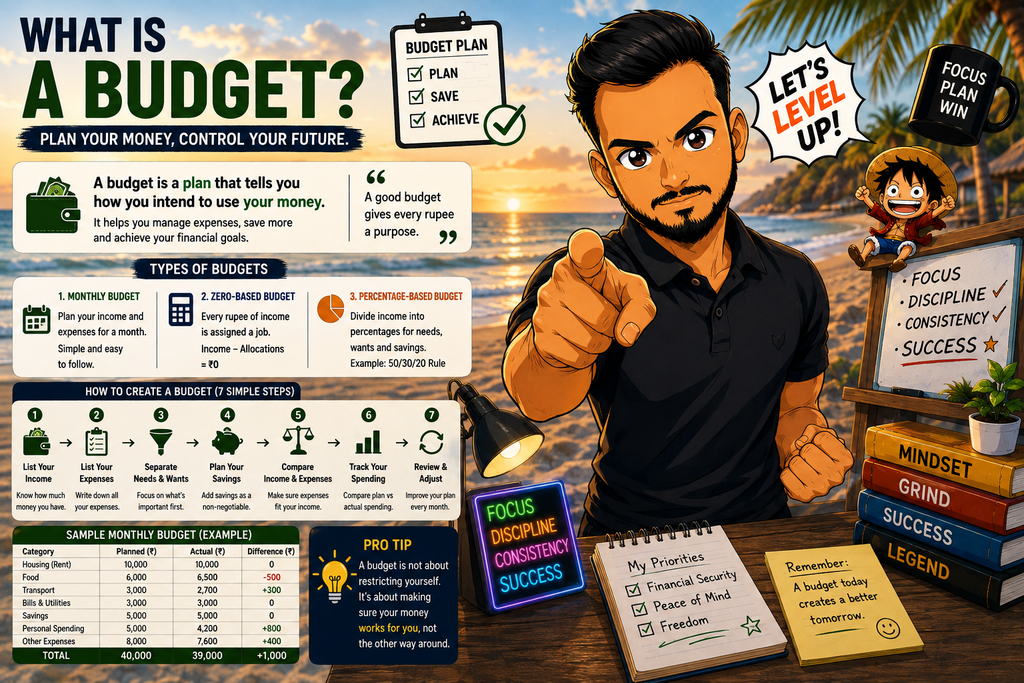
A budget is a plan that tells you how to use your money.

It helps you to how much money you can spend, save and use for financial.

Budget is not about stopping from spending money.

Deciding where your money should go before you spend it.

What Does a Budget Mean?

A budget is plan for you income and expenses for short duration like month.

Example

₹50,000 per month

  • rent
  • food
  • bills
  • Transportation
  • Saving
  • Personal expenses
  • insurance

there is no such sibgle budget for everyone.

The purpose is to give your money clear way.

Why Is Budgeting Important?

Budget gives you clearity using of your money.

1. A Budget Shows where Your Money Goes

without a budget you do not know your monthy salary where get spend.

When you create a budget, every spend have it own categories.

  • Food
  • Online Shopping
  • Subscriptions
  • Wants

Once you figure it out you get your number where you could less spend on it.

2. A Budget Helps You Priortize Expense

Not every expense has have same improtance.

budget helps you priotize you expense.

Higher Priority

  • Rent
  • food
  • bills
  • Transportation
  • Loan EMIs

Lower Priority

  • Enterainment
  • Personal wants
  • Subscription
  • Eating out

It simply means you should prioritize your expense first and after rest of it.

3. A Budget Can Help You Save

Saving become easier when you create a budget and include in it.

Example:

Income: ₹50,000

Spending the enire amount and saving whatever remains you can includes

Planned saving: ₹5,000

saving part of your financial plan.

the amount you save should be realistic as per personal situation.

4. A Budget Can Helps You Avoid Overspending

Lets say you plan to spend ₹7,000 for dinning out, shopping and enterainment, etc.

Once you reach this amount you automatically stop spend in this category.

this creates a simple boundary for uour money.

A Budget helps you become more aware before spending.

5. A Budget Helps You Plan Ahead

Budget isn’t only helps for today’s expense.

It’s also helps to prepaare for future expense.

Example

let say you have annually isnurance perminum every year

In three months you have to pay in full payment. So one timw wholly payment will shake your financial situation.

So you keep it in budget in advance before payment date come you keep aside some amount for insurance plan.

Preparing you today for tomorrow’s financial situation is budget.

What Are the Different Types of Budget

There is no such single budget types.

Common bduget plan:

1. Monthy Budget

This is simplest budget for beginner.

Create a Plan for single month of income and expense.

monthy salary person create easy by this types of budget to understand and maintain.

2. Zero Based Budget

In zero based Budget, every money of income for planned budget.

Example:

Income: ₹50,000

You allocation all money ₹50,000 like:

  • Rent
  • Expense
  • Debt EMIs
  • Enterainment
  • Subscription

Money Allocated to saving and EMIs repayment is also purpose.

3. Percentage -Based Budget

Budget divided into percentage based from income.

Categories:

  • Need
  • Wants
  • Saving or Invest

Very Popular and famous Framework 50/30/20 rule in budget.

Genrally

  • 50% Needs
  • 30% Wants
  • 20% Saving and Invest

This may change in Categories based on income, expense, debt and financial situation.

Don’t force your life into a budgeting rule that suit you financial situation.

Fixed Vs Variables Expenses

Understand your fixed and variable expenses

Fixed Expenses

This expense is fix and can’t change every month to month and can’t change in this expense.

Example:

  • Rent
  • EMIs
  • Fixed Transportation
  • Groceries

Rent= ₹12,000 every month

Variable Expense

These expense is change time to time.

Example:

  • Dinner out
  • Subscription
  • Fuel
  • Shopping

Example:

  • January Outing = ₹2,000
  • Febuary Outing = ₹2,750
  • March Outing =₹3,000

Create a Budget with types of expense in mind with realistic way.

How to Create a Budget Step to Step

You can use spreadsheet, note book. You don’t require of apps or software for it.

Step 1: Write Down Your Income

Start with your expected income.

Example:

Salary = ₹50,000

If your Income change every month assume it like lesser amount so if less money comes to your account you adjust in your budget plan.

Step 2: List Your Expenses

Write down all your expenses includes all fixed and variables expenses.

Example:

  • EMIs
  • Rent Food
  • Transport
  • Bills
  • Shopping
  • Outting and Enterainment

Tiny expense also to included into it.

Separate your Wants and Needs

Divide into Needs and wants

NEEDS

  • Rent
  • Food
  • EMIs repayments
  • Transportation

This are important and non-neogotiable every month.

WANTS

  • Subscription
  • Dinning out
  • Shopping

These are unimportant can be ignore and set into next month budget.

By this approach you get flexibility in your budget and piroritize.

Step 4: Add Savings to Your Budget

Decide your realistic amount of saving.

Example:

Monthy Income = ₹50,000

Saving = ₹5,000 with purpose

This is low but realistic amount you to save every month.

  • Emergency fund
  • Short-term goals
  • Long-term goals

Step 5 Compare Your Income and Expenses

Income – expense = Remaining Money

Example

₹50,000 – ₹5,000 = ₹45,000

If you have money left, you can decide use in saving, Loan repayment and other financial goals.

If your expense cross than income, then you has to reconsider your budget and chsnge into it.

  • Reduce unimportant spending
  • adjust your plan
  • review your loan
  • reduce unwanted purchase

Budget gives you visvible problem in your financial plan.

Step 6: Track Your Actual Spending

Beginning is to create a Budget.

you need to compare your planned and actual spending.

CategoryPlannedActual
Food₹6,000₹6,750
Dinning Out₹5,000₹6,550
Transport₹4,500₹5,250
Shopping₹6,000₹8,000

Now easily it visible that you has spend more or less than planned.

this simple gives idea to create a budget next time better.

Step 7: Review Your Budget

At end month, ask yourself:

  • did i stay with my budget?
  • where I spend more than planned?
  • Which expense I can Reduce?
  • Did I save Some money?
  • which Unwanted purchased I made?

Budget and financial journey continous and learning process.

first budget is not your final budget and it should not be perfect.

A Simple Monthy Budget for Beginners

let’s say someone income is ₹50,000

CategoryAmount
Essential expense₹20,000
Saving₹6,000
Debt Repayment₹10,000
Personal expense₹5,000
other expenses₹9,000
Total₹50,000

this just a example.

Everyone life is different from others.

so, rent may increase need to vary change in budget.

Someone living with parents there expense also low.

Your budget gives reflection of your actual life.

What If You Cannot Save Money?

Sometimes your income may just enough to cover your important expnese.

In that situation, you had create unreal budget without any certain percentage allocate in your budget.

First look into budget

Where is my budget going?

look for realistic opportunity

  • Reduce unnecessary Expenses
  • stop unwanted subscription
  • Campare your bills
  • Avoid impulse buying
  • look to increase your income

Build saving habit with small amoutn intially.

Common Budgeting Mistakes

Making a Budget and Never Checking It

A budget only become useful when start compare your expected expense with actual expense.

Forgetting Small expense

Small Purchase later added.

Making Budget too Strict

A budget with cut to cut allocate money is too difficult keep on track.

Copying someone’s Budget

Your income and expense is different from someone life. Create you own budget according to your cricumstances.

Giving Up Afte One Bad Month

Overspending is not mean that you has bad budget or fail in your financial journey.

Learn from it and review recreate with new budget.

Budget Vs Money Management

these Term are connected to each other but not exactly same meaning.

Budget

Budget is a plan for how to use your money.

Money Management

Money Management is a process to handle your income, expense, saving, Budgeting and managing debt.

Simple way

Budget = your money plan

Money managment = how to manage your money overall

FAQs

What is Budget?

A budget is a plan that tells you how to use your income for expense, saving and other fincial purchases.

Is budgeting only for People with Low Income?

No. Budgeting cane be useful at any income level because everyone needs to decide how use your money effective way.

How often shoul I make a Budget?

A Monthy budget is simle starting point for many people, who recieve salary monthy.

Can I change my Budget?

Yes. Budget should be flexible. so that you can adjust your unexpected expense can fit into it.

What is the easiest way to start budgeting?

Start with three things

  1. income
  2. list your expense
  3. decide where to save

Track and review your budget with actual spending.

Link this article to:

What Is Saving? Meaning, Importance, Types & How to Start | Article #9

What Is Saving? A Beginner’s Guide.

Saving is one of the simplest and most important financial habit you can develop.

you earn money for today, but you may need money for future may be for unexpected expense or emergency, planned purchase or important financial goals.

Instead of spend your recieve money you had keep focus on to keep aside money for future use.

this is called saving.

In simple words:

Saving means to keep aside small amount of money for future use instead of spend immediately.

Example:

if your income is about 35,000 per month. you has to immediately keep 5,000 month aside before spending on any penny from it.

Saving do not start with huge amount of money it may be start with very small amount of money.

For beginner, the Most important thing is to develop the habit of saving regularly.

Why Is Saving Money Important?

Saving Can gives financial safety net and help to prepare your future needs.

Some Important Reason to develop saving habits.

1. Saving Helps You prepare for Unexpected Expenses

LIfe is a full of unexpected moments.

For Example:

  • Vehicle Repairs
  • Unplanned Travels
  • unexpected bills
  • job lay offs
  • Home repairs

If you keep lumpsum amount of money aside for something unexpected events or emergency events.

this is why we called emergency fund and it is starting point.

2. Saving Helps You Reach Financial Goals

Many Goals Require Money.

Example:

Goal: Let’s say want to buy ₹50,000 worth PS5.

it is not save in one time directly one time money comes I will buy it.

Keep it simple way, Put a Side money Every month let say ₹5,000.

₹5000 X 10 months = ₹60,000

now go and buy it.

The amount amount may change as per your income, expense and goal time horizons.

The important is to start your saving towards your goal with smaller and regularly steps.

3. Saving can Reduce the need of borrow

let say you required urgent 15,000 for any important payment.

Car break down and you have tmororrow important meeting at your job. to attend meeting at right time. Car repair should done by today so that you go to office tomorrow on time.

In this situation you have no saving, first ideas comes to your mind is to borrow money from relative or friends.

If keep aside saving for this type of situation you have to just tap and transfer to service account without taking any new debt,

saving gives you this type Financial Flexibility.

saving willgive you this financial relaxation and without financial debt and keep you been prepared for future substances.

4. Savings Helps You Build Financial Discipline

Saving is not just one time amount gather and doing nothing after achieve this amount.

Example

someone just achieve amount of saving ₹35,000 and stop it from next pay month but other side somone regularly save ₹1,500 evem after achieve saving goals after ward also.

Consistency matters.

You can increase you saving over peroid of time to improves situation.

5. Saving Gives You More Financial Choices

Having money gives you more choices in life in nevery situation.

Example:

  • Planned purchase for your wants
  • Pay your important expenses
  • work toward your financial goals

Without saving, even smallest amount goes to unexpected expense feels lot of pressure.

Saving gives great sense of financial choices and flexibility.

What Are the Different Types Of Saving

All Saving not go for one purpose at a time.

For Beginner, give purpose to your saving to keep going it:

1. Emergency Savings

Emergency saving are money that kept aside for emergency situation.

Example:

  • Urgent medical bills
  • car repairs
  • home repair
  • loss job
  • urgent family financial situation

Purpose of saving should be stronger that even you get good discount any shopping still stick to your saving.

clear goals is to use for emergencies on;ly.

2. Short Term Saving

Short Term saving is for goals to achieve in next month to three months. Require this types purchase very soon.

Example:

  • Buying phone
  • starting a paid courses
  • planned trip
  • uncoming expenses
  • buy a laptop

3. Medium Term Saving

These types of saving goals required some more time to achieve goals.

Example

  • Buying Vehicle
  • Large planned purchase
  • International Trips
  • upgrade skill courses

these may take some ltime to achive but stick to it gives you money you get target.

4. Long Term Goals

Some saving requires longer time period.

Example

  • Buying Home
  • Education Aboard
  • Retirement

Long term goals, Keeping money aside may not enough

This types of goals requires invest in asset and work on assetto achieve long terms goals.

Saving and investing are not same thing.

Saving Vs Investing: What Is the Difference

Beginners often get confuse saving and investing.

Basic Difference:

Saving

Money is generally set aside for future use and emergency or planned goals.

Investing

Money is put into asset with expectation of growth over time.

Example

If you are planning for a goal for long term goals with many years away, just by saving that long term goals cannot achieve it.

Investment will comes in a way growth your money over period of long period time.

In Simple word investment will helps you grow your money with time for long period.

Investment can be done with your understanding of risk tolerence, income, saving and nature of investing risk.

How Much should You Save?

There is no amount that is perfectt for everyone.

Your saving capacity factor depends on:

  • Your Income
  • Your Saving
  • Your Expense
  • Your Debt
  • Your Financial Goals

People only able to save 10% of their Income.

Example:

Monthy Income: ₹50,000

₹50,000 of 10% is ₹5,000 only. start smaller amount for saving habit and later increase it.

How Can Beginner Start Saving Money?

New to saving, keep the process simple.

Step 1: Choose a Saving Goal

Give your saving purpose

example:

I want to Build ₹50,000 for a emergency fund

specfic target of saving makes saving easy.

Step 2: Decide on Regular Amount

Choose a amount realistically save on regular base.

Example:

5,000 for 50,000 salaried person is small amount to save.

Consistency is more important than choosing unreal amount to save.

Step 3: Save Soon After Receiving Income

Instead of waiting untill end of month and keep saving whats remains end of month, keep saving soon after receiving your income.

keep a saving early as income comes.

in simple words, pay yourself first

And than rest of it goes to your essential expense and personal.

Step 4: Keep Saving Separate

Keep saving money aside from regular expense money.

Put money in another bank saving account so that you can not touch or spend in daily money expense.

If you cutoff easy access this account and untouchable this account. It is easy to save the money easily.

Step 5: Track your Progress

Check your saving regularly

Example

Monthmonthy savingtotal saving
january₹5,ooo₹5,ooo
Febuary₹5,ooo₹10,ooo
March₹5,ooo₹15,ooo
April₹5,ooo₹20,ooo
May₹5,ooo₹25,ooo
June₹5,ooo₹30,ooo

Consistency is a key of saving habit.

Common Saving Mistakes Beginners Should Avoid

Saving Without a Goal

If you do not know the goal saving, after some amount saving you spend immediately.

Setting an Unrealistic Goal

tsarget should be suitable and realistic with your income, expense and saving capacity.

Using Saving for every wants

saving is for emergency not for every normal spending like shopping.

Ignoring Emergency Saving

Before focusing on long term goals, be prepared for enough emergency fund for unexpected situation or needs.

Camparing Your Saving with Others

Evryone have different income, expenses and situation in their life.

Your Financial Progress should measured in your own situation.

A Simple Saving Strategy For Beginners

You can start with three simple catgeories:

1. Emergency Funds

Money for unexpected situation.

2. Short-Term Goals

Money for planned spending for very soon for next or next to next month.

3. Long Term Goals

these money are for longer period time and it’s may takes around years and years.

Investing may helps you to grow your time over period time with higher returns.

These simple step simply say that without purpose for saving is just collecing money for dust.

FAQs

Whats is saving?

Saving means Keeping some amount of money aside every month for futre unexpected expense, futre financial goals and Needs.

Why Should I save Money?

It is Preparation of unexpected expenses, achieve future financial goals and reduce dpends of borrowing money.

Is Saving the same as investing?

No. Saving is to put money aside for future needs or wants. investing is for putting money into asset for long term period to growth of money and risk will be there.

How much money should a beginner save?

there is no such fixed amount that beginner should start. It depends on your income, expenses, saving and financial reponsibility but try to consistency keep saving regularly.

Where should I keep my savings?

There is no such fixed place to keep your saving. It’s all about in emergency how easily accessible your money without any delay or fine.

Link this article to:

What Is Money Management? A Beginner’s Guide | Article #7

What Is Money Management? A Beginner’s Guide

This is a common question everyone ask

“Where does all my money goes?“

You Earn money, Pay bill, buy things, save some money and make financial decisions throughout the month.

Simply earning money does not automatically mean that you know how to manage it.

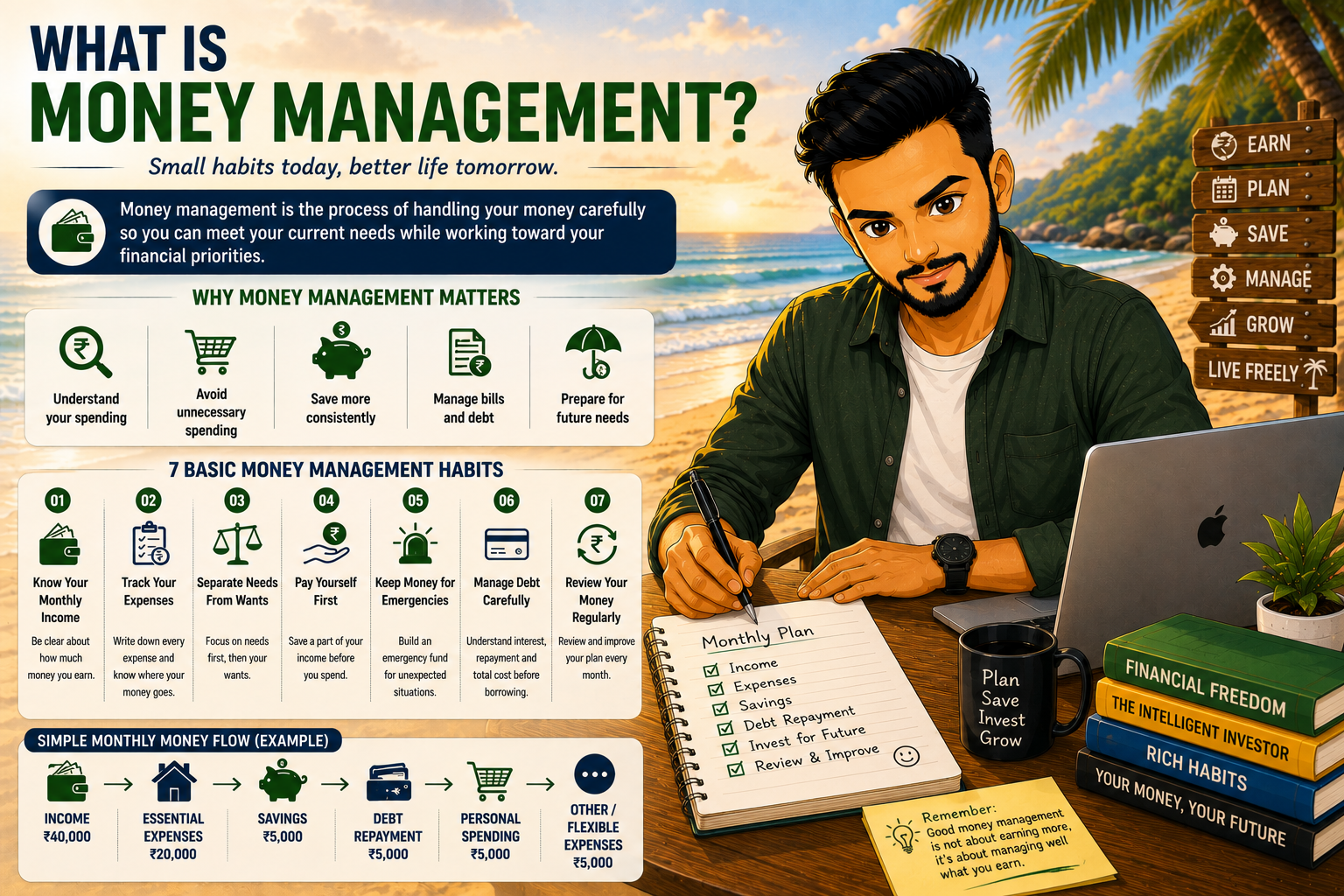
Money Management is the process your handling of money carefully so you meet your current need with working on future financial goals.

It Includes everyday Activity :

  • Managing Expense
  • track your Expense
  • Saving Money
  • Managing Debt
  • Preparing your future needs
  • Planning your cashflow

You can start with simple steps.

What Does Money Management Mean?

In Simple Mean

Money Managment means to understanding how much your earning, where to spend goes and how want to use it.

Imagine You Receive a monthy income of ₹50,000

  • Paying your essential expenses
  • Buying thing you want
  • Save money
  • repay money
  • Protection finance
  • money toward future goals

Money management helps you how to spend and save the money wisely insteady of spending it without knowing how much you have left.

A Simple Formula

Income → Plan → Spend → Save → Review

Simple cycle can help keep you on track of your money.

Why Is Money Management Important?

Food Money Mangement can make financial life more organized and better.

It can helps you:

1. Understand Your Spending

You can see actually watch where the money goes.

2. Avoid Unnecessary Spending

Tracking expenses can reveal purchase that may not important.

3. Save More Consistently

when you plan your money, saving should be regular every month.

4. Manage bills and debt

Panicking in last minute, make a plan for repayment of debt every monthy.

5. Prepare for Future needs

Managing today’s money can help your future financial goals.

7 Basic Money Management Habits for Beginners

you don’t need complicated financial plan to begin.

here is a seven simple habits.

1. Know your Monthy Income

Start with the money that comes to your account.

For someone with salary and small amount comes from bonds or FD.

For someone wigh freelance or business income, that income may change every monthy.

Example

Monthy Income = ₹35,000

Starting point of your monthy plan we got it.

2. Track your Expenses

Understanding your where it’s goes every monthy.

to track your money use like:

  • simple notebook
  • spreadsheet
  • track or apps
  • banking apps
ExpenseAmount
Rent8,000
Bill2,000
Food5,000
transportation3,000
shopping2,000
Enterainment2,000
other expense4,500

Goal is to just become aware of where money goes.

once you know your money goes, you get better with financial decision.

3. Separate Needs From Wants

Understanding the difference betweens needs and wants is simplest way of money management.

Needs

Expense that are important and can’t be chnage every monthy. This expense require every month atleast minimum.

  • Rent
  • Food
  • Bills
  • Transportation

Wants

This Expense is we wish to spend but it is not important.

  • buy a clothes
  • extra shopping
  • app subsription
  • expensive gadgets

The Important thing you get exact amount of every monthy required and how much you needed in your wants purchased.

4. Pay Yourself First

Most Easily or without doubt just put money aside from income before spending single penny .

Example

Income comes every 2nd of every month. Put aside on same day that can’t be touch even if you want.

Income: 35,000

Saving: 5,000

Saving first is more effectively than save in later on.

5. Keep Money for Unexpected Expenses

Not every expense is planned.

some expense come in unplanned way.

example:

repairs of vehicles

medical bill for family members

Unexpected bill or travelling expense comes sometimes.

This is why Emergency fund is very important part of money managment.

Emergency fund is for unexpected but important of that situation like opreation deposit, foreseen etc.

Using your emergency fund in enterainment, shopping or luxury shopping should not be done. it is for unexpected finnancial needs only.

6. Carefully manage debt

Debt is a another part of money mangment.

If you know your debt or credit balance:

  • how much money you owe
  • at what rate of interest
  • Your Monthy EMIs
  • Your Repayment
  • Total no. of loans or Total amount

Example

Loan should be managable with every month expense.

Before taking loan you should know your current debt status your repayment plan.

Borrowing money should be done in very decisive way so you can manage every time without regret.

7. Review Your Money Regularly

Money managment is not something done once and automatic goes every month or years.

You may get to change in:

  • chnage in income
  • changhe in expense
  • higher rent
  • new fianncial goals
  • new family responsibility

it is useful to review you monthy money.

this helps to know:

  • how much money spended?
  • how much money in income change?
  • how much money required in new financial goals?
  • How much money required in wants and needs?
  • Where am I can save more?

THis is a continous habits. it is a long journey of your life.

Money Managment Vs Financial Planning

These two terms sound same and closely related, but they are not exactly same.

Money Managment

Focus on handling your money effectively in everyday life.

Example

  • Track expense
  • paying bills
  • save regularly
  • manage debt
  • finance protection

Finance Planning

Focus on create an plan towards future financial goals.

Examplw

  • Puchase a house
  • children higher education
  • Setting Short-medium-long terms goals
  • Preparing retirement

A simple way to remenber it

Money Managment = Managing today’s money

Financial Planning = Managing today’s money toward future financial goals

How To Start Managing Money Today

Today:

Write down your monthy Income

This week:

Track your expense.

This Month:

Create a Simple spending Plan.

Going Forward:

Set aside save money regularly and review progress.

this not change your financial journey overnight. It’s takes time to reach to certain point og financial goals.

FAQs

What is Money Management?

Money Management means manage and controlling your income expenses, saving and debt so you can use it effectively.

What is the First Step in Money Managment?

A First step for money managment is to know your income expenses and saving.

How can I Manage my money better?

Starting tracking your expense, understanding needs from wants, create financial plan, saving regularly every month and pay off debt effectively.

Is Money management the same as budgeting?

Not exactly. Budgetting is a important part of money managment. Money managment also includes like income, expense, debt, saving and money protection from unexpected situation.

Can I manage money even if my income is low?

Yes. Money managment can be useful in different level of income. Just amount of needs, wants and saving may change but principle will be same. steps to track expense, start saving, pay off debt first aare same in every level of income.

ink this article to:

What Is Financial Planning? A Beginner’s Guide

Most People have financial goals. You may want to buy a car, Builds a Emergency fund, nut a home, start side hustle or business and prepare for retirement.

Having a goal is first step. you also need a think how to achieve that goal.

here is financial planning is important.

In Simple word, Financial planning is the process of creating a plan for your money to achicve your financial goals.

It includes understanding your current situation, what step taken over time to reach a future goals.

Financial Planning is not only for high income or wealthy person . Anyone with normal salry can do financial planning for there future financial goals in life.

let dive into article of financial planning with beginner friendly. to easily you can create your own Simple and understand financial planning.

What Is Financial Planning?

Financial Planning is a process of managing your money for future purpose or goals.

For example, you want a build your emergency funds let say 1 lakh for safe fund.

now you have give yourself target or identify how much i can save montnhy basic so that i can reach my target over peroid of time.

keep the smaller steps for easily to do without compromise in other expense or life of living.

I think ₹5000 every month is good amount and track your progress and review it if it is necessary with your situation.

Main purpose fo financial planning is to have clear direction of your money and use without any guilt in spending life.

Why Is Financial Planning Important?

Every one knows money is solve many problems of our life. but without planning of your money is like you running behind something that not have any direction where to go.

Here there some financial planning way to gives you help create it.

  1. Give Your money a Purpose

When you receive a salary or big payment from selling a asset anything like this you have many choices to spend it.

You can spend online or invest MFs and repay your debt or alloacate for future goals.

Example

  • Part of your money on your monthy expense
  • Repay of your debt
  • Build a emergency funds
  • Invest in Stockmarket or bonds.
  • allocate in sparate account for future financial goals.

2. It Helps You Set Clear Financial Goals

Financial Goals is something to do, expirence or buy thing which require of money.

Example:

  • Build a Emergency fund
  • Buy a Car
  • set child education fund
  • Buying home
  • Retirement fund

Financial planning have clear and exact goals.

I want some money in my saving. there is no define of “some money”.

I want ₹1 lakh money for emergency fund. I will save ₹5000 every to achieve this goals.

3. It Helps You Understand Your Current You Financial Situation

Before a Create financial planning you have understand your current situation of your financial.

Example:

  • Your Income
  • Your Expense
  • Your short term goals
  • How much saving do have right now
  • Your debt situation
  • Your financial Responsibiliity

Current situation is your foundation of your financial planning.

The 5 Basic Steps of Financial Planning

Financial Planning does not nee to be complecated.

Beginner Cand start with this 5 simple steps:

Step 1: Udnerstand Your Current Financial Situation

write down your basic financial situation.

Example

Income

How much money do you earn every month?

Expenses

How much money goes to necessary or personal expenses?

Saving

How much Money do i have in my saving?

Debt

what amount of debt i have in total and which interest have in my every loan and how much EMIs i have pay every monthy?

Step 2: Set Your Financial Goals

Your Financial goals divided into different Time Periods

Short-Term Goals

Goals that requires want in next month or before next 6 month

  • buying phone
  • build emergency fund
  • Pay off your tiny debt

Medium-Term Goals

Goal to completes in 6 -12 months of your planning period of time.

  • Starting a business
  • Paying tuition Fees
  • Buying a Vehicle

Long-Term Goals

Goal requires more than years like 2- 10 years.

  • Buying a House
  • Children Education
  • Retirement planning

Step 3: Calculate What You Need

Once you decided your goals, estimated your goals money how much it required to achive this money.

Example

let say You required a Emregency Fund of 1 Lakhs for a year.

Now tell yourself and decide how much money you can keep a aside without any change in your other expense.

Start with with small amount like 5000 every month before spending on other essential or personal expenses.

Your Every month plan can change as per income circumstance of very month. Just by create a plan is not right direction but excueate every month save regularly is more important to have it.

Step 4: Create an Action Plan

Now it’s time to do it in action regularly

Example

Build a Emergency Plan of 1 lakh

Action Plan:

  • Save Regular amount every month
  • Track of Progress
  • Save more if get extra money like bonus, or money from parents grandparents.
  • Avoid spending from save for emergency fund
  • avoid unnecessary purchase

Every person have different exact plan to achieve it.

Important thing is to move from

I want to save some day

rather than say

i will save small amount every month work for it.

Step 5: Review and Update Your Plan

Financial Plan is not something you just create it and not looking at again for action.

situation may change over peroid of time.

Example

  • Increase in income
  • Increase in expense
  • Add a new respinsibility
  • You may achive first goal and another requires more money than last one.

Financial Plan shouls be flexible enough to contiue your financial goal as change in your life.

Review your plan regulary can help to adjustment of with your life.

What Areas can Be Included in financial Plan?

Income Planning

How much money comes to your pocket every money and plan your income before it’s comes to your pocket.

Expense Planning

Understanding and mange your regulary expenses.

Saving Planning

Automate your saving by automaticaly transfer saving into your saving account or cash out and put it give it to your mother for future emergency situation.

Debt Planning

Identify your current debt,EMIs and plan your repayment of every month.

Investment Planning

Learning about investing to where invest instrument like MFs, stock market, golds and bonds.

Financial Protection

Thinking about Financial risk, emergency portection and good insurance needs.

Goal Planning

Goal clear planned into short-term,medium-term and long-term goals planning.

Financial Planning Is Personal

There is no such same financial plan for everyone.

Example

Two People have same salary and may have different situation.

First Person have:

  • Have family repsonsilbilty
  • Pay Rent
  • Having multiple loan EMIs
  • Sned money to home

Second Person Have:

  • Live with family
  • Lower expense
  • Fewer financial repsonsbility

Financial planning may change by situation

Financial Planning should be consider like:

  • income
  • expense
  • saving
  • insuarance
  • parent dpendence
  • goals
  • debts
  • time peroid

this is called Personal Financial Planning.

Common Mistakes to Avoid When Financial Planning

Beginners may make common Mistakes.

  1. Having no Clear Goal

It is difficult to plan or take action that you do not know how much money to have achieve your goals.

2. Create a Uncrealistic Plan

Plan your current situation of financial.

saving should be realistic so that you can save regularly and consistently and easy to maintain.

3. Ignoring Unexpected Expenses

Life can change, create a financial planning with flexible so it can adjust by money and you still stick to your plan that you created you planning.

4. Trying to achieve Everything at Once

You may have many financial goals

Start with most important priorties trying into action to achieve toward goals.

5. Never Reviewing your Plan

Your fiancial Situation required review your plan regular or required may change to achive it.

FAQs

What is Financial Planning?

Financial planning is the process of creating a plan for your money to achicve your financial goals.

What is the first step in Financial planning?

The First step to undertanding your financial Situation,including your income,expense and debt financial repsonsilbity.

Is Financial Planning Only For Wealthy People?

NO. Financial Planning is for everyperson with lower income to higher income. Mainly understanding your money and setting goals as per income level.

How Often should I review my financial Plan?

you can review regular time and when you may major change in income,expense, financial goals.

Do I need to Know about investing to start financial Planning?

No. Beginner can start with basic concept likr income, expense,budgeting and manage debt. Investment is knowledge can be learn gradually.

ink this article to: