What Are Expenses? A Simple Guide to Understanding Where Your Money Goes

What Are Expenses?

Expenses are the money you spend to pay your bills, good , services, rents and daily spending.

In simple Words:

Income is incoming to your pocket. Expenses is that goes out of the pocket.

Example:

Let assume, your income around ₹50,000 per month and you spend around ₹25,000 on your bills, rent, food, transportation and other things, that ₹25,000 is your every monthy expenses.

Understanding your expenses help out where your money is actually going.

Why Should You Understand Your Expenses?

Many of people know there monthy income but don’t know how much they are spending on monthy basis.

This can create problems in future.

If your expenses are consitiently higher than your income, that a create problems by taking borrowing money from friend or taking debt from financial instituational.

Undrstanding your expenses help you to:

  • Create a realistic budget
  • Reduce unnecessary spending
  • Increase savings
  • Avoid debts
  • Prepare for future goals
  • Find a way to invest

Types of Expenses

Expenses is divided into two catgeories:

1. Fixed Expenses

Fixed expenses is expenses that become same from every month to month basis.

Example:

  • Rent
  • EMIs
  • Insurance premium
  • yearly house mainteance

If your rent is ₹15,000 every month is fixed expenses that you have cleasr every month to month. not matter how much tide your financial situation for that time period.

2. Variable Expenses

Variables expenses that may change from month to month basis.

Example:

  • Fuel
  • Groceries
  • Electricity
  • Enterainment
  • Shopping
  • Subscriptions

Example:

you might spend on food and enterainment one month ₹7,000 and next month you spend around ₹11,000.

In simple chanages in your spending every month it may be less or more it is depends on your spending habits.

Needs vs Wants

This is very useful concept in our personal finance. This will give you understanding your spending habits, what is essential and non essential spending.

Needs

Needs are those things that you required every month for day to day life basis.

  • Food
  • housing
  • basic transportation
  • essential healthcare
  • utilities

Wants

Wnats are those things that make your life enjoyable and happy but it is not essential for daily basis.

  • Buy or upgades your gadgets
  • Restaurant meals
  • Enterainment
  • luxury purchases
  • unnecessary subscriptions

This is doesn’t not mean you have to not to spend money your wnats and not to eanjoy your life.

The goals is to enjoy your life and money but without damaging your financial future goals and life.

How to Control Your Expenses?

You don’t need to stop spending your spending money completely.

Track your spending

Write down your your expenses or use a budgeting apps or use a spreedsheet.

you may discover that unwanted and avoidable small purchased.

Separate Needs and Wants

SImply ask before buying something:

“Is i really needed or just want it.”

you don’t always have to choose “no.”

the question helps you to make consious decision.

Review Subscriptions

Check your rerpeating payements

You may be some payments of your service that you rarely use in your life.

Set Spending Limits

Give yourself a realistic and budget friendly limits to spend in such such catgeories like entairnment, dinner out, hobbies luxury purchase and shopping etc.

Avoid Lifestyle Inflation

When your Income increase, stop increase your expenses too.

Instead, try to those increase income into some increase towards investment or saving.

Expenses Are Not Always Bad

Spending money isn’t automatically a bad thing.

You need spending to live your life.

The problems is arise when you keep spending consistently excees your afford limit or preventing you froma chieving your fianncial goals.

Good money managment is not always least spending, but is to put it in mind financial pirorities that helps you to achieve future financial goals.

Spending according to your pirorities. affordability should be in your mind as per your financial situation.

Income and Expenses Work Together

Simple Equation keep in mind:

Income – Expenses = Available money remains for loan repayments, Saving and Investing.

If your Expenses are in keep in control and income higher than your expenses, so you may more money available for your financial goals.

If your expenses are more than your income, it may create problems for your future fiancial goals.

That why understanding both sides is important.

FAQs

What are expenses?

Expenses are the money you spend to pay your bills, good , services, rents and daily spending.

What are Fixed Expenses?

Fixed expenses is expenses that become same from every month to month basis. Example EMIs, Rent etc.

What are Variables Expenses?

Variables expenses that may change from month to month basis. Examples: foods, Outing, enteraiment, subscriptions and shopping etc.

What is the difference between a Need and a Want?

A need is basically you required in your day to day life expenses, and wnats are those you desire to have but it not important into your life.

How can I reduce my expenses?

Tracking your spending, review repeating costs, avoid unnecessary wants and purchased ans set purchased limits.

Link this article to:

What Is Income? A Simple Guide to Understanding Your Money

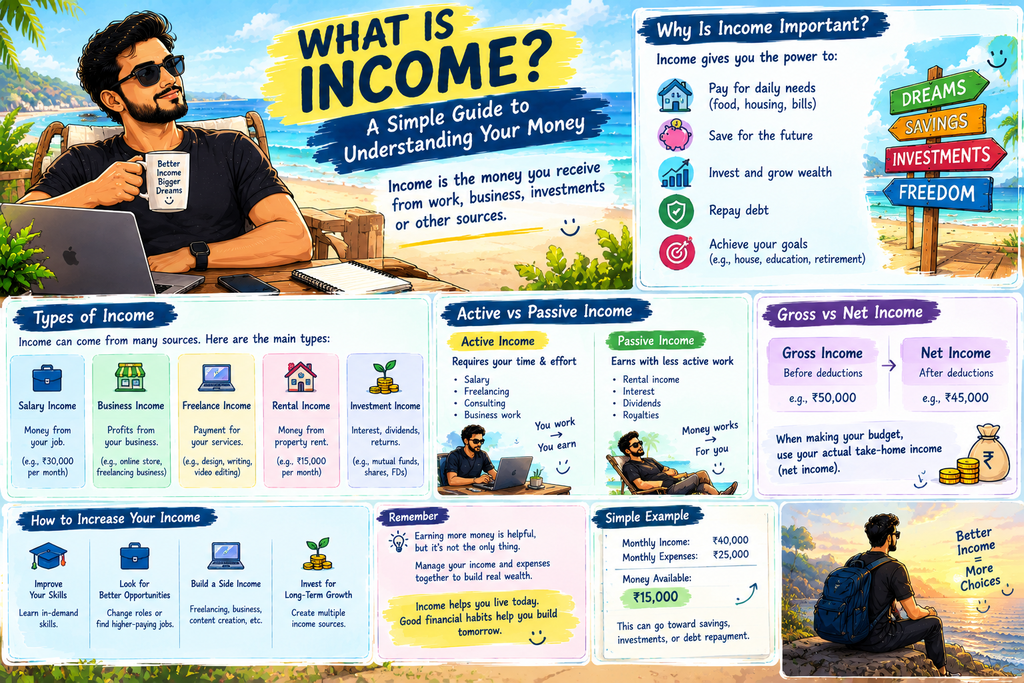
What Is Income?

Income is the money you receive from work, business, investments or other sources.

In simple word, Money that comes into your pocket or bank account.

Example:

30,000 per month comes to your bank account as salary by doing job in a company. So, this 30,000 is a income source of yours.

But only salary income is not a limit.

You could also receive money from business, freelancing, rent, Investment or other resources.

Understanding your income is the first steps towards managing you money properly.

Why Is Money Important?

Income provides the money you use to pay for day to day life and future goals.

Your income in:

  • Pay for food gorecies
  • Rent
  • save money
  • Invest for future
  • Build an emergency fund
  • Vacation
  • achieve financial goals
  • travels

Simple step of personal finance:

Income – Expenses – Savings – Investments – Wealth

Different Types of Income

Income has many different source:

1. Salary Income

Salary is money you earn from your active work.

Example:

Monthy Salary = ₹40,000

It is easier to plan a budget. if you get salary every monthy way.

2. Business Income

Business income is money came from running a business.

Example:

Let’s say someone started a online store 1 year a old and makes around ₹40,000 in sales.

Sales are not same as income or expenses.

If your business spends ₹15,000 on products, delivery, advertising and other cost the amount left after expenses are very smaller.

This is why business owners need to understand both incomes and expenses.

3. Freelance Income

Freelancers earn money by providing a service to clients for single time or multiple times sometimes.

Examples:

  • Graphic design
  • Writing
  • Video editing
  • Programming
  • Consulting

Freelancing income changes every month to month.\

4. Rental Income

If you own any house or porperties and rent it to someone , the rent comes to you is rental income.

Example:

Monthy Rent =₹13,000

It can be residential or commerical property. If you multiple property it is good source of income.

5. Investment Income

Investment can potentially generate through thing such as:

  • Dividend
  • interest
  • rental income
  • buy low and sell high

Investment returns are not guarnteed and amount can vary after taxes reduced on your investment.

Active Income vs Passive Income

Active Income

Active income comes from where you give your time or skills. Active owrking on it to earn.

Example:

  • Job
  • Freelancing Consulting
  • Business work

You work and recieved money in return.

Passive Income

SOme income work ccontinues for 24 hours dily without your active involvement into it after it is established.

Example:

  • Certain rental income
  • Interest
  • Dividends
  • Royalties
  • online store

Passive income not fully automated, it is required some work time to time.

It is required some time updation, omgoimg management.

Gross Income vs Net Income

Gross Income

Gross income that earn amount earned before deductions.

Example: ₹40,000

Net Income

Net Income is the amount you earn after applicable deductions.

Example:

  • Gross Salary: ₹40,000
  • Deductions: ₹5,000
  • Net Income:₹35,000

When you creating budget always keep in mind make a budget on net income.

How Can You Increase Your Increase?

There are sevral ways to increase your income

Improving your skills

Learning valuable skills can increaase you earning potential.

Example:

  • Technology
  • sales
  • design
  • fiance
  • comminication

Ask for Better Opportunities

You may increases your salary by changing roles, taking on project or additioonal responsibiltiies or finding better opportunity.

Build a side income

You could potentially earn additional money through freelancing, small business, digitla products, content creation or legalimate works.

Build Long Investment

As time goes, invetemtns may create additional income of retuns or income.

Long term investment work on there on own by time into years and years.

Investing involves risk into it, it is not a gurantneed income.

The Goal Isn’t Just to earn More

Earning more money is useful, but just earning more alone doesn’t automatically create wealth.

Imagine:

Person A earns ₹50,000 ans spends ₹48,000.

Person B earns ₹40,000 and spends ₹30,000.

Person has left ₹10,000 left and less erning saving rate is more.

This is why income important but saving and investemnt also most important.

FAQs

What is Income in simple words?

Income is the money you receive from work, business, investments or other sources.

Is Salary the same as income?

Slary is one types of income. income can be many more types of incomes.

What is Gross Income?

Gross is a amount before deductions.

What is Net income?

Net income is amount after applicable deductions.

How can Increase my income?

Learning valuable skills can increaase you earning potential.

Example:

  • Technology
  • sales
  • design
  • fiance
  • comminication

Link this article to:

Step- Up SIP Calculator

📈 SMART INVESTING TOOL

Step-Up SIP Calculator

Calculate how increasing your SIP investment every year can help you build a larger investment corpus.

Currency conversion will appear here. Ready
Total Investment ₹0
Estimated Returns ₹0
Final Value ₹0

Investment Breakdown

Final Value ₹0
Investment
Returns

Year-by-Year Growth

Year Monthly SIP Invested Returns Final Value
Disclaimer: This calculator is for educational and illustrative purposes only. The expected return is an assumption and is not guaranteed. Actual investment performance may vary. Currency exchange rates fluctuate and may affect the converted value. This calculator does not constitute financial, investment, tax, or legal advice.

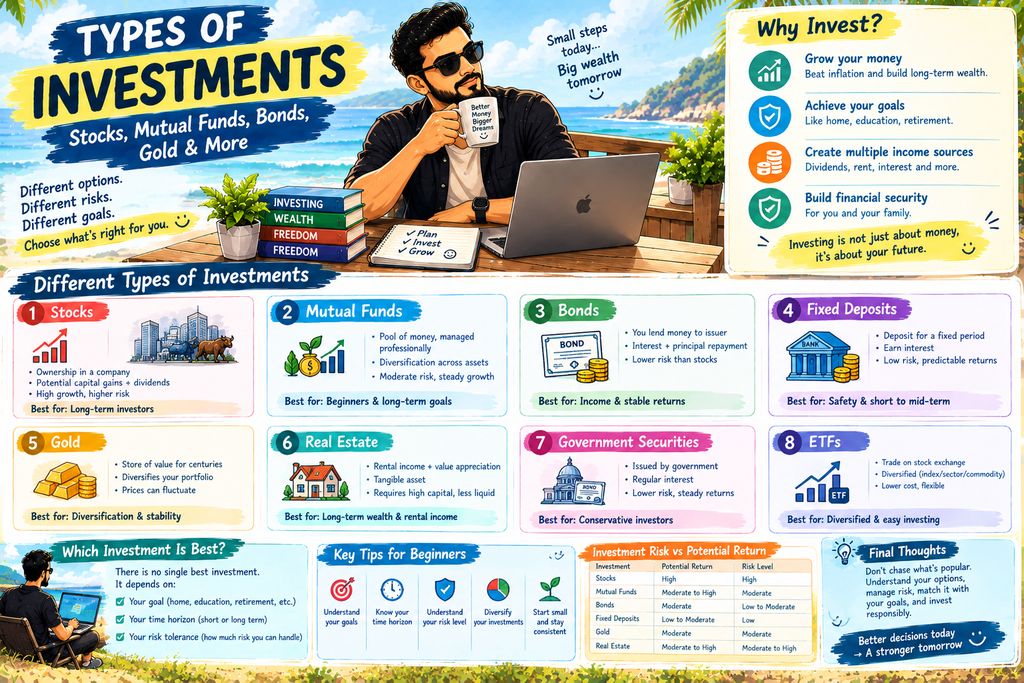
Types of Investments: Stocks, Mutual Funds, Bonds, Gold & More

What are the Different Types of Investments?

Once you unserstand what investing is your next question arise:

“Where I am suppose to investing like in which assest or instrument?”

There are differment types of investment option available. Each one have there own risk level, Potential Returns, Liquidity and purposes.

You don’t need to invest in every Instrument or assets.

The Goal is to Understand the investment option and choose as per your financial goal, responsbilities, and risk tolerence.

Let look into common types of investment available in simple word.

1. Stocks

When you buy shares of a company you are buying small ownership stake in company.

Example:

If buy shares of listed company shares from market, you become a small part owner of that company.

How can you make money?

  • Increase in share price
  • Dividends, if company pays

Advantages:

  • Start with small amount in stocks
  • High potential in long term growth
  • Eay to buy or sell in market hours

Risks:

Stock price fluctuation every day price fall and rise.

Stocks is best for those who have patience for longer time period and risk tolerence is better.

2. Mutuals Funds

A mutual funs collect money from many investor and invest that money a portfolio of assets according to its investment strategy.

Example:

Buying individual companies shares, Euity mutual fund may invest in shares of multiple companies. According to the fund strategy.

Advantages:

  • Professional managment
  • Diversification
  • Many diiferent fund to invest
  • SIPs make easier to invest regularly

Risks:

Mutual funs are not risk free. There risk depends on the assets and strategy of the particular fund.

Bets suited for: Investors who want diversification and don’t necessarily wan tot select individual stocks.

3. Bonds

A bond is essentially a form of borrowing.

When you purchase a bond, you are lending money to a brorrow such government or a company, according to a bond terms.

In return, the bond may provide interest payments and repayment od principal according to bond terms.

Advantages:

  • Can provide predictable income
  • Can play role in portifolio diversification
  • Some bonds are very low risky than stocks.

Risks:

Bonds still carry some risks, includes credit riaks, market pricefluctuation and interest rate risk also.

Best Suite for:

Investor who looking for diversification and regular income other than salaries.

4. Fixed Desposits

Fixed deposits Commonly called as FDs, allow you to desposit money with bank or institution for specfic period ot time and earn interest.

Advantages:

  • Simple to understand
  • Fixed return to guarntee
  • predictable interest
  • Generally lower risk than market linked investment

Risk:

Returns are generally lower risk than potential long term returns of higher risk assets.

You can withdrawn after fixed term pass.

You should aslo consider taxation, inflation and term for premayure withdrawal.

Best suited for:

Investors who looking dor stability and fixed returns.

5. Gold

Gold has been used as a store of value for centuries.

People can gain exposure to gold in many forms like in physical, digtial form and Certain fiancial insturment linked to gold.

Advantages:

  • Can diversify in portfolio
  • Globally recognized as a assets.
  • May provide safety in bad economic in personal or country.

Risks:

Gold prices also fluctuate.

Physical goals can also sotage, security, making charges and other cost depending on the form pruchases.

Best suited for:

Investors who wants gold in their portfolio.

6. Real Estate

Real estate include such as residential property, commerical building and land.

Investor may can make money:

  • Appreication in property value
  • Rental income

Advantages

  • Rental income
  • Long term apperication potential
  • Physicl asset
  • land value appericated more

Risks:

Real estate required good amount o capital.

It is difficult to seel quickly and investor faces maintenance, legal and other costs.

Best suited for:

Investors who have good capital and long term investment.

7. Government securities

Government issue securities to borrow money.

Dpendign on the countryand security these include treasury bills and govrnement bonds.

This bonds are very lower risks than equity investment and many corporate, but they are not completey free from risk.

Best suited for:

Investor who want to predictable reurn and lower risk investment.

8. Exchange-traded Fund(ETFs)

Which Investment Is Best?

There is no single best investment for everyone.

Your Goal:

  • A House
  • Retierment
  • Education
  • Wealth creation
  • Future business
  • Another long term goals

Your Risk Horizon

Money needed in the next year is very difficult to grow.

Money you won’t need over 20 year period.

Longer time horizons can give investor ability to tolerate fluctuations.

Your Risk Tolerence:

Your tolerence depends on your family responsilitibies, income, expenses and savings.

Don’t put All Your Money in One Place

One Important investing to be done by everyone is diversification.

Diversification means spreading your investment across different assets rather than put it in one place.

Example:

You have 1000 rupees at your hand . instead of putting in one asset you smal amount in different asset like 200 in gold, 300 in mutual fund and 250 in ETF remaining ion government bonds.

Diversification can reduce your risk of losing your money by putting into at one asset place.

Investment Risk vs Potential Return

A useful beginner concept is that risk and potential retuens are connected.

Investment with greater potential are can experience great looser sometimes.

Example:

Stocks – Higher growth potential + Higher volatility

Bonds – Genrally lower volatility than stocks, risk remains.

Fixed Deposits – Predictable returns, generally low risk and regularly income.

They serve different purposes.

FAQs

1. What are main types of investments?

Common Investment types includes stocks, mutual funds, bond, fixed deposits, gold, real estate, government bonds.

2. Which Investment has the highest return?

There is no such investment that consistently provides return every year without any risks. higher potential returns may have higher risk.

3. Are Fixed deposits an investment?

Yes. Fixed deposits is an investment products that provides interest according to its terms.

4. Are mutual funds safer than stocks?

Not necessary. mutual funds can be diversified, which may reduced risk but their investment can still lose value.

5. Should beginners invest in multiple assets?

Diversification can be useful, but the mix appropiate dpends on your goals risk tolerence and financial situation.

Link this article to:

What Is Investing? A Beginner’s Guide to Growing Your Money

What Is Investing?

Investing means Putting money into fiancial produect with a goal of growing over time.

Insted to keeping all your money unused , you some money into asset that may increase in valye and generate income.

Example:

  • Stocks
  • Mutuals Fund
  • Bonds
  • Golds
  • Real Estate
  • Fixed Desposit
  • Other Investment assets

The main idea:

Save money for safety.Invest money for future growth.

Investing is not same as simply puttuing into account and expecting to grow. Investing involve different level of risks, returns and time commitment.

Why Do People Invest?

One major reason people invest si to help their money grow faster than it.

Let say you have ₹ 1,00,000.

If you cash out this all ₹1,00,000 remain or may be lost just keep it Unless added more money into it.

But if you put it into some asset for long term there will generate returns to increase value over period of time.

Remember:

Investment Rteurns are not guaranteed and actual can be higher or lower.

Saving Vs Investing: What’s The Difference

Saving and Investing are Both Important, but they have different purposes>

SavingInvesting
Usually focused on safetyFocused on long-term growth
Generally lower riskRisk varies by investment
Useful for short-term needsOften better suited to long-term goals
Easier access to moneySome investments may take time to sell
Usually lower potential returnsPotentially higher returns, with higher risk

Example:

  • money you may need in emergency or unexpected events so you can put it easy accessible saving products.
  • When money are not required for longer period time you can put it in investment without any disturbing this money for growth over period of time.

How Does Investing Make Money?

There are several ways of investment can generate returns:

1. Capital Appreciation

An asset can increase in value.

Example:

Your house value at time of buying is ₹25,00,000 and after 10 years to hold this house its value grow upto ₹50,00,000.

This potential growth this appreciation of ₹25,00,000 if you sell at that price.

2. Interest

Some investemtn pay interest.

Fixed and bonds are pay in interest of yours returns.

3 Dividend

Some companies shared there to shareholder in form of dividends.

Dividends aren’t guranteed for every company.

4. Compounding

Compunding happens when your investment returns begin generating returns in their own.

This is the one reason time can be extremely valuable for long term investor.

What Can Beginners Invest In?

There isn’t one investment that is perfect for everyone.

Differment investment have differment level of risks and potenetial return.

Stocks:

When you buy stock of a company, you become part-owner of a company.

Stock can provide long term groeth potential, but hteir prices can also rise and fall.

Mutual Funds

Mutual funds collect money from the investor and invest it in market accordingly to fund strategy.

They provide diversification and are available in different categories.

Bonds:

Bonds are genrally debt instrument where investor money to a goverment , toa company or brorrow in reutn it return and repayment according to the terms.

Fixed Deposits

Fixed deposits allow you to deposit money iwth in bank for specified period of time and earn interest.

There are generally consider as low risk than market linket instrument although the exact risk and term depend on the insitiuation or product.

Gold

Gold can be purchased in form of digital, Physical and Invest in gold account through jewellers.

Gold gives balance in your protfolio and diverified.

Real Estate

Property can potentially genrate rantal income and appreciate in value.

Reals estate reqires large amount of Capital in beginners and can be less liquided than fiancial instrument.

What Is Investment Risk?

One of the most important thing beginner keep in mind:

Every investment does not provide guaranteed returns.

Investment with higher potential returns can be also involve higher risks.

Example.

Stock Price changes every day to day because of company depends Performance, growth, investor sentiment and many others factor.

This does not mean you should avoid investing.

It means you should understand what is investing and how much risk you are taking.

Why Is Starting Early Important?

Time can be Investor’s biggest Advantages.

Let say two people started investing

Person A start investing at age of 25.

Person B Start Investing at age of 35.

Even if they invest similar amounts, Person A has additional Decade for their money to potential grow and compound.

That’s why you do not need high amount of money to begin learn about investing.

The bigger investing is just start as early as you can.

Can You Start Investing With a Small Amount?

YES.

You don’t need lakhs or thousand money to start investing.

Depending on the investment product, people can start investing with smaller amount of money.

Example:

Best way to start with early and lower amount SIP Systematic Investment Plan a fixed amount regularly into egible mutual Fund.

The Important thing is not invest that required immediately for emergencies and essential expenses.

A Simple Beginner Investing Process

If you compelty new to investing , you can follow tih this step to step:

Step 1: Understand your income and expenses.

Step 2: Build a Emergency Funds

Step 3: Understand your financial goals

Step 4: Learn about different investemtn options.

Step 5: Understand the risks before investing.

Step 6: Start with invest with smaller amount as you comfortable.

Step 7: Invest consistently

You don’t required to learn everything before learn.

You should understand an investment before putting investing money into it.

Common Investing Mistakes Beginners Make

Investing without understanding

Don’t invest simply just seening from social media somone saying this make you get rich.

Chasing Quick Profits

Investing long term process, not a guarntee shortcut to becoming rich quickly.

Putting Everything Into one Investment

Putiing all eggs into one basket become risky. Same as Putting all money into one assets make your protfolio risky.

Diversification is best ways minmize your risk by putting into different asset.

Investing Money You Need Soon

Plan separately for those money you required in short term goals purchurse. Investing is long term journey.

Ignoring Risk

Don’t look only on returns.

Investment are mostly from market-link product it may go up always and may goes into negative.

FAQs

What is Investing in simple words?

Investing means Putting your money into an assets with the expectation that it may grow in value or genrate income over the time.

Is Investing the same as saving?

No. Saving genrally focus to keep safe and accessable money.

While Investing is focus to grow money on long term and create wealth with risk involve.

Can Beginners Start investing with little money?

Yes. Some investment products allows people to start with small amount money but it is depends on product rules and regulations.

Is Investing Risky?

Yes. The level of risk depend on the investment. market-linked investment can lose value and return is not Guaranteed.

What is best Investment for beginners?

There is no single best investment for everyone. The appropiate choice depends on your goals, income, expense, risk tolerence and financial situation.

Id dpends on your goals and investment. Long term investing is genraly good when you keep remains invested at as long as time period.

Link this article to:

Saving vs Investing: What’s the Difference and When Should You Do Each?

Saving vs Investing: What’s the Difference and When Should You Do Each?

When you start learning about Personal Finance, you often hear two important words: Saving and Investing

They sound same but different purpose.

Saving is mainly about keeping money afe and avilable for your shot -term goals.

Investing is about putting money into asset to grow money over period of time.

understanding the difference can help you to decide where your money shopuld go instead of simply keeping in saving account or investing everything without a plan.

“Saving vs investing infographic showing a young man at a beachside desk, comparing saving for short-term security with investing for long-term growth, including differences in risk, time horizon, access to money, potential returns, and when to use each.”

What Is Saving?

Saving means keep aside part of your income insted of spending it.

You might save money for:

  • Emergency fund
  • New phone or laptop
  • vacation
  • Purchase a vehicle
  • Annual expense
  • Short term financial goals

The main focus of focus is safety and accessibilty.

Saving to be available when you need it.

What Is Investing?

Investing means Putting money into assets for longer period to grow and genrally income over a period a time.

Example:

  • Mutuals fund
  • Stocks
  • Gold
  • Bonds
  • Exchange -traded funds

Investing genrally for long term financial goals.

Investing is risky so no such gaurantee of returns. it is all linked to market.

Saving Vs Investing: The Main Difference

Easiest way to understand the difference is:

Saving protect money for short-term goals and investing is grow money for future goals.

FeatureSavingInvesting
Main purposeSafety and short-term needsLong-term growth
RiskGenerally lowerCan be higher
AccessUsually easierDepends on investment
Return potentialGenerally lowerPotentially higher
Suitable forEmergency funds and short-term goalsLong-term goals
Value fluctuationsUsually limitedCan rise and fall
Time horizonShort termUsually long term

Why You Need Both?

You don’t necessary to choose between saving and Investing.

A healthy financial plan is keep both in plan.

Think in your money as having different jobs.

Money for today and emergencies- saving

You mau need this money soon, accessibility and stability matter.

Money for future goals to grow – Invest

If you need create wealth and you want this money for longer time period .Investing is goopd option to grow your money.

Example:

Monthy – Expense – Savings – Investments

The amount for each catgeory depends on your Personal Situation.

When Shouls You Save?

Saving Should generally comes first for important short-term financial needs.

  1. Emergency Fund:

Before taking risky investment, build emergency fund is safety cushion for this type of circumstances.

This money can help for unexpected expenses or temporary loss of income.

2. Short terms Goals

If you need money within next few months ot in a year keep it in low risk and accessible place may be more appropriate than putting into volatile investment.

Example:

  • High value courses
  • Vehicle down payment
  • Annual Insurance payment

Stability becomes important when you neede in shorter period of time.

When Should You Invest?

Investing can make more money when you give your money loner period time it can be many years and you have tolerate to fluctuation in value.

Example:

  • Retirement
  • Long term wealth creation
  • Children future education
  • A long term Independence Goal
  • Other goals many years in future

Long term investing i still risk involves and right investment depend upto risk take ability and your goals.

What Happens If you Only Save?

Saving money is important but keeping all your money in low risk and low return sving for many year can create another problems.

Over long periods, rising prices can reduce what your money can buy.

Example:

Today ₹10 pen may cost more in the future.

This is th main reason people consider long term investing for future goals.

What Happens If You Only Invest?

Investing without maintaining accessible saving can create poblems.

The market go to low and you required some amount for urgent purposes.

You might need to forcefully withdrawn your investment when it is at it’s lowest.

This is why emergency fund is appropriate short term goals is important.

Investemnt are for future. Saving are your fiancial cushion.

A Simple Money Systems for Beginners

Layer 1: Daily Expense

  • Food
  • Rents
  • Bills
  • Transportation
  • other regular expenses

Layer 2: Safety Money

  • Short-terms goals
  • Emergency Fund
  • Unexpected expenses

Layer 3: Growth Money

  • Long-term investments
  • Retirement
  • Wealth-building goals

Common Mistakes to Avoid

Mistake 1: Investing Your Emergency Fund

Emergency money Should genrally for priporties safety and accessibility rather than maximum returns.

Mistake 2: Keeping long term money complelty idle

If money intended for goal many years away consider whether simple holding cash or low risk saving accounts.

Mistake 3: Investing Without Understanding risk

Never invest simply vecause someone promises high returns.

Understand what are you buying and how much you could potentially lose.

Mistake 4: Confusing Saving With Investing

Putting aside and investing money are not same thing.

Both are useful, but they solve different financial Goals.

Mistake 5: Ignoring your Goals

Your Fiancial goals should influence where you keep your money.

Vaction for next year, Early Retirement 30 years from now should not necessary be treated the same way.

How Much Should You Save and Invest

There is no single percentage that works for everyone.

Your income, expenses, debt, Financial Reponsinility and goals all matters.

Bindly making rule ask yourself first this question:

  1. Are my basic expense covered?
  2. Do I have an emergency Fund?
  3. What financial goals am I working towards?
  4. Which are short term goals and wjich are long term goals?
  5. Di i have expensive debt that needed attentions?

Once you understand these things, you can decide how much money should remain in savings and how much money should remain in Long-term Investing.

Saving vs Investing: The Easy Rule of Remember

Simple way to remember the difference:

Need the money soon?

Save it

Need the money many years from now

Consider investing it

Need Protection against unexpected expense

Build an Emergency Funds.

Want to Build Long term Wealth

Consider Investing it

FAQs

Is saving better than investing?

Neither is automatically better. There have different purposes. Savibg is useful for safety and shor-term goals, whil investing for long term goals and wealth creation.

Should I save before investing?

For many beginner, Building saving for basic essential monthy expnenses and emrgency fund should there so not create problems in between long term investing like urgent withdrawn for urgent purposes. It is important saving like safety cushion

Can I save invest at the Save time?

Yes. In Fact, many people use saving for short terms goals or needs and while investing for long term future goals.

Is Investing risky?

Yes. Market-linked investment can rise and fall in value. Higher potential returns genrally come with greater risk.

How Long Should I Invest My money?

Id dpends on your goals and investment. Long term investing is genraly good when you keep remains invested at as long as time period.

Link this article to:

How to Build an Emergency Fund: A Simple Guide for Beginners

How to Build an Emergency Fund: A Simple Guide for Beginners

Imagine your car nneds arepair, uneexpected medical expenses ot your income stops for a while.

These situation cann be stressful especially when you have no money keep a side.

An Emergency fund gives you fiancial safety net for unexpected expenses.

It helps you to manage difficult situation without depending on loans, credit cards or any other borrowing products.

The good news is that you do not required larger salary to start. Even with small amount saved with regularly help you to build financial security.

Before we further go to in this article go check earlier related to Article

What Is Emergency Fund?

In this article, you will learn how to build an emergency fund, how much you have to save, where to keep it and how to start from zero.

What Is Emergency Fund?

AN Emergency Fund is money that kept aside specifically for unexpected expenses and important expenses.

Example:

  • Sudden medicial expenses
  • essential home repairs
  • Unexpected Travel for family emergency
  • Temporary loss of income

The Purpose is clear if any unexpected event occured the money should be ready.

An emergency fund is different from money is save dfor like vacation, luxury gadgets, and shopping. those are comes in planned purchases. Emergency savings are meant to protect you when life does not go according to plan.

Why is an Emergency Fund Important?

Without emergency fund , an unexpectes expenses can disturb your entire monthy budget.

Last month you earn ₹40,000 ans suddenly ₹22,000 you get a home repair in monsoon and in this wheather you can not postponed. If you have no saving, you may need to borrow money or use a credit card.

But if you already have an emergency fund, you can manage the expense without any new debt.

An emergency fund can help you to:

  • Protect your monthy budgets
  • reduce financial stress
  • avoid unnecesaary debts
  • continue works towards to your financial goals
  • Stay prepared for unexpected expenses

Saving for emergency is do noit mean to inviting the unexpected events, it means be prepared for it.

How Much Emergency Fund Should You Have?

A common goals is save up to 3 to 6 months of essential living expenses.

Your target depends on your income, expenses, family responsibilities and financial stability.

Example

Suppose your essential monthly expenses are:

ExpenseMonthly Amount
Rent₹8,000
Food₹5,000
Electricity and bills₹2,000
Transport₹2,000
Other essential expenses₹3,000
Total₹20,000

Your emergency-fund target could be:

TargetAmount
1 month₹20,000
3 months₹60,000
6 months₹1,20,000

If you starting with zero do not pressure to save large immediately. start with small amount and build gradually.

Building an emergency fund helps you prepare for unexpected expenses and protect your financial future.

Step 1: Calculate Your Essential Expenses

Before decide how much to save, understand how much money you needed

Focus on your expenses for basic living:

  • Rent or house costs
  • grocies
  • electricity
  • transportion
  • Loan payments
  • insurance Premiums
  • Essential family expenses

you do not need to include every shopping expense

Your emrgency fund should cover what you need to surivive. not everything you normally spend.

Step 2: Set a Small First Goal

If you haveno emergency savings, start with e realistic target.

Example:

First Goal:₹5,000

Once you reach ₹5,000 contiue towards:

₹15,000 – ₹25,000 – ₹35,000 -₹55,000 – 3 motnhs of expenses

Smaller saving milestone make goal easier to manage.

Smaller amount saving than 0 saved.

Step 3: Decide How Much to Save Every Month

For example:

Monthly SavingTime to Save ₹30,000
₹1,00030 months
₹2,00015 months
₹3,00010 months
₹5,0006 months

The Important things is to save consitently, even amount is small.

Step 4: Automate Your Savings

One of the easiest ways to builds meergency fund is to save before spend it.

You can:

  1. Recieve your salary
  2. transfer to another saving account
  3. keep remaining to monthy expenses

Example: ₹35,000 and decide to save ₹5,000 towards every month saving transfer to another saving acccounts.

this habits helps you to build a habits.

Step 5: Keep Your Emergency Fund Separate

Keep emergency fund in separate account can make easier to avoid spending it accidentally.

THe most Important Feature are:

  • Easy access when needed
  • Low risk
  • Clear separation from daily expenses
  • no unecessary withdrawal ristrictions

Your emergency fund for safety and access nto chasing high returns.

Step 6: Use Your Emergency Fund Only for Real Emergencies

Before withdrawing money ask yourself:

“Is this expense unexpected, necessary and difficult to postpone.”

Genuine Emergencies:

  • Urgent medical emergencies
  • essential repair
  • sudden loss of income
  • important family emergency

Not an Emergency:

  • Buying a new phone
  • shoppinmg during a sale
  • eating out
  • a planned holiday

Step 7: Rebuild Your Fund After Using It

Sometimes you may to use your emergency savings. That ism exactly whta you created it.

After using the money:

  • Check how much remains
  • Calculate the amount you use
  • Restart your monthy savings
  • Rebuild the fund gradually

Rebuild your fund will easy this time because you have now habit of saving.

Using your emegency fund is not a failur. Using it for genuine emergency means it doing it jobs.

Common Emergency-Fund Mistakes

1. Waiting Until You Earn More

Many people think they will start saving after getting better salary.

But saving from ₹500 or ₹1000 todat can help you build a habit.

2. Keeping No savings because you have investments

Investement and emergency fund are build for different purposes.

Your emergency fund is for sudden unexpected expense when you need in liquided immediatelt and while investment is for long term financial goals.

3. Saving too much and running out of money

Your saving should be realistic.

If you save so muchthat you cannot manage your monthy expenses, it may not available when you really needed it.

4. Using Emergencies Money for Shopping

If you spend your money from emergency-fund for unncessary expenses purchase or shopping, it may not available when actually need the most.

5. Never Increasing Your Savings

As your income inreases, consider to increase your saving in emrgency funds.

For Example:

if you save today ₹1,000 oer month you may increase your saving ₹1,500 to 2,500 when your salary increases.

How to Build an Emergency Fund From Zero

If you start with no saving, follow this simple steps plan:

Month 1: Understand Your Expenses

Track your financial expenses and decide on realistic saving amount.

Month 2: Start Saving

Save your chosen amount every month, even if it is small.

Month 3: Reach Your First Milestone

Try to Your first ₹5,000 or ₹10,000.

Month 4-6: Continue Building

Keep saving regularly and avoid unnecessary withdrawals.

After that: Work Towards 3-6 months

Once you have build a basic emergency fund, contiue building it for long term goals.

The goal is progres not a perfection.

FAQs

How much emergency fund should a beginner have?

A beginner can start with ₹500 or ₹10,00 per month and gradually increase saving for gradually 3 to 6 months essential expenses.

Can I build an emergency fund with a small Salary?

Yes. Start with an amount that suitable from our budget and increase by time passes. Increase your savings when your salary rises.

Should I invest my emergency fund?

Emergency money should priorities safety and accessibility. avoid high risk instrument for money may need urgently.

Can I use my emrgency fund fora planned expense?

It is better create another saving plan for this types of purchasesso your emergency fund do not get disturbed or available for unexpected events.

What if I have debt and no savings?

You can start with small emegency fund while working on your debt.

The right balance depends on your interest rate, expenses and financial situation.

Link this article to:

Global Currency Exchange Rates

“`
🌎 GLOBAL MARKET DATA

Global Currency Exchange Rates

Check the latest available exchange rates for currencies around the world.

“`
“`

Currency Converter

Convert currencies using the latest available rates.
CONVERSION RESULT
Loading…
Loading rate…
“`
“`

Popular Currencies

Major global currencies against your base currency

“`
“`

Global Exchange Rates

Search and compare available currencies worldwide.

Loading global exchange rates…
Updating rates…
Reference data · Frankfurter API
“`

Global Fuel Prices — Petrol & Diesel Prices Worldwide

🌎 Global Fuel Prices

Petrol, diesel and LPG prices from countries around the world

Loading global fuel prices…

SIP Calculator

🌍 GLOBAL INVESTMENT CALCULATOR

Global SIP Calculator

Calculate your potential investment growth in 150+ currencies with automatic currency conversion, yearly growth projections and a premium investment report.

💱 Currency conversion will appear here.
Ready
Total Investment ₹0
Estimated Returns ₹0
Final Value ₹0

Investment Breakdown

Final Value ₹0
Investment
Returns

Year-by-Year Growth

Year Invested Returns Final Value
Disclaimer: This calculator is for educational and illustrative purposes only. Investment returns are estimates based on the selected assumptions and are not guaranteed. Actual investment performance may vary. Currency exchange rates fluctuate and may affect the converted value. This calculator does not constitute financial, investment, tax, or legal advice.