
What Is a Stock?
When you hear people talk about insvesting, youi will oftern hear words such as stcoks, shares, companies, and stocks markets.
But wha is an stocks?
Ins simple words:
A stocks represents ownsrship in a company.
Hownever you buy a stock, you are purchasing your small onwership in a company.
Example:
Let say a company have 1,000 shaes in company and you own 10 shares of it.
You own:
10 ÷ 1000 = 1%
of the comapany’s shares, subjetc to the company’s share sturcure and types of shares involved.
This is the basic stock idea behind stock ownership.
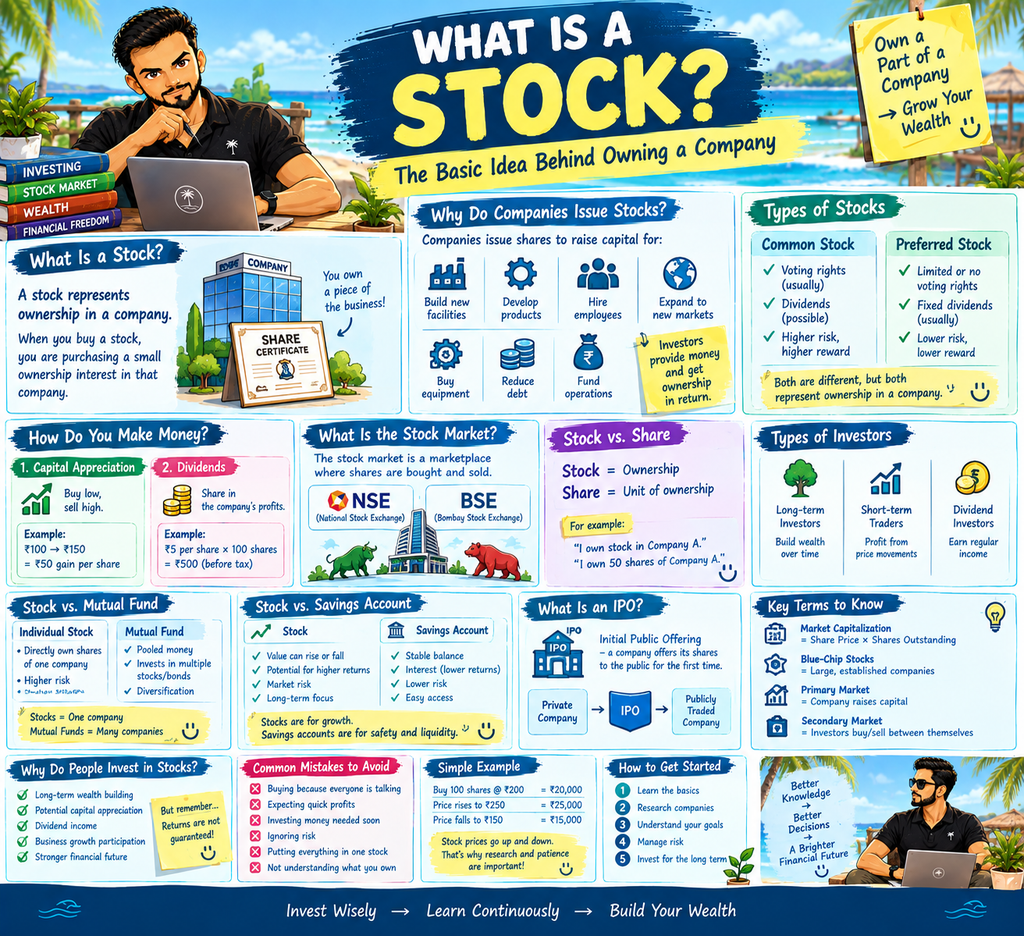
Table of Contents
What Does Owning a Stock Mean?
Owning stock means you own small portion of a company.
Owning a small numbers of shares does not mean you can walk into the company’s office and take something home.
Your iwnership is represented through shares reocreded in your investment account.
Depending on the types of shares, shareholder may have certain rights, such voting rights and potential egibility for dividends.
The exact rights depends on the company’s share structure and applicable taxes.
Why Do Companies Issue Stocks?
Companies needs money to grow their businesses.
They may needs capital to:
- Develop products
- Hire employees
- Expand into new markets
- Purchased equipments
- Reduced certain debts
- Fund business operations
- Build new facilities
One way companies cn raise captial is by issuing share to a investors.
A company wants a arise ₹100 crore to expand its business.
It may issues shares to investors a spart of raising capital.
Investors provides money and in returns they recieve an ownership interest represented by shares.
What Is a Share?
The words stock and share are oftern used together, but they arent’t exactly identical.
Stock
Stock generally ferefers to ownership in one or more companies.
Share
A share is unit of ownership in a particular company.
Example:
“I own stock in Company A.”
You could Say:
“I own 50 Shares of Company A.”
Simple way to remember it:
Stock = Ownership
Share = Unit of Ownership
How Do Investors Make Money From Stocks?
There are two major ways investors may potentially benfits from owning stocks.
1. Capital Appreciation
Let say you buy a stock at:
₹100 per share
Later, its market price becomes:
₹200 per share
If you sell at ₹200, your gross gain is:
₹200 – ₹100 = ₹100 per share
For 100 shares:
₹100 x ₹100 ₹10,000
This is an example of a capital gain before consdiering taxes,fees and other costs.
the price could also fall.
If the stock fall from ₹100 to ₹60 , the investment hase lost ₹40 per share in market value.
2. Dividends
Some companies distribute part of their profits to shareholders in form of dividends.
Example:
If a company declares a dividend of
₹6 per share
and you own:
100 shares
you could recieve:
₹6 x 100 = 600
before applicabale taxes and subject to th company’s dividends terms.
Not every company pays dividends.
Some companies may choose to reinvest profits into the business instead.
Why Do Stock Prices Change?
Stock prices changes constantly during market trading because buyers and selelrs have different expectations about a company future.
Factors influeences stcock prices includes:
- Company Earnings
- Revenue growth
- Business performance
- Industry conditions
- Economic codntions
- Interests rates
- Compelition
- Government policies
- Global events
- Markey sentiments
Example:
If invetsors believe a company future earning could improve, demands for it shares may increases.
But if expectations become negative, demand may fall.
What Is the Stock Market?
The stock market is th market places where shares of pubilcly traded companies can be brought and sold.
In India, Examples of major stock market exchanges :
- NSE – National Stock Exchanges of India
- BSE – Bombay Stock Exchange
Investors genrally acces the markets through registered brokers and investment platforms.
The exact process may different vary on country and markets.
What Is a Stock Exchange?
A stock exchange is any organized market place where securties can be traded according to established rules and regulations.
Example:
NSE and BSE
are major stock Exchanges in India.
A company may have it shares listed on an exhanage, allowing eligible invetsors to buy and sell those share through the market.
What Is a Public Company?
A pubilcly traded company is a company whose shares are available for tading in a public market, Subjetc to applicable lisying and regualatory requirements.
This is different from a privately held company, whereownership is generally not freely traded on a public stock exchange.
When aprivately compny becomes Publicly listed through a proess such as an Inital Public Offering(IPO), its shares can become avilable to public invetsors udner the applicbales taxes.
What Is an IPO?
IPO stands for Initial Public Offering.
An IPO is th process through which a company offers its shares to the public for the first time a spart of becoming publicly listed.
Example:
Private Company ➔ IPO ➔ Publicly Traded Company
An IPo can allow a company to raise capital from investors.
After listing shares can genrally be brought and sold in the secondary market.
What Is the Difference Between Primary and Secondary Markets?
This is an important concept for beginners.
Primary Market
The company issues securties to investors to raise capital.
An IPO is an example of Primary market transaction.
Secondary Market
Investors buy and sell securities form one another after securties have already been issued.
Most everyday stock martket trading takes places in the secondary market.
Why Do companies’ Values Changes?
A comapny value changes because its future prospects changes.
Example, investors may pay attentions to:
Revenue
How much money is the money generating.
Profit
How much money remains after expenses?
Debt
How much Does the company Owe?
Growth
Is the Company Expanding?
Competition
Are competors taking market share?
Management
Hoe effectively is the business being Managed?
Industry
Is the company’s industries growing or declining.
These are the some investors maay considers when researching a company.
Stock vs. Mutual Funds
Stock and mutual are different investment structures.
Individual Stocks
You invest in directly in shares of a particular compnay.
Mutual Fund
A mutual fund pools money from investors and invest according to its stated strategy.
Example:
Many Investors – Mutual Fund – Multiple Investment
A mutual fund mayprovide diversification across multiple securties, depending on the fund.
Stock vs. Saving Accounts
A saving accounts and stock are very different purposes and risk charcherisitc.
| Feature | Stock | Savings Account |
|---|---|---|
| Ownership | Company ownership | Bank deposit |
| Value | Can rise or fall | Deposit balance is generally stable |
| Return | Not guaranteed | Interest according to account terms |
| Risk | Market risk | Different risks and protections apply |
| Liquidity | Can generally be sold during market hours | Generally easy to access |
| Main purpose | Long-term investing/growth | Saving & liquidity |
What Are Blue Chip Stocks?
You may hear of blue chips stocks when you learning about investing.
It generally refers to sharesof large and established company of the country with long history of significant operations.
Being considered a blue chip companies does not mean its prices not fall down.
Every stocks investment involves riskes.
What Is Market Capitization?
Market Capitalization often called market cap, is away of measuring the market value of thate public traded companies’s equity.
Simple Formula:
Market Capitalization = Share price x Shares outstanding
Example:
Share price =₹300
Shares oustanding = 10 crore
MArket capitalization:
₹300 x 10 crore = ₹3,000 crore
Market capitalization is commonly used to compare the size of publie traded companies.
Why Do People Invest in Stocks?
People may invest in stocks for different reasons includes:
- Long term wealth building
- Poteential Capital appreication
- Dividend income
- Building an Inmvestment Protfolio
But stocks are not guaranteed to icnrease in value.
The appropiate investment approach depends on a person:
- Goals
- Time hroizons
- Risk tolerence
- Financial situation
What Should a Beginner Understand Before Buying Stocks?
COnsider learning about:
1. What the company Does
Understand the products,services and business model.
2. Renvenue and profits
Look at how the company makes money.
3. Debt
Udnerstand the company’s brorrowing and financial obligations.
4. Valuation
A good company can still be expensive if investors are payinga very high prices relative to fundamentals.
5. Competition
Udnerstand the company’s psoition within is industry.
6. Risks
Every company Faces business and fiancial risks.
7. Your invstement horizon
Stocks can experience significant short term price movements, so consider how long you can remain invested.
Common Stock Market Mistakes Beginners Make
1. Buying Because veryone Is talking About It.
Popularity does not guarantee future returns.
2. Expecting Quick Profits
Stocks can rise or fall unexpectedly.
3. Investing Money Needed Soon
Money needed for rent, emergencies or near term expenses may not be suitable for volatile investments.
4. Ignoring Risk
A stock can lose a substantial portion of its martket value.
5. Puttuing Everything Into the Company
Concentration in one stock can expose your money to company specfic risk.
6. Not understanding what You own
Before Buying a Stock Understand the Business and The Investment case.
FAQs
What is stock in simple words?
A stocks represents ownsrship in a company. You buy a stock, you are purchasing your small onwership in a company.
What is the difference between a stock and a share?
Stock generally ferefers to ownership in one or more companies, while A share is unit of ownership in a particular company.
How do stocks make money?
Investor potentially make money through capital appreciation if the stock price rises and through dividends when company distributes them.
Can I Lose money in stocks?
Yes. Stock prices can fall and you can los part or ptotentially all the money invested in a particular stock.
What is a Dividend?
Some companies distribute part of their profits to shareholders in form of dividends, according to its polices and applicables rules.
What is the stock market?
The stock market is a marketplace where shares and other securities can be nrought ans sold.
What is an IPO?
IPO stands for Initial Public Offering. An IPO is th process through which a company offers its shares to the public for the first time a spart of becoming publicly listed.
Link this article to:
- What is Saving?
- What is Income?
- What is Compound Interest?
- What Is Inflation?
- What is Insurance?
- What is investing?
- Types of Investment?
- What is Budget?
- Saving vs Investing
- What is Net worth?
- What Is Exapenses?
- What is Cash Flow?
- What is Liquidity
- What Is Loans?
- What Is EMI?
- What Is Credit Card?
- What Is Bank Account?
- What Is ATM?
- What Is UPI payment?
- What Is Recurring Deposit?
- What Is a Asset?