
What Is an Asset?
When you start learning about personal finance, you will often hear the word Asset.
But what exactly it’s mean?
In simple Terms:
An asset is something you own or control that has financial or economic value.
Assets include money in your bank account, investment, property, vhicles, valuable items and certian business resources.
Example:
- Money in your bank account
- Stocks
- Mutual Fund
- Gold
- A house
- Land
- A business
- Certain Valuable Equipments
- Valuable or rare Arts
All of these can be considered assets because they have economic value.
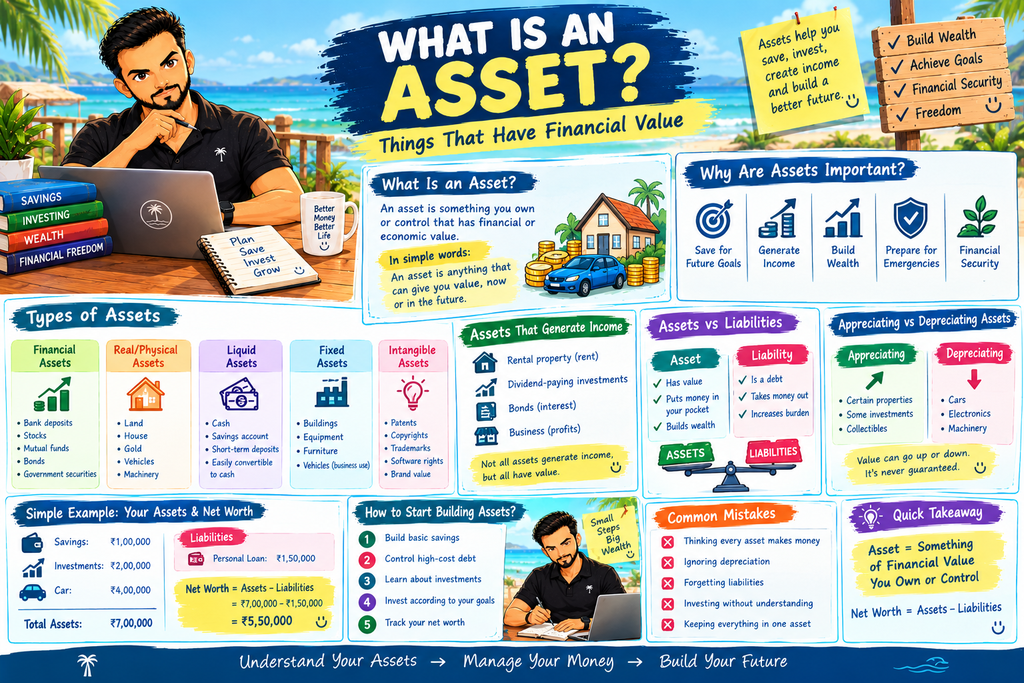
Table of Contents
Wht are Assets Important?
Assets is very important part of your fiancial Position.
Let say you have:
- ₹ 2,00,000 in Investment accounts
- ₹ 1,00,000 in saving account
- ₹ 3,00,000 of car value
Thes things represents your own value.
Building assets can help you:
- Generate Income
- Buld Wealth
- Be prepare for emergencies
- Icnrease Financial stability
- Save for future goals
- Create long term financial independence
Not every assets produces income and the value of assets rise or fall.
Different Types of Assets
Assets can be classified in different ways depending on their purpose and accounting treatment.
For Beginners, it is useful to understand the following Broad categories.
1. Financial Assets
Financial aassets are assets that reprents financial value or financial claim.
Example:
- Bank deposits
- Stocks
- Bonds
- Mtual Fund Invetments
- Certain govermnet securities
For Example, If you own ₹75,000 worth od invesment, those are part of Financial Assets.
2. Physical or Real Estate
These things are physical existence and ecnomic value.
Examples:
- Lands
- Houses
- Gold Vehilces
- Machinery
- Equipment
A house is physical asset value that may have significant fiancial value.
3. Liquid Assets
A Liquid assets is an assets that convert into cash without quickly losing its value.
Example
- Cash
- Bank Deposits
- Highly traded investments
Liquidity are important because you may need accessible money for emergencies and short term expenses.
4. Fixed assets
Fixed assets are generally long term physical assets used by business.
Example:
- Building
- Machinery
- Equipment
- Furniture
- Vehicles used for business
These assets are generally used for long term business and it not for resale.
5. Intangible assets
Not all assets are physical.
An intangible asset has value but you cannot Physically touched.
Examples
- Patents
- Copyrights
- Trademarks
- Certain software rights
- Brans related intellectual property
These types of aassets are very importane modern day business.
Assets that generate Income
Some assets can generates income.
Example:
Rental Property
A property may generates rental incomes.
Dividends related investments
Certain investment provide dividends monthy.
Bonds
Some Bonds provides interest according to their terms.
Business
Abusiness can generate profits.
These are called income -producing assets.
Income are not guaranteed and value or perfoemence od an assets can changes.
Assets That Do Not Generate Regular Income
Some assets may have financial valuw withou producing regular income. Example:
Gold
Gold can have significant market value, bit simply owning in physical gols does not produce monthy income.
Simliarly, a personal use vehicle may be valuable but generally doesn’t valuables unless you use in monthy incomes ghenerate activity.
This is why is useful to difference between:
An asset that value and an assets that generates incomes.
Thet are not necessarily same thing.
Asset vs. Liability
One of the most important concepts in personal finace is understanding the difference between assets and liabilities.
Assets
An assetsis something you own or control that has financial or economic value.
Liability
A liability is an obligation or debt uou owe.
Example:
| Asset | Liability |
|---|---|
| Money in bank | Credit card debt |
| Stocks | Personal loan |
| Gold | Outstanding loan |
| Property | Home loan |
| Business assets | Business debt |
Underatsnding both sides give you a better picturte of your financial position.
Simple Example of Assets and Liabilities
Imagine you own:
Savings: ₹1,00,000
Investments: ₹2,00,000
Car: ₹4,00,000
Your total assets would be:
₹7,00,000
Now imagine you also have:
Personal loan: ₹1,50,000
Your liabilities would be:
₹1,50,000
A simplified calculation of your net worth would be:
Net Worth = Assets − Liabilities
₹7,00,000 − ₹1,50,000 = ₹5,50,000
This is a simplified example, but it shows why both assets and liabilities matter.
Assets and Net Worth
Your net Worth gives you idea of tour overall financial position.
Basic formula is:
Net Worth = Total Assets – Total Liabilities
Example:
Total Assets = ₹10 lakhs
Total Liabilties = ₹ 5 lakhs
Net Worth = ₹10 lakh – ₹5 lakh = ₹5lakh
As your financial life devlops, tracking your assets and liabiltities can help you to understand whether your financial position is improvng or not.
Good Assets vs. Bad Assets?
“GOOd assets make you money and bad money costs you money.“
This can be simple idea, but real life more complicated.
An asset can have value without genrating income.
Example:
A family home can provide you provide to live even though it is not genrating rental income.
A car can provide transportation nut usually loses it values over time.
Insted of saying “good” or “Bad” ask:
- Does it have value?
- Does it genrate income?
- It is decresing or increasing in value?
- How easily to seet it?
- Does it support ot my financial goals?
Appreciating vs. Depreciating Assets
Some assets may increase in valye, whule may lose in value.
Appreicating Assets
These are may increase market value may increases over time.
Example:
- Properties
- Some invetsments
- Certain Collectibles
But appreciation never guaranteed.
Depreciating Assets
These are assets that generally lose value over time.
Example:
- Cars
- Motocycles
- Electronics
- Some not in use machinery
Example
Car ism worth 10lakhs in new showrooms at time of purchased, but after some time goes gradually get depreicating in value over time.
Why Should You Build Assets?
Building Assets can be important part of long term financial planning goals.
Instead of using all your income in consumption or unnecessary expenses, you can allocate in assets building option for long term for your goals.
Example:
Income ⇒ Expenses ⇒ Savings ⇒ Investments ⇒ Assets
Over period of time, your collection of financial and physical assets can be come an important part of your financial journey.
How Can a Beginner Start Building Assets?
Your don’t need big amount of money to start learning about assets building.
Step 1: Build Basic savings
Start by keeping some money avaiable for emergencies and short term goals.
Step 2: Control high-cost debt
Understand your existing debts and their costs.
Step 3: Learn abou Investments
Learn the basic of investment option before putting money into them.
Step 4: Investing According to Your Goals
Your Invetsments should your match:
- Time horizon
- Risk tolerence
- Financial Goals
- Available money
Step 5: Track your Net Worth
Periodically calculate :
Assets – Liabilities = Net Worth
This help you saee your financial Progress.
Common Mistakes About Assets
Mistake 1: Thinking Every Asset Makes Money
Some assets have value but doen’t generate regular income.
Mistake 2: Ignoring Depreciation
Cars, Electronic and other physical items can lose value over time.
Mistake 3: Forgettinmg Liabilities
Owing valuable things doent’ necesaarily mean you are weathy if you also have large debts.
Mistake 4: Investing Without Understanding
An Asset value can rise or fall. Always understand what you are buying.
Mistake 5: Keeping Everything in Onje asset
Depending too heavily on one type of asset can create concentration risk.
FAQs
What is an asset in simple words?
An asset is something you own or control that has financial or economic value.
What are examples of assets?
Example: Cash, bank deposits, stocks, mutual funds, gold, property, vehicles, businesses and certain intelluctual property.
Is money in a bank account an asset?
Yes. money you have in bank account is generally considered a fiancial asset.
Is car an asset?
Yes. A car has fiancial value and can therefore be considered an asset. vehicle get commonly depreicate over time.
Is a house an asset?
Yes. A house you own is generally considered a physicl asset and has financial value.
What is the diffwerence between an assets and liability?
An assetsis something you own or control that has financial or economic value, A liability is an obligation or debt you owe.
What is net worth?
Net worth is th value of your assets after subracting your liabilities.
Net Worth = Assets – Liabilities
Some bank allow permature closure, but reduced interest, penalties or other indcidual circumstances.
Link this article to:
- What is Saving?
- What is Income?
- What is Compound Interest?
- What Is Inflation?
- What is Insurance?
- What is investing?
- Types of Investment?
- What is Budget?
- Saving vs Investing
- What is Net worth?
- What Is Exapenses?
- What is Cash Flow?
- What is Liquidity
- What Is Loans?
- What Is EMI?
- What Is Credit Card?
- What Is Bank Account?
- What Is ATM?
- What Is UPI payment?
- What Is Recurring Deposit?