
What Is a Dividend?
Hwn you start learning about stocks, you may hear the word dividend quite often.
But what exactly is dividend?
In Simple Words:
A dividend is a payment thaat a company may distribute to its shareholder, often from its profits or accumulated earnings.
When you own shares of a company that declares a dividend, you may receive money based on the number of eligible shares you own.
Example:
let you have 100 shares of a company.
If the company declare a dividend of:
₹6 per share
you could receive:
100 x 6 = ₹600
Before any applicable taxes or other consideration.
Companies are not required to pay divends simply because thay make a profit. Whether a dividend is declared depends onthe company’s policies, financial position, board decisions, applicables laws and other factors.
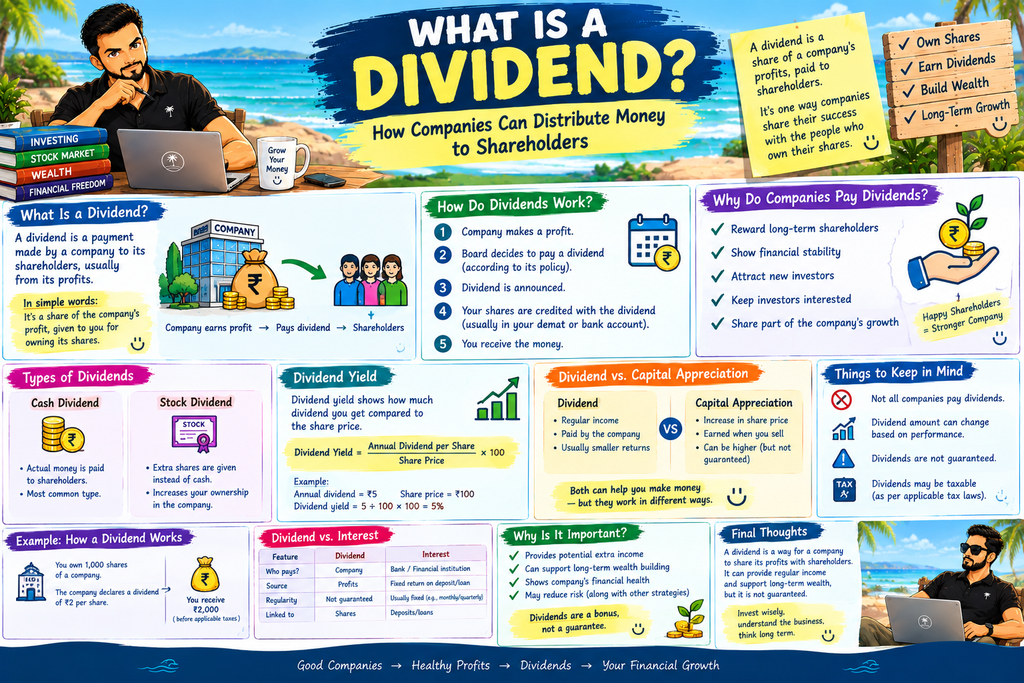
Table of Contents
How Do Dividends Work?
The basic process is relatively simple.
Step 1: The company earns Money
A company operates it business and may generate profits.
Step 2: The company Decides what to Do with its Money
The company mau use it money for things such as:
- Expanding the business
- Buying Equipment
- Developing Products
- Paying debts
- maintaining Cash reserves
- Acquireing another business
- Distributing money to shareholders
Step 3: A Dividend Id declared
If he company decides to ditribute a dividend, it announces the relevent details.
Step 4: Eligible Shareholders Receive the Dividend
Shareholders who meet the applicable eligibility requirements receive the dividend according to the company’s announced terms.
The payment may be credited to the investor’ bank account through the appplicable process.
Why Do Companies Pay Dividends?
Companies may pay dividends for several reasons.
1. Sharing Profits With shareholders
A company may distributes part of its earnings to shareholders.
2. Returing Capital to investors
Dividends can be one wayt to return capital to investors.
3. Attracting Certain Investors
Some investors prefer companies that have a history od ditributing dividends.
4. Showing Financial Strength
A consistent dividend history may be viewed by investors as one part of a company’s Financial profile athough a dividend by itself does not guarantee that a company if fiancially strong.
Do all Companies Pay Dividends?
NO.
This is one of the important things beginners should understand.
Some companies pay regular dividend, while other reinvest in company.
Example, instead of paying:
10 crore rupees in dividends.
A company might use that money to:
- Open new location
- Develop new procduct
- Hire employees
- Purchases machinary
- Exapand internationally
The company’s approach depends on its busness strategy and financial circumstances.
Types of Dividends
There are different ways companies can distributes values to share holders.
1. Cash Dividends
A cahs divdiend is the most familier type.
The company pays aligible shareholders money.
Example:
- ₹4 per share
- If you own 500 shares:
- 500 × ₹4 = ₹2,000
2. stock Dividend
Instead of paying cash. a company may distribute additional shares eligable shareholders under the applicable terms. Example
A company could distribute additional shares based on a specfied ratio.
This increases the number of shares an investor owns, athough the overall ecnomic eggects depdnds on the company’s valuation and terms od the distributions.
3. Special Dividend
A company may sometimes declares a speical dividend which is anadditional; or unusal distrubution outside its regular divdiend pattern.
This can happen when a company has excess cash or experiences an unusal financial event. Special divdiend are not necessarily recurring.
What Is Dividend Yield?
Another Important terms is Dividend Yield
Dividend yield shows the annual dividend relative to the current share price.
The basic formula is:
Dividend Yield = Annual Dividend Per share ÷ Share Price x 100
Example
Annual Dividend = ₹ per share
Share price =₹100
Tehre fore:
₹5 ÷ ₹100 x 100 = 5%
Dividend Yield = 5%
Dividend yield can change when the share price changes, even if the company dividend amount remains the same.
Simple Dividend Yield Example
Imagine Company A pays:
₹8 annual dividend per share
Its current share price is:
₹200
Dividend yield:
₹8 ÷ ₹200 × 100 = 4%
So the dividend yield is:
4%
But remember that dividend yield is based on the share price and dividend amount; it should not be interpreted as a guaranteed future return.
Dividend vs. Capital Appreciation
There are two different ways shareholders may potentially benfits from owning Stocks.
Dividend
Money distributed by the company to eligible shareholders.
Capital Appreciation
An icnrease in the market price of the shares.
Example:
But a share ₹100
Later sell at ₹140
The increase of ₹40 represent a ptoential cpaital gain if you sell at that price, before cosndiering taxes and transaction costs.
If tyhe company also pay dividend you may recieve noth:
Dividend + Potential Capital Appreciation
Neithe is guaranteed..
Dividend vs. Interest
Dividend and Interest are also different.
| Dividend | Interest |
|---|---|
| Paid by a company to eligible shareholders | Paid according to a debt, deposit, or lending arrangement |
| Linked to share ownership | Linked to deposited or borrowed money, depending on the arrangement |
| Usually not guaranteed | Terms depend on the financial product |
| Amount can change | Rate may be fixed or variable depending on the product |
| Company decides according to applicable rules | Usually determined by the agreement/product terms |
What Is a Dividend-Paying Stock?
A dividend paying stock is a company’s stock whose shareholders recieve divdiend when the company decalres and distributes them.
Some companies have along history of paying dividends.
Other may pay occasionally.
And some companies nolt pay any Kind of dividends at all.
Simple looking for whether a copmpany pay dividends is not enough to udnerstand whether the stock suitable for a particular investor.
Are Dividends Guaranteed?
No.
A company can change, rduce, suspend or stop its divdiend depending on its circumstances and applicbale rules.
Even long histoires f dividend company can change their policies.
This is why investor should not assume:
“The company paid a dividend last year, so it must pay th same divdind last year.”
Dividend are not guaranteed returns.
What Is a Divdiend Payout Ratio?
The dividend payout ratio indicates how much of a company’s earning are distributed as dividends.
A simple formula:
Dividend Payout Ratio = Dividends ÷ Earning x 100
Example
Company earning =₹100 crore
Dividend = ₹40 crore
Payout ratio
₹40 crore ÷ ₹100 crore x 100 = 40%
The interpretation of this ratioo depends on the company’s industry, fiancial position, accounting results and ther results.
Why Do Some Companies Not Pay Dividends?
There are several reasons.
A company may prefer to use its money for:
- Business expansion
- Research and development
- New products
- Acquistions
- Debt reduction
- working capital
Example:
A young companies with many growth opportunities ma choose to reinevst its earning isnted of sistributing them.
That doesn’t automatically means company is good or worse; its refects how the company chooses to alloacate capital.
What Should You Check Before Investing in Dividend Stocks?
If you are lookin for dividends paying compaqnies don’t look just on dividend pay out:
1. Dividend History
Has the company paids dividends consistently?
2. Profitability
Does the business generate sustainable profits?
3. Cash Flow
Does the company genrate enough Cash to support its operations and distributions?
4. debts
How much debt does the company have?
5. Payout Ratio
How muchof its earning is being Distributed?
6. Business Growth
Is the underlying business grwoing, stable or declining?
7. Dividend Yield
Is the yield reasonable relative to the company’s Circumstances.
A very highly divdiend yield should not automatically be cosndiered attractive because a falling share price can make yield appear unusually high.
Common Dividend Mistakes Beginners Make
1. Thinking Dividends Are Free Money
A divdiend is a distrbution asociated with owning shares. it isn’t free money separate from the ecnomics of the investment.
2. Looking Only at Dividend Yield
A high yield does not automatically mean a better insvestment.
3. Assuming Dividends Are Guaranteed
Companies can reduced or stop dividends.
4. Lgnoring The business
A divdiend should bot be only thing you research.
5. Forgetting Taxes
Divdiend income may ahve tax implications dpending on your country and circumstances.
Why Dividends Matter to Investors?
Dividends can be used for investors who want to understand how companies distribute cash to share holders.
They can poitentially provide:
- An additional income of investment income
- Cahs distributions
- A way to paryicipate in company profits
- Another companonets of total investment returns
Investors should consider divdiend alongside the company’s overall financial health, valuation, growth risks, and thier own goals.
FAQs
What is a divdiend in simple words?
A dividend is a payment thaat a company may distribute to its shareholder, often from its profits or accumulated earnings.
How do Dividend Work?
A company decides to distribute a divdiend, announces the relvent terms and dates and eligible shareholders recieve the declared amount according to those terms.
Do all Companies pays dividends?
No. some companies pays dividends,whle others reinevst their earnings into the business.
How is a dividend calculated?
Simple calculation
Dividend Recieved = Number of shares x Divdiend Per share
Example
100 shares x ₹5 dividend =₹500 before applicable taxes
What is dividend yield?
Dividend yield shows the annual dividend relative to the current share price.
The basic formula is:
Dividend Yield = Annual Dividend Per share ÷ Share Price x 100
Are dividends guaranteed?
No.
A company can change, rduce, suspend or stop its divdiend depending on its circumstances and applicable rules.
What is cash dividend?
A cash divdiend is a dividend paid in money to eligble shareholders.
Link this article to:
- What is Saving?
- What is Income?
- What is Compound Interest?
- What Is Inflation?
- What is Insurance?
- What is investing?
- Types of Investment?
- What is Budget?
- Saving vs Investing
- What is Net worth?
- What Is Exapenses?
- What is Cash Flow?
- What is Liquidity
- What Is Loans?
- What Is EMI?
- What Is Credit Card?
- What Is Bank Account?
- What Is ATM?
- What Is UPI payment?
- What Is Recurring Deposit?
- What Is a Asset?
7 thoughts on “What Is a Dividend? A Simple Guide for Beginners”