
What Is Risk in Investing?
When people start lesarning about investing, they often focus on one question.
“How much money can I make?”
But there is another question that is just as important:
“How much could I lose?”
This is where investment risk comes into the picture.
Investment risk is the possibility that an investment may not perform as expected, You could receive a lower return that expected, lose part of your original money or in some cases lose most or all of the amount invested.
Different investment have different types and levels of risk.
Udnerstnding risk does not mean avoiding investing completely. It mean understanding what could happen to your money before you invest.
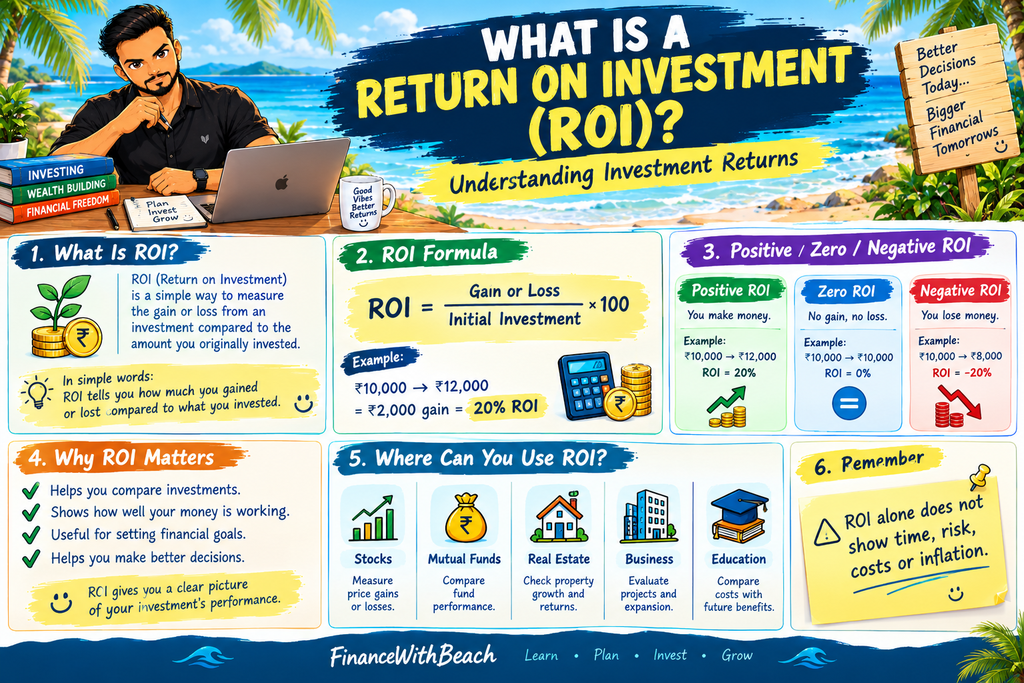
Table of Contents
What Does Risk Mean in Investing?
In simple words:
Investment risk is the possibility that the actual results of an investment will be differently from what you expected.
Example
Let say you have ₹10,000 in an investment expecting it ot grow.
Instead ts value falls to ₹9,000.
You have have potential loss of:
₹10,000 – ₹9,000 = ₹1,000
Teh investment therefore carried the risk pf losing value.
Risk can also mean something other than losing money.
Example an investment may perserve your money but grow too slawly to keep up with inflation.
Why Does Every Investment Have Some Risk?
There is no investment that can guarantee the exact outcome of every future situation.
Different risks can come from:
- Chanmges in market prices
- Inflation
- Interest rated
- Economic codnitins
- Company performance
- Governament policies
- Currency movements
- Liquidity problems
- Changes in demand
- Unexpected events
The amount and type of rsik vary significantly between investments.
Example:
The risk associated with a bank deposits can be vary different from the risk associated with an individual stock.
A Simple Example of Investment Risk
Suppose you have ₹50,000.
You invest it in a stock.
After some time, the stock price increases and your investment becomes:
₹60,000
Your gain is:
₹10,000
But the stock price could also fall.
If your investment becomes:
₹40,000
your loss is:
₹10,000
This uncertainty is one form of investment risk.
The important point is that market-based investments can move both upward and downward.
Different Types of Investment Risk
Investment risk is not just one thing.
there are several different types of risk that investors should understand.
1. Market Risk
Market risk is a possibility that an investment will lose value because the overall market or market codnitions change.
Example
Stock prices fall because of
- Econcomic concerns
- Interest rate change
- Investor sentiments
- Company or industry news
A stock was worth ₹500 could later trade at ₹450 or ₹400.
Market prices can change frequently.
2. Business Risk
When you invest in a company, you are exposed to the possibility that the company mat perform poorly.
A business could face:
- Falling Saless
- Increasing costs
- Strong Competition
- Poor managment decisions
- regulartory changes
- Technologicial disruption
If the company’s performance deteriorates it share price may also decline.
This is known as business risk.
3. Inflation Risk
Inflation means that the rpices of goods and services generallyincreases over time.
prices rise the purchasing power of money can decrease.
Example
Let say you have ₹10,00 todays.
If prices rise significantly over several years, ₹10,000 in the future may not but same amount of goods and service.
Thgis creates inflation risk.
An investment can increase in value while still providing limited growth in real purchasing power if inflation is high.
4. Interest Rate Risk
Interest rates affect different investment in diferent ways.
Example
Changes in interest rates can influence the price of bands.
When the interest rates change,existing bonds with fixed interest payments can become more or less attractive compared with newly issued bonds.
Interest rates can also affect businesses because borrowing costs may increases or decreases.
Therefore, investors should understand how interest rate changes can affect the types of investment they own.
5. Credit or default Risk
Credit risk is particularly relevent when you lend money through an investment such as a bond.
The borrower may have difficulty making interest payments or repaying the principal.
Example:
You lend a company ₹50,000 through a bond.
The company is expected to pay interest and eventually return your ₹50,000.
If the company experiences serious financial problems, there may be e risk that payments are delayed or not fully made.
This is called credit or default risk.
6. Liquidity Risk
Liquidity refers to how easily can buy or sell an investment without signifcantly affecting its price.
An investment may be difficult to sell quickly.
Example
Let’s may have to wait to find buyer or accept a lower price to sell quickly.
That is liquidity risk.
7. Currency Risk
Currency risk can affect people who invest in assets denominated in another currency.
Let say an indian investor invests in an asset priced in UD Dollars.
Even if the investment’s dollar value stays unchanged, changes in the USD/INR Exchange rate can affect the investment’s value when converted back into rupees.
This is known as currrency risk.
Risk and Return
There is an important relationship between risk and potential return.
Generally investment with greater uncertaintymay offer the posibility of higher returns, while investments with lower risk may offer lower potential returns.
But this does not mean:
Higher Risk = Guranteed higher returns.
It doesn’t A risky investment can produce a high return or a loss.
| Investment | Potential Risk | Possible Outcome |
|---|---|---|
| Savings/deposit products | Generally lower | Lower potential return |
| Government securities | Generally lower, depending on the security | Relatively predictable payments if held under applicable terms |
| Bonds | Varies | Interest income and possible price changes |
| Mutual funds | Varies by fund | Returns can rise or fall |
| Stocks | Can be high | Significant gains or losses are possible |
| Speculative assets | Can be very high | Large gains or losses are possible |
Teh exact risk depends on the specfic product not simply its category.
Can You Avoid Investment Risk Completely?
You generally cannot eliminate all investment risk.
However, you can understand and manage risk.
Some common approaches includes:
Diversification
Spread investment across different assests rather than relying heavily on one investment.
Understanding What You Buy
Learn how an investment works before putting your money onto it.
Considering Your TIme Horizon
An investment may behave differently over a few months compared with several years.
Maintaining an Emergency Fund
Money needed fo unexpected expenses genrally should not depend on selling a volatile investment at an inconvenient time.
Avoiding Unnecessary Concentration
Putting too much money into one company, sctor or assest can increase concentration risk.
Reviewing Costs
Fees and other Costs can reduce investment returns.
Risk Tolerance vs Risk Capacity
Two People can have the same investment but very different abilities to handle ot risks.
Risk Tolerence
This is about how comfortable you are wuth investment fluctuations and potential losses.
Somone may be uncomfortable seeing their investment fall 20%.
Another person may be mire comfortable with signifant fluctuations.
Risk Capacity
This is about your financial ability to handle a loss.
Someone with stable income, adequate savings and along investment horizon nay have a different financial capacity for risk than somone who needs the oney soon.
Both concept are important when thinking about investments.
Wht Time Horizon Matters?
Yor Time Horizon is how long you expect to keep your money invested.
let’s say you need ₹2 lakh in three months.
Putting that money into a highly volatile investment could expose you to the possibility of needing to sell after a market deline.
Now consider money that you don’t expect to need for many years.
You my have more time to expernience and portentially recover from matket fluctuations, although recovery is never guaranteed.
Therefore, your investment time horizon is an important part of understanding risk.
What Happens When You Take TOO Much Risk
Taking more risk than you can finacially or emotonally handle can create problems.
Example:
You invest ₹5 lakh in a highly volatile investment.
The value falls to ₹3.5 lakh.
If you need the money immedtiatelly you may feel forced to sell during the decline.
This casn turn a temporacy declineinto permanent realized loss.
That’s why investment should genrally be matched with your financial goals, time horizonsand ability to handle losses.
Risk Does Not Mean an Investment IS Bad?
An Investment having risk does not automatically make it a bad insvestment.
Risk is simply a charcteristic that needs to be understood.
Example:
Stocks can experience significant price movements,but they are also commonly used by investors seeking long term growth.
Smilaarlylower risky investments may provide greater atavility but may have lower growth potential.
The important question is not simply:
“Does this investment have risk?“
Instead consider:
“What risks does this investment have, and can I handle Them?“
A Simple Risk Checklist for Beginners
Before investing, ask yourself:
1. What am I in vesting in?
do you understand the investment?
2. How can I make money?
Understand where the potential return comes from.
3. How can I Losemoney?
Identify the major risks.
4. How long can I keep my money Invested?
Think about your time horizon.
5. How easily can I access my money?
Cosnider liquidity.
6. What Happens if the investment falls?
Think about Whether you could financially handle a decline.
7. Are there fees or taxes?
These can effect your actual returns.
8. Is my moey diversified?
Avoid unncessary concentration in one Investment.
Common Mistakes Beginners Make
Mistake 1: Looking Only at Potential Returns
A high potential return can come with high uncertainly.
Always consider both potentialreturn and risk.
Mistake 2: Believing Past Performance is Guaranteed
An Investment that performed well in the past may not perform the same way in the future.
Mistake 3: Investing Money You Need Soon
Short Term Financial Needs and long term investments sholud be Considered Separately.
Mistake 4: Putting Everything Into One Investment
Concentration can increase the impact of an singl;e investment performing poorly.
Mistake 5: Following Others Without Undrstanding the Investment
Someone else’s investment choice may not match your fianncial situation, goal or risk tolerence.
A negative ROI means the investment lost value relative to the Original Investment.
Link this article to:
- What is Saving?
- What is Income?
- What is Compound Interest?
- What Is Inflation?
- What is Insurance?
- What is investing?
- Types of Investment?
- What is Budget?
- Saving vs Investing
- What is Net worth?
- What Is Exapenses?
- What is Cash Flow?
- What is Liquidity
- What Is Loans?
- What Is EMI?
- What Is Credit Card?
- What Is Bank Account?
- What Is ATM?
- What Is UPI payment?
- What Is Recurring Deposit?
- What Is a Asset?
- What Is a Dividend?
- Simple Interest and Compound Interest
- What Is a Return on Investment?
3 thoughts on “What Is Risk in Investing? — Why Every Investment Has Some Risk”