
What Is Diversification?
Diversitfication mean spreading your money across different investment inbsted of putting all your money into one investment.
The basic idea is simple:
Don’t Pull all your eaggs in one baskets.
In investing, this means you don’t necessarily want your entire portfoilio to depend on one company, one asset, one industry or one types of investment.
Example:
Instead of investing ₹1,00,000 ebtirely in one company’s stock, an investor could spread money across different investment based on their goals, risk level and time horizon.
Diversification can help reuce concentration risk,although it cannot eliminate investment risk completely.
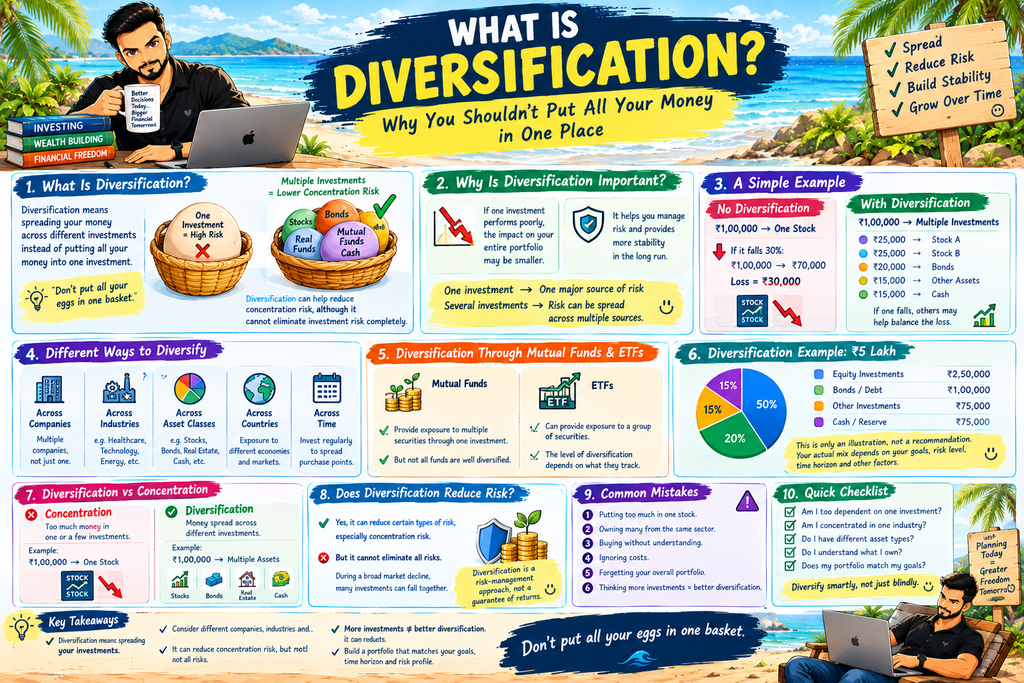
Table of Contents
Why Is Diversification Important?
Let’s say you have ₹1,00,000.
You Invest the entire amount in one company.
IF that company’s share price falls sharply, a large portion of your investment could fall at the same time.
Let say Imagine that the ₹1,00,000 us spread across several different investment.
If one investment performs poorly, the impact on the entire portfolio may be smaller, depending on how the other investment perform.
This is the basic purpose of diversification.
In Simple Words:
One investment ➔ One Major source of risk
Several different investments ➔ Risk can be spread across multiple sources
However, diversification does not guarantee profits or prevent losses.
A Simple Example of Diversification
Let say you have ₹1,00,000.
Example 1: No diversification
You put:
₹1,00,000 ➔ One stock
If that stock falls 30%:
₹1,00,000 ➔ ₹70,000
You have ₹30,000 decline.
Example 2: Diversified Investments
You divide the money across several investments:
- ₹25,000 ➔ Stock A
- ₹20,000 ➔ Stock B
- ₹25,000 ➔ Bond Investment
- ₹15,000 ➔ Another Asset
- ₹15,000 ➔ Other diversified investment
Let’s say stock A falls Significantly.
The entire ₹1,00,000 isn’t dependnent on stock A.
The other investment may perform differently.
This can reduce the impact of a single investment performing poorly.
Diversification Doesn’t Mean Owning Everything
A common Misunderstanding is:
If I own many investments, I am Automatically diversified.
Nto Necessarily.
You could 20 stock different stocks but still have sigificnt exposure to the same industry.
Example:
If most of your investmenbt are companies from the same sector, they may react similarly to the same ecnomic events.
Good diversification consider how investment behave, not simply how many investments you own.
Different Ways to Diversify
There are several ways investors can diversify.
1. Diversifcation Across Companies
Instead of investing all your money in one company, you can spread exposure across multiple companies.
Example:
- Company A
- Company B
- Company C
- Company D
If any one company experineces problems, the entire protfolio may not be affected to the same extent.
2. Divertification Across Industries
You can also spread investments across different industries.
Example:
- Banking
- Technology
- Healthcare
- Consumer goods
- Energy
Different industries can respond diffierently to ecnomic conditions.
3. Divertification Across Asset Classes
Investors can also diversify across different asset classes.
Example:
- Stocks
- Bonds
- Cash
- Real Estate
- Other Investment assets
Each Assets class has different charcheristics and risks.
4. Diversification Acros Countries
Some Investors may also invest inm companies or assets from different countries.
Example:
- India
- United states
- Europe
- Othe International investment Markets
This can provide exposure to different ecnomices andd markets. Howeevr, International investing can introduces additonal risk, includiong currency risk and country specfic risks.
5. Diversification Across Time
Diversification Isn’t only about where you invest.
It can also involve when you invest.
Example
Someone making regular investment over time may avoid [utting all thier money into the market on partcular day.
Regular investing can help spread purchase points across different, market conditions.
However, strategy you use should dpend on your financial situation and investment Plan.
Diversification Through Mutual Funds
Mutual Funds are one way investors can obtains exposure to multiple securitiesthrough a single investment product.
Example:
Instead of individually buying shares of many companie, a mutual fund may hold a portfolio of securities according to its investment strategy.
This can make diversificatin more accessible to some investors.
A Mutual Fund is not automatically well diversified.
A fund may be concentrated in a particular secotr, asset clas, geography or types of security.
Therefore, investors should understand what a fund actually owns.
Diversification Through ETFs
Exchange-traded funds or ETFs can also provide exposure toa group of securities.
Example
An ETF that tracks a board marketindex may provide exposure to many companies through one investment.
This can reduce the need to indvidually purchase every security.
However, the level of diversification dpends on what the ETF tracks.
A narrowly focused ETF may still have signifcant concentration.
Diversification Example: ₹5 Lakh
Someone has ₹5,00,000 avialable for long term investing
Instead of putting the entire amount into one company they might create a divdisified allocation based on their financial goals and risk profile.
Example:
Hypothetically:
| Investment Category | Amount |
|---|---|
| Equity investments | ₹2,50,000 |
| Bonds/debt investments | ₹1,00,000 |
| Other diversified investments | ₹75,000 |
| Cash/reserve | ₹75,000 |
| Total | ₹5,00,000 |
This is only an Illustration, not a recommended allocation.
The appropriate allocation dpends on factors such as:
- Financial goals
- Time horizons
- Risk tolerence
- Risk capacity
- Income
- Existing investments
- Liquidity Reuqirements
Diversification vs Concentration
These wo iedeas are opposites.
Concentration
A large percentage of your money depends on small number of investment.
Example:
₹1,00,000 ➔ One stock
This creates siginficant dependence on that investment.
Diversification
Money is spread across different investments.
Example:
₹1,00,000 ➔ Multiple Investments
This can reduce independence on one particluar investment.
Does Diversification Reduce Risk?
It can rduce certain types of risk, Particularly concentration risk.
Let say, you own only one company’s stock.
If that company experiences major problem, your investment could be heavily affected.
If you own investment that are not pertfectly correlated with one another, the poor performance of one may have a smaller effect on the overall portfolio.
But diversification cannot eliminate all risks.
Example:
During a Broad market decline, many investments can fall together.
What Is Correlation?
Correlation Decscribes how investments tend to move in relation to one aonther.
If two investments frequently move in the same direction, they have higher positive correlation.
If thay behave differently, diversification between them may provide greate risk sreading benefits.
Example:
Investment A falls 10%.
If investment B also tends to fall at the same time, owning both may provide less diversification benfits than if investment B tends to behave differently.
This si simply counting the number of investment isn’t enough.
The Problem With Over Diversification
Diversification can be useful, but more investment aren’t alwats better.
Let say you own 100 different investments but don’t understand what they are.
You may find difficults to:
- Track Them
- Understand their risks
- Monitor their costs
- Revire your protfolio
- Decide when changes are necessary
This can lead to unnnecessary complexity.
The Goal is generally appropriate diversification, not owning as many investment as possible.
Diversififcation and Risk vs Return
In the pervoius article, we discused RIsk vs Return
Diversification fits directly into that idea.
Different investments can have different levels of risk and potential return.
By combining investments, an investors can conduct a portfolio that matches their objectives and risk considerations.
Example:
Higher risk assets +Lower risk assests
may create a different overall portfolio risk profile than investing entirely in higher-risk assets.
The reults depends on the assets, their proportions and how they behave relative to one another.
Diversification Does Not Guarantee Profits
This is extremely important.
Diversification does not mean:
- You cannot lose money
- Your protfolio will always increase.
- Every investment will preforms well.
- Your protfolio will outperform the market
A diversified portfolio can still lose value.
Example:
During a Broad market Downturn, many different investment mat decline simultaneously.
Diversification is a risk- managements approach, not a gurantee of returns.
Common Diversification Mistakes
1. putting Too Much Money Into One Stock
This creates concenration risk.
2. Owning Many InvestmentFrom the Same Sector
Ten Technology srocks may still leave you heavily exposed to technology sector risks.
3. Buying Investments You Don’t Understand
DIversification Shouldn’t be an excuse to buy random assests.
4. Ignoring Costs
Holding many Investment can somtimes create additional transaction or managment costs.
5. Foregetting About Your Overall Portfolio
You should Look at all you rinvestment together rather than cosnidering ach investment spearately.
6. Thinking Diversification Eliminates Risk
It doesn’t.
How Beginners Can Think About Diversification
Before Investing Ask Yourself:
Question 1: Am I too dependent on one Investment?
If one investment represents a very large part of your portfolio, connsider whether that concentration is intentional.
Question 2: Am I concentrated in one industry?
Several investments may still be exposed to the same ecnomic risks.
Question 3: Do I have different types of assets?
Depending on your goals, you may consider whether your portfolio needs exposure to different asset classes.
Question 4: Do I understand what I own?
Don’t diversify simply for the sake of having more investments.
Question 5: Does my Portfolio match my goals?
Your Investment mix Should make snese for your time horizons and financial objectives.
FAQs
What does diversification mean in simple words?
Diversitfication mean spreading your money across different investment inbstead of putting all your money into one investment.
Why is diversification important?
It can concentration risk and limit the impact that one poorly performing investment has on the overall portfolio.
Does diversification Gurantee profits?
No. A diversified portfolio can still lose money.
How many investments Should I own?
There are no universal number. The appropriate level of diversification depends on your protfolio, goals, risk profile and investment you hold.
Can Diversiifcation reduce all investment risk?
No. It can help manage certain risk, partucularly concentration risk, but markt wide and other risks can still affect a diversified protfolio.
Can mutual funds provide diversification?
Many mutual fund hld multiple securities, which can provide diversification. However, level of diversification depends on the particlulat fund.
Link this article to:
- What is Saving?
- What is Income?
- What is Compound Interest?
- What Is Inflation?
- What is Insurance?
- What is investing?
- Types of Investment?
- What is Budget?
- Saving vs Investing
- What is Net worth?
- What Is Exapenses?
- What is Cash Flow?
- What is Liquidity
- What Is Loans?
- What Is EMI?
- What Is Credit Card?
- What Is Bank Account?
- What Is ATM?
- What Is UPI payment?
- What Is Recurring Deposit?
- What Is a Asset?
- What Is a Dividend?
- Simple Interest and Compound Interest
- What Is a Return on Investment?
- What Is Risk in Investing?