
What Is a Portfolio?
An investment Portfolio is the collection of investments you own.
These investments can include different types of assets.
Sych as:
- Stocks
- Mutual Funds
- ETFs
- Bonds
- Fixed deposits
- Gold
- Real Estate
- Cash or cash equivalent
- Other investment
In simple Words:
Your investmnet portfolio is everythingyou own as investments, considered together.
Example:
- ₹50,000 in stocks
- ₹30,000 in mutual funds
- ₹20,000 in bonds
Together,these investments make up your investment portfolio 0f ₹1,00,000.
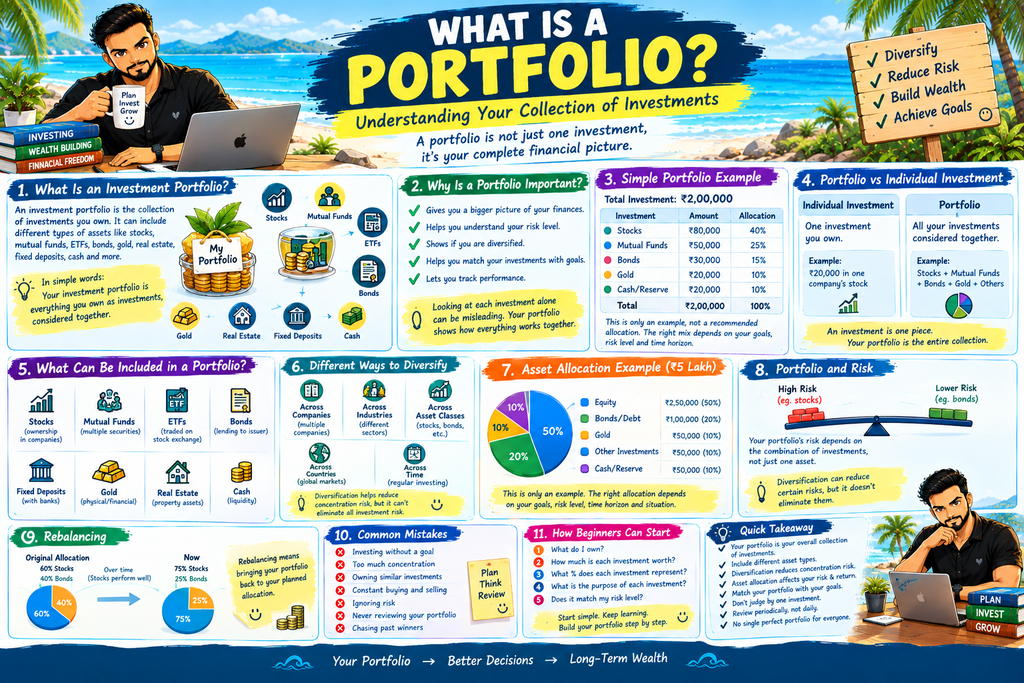
Table of Contents
Why Is a Portfolio Important?
Looking at each investment separately can make it difficult stocks and think you are diversified.
A portfolio gives you a bigger picture.
Example:
You may own five different stocks and think you are diversified.
But if all five companies belong to the same industry, your portfolio may still have significant exposure to that industry.
By looking at yourentire portfolio, you can understand:
- Where your money is invested?
- How much risk you are taking?
- whether you are diversifiied?
- Whether your investment match your goals?
- How your overall investments are performing?
A simple Portfolio Example
Let say you have ₹2,00,000 to invest.
You decide to divide it among different investments.
| Investment | Amount | Percentage |
|---|---|---|
| Stocks | ₹80,000 | 40% |
| Mutual Funds | ₹50,000 | 25% |
| Bonds | ₹30,000 | 15% |
| Gold | ₹20,000 | 10% |
| Cash/Reserve | ₹20,000 | 10% |
| Total | ₹2,00,000 | 100% |
Togeher these investment form your protfolio.
This is only an example, not a recommended investment allocation.
Portfolio vs Individual Investment
These are two terms are different.
Individual Investment
One investment that you own.
Example:
₹20,000 invested in one company’s stock.
Portfolio
Alll the invetsment considered together.
Example
stocks + Mutual fund + Bonds + gold + other investment
An investment is one piece. Your portfolio is the entire collection.
What Can Be Included in a Portfolio?
1. stocks
Stocks represent ownership in companies.
They can provid potwential capital growth and in some cases dividends. However, stocks prices can fluctuate signifantly.
2. Mutual Fund
A mutual Fund Pools money frominvestors and invests according to its stated strategy.
A mutual fund can provide exposure to mutliple securities through one investment product.
Different mutual funds have different objectives and risk levels.
3. ETFs
An Exachanged-traded Fund(ETF) is a fund whose units trade on a stock exchange.
Many ETFs track an index or particular group of assets.
The levels of diversification dpedns on what the ETF Holds.
4. Bonds
A bodn generally represents lending money to an issuer in exchange for interest and repayment according to the bond’s term.
Bond can be issued by governements, companies and other entities.
They also involve risk including interest-rate and credit risk.
5. Fixed Deposits
A fixed deposits or Fd allows you do deposits money with a bank for specfied period under agreed terms.
FDs can be part od somone’s overall financil assets, although whether they belong in an investment portfolio dpends on the person’s financial plan.
6. Gold
Gold can also form part of an investment Porfolio.
Investors may gain exposure ot gold in different ways, including physical gold and financial products linked to gold.
Like othe rinvestment, gold prices can rise and fall.
What Id Portfolio Diversification?
Portfolio diversification means spreading your invetsments across differents assets, companies, industries or market.
Example
Portfolio A
₹1,00,000 ➔ One Stock
This is highy concentrated.
Portfolio B
₹1,00,000 ➔ Mutliple invetsments
This spreads the money across different sources of risk.
As discussed in the pervious article, diversification can help reduce concentration risk, but it cannot eliminate investment risk.
Why Should You Track Your Portfolio?
Creating a protfolio isn’t enough.
You should also understand what you own.
Regularly reviewing your portfolio can help you identify:
- Investment that have become too large a percentage of your portfolio.
- Excessive concentration
- Changes in your financial goals
- Unnecessary fees
- Investments that no longer fit your plan
- Whether your assets allocation has changed siginfantly
This doen’t mean you need to track your investment every day.
For many long term investors, constantly watching daily price movemnts can create unnecessary stress and encourage emotional decisions.
Portfolio Allocation
Portfolio allocation refers to how your money is distributed among different investments or assets classes.
Example:
- 60% ➔ Equity
- 20% ➔ Bonds/debts
- 10% ➔ Gold
- 10% ➔ Cash or oher assets
This is called an assets allocation.
The appropriate allocation varies from person to person.
Why Does Asset Allocation Matter?
Different investment behave differently.
Example:
Stocks can experience significant price movement,while some lower risk assets may have different return and risk charcteristics.
By combing different asset clsasses, investors can create a protfolio that reflects their objectives and risk tolerence.
Example
Long-Term Growth Investor
May be comfortable with greaterexposure to growth-oriented assets because the investment horizin is longer.
Short-Term Goal
Someone who needs the money soon may have less ability to tolerate large fluctuations.
There is no single portfolio that is right for everyone.
Portfolio and Risk
Your protfolio’s risk isn’t deteremined by just one investment.
It depends on the combination of investment you own.
Let’s Say:
- Stock A = high Volatility
- Stock B = high Volatility
- Stock C = high Volatility
- Stock D = high Volatility
- Even though you own four stocks, your portfolio could still be highly exposed to euity-market risk.
Now Let’s say a portfolio containing different types of assets.
The overall a porfolio containing different types of assets.
The overall risk profile may be different.
This is why investors should look at thier porfolio as a whole.
A ₹5 lakh Porfolio Example
An investor ₹5,00,o00 for long term investing.
A hypthetical portfoliomightlook like:
| Asset | Amount | Allocation |
|---|---|---|
| Equity investments | ₹2,50,000 | 50% |
| Debt/bonds | ₹1,00,000 | 20% |
| Gold | ₹50,000 | 10% |
| Other investments | ₹50,000 | 10% |
| Cash/reserve | ₹50,000 | 10% |
| Total | ₹5,00,000 | 100% |
This is only an example, not a recommended personal investment advice.
Portfolio Rebalancning
Over time your portfolio allocation can changes.
Let say you originally have:
60% stocks + 40% bonds
if stocks performs strongly, your portfolio could eventually become
75% stocks + 25% Bonds
Your portfolio is now taking a different level of exposure than you originally planned.
Rebalancing means bringing the portfolio back toward your intended allocation.
The exact approach dpends on the investor’s plan and circumstances.
Portfolio vs Bank Account
A bank account and an investment portfolio are not the same thing.
Bank Account
Primarily used for:
- Receiving Money
- Making payments
- Keeping accessible cash
- Everyday financial needs
Investment portfolio
Contains investment intended to help meet longer-term financial goals.
A person can have boths.
Example:
Bank account ➔ Emergency savings
Investment Portfolio ➔ Long-Term wealth building
Keeping thes purposes separate can amke fiancial planning easier.
Portfolio and financial Goals
A portfolio should have a purpose
Example:
Goal: Buying a House
You may need money for a future down payments.
Goal: Retirements
you may be investing over sevral decades.
Goal: Education
You may need money at a specfic future date.
Goal: Wealth Building
You may be investing for long term growth.
Your goal influences:
- How long you can invest?
- How much risk you can portentially take?
- How much liquidity you need?
- Wht types of investment may be appropriate?
Common Portfolio Mistakes
1. Investing Without a Goal
Buying random investment doesn’t automatically create a good portfolio.
2. Too Much Concentration
Putting a very large percentage of your money into one investment can increase concentration risk.
3. Owning Too Many Similar Investments
Five different funds may still hold many of the same companies.
4. Constnly Buying and Selling
freuent decisions can increase costs and make it harder to follow a long term plan.
5. Ignoring Risk
A portfolio should match your abitity and willingness to handle losses.
6. NeverReviewing Your Portfolio
Your goals and financial situation can change over time.
7. Chasing Past Winners
An Investment that performed well in the past isn’t gurnteed to continue doing so.
How Beginners Can Start Understanding Their Portfolio
You don’t need a complicated spreadsheet to begin.
Start with these five questions:
- What do I own?
List all your investment
2. How Much is each investment worth?
Claculate the current value.
3. What percentage does each investment represent?
this helps identify concentration.
4. What is th purpose of each Investment?
Connect investments to financial goals.
5. Does the protfolio match my risk level?
make sure your investment are consistent with your ablity o handle losses and your time horizons.
Portfolio Return
You can also calculate how your portfolio has performed.
Let’s say your protfolio was worth:
₹2,00,000
and later becomes:
₹2,20,000
Your gain is:
₹20,000
Simple ROI:
₹20,000 + ₹2,00,000 x 100 = 10%
But remember that protfolio performance can be more complicated when you add or withdraw money during the period.
For a Proper performance analysis, timing of contribution and withdrawals matters.
Portfolio Does Not Mean Guranteed Profit
Having a Diversified portfolio doen’t guranteed that you will make money.
Market can fall.
Individual investments can lose value.
Different asset classes can decline at the same time.
A portfolio is simply a structure for organizing and managing your investments.
The goal is to build a protfolio that is appropriate for your financial objective and risk consideration–not one that guranteed a particular return.
FAQs
What is an invest ment portfolio in simple words?
An investment portfolio is the complete collection of investment you own.
What can a portfolio contain?
It can contain stocks, mutual fund,ETFs, Bonds,Fixed deposists,Gold, cash, real estate and other investment.
Is Portfolio the same as diverification?
No. A portfolio is your collection of investments. Diversification is th process of spreading investments to reduce concentration risk.
Should Beginners have a diversified portfolio?
Diversification can help reduce concentration risk, but the right porfolio dpends on the individual’s circumstances and goals.
Should I check my porfolio every day?
Not necessarily. Daily monitoring can encourage emotional decision, especially forlong term-term investors. Periodic reviews may be more useful.
Can a Portfolio Lose Money?
Yes. Every investment portfolio can experience losses depending on the invetment it contains and market conditions.
Link this article to:
- What is Saving?
- What is Income?
- What is Compound Interest?
- What Is Inflation?
- What is Insurance?
- What is investing?
- Types of Investment?
- What is Budget?
- Saving vs Investing
- What is Net worth?
- What Is Exapenses?
- What is Cash Flow?
- What is Liquidity
- What Is Loans?
- What Is EMI?
- What Is Credit Card?
- What Is Bank Account?
- What Is ATM?
- What Is UPI payment?
- What Is Recurring Deposit?
- What Is a Asset?
- What Is a Dividend?
- Simple Interest and Compound Interest
- What Is a Return on Investment?
- What Is Risk in Investing?
- What Is Diversification