
What Is an Index Fund?
An Index fund is a types of mutual fund that aims to tracks the performance of a particular market index, such as the Nifty 50 oe sensex.
Instead of trying to select individual stocks to outperform the market, an index fund follows a predefined index and investes according to its composition.
Example:
A nifty 50 index fund aims to track the performance of the nifty 50, which represents 50 major companies listed on the national stock exhanges of india.
In simple Words:
An Index fund Allows you to invest in a group of companies through single fund designed to foolow a market index.
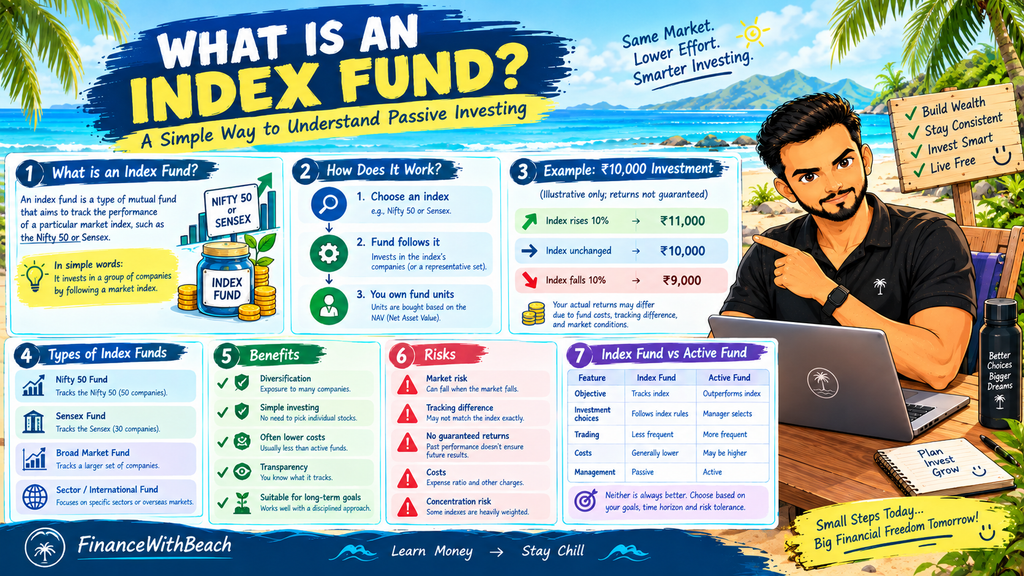
Table of Contents
How Does an Index Fund Work?
An index fund follows the rules of its chosen index.
Let’s understand the process step to step.
Step 1: Choose a market index
The fund selects an index to track, such as the nifty 50 or sensex.\
Step 2: Follow the market
The fund invests in the securities included in the index, generally in proportions designed to reflect the index’s composition.
Step 3: Investors Buy fund units
When you invest in an index mutual fund, you recieve units based on the apllication Net Asset Value(NAV).
Step 4: The investment value changes
As the prices of the underlying securitis change, the fund’s NAV can rise or fall.
Step 5: The fund aims to track its index
The fund attempts to deliver performance similar to its benchmark. Its actul return may differ because of expenses, trading costs, cash holdings, and tracking differences.
Example: Investing ₹10,000 in an Index Fund
Let’s say you invest ₹10,000 in an index fund.
| Hypothetical market movement | Approximate investment value |
|---|---|
| Index rises 10% | ₹11,000 |
| Index remains unchanged | ₹10,000 |
| Index falls 10% | ₹9,000 |
These figures are simplified illustrations before fund expenses, taxes and tracking differences.
The example shows that index funds can grow when their underlying investment perform well, but they can also lose value when the markey falls.
Important: Index Fund Returns are not guaranteed.
What Is Passive Investing?
Passive Investing is an investment approach in which a fund follows a predefined index or strategy rather than actively trying to otuperform the market by slecting individual investments.
Index Funds are a common examples of passive investing.
A nifty 50 index fund geberally folloes the composition of the nifty 50 rather than independently deciding which 50 companies it believes will perfrom test.
The objective is to track the index, not necessarily beat it.
What Is the difference Between and Index Fund and an Active Mutual Fund
Both are mutual fund, but they use difference inestment approaches.
| Feature | Index Fund | Active Mutual Fund |
|---|---|---|
| Main objective | Track a market index | Try to outperform a benchmark |
| Investment decisions | Follows index rules | Fund manager selects investments |
| Portfolio changes | Generally follows index changes | Depends on the manager’s strategy |
| Management style | Passive | Active |
| Costs | Often lower, but vary | May be higher, but vary |
| Returns | May differ from the index | May outperform or underperform its benchmark |
Neither approach guranteed bbetter performance. The right choice depends on the fund’s strategy, costs, risks, and your financial goals.
What Are th Different Types of Index Funds?
Index Fund can track different types of indexes.
1. Nifty 50 Index Fund
This type of fund aims to tracks the nifty 50 index, which represents 50 major companies listed on the National Stock Exchanges.
If offers exposure to large Indian Companies across different sectors,although the portfolio actual sector and company weights can vary.
2. Sensex Index Fund
A sensex index fund aims to track the BSE Snesex, an index representing 30 major companies listed on the Bombay stock Exchange.
3. Broad Market Index Fund
Some index Fund track broader indexes that represents a larger group of companies.
Example:
A fund tracking the nifty 500 aims to follow a much broader slection of indian companies than a nifty 50 fund.
4. Mid-Cap or small -cap Index Fund
These fund trackm indexe found on mid-sized or smaller companies.
They may havd idffeent risk charcherisic from large company indexes, including potentially greater volatility.
5. International Index Fund
Some funds provide exposure to international ,arkets by tracking indexes containing companies outside India.
Their risk may include international market moavemnts and currency fluctuations.
Remember: The index a fund Tracks determine much of its investment exposure and risk profile.
What Are the benfits of Index Funds?
Index Fund can offer severals advantages of investors.
1. Diversification
A broad index fund can provide exposure to mulitple companies through one investment.
Thsi reduce dpendence on any single company copared with holdinbg only that company’s shares. however, diversifcation does not eliminate market risk.
2. Simple Investing
You don’t need to research and buy every company individually.
The fund follows its index’s rules, making the investment approach relatively staright forward.
3. Potentially Lower costs
Because index fund generally follow a predefined strategy, they often have lower management costs than actively managed funds.
However, Expense ratios vary, so always compare the actual costs.
4. transparency
You can identify the index being tracked and review the fund’s holding and investment strategy.
5. Suitable for long term goals
An index fund may be useful gor long term investing when its market exposure matches your goals and risk tolerence.
It is not automatically suitable for every investor or every financial goals.
6. SIP investment options
Many index mutual funds offer systematic Investment Plans (SIPs), allowing investors to contributea fixed amount regularly, subject to the fund’s terms.
What Are the risks of Index Funds?
Index Funds are not risk-free investments.
1. Market risks
If the index falls, the fund’s value can also fall.
Example:
A ₹50,000 investment copuld decline to ₹40,000 after a hypothetical 20% fall, before considering expenses or tracking differences.
2. Concentration risk
Some indexes are heavily weighted towards particular companies or sectors. Holding many stocks does not necessarily means risk is evenly distributed.
3. Tracking difference
An index fund mayu deliver return that differs from its benchmark because of expenses,trading costs,cash golding and other factors.
4. Nor guaranteed returns
An index fund cannot guarantee profits simply because it tracks a well-known index.
5. timing risk
Investingn just before a market decline can lead to shor-term losses.Even long-term investos can experience periods of poor performance.
6. International and currency risk
International index fund can be affected by cahnges in overseas markets and exchanges rates.
Before investing, understand what the index contains and whether you can tolerate the potentil losses.
What Is an Expense Ratio?
The expense ratio represents the annual operating expenses of a mutual fund as percentage od its assets.
Example:
Let’s say an index fund has an expense ratio of 0.30%.
This means the fund’s mutual annual operating expenses are equivalent to approximately ₹30 oer ₹10,000 invested, based on that percentage.
You generally don’t pay this as a separate monthy bill. Fund expenses are reflected in the fund’s NAV over time.
When comparing index fund, look at both the epxense ratio and tracking differene rather than choosing a fund on cost alone.
What Is Tracking Error?
Tracking error measures how closely a fund’s returns follow the returns of its benchmark over time.
Example:
Let’s say and index deliversa 10% return over a partcular period while fund tracking it delivers 9.8%
The fund’s return differs from the index by 0.2 percentage pointss foir that period. This single- peiod difference is not istelf the tracking error, which is genrally msaured using the variability of return differnces over time.
When comparing fund tracking the same index, review their costs, tracking performance and investment terms.
Index Fund vs Indvidual Stock
An index fund and an individual stock provide different types of exposure.
| Feature | Index Fund | Individual Stock |
|---|---|---|
| Investment | A collection of securities | Shares of one company |
| Diversification | Usually greater for broad indexes | Depends on your other holdings |
| Research required | Understand the index and fund | Research the company |
| Risk | Market and index-specific risks | Company-specific and market risks |
| Management | Follows index rules | You decide when to buy or sell |
| Example | Nifty 50 index fund | Shares of one listed company |
An idnex fund can make diversification easier, but it does not rmeove the possibility of investment losses.
Index Fund vs ETF: What Is the Difference?
An index fund and an exchange-traded fund(ETF) are not exactly the same thing.
An index fund describes an investment strategy:tracking a particular index.
An ETF describes a Fund structures whose units trade on a stocks exchnages during market hours. Many ETFs track indexes, whike some mutual fund also track indexes without being ETFs.
| Feature | Index Mutual Fund | Index ETF |
|---|---|---|
| How you invest | Through the mutual fund’s transaction process | Through a stock exchange using a trading account |
| Price | Usually based on the applicable NAV for the transaction | Trades at market prices during exchange hours |
| Trading | According to fund rules and cut-off times | During market hours |
| Additional consideration | Fund costs and tracking | Fund costs, brokerage where applicable, bid-ask spread and liquidity |
Both can provide index ecposure. The more suitable option depends on your prefences, costs and access to investing facilites.
Can Beginners Invest in invest Fund Through an SIP?
Yes. many index mutuals fund offers SIP facilities.
An SIp allows you to invest a fixed amount at regular intervals instead of investing all your money at once.
Example: Let’s say you invest ₹3,000 per month in an index fund.
- Monthly invetsment: ₹3,000
- Total invested in one year: ₹36,000
- Total Investment in Fuve years: ₹1,80,000
- Total invested in ten years: ₹3,60,000
These amount represent contribution only, not investment returns.
Your actual investment vlue may be higher or lower depending on the perromance of the index and fund.
An SIP can Help build a consistent investing habit, but it does not guranteed a profit or prevent losses.
How Should Beginners Choose an Index Fund?
Before selecting an Index Fund, cosnider the following points.
1. Understand the Index
Find out which companies, sectors, countries or assets classes the index represents.
2. Match it to your goal
A broad large-company index fund has a different risk profile from a small-cap or sector-specfic index fund.
3. Compare expense ratios
Lowe costs can help preserve returns,all else being equal, but cost should not be your only considertion.
4. Review Tracking performance
Check hoe closely the fund has followed its benchmark over diferent periods.
5. Check he investment method
understand the minmum investment, SIP availability, redemptions rules and any applicable charges.
6. Consider your time horizon
Equity index fund can experence significant market declines. Don’t invest money needed for essential expenses or near-term goals without understanding the risk.
7. Read the scheme documents
Review the fund’s sated objective, risk information, benckmarkl and other relvent disclosures before investing.
Are Index Fund Good for Long-Term Investing
Index Funds can be useful for long-term investing because they offer a straightforward way to access a market index.
Their suitability depends on the index they track, your financial objectives, your investment eriod and your risk tolerence.
Example: A broad equity index fund may suit an investor seeking long-term expsoure to the stock market, while someone who needs the money soon may reqire a different approach.
There is no single index fund that is best for everyone.
Common Beginner Mistakes to Avoid
Mistake 1: Assuming index fund are risk free
Index fund can lose value when the underlying market falls.
Mistake 2: Choosing a fund only because of its low NAV
NAV lone does not tell you whether a fund is better or cheaper.
Mistake 3: Assuming every index is diversified equally
Some indexes are concentrated in particular companies or sectors.
Mistake 4: Ignoring expenses
Costs can reduce your investment returns over time.
Mistake 5: Expecting an index fund to beat the index
The primary objective is usually to track to track the index, not outperform it.
Mistake 6: Investing Without a financial Plan
Choose investment based on your goals, time horizons and ability to tolerate losses.
Mistake 7: Reacting to every market movement
Review your plan thoughtfully rather than making frequent decisions based only on short term market changes.
FAQs
1. what is an Index fund in simple words?
An index fund is amutual fund that aims to follow a market index, suchs as the nifty 50 or sensex.
2. Is an index fund a mutual fund?
Yes. An index mutual fund is a types of mutual fund that follow a partcukar index.
3. Can I Lose money in an index fund?
Yes. If the underlying declines, your investment can lose value.
4. Are Index funds good for beginners?
They can be a simple gain exposure to a market index, but beginners should understand the fund’s risks and costs before investing.
5. What is the difference between an index fund and in SIP?
An index fund is an investment product.An SIP is amehtod of investing regularly in a mutual fund. You can use an SIP to invest in an eligible index mutual fund.
6. Are index guranteed to make money?
No. Index Fund are market-linked investments, and their returns are not guaranteed.
7. Do Index funds have fees?
Yes. Index funds generally have an expense ratio, and other costs may apply depending on the fund and investment method.
8. What is better: an index fund or an ETF?
It depends on hoe your refer to invest, the costs invloved, Liquidity and the paicular porducts available. Many ETFs track Indexes, but an ETF and an index fund are not interchangeable terms.
9. How long should I stay invested in an inde fund?
There is no universal holding period. It dpends on the index, the fund’s risk and your goals. Equity index funds ae generallly better considered for goals with a sufficiently long investment horizon rather than money needed immediately.
gularly
What Is an SIP?
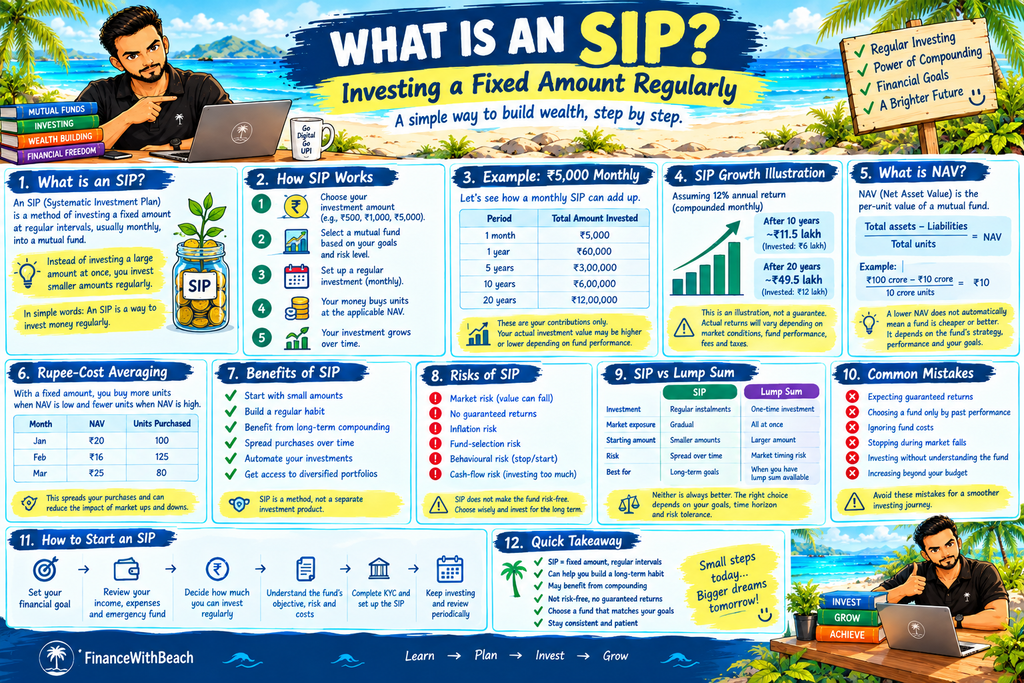
An SIP(Systematic Investment Plan) is method of investing a fixed amount of money at regular intervals, usually monthy, into a mutual fund.
Instead of investing a large amount all at once, you can invest smaller amounts regularly, This makes investing easieer to organise and helps build a consistent investing habits.
Example
Let’s say you decide to invest ₹2,000 every month ina mutual fund.
- Month 1: ₹2,000
- Month 2: ₹2,000
- Month 3: ₹2,000
- Month 4: ₹2,000
After four months, you would have invested ₹8,000 in total.
Over time, regular investments may help you build wealth, depending on the performance of the mutual fund and the length of time you remain invested.
In simple Words:
An SIP is a way to invest money regularly instead of investing everything at once.
Table of Contents
- What Is an SIP?
- How Does an SIP Work?
- What Is Rupee Cost Averaging in an SIP?
- What Are the Benefits of SIP Investing?
- What Are the Risks of SIP Investing?
- SIP vs Lump Sum: What Is the Difference?
- Is an SIP Better Than a Recurruing Deposits(RD)?
- Common SIP Mistakes Beginners Should Avoid
- How Can A Beginner Start an SIP in India?
- FAQs
- Link this article to:
How Does an SIP Work?
An SIP makes investing systematic. You choose an amount, selecta mutual fund and set a regular investment schedule.
Step 1: Decide your investment amount
Choose an amount that fits your income nd expenses, suchs, ₹500,₹1000 or ₹1,500 per month, subject to the fund’s minimum.
Step 2: Select a mutual fund
Choose a fund based on your financial goals, time horizons, risk tolerence and the fund’s investment strategy.
Step 3: Invest regularly
Your SIP is scheduled at your chosen frequency. Monthy SIPs are common and payment arrangements depend on the platform and fund.
step 4: Continue and review
Your money buys mutual fund units at the applicable NAV. Review your investment periodically to check that it still suits your goals.
Example: Investing ₹5,000 Every Month
Let’s understnad how regulaar investing works with a simple example.
You invest ₹5000 every month.
| Period | Total amount invested |
|---|---|
| 1 month | ₹5,000 |
| 1 year | ₹60,000 |
| 5 years | ₹3,00,000 |
| 10 years | ₹6,00,000 |
| 20 years | ₹12,00,000 |
These figures show your contributions only. Your actual investment value may be higher or lower depending on return, fess and taxes.
The important ideas is that investing a managable amount regularly can help you build a long-term investment habits.
What Is Rupee Cost Averaging in an SIP?
One portential bebfits of investing regularly is rupee cost averaging.
When the NAV os lower, your fixed investment amount buys more units.
When the NAV is higher, it buys fewer units.
Example:
Let’s say uou invest ₹2,000 in a mutual fund each month.
| Month | NAV | Units purchased |
|---|---|---|
| January | ₹20 | 100 |
| February | ₹16 | 125 |
| March | ₹25 | 80 |
| Total | — | 305 units |
Your Investment is ₹6,000 and you own 305 units. Your average purchase cost os approximately ₹19.67 per unit.
What Are the Benefits of SIP Investing?
1. Start with mangable amounts
You may be able to start with a relatively small amount, depending on the mutual fund’s minimum investment rules.
2. Build a Regular Habit
A recurring investment can help you make investing part of your monthy financial routine.
3. Benefit from long -term compounding
If your investment earns positive returns and those returns remain invested growth can build over time.
4. Avoid needinmg a large Lump Sum
You don’t have to wait until you have a large amount of moneu before beginning to invest.
5. Spread purchases over time
Regular investing means you buy units at different NAV levels instead of making all your purchases at one point in time.
6. Automate Contributions
Automatic payments can make ir easier to stay consistent, Provided your account has sufficient funds and the payment instruction remains active.
What Are the Risks of SIP Investing?
SIP is only an investment method. It does not make the mutual fund iitself safe.
- Market Risk: The underlying investment can fall in value.
- No guaranteed returns: A SIP does not guarantee porfit.
- Inflation Risk: Your future money may buy less than expected.
- Fund-slection risk: A poorly suited fund may not matchn your goals or risk tolerance.
- Behavioural risk: Stopping or changing your plan in reponse to every market movement can disrupt your strategy.
- Cash-Flow risk: Investing too much may leave you short of money for regular expenses or emergencies.
Before investing, consider your emergency savings, expensive debt, fianncial goals and ability to handle losses.
SIP vs Lump Sum: What Is the Difference?
| Feature | SIP | Lump Sum |
|---|---|---|
| Investment method | Regular instalments | One larger investment |
| Timing | Money enters at different times | Most money is invested at once |
| Starting amount | Often more manageable | Requires a larger amount |
| Market exposure | Builds gradually | Begins on the investment date |
| Return guarantee | None | None |
Niether approach is alwys better. The choice depends on your available money, investment objective, time horizons and comfort with market fluctuations.
Is an SIP Better Than a Recurruing Deposits(RD)?
An SIP and an RD are different financial Products.
| Feature | SIP | Recurring Deposit |
|---|---|---|
| Product | Investment method into a mutual fund | Bank deposit product |
| Returns | Market-linked, depending on the fund | Interest rate set under deposit terms |
| Risk | Depends on underlying investments | Depends on the institution and applicable deposit protection |
| Value | Can rise or fall | Principal and interest generally follow the deposit contract, subject to its terms |
| Suitable for | Investment goals based on risk and time horizon | Planned savings with defined deposit terms |
Choose based on the purpose of the money, how soon you need it, and the risks you can accept.
Common SIP Mistakes Beginners Should Avoid
- Expecting Guaranteed Returns: Mutual Fund investments can lose money.
- Choosing a fund only because of recent performance: Past Performance does not guranteed future results.
- Investing before planning essential Expenses: Keep Money available for emergencies and near-term needs
- Stopping every time the market falls: Reassess your goals and fund rather than reacting automatically.
- ignoring fund costs: Expenses and taxes can reduce your final outcome.
- Assuming every SIP is Long-term: Select a fund and time horizon that match the goal.
- Increasing contribution beyond your budget: A sustainable amount is better than one that creates financial stress.
How Can A Beginner Start an SIP in India?
here is a simple checklist:
- Set a Clear Financial Goal.
- review your income, expense,mergency savings and debt.
- decide how much you can invest regularly
- Understand the fund’s invetment objective and risk level
- Review the expense ration and other applicable costs.
- Complete hthe required account and identity-vertfication porcess through a legitmate investment platform or fund provider.
- Set the SIP schedule and make sure the money is available.
- Review your plan periodically rather than judging it by short-term market movements.
Do not select a mutual fund merely because someone promises high returns.
FAQs
1. What does SIP stand For?
SIP stands for Systematic Investment Plan. It is a way to invest a fixed amount regualrly into a mutual fund.
2. Can I start an SIP with ₹500?
Some mutual fund Permit SIPs starting at ₹500 or less, while others require more. Check the minmum amount for the specfic fund.
3. Can I lose money in an SIP?
Yes. If the underlying fund investment fall in value, your SIP investment can also lose value.
4. Is SIP suitable for beginners?
It can be a convenient way to build e regular investment habit, but neginners should first understand the fund, it risks, and their own financial needs.
5. is an SIP suitable Guranteed to make money?
No. Nither SIP investing nor mutual fund returns are guaranteed.
Link this article to:
- What is Saving?
- What is Income?
- What is Compound Interest?
- What Is Inflation?
- What is Insurance?
- What is investing?
- Types of Investment?
- What is Budget?
- Saving vs Investing
- What is Net worth?
- What Is Exapenses?
- What is Cash Flow?
- What is Liquidity
- What Is Loans?
- What Is EMI?
- What Is Credit Card?
- What Is Bank Account?
- What Is ATM?
- What Is UPI payment?
- What Is Recurring Deposit?
- What Is a Asset?
- What Is a Dividend?
- Simple Interest and Compound Interest
- What Is a Return on Investment?
- What Is Risk in Investing?
- What Is Diversification
- What Is a Portfolio?
- What Is an Index?
- What Is an Stock MArket Index?
- What Is an Mutual Fund?
- What Is an SIP?
One thought on “What Is an Index Fund? — A Simple Way to Understand Passive Investing”