What Is Risk vs Return? — Understanding the Relationship

What Is Risk vs Return?

when you invest money, two important ideas you should understand are risk and return.

  • Risk means the possibility that your investment may lose money or perform differently than expected.
  • Return means the money you gain or lose from an investment over period of time.

Risk vs return describes the relationship between the amount of risk you take and the potential return you may receive.

In simple Words:

Investments with higher potential returns often come with higher levels of risk.

However, Higher risk does not guarantee higher returns.

Understanding this relation ship can help beginners make informed investment decisions.
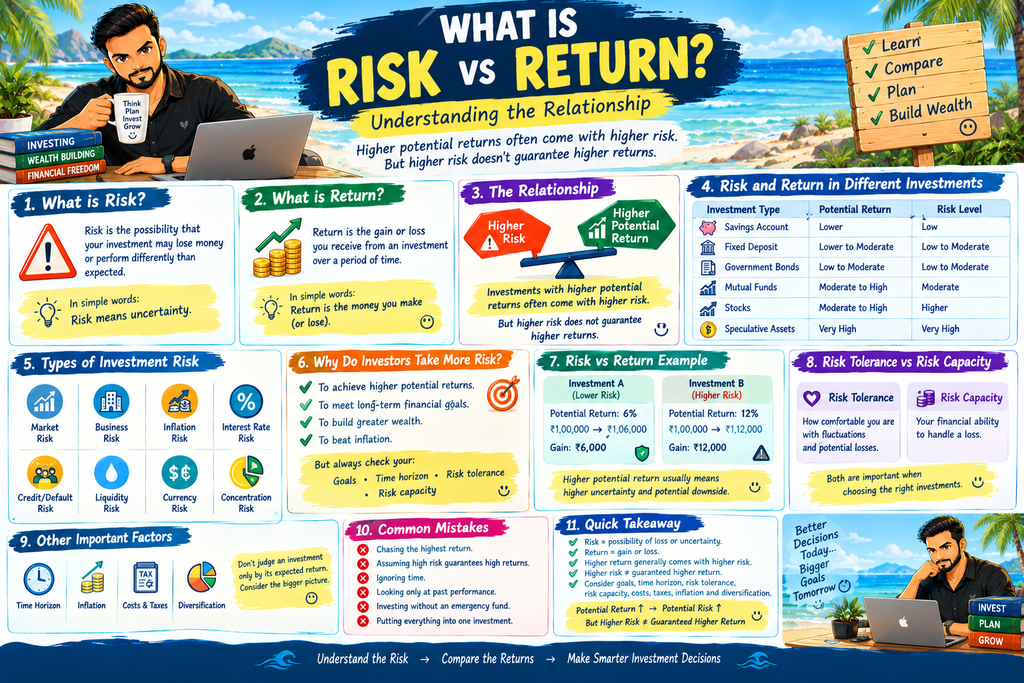
Risk and return: The Basic Idea

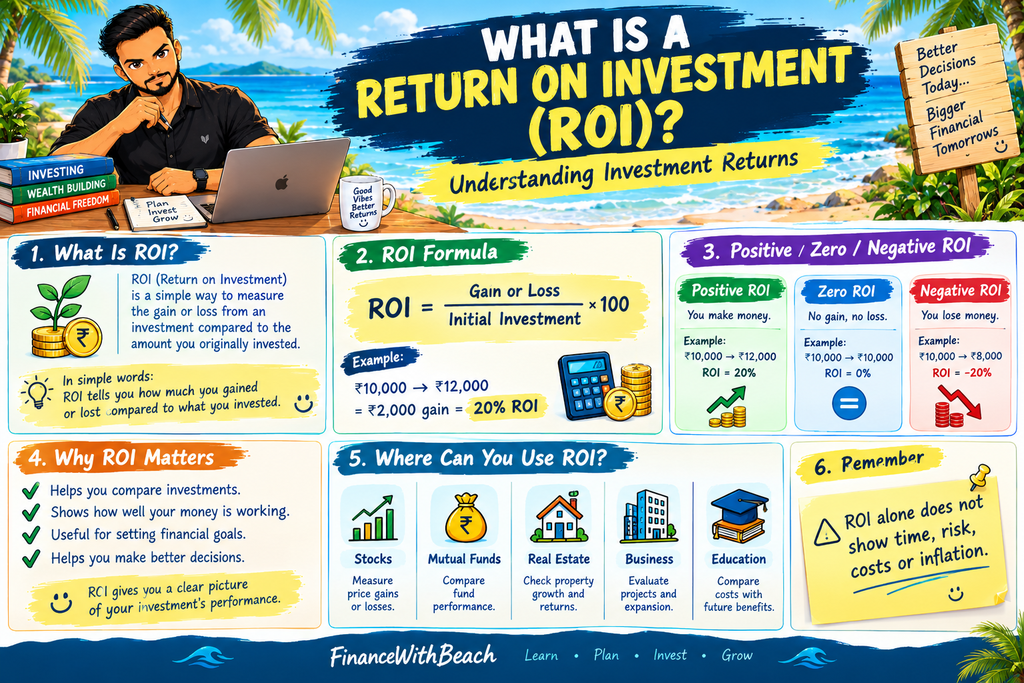
Let’s say you have ₹10,000 to invest.

You have several possible choices.

Investment TypePotential ReturnRisk
Savings accountLowerLow
Fixed depositLower to moderateRelatively low
Government bondsLow to moderateRelatively low
Mutual fundsModerate to highModerate
StocksModerate to highHigher
Speculative investmentsVery high potentialVery high

Actual risk and returns vary dpending on the specfic Investment, tim period market conditions and products.

The important idea is that you generally cannot expect high potential returns without accepting some possibility of loss or uncertainty.

What Is Risk?

Investment risk is the possibility that your investment may not produce the results you expected.

Example:

You invest ₹10,000 in stock.

Later, its value falls to ₹8,500.

Your investment has decreased by ₹1,500.

That is an example of investment risk.

Risk can come form many sources including:

  • Market movment
  • business problems
  • inflation
  • inetrest rate changes
  • default or credit problems
  • Lack og liquidity
  • Currency movemnts
  • Concentrationm in one investment

We discussed these different types of investment risk in the pervious article,”What Is Risk in Investing?“

What Is Returns?

Returns is th gain or loss you recieve from an investment.

Example:

You invest ₹10,000

After sometime, your investment becomes ₹11,500.

Your gain is:

₹11,500 – ₹10,000 = ₹1,500

Your return is:

₹1,500 ÷ ₹10,000 x 100 = 15%

So, your investment produced a 15%n return before considering applicable costs, taxe or other factors.

Returns can be:

Positive Return

you make money

  • ₹10,000 ➔ ₹12,000
  • Return = 20%

Zero Return

You neither gain or loss.

  • ₹10,000 ➔ ₹10,000
  • Return = 0%

Negative return

You lose money.

  • ₹10,000 ➔ ₹9,000
  • Return = -10%

The basic relationship can be undrstood like this:

Higher potential return ➔ Usually higher potential risk

Lower potential return ➔ Usually lower risk

But this is not guarantee.

Example

Let say Investment A has a potential return of 6%, while Investment B could Potentially earn 12%.

This means an investor seeking the possinility of higher returns may have to acdcept greater uncertainty.

Does Higher Risk Always Men Higher Return?

NO.

This is one of the most importan things beginners should understand.

Taking more risk does not guarantee that you will make more money.

Consider two investments:

  • Investment A has moderate risk and eventually earns 10%.
  • Investment B has high risk but eventually loses 20%.

Investment B involved more risk, but it produced a negative return.

Higher risk = Higher potential return, nit guranteed higher return.

The word potential is important.

Why Do Investors Accept More Risk?

Investors may accept greater risk because they want the possibility od achieving higher returns.

Example:

Someone investing for a lonf term financial goal may consider investment with higher potential frowth than atraditional savings product.

But beofre taking additional risk, an investor should cosnsider.

  • Fiancial Goals
  • Investment time horizons
  • Ability to handle losses
  • Emergency savings
  • Existing investments
  • Income Stability
  • Investment Knowledge

Risk should not be taken simply because an investment promises a higher return.

Risk vs Return and Time Horizon

Your time horizon can also affect how you think about risk.

A time horizon is the length of time you expect to keep your money invested.

Short Term Goals

Let’s say you need ₹2 lakh for an expense next year.

A large loss shortly before you need the money could create a problems.

Long Term Goal

Let’s say are investing for a goal many years away.

You may have more time to deal with market fluctuations,athough losses are still possible.

This does not mean long term investments are automatically safe.

It means the amount of time available can effect how much short term volatility you may be able to tolerate.

Risk Tolerance vs Risk Capacity

Two Term are useful for beginners:

Risk Tolerence

This refers to how confortable you are with investment losses and price fluctuations.

Example:

If you seeing your investment fall 20% would make you panic and sell immediately, you may have lower tolerance for large fluctuations.

Risk Capacity

This refers to how much financial loss you can actually afford.

Example:

Someone with an emergency fund, stable income and a long investment horizon may have greater financial cpacity to withstand temporary losses than someone who needs the money soon.

These are different concept.

You ight be emotionally comfortable with high risk but financially unable to afford a large loss.

Risk vs Return Example in Real Life

Let’s say three Hypothetical investors.

Investor A – Low Risk Preference

Invest mostly in reltively lower risky-risk products.

Potential returns may be lower but large fluctuationsmay also be less likely

Investor B – Moderate Risk

Uses a mixture of idfferent investments.

The protfolio may have a balance between growth potential and risk.

Investor C – Higher Risk

Invests a Larger portion in assets with significant price fluctuations.

There may be greater potential form growth, but also greater potential losses.

None of these approches automatically produces a better results.

The appropriate level of risk depends on the person’s fiancial situation, goals, time Horizon and ability to handle losses.

Risk vs Return in Stocks

Stocks are a common example of the risk return relationship.

A stock’s price can rise signifantly.

But it can also fall signifcantly.

Example:

You invest ₹50,000

If the investment rises by 20%.

₹50,000 ➔ ₹60,000

Gain = ₹10,000

But if it falls by 20%:

₹50,000 ➔ ₹40,000

Loss = ₹10,000

The same investment can produce very different outcomes.

This is why potential return should al;ways be considered longside risk.

Risk vs Return in Mutual Funds

Mutual funds invest in a collection of securities according to their investment strategy.

Different types of mutual funds can have different levels of risks.

Example:

  • Some funds focus on equities.
  • Some focus on bonds
  • Some combine different types of assets.

A fund’s historical return does not gurantee its future returns.

Therefore beginners should look at more than just the return percentage.

The Role of diversification

One way investors can manage certain types of risk is through Diversification.

Diversification means spreding money across different investmebnt insted of putting everything into one investment.

Example:

Instead of investing your entire ₹1,00,000 in one stock, an investor may spread money across different assets.

Diversification cannot eliminate investment risk, but it can help reduce the impact of apoor performance from one particular investment.

Our nect article will explain diversification in detail.

Risk, Return, and Inflation

There is another factor beginners should remember:

Let say your investment earns 6% per years, but inflations is 5%.

Your money has grown in nominal terms, but its puchasing power not have not have increased by the same amount.

Therefore, when thinking about returns, investors should consider:

Return + Risk + Inflation + Costs + Time

Looking at the return percentage alone may not give you the comlete picture.

Risk vs Return vs ROI

These concept are related but differently

ConceptMeaning
RiskPossibility of loss or uncertainty
ReturnGain or loss from an investment
ROIA percentage measure comparing gain or loss with the original investment
Risk vs ReturnRelationship between potential returns and the level of risk involved

Example:

You invest ₹10,000 and recieve ₹12,000.

Your gain is ₹2,000.

Your ROI is:

₹2,000 ÷ ₹10,000 x 100 = 20%

But ROI Alone doesn’t tell you how much risk was invilved or how long it took to acieve that returns.

Common Beginner Mistakes

1. Chasing the Highest Return

A high expected return can come with significant risk.

2. Assuming High Risk Gurantees High Returns

It doesn’t

Higher risk means greater uncertainly, not guranteed profit.

3. Ignoring Time

A 20% return over one year is different from a 20% return over ten years

4. Looking Only at past Peformance

Past Performance does not gurantee future results.

5. Investing Without an Emergency Fund

Money Needed for emergencies generally shouldn’t depend on risky investment.

6. Putting Everything Into One Investment

Concentration can increase the impact of a single invesment performing poorly.

FAQs

Is Higher risk Always better?

No Higher risk simply means greater unceertainly and potential downside. Whether a particular level of risk is appropiate depdns on the investor’s circumstances and goals.

Can a low risk investment lose money?

Yes.”Lower risk” does not mean “zero risk.”

Does higher return mean a better investment?

Not necessarily. You Should also consider risk, time period, costs, taxes, inflation, anmd your financial goals.

What is the main idea of risk vs return?

The basic idea is that investment offering higher potential returns generally ivolve greater uncertainly and potential losses.

Can Diversification reduce risk?

Diversification can reduce certain concertration related risks, but it cannot eliminate all investment risk.

Should Beginners always choose low risk investments?

Not necessaril;y. The appropriate level of risk depends on factors such as financial goals, time horizons, financial capacity and riskl tolerences.

Link this article to:

What Is Risk in Investing? — Why Every Investment Has Some Risk

What Is Risk in Investing?

When people start lesarning about investing, they often focus on one question.

“How much money can I make?”

But there is another question that is just as important:

“How much could I lose?”

This is where investment risk comes into the picture.

Investment risk is the possibility that an investment may not perform as expected, You could receive a lower return that expected, lose part of your original money or in some cases lose most or all of the amount invested.

Different investment have different types and levels of risk.

Udnerstnding risk does not mean avoiding investing completely. It mean understanding what could happen to your money before you invest.

What Does Risk Mean in Investing?

In simple words:

Investment risk is the possibility that the actual results of an investment will be differently from what you expected.

Example

Let say you have ₹10,000 in an investment expecting it ot grow.

Instead ts value falls to ₹9,000.

You have have potential loss of:

₹10,000 – ₹9,000 = ₹1,000

Teh investment therefore carried the risk pf losing value.

Risk can also mean something other than losing money.

Example an investment may perserve your money but grow too slawly to keep up with inflation.

Why Does Every Investment Have Some Risk?

There is no investment that can guarantee the exact outcome of every future situation.

Different risks can come from:

  • Chanmges in market prices
  • Inflation
  • Interest rated
  • Economic codnitins
  • Company performance
  • Governament policies
  • Currency movements
  • Liquidity problems
  • Changes in demand
  • Unexpected events

The amount and type of rsik vary significantly between investments.

Example:

The risk associated with a bank deposits can be vary different from the risk associated with an individual stock.

A Simple Example of Investment Risk

Suppose you have ₹50,000.

You invest it in a stock.

After some time, the stock price increases and your investment becomes:

₹60,000

Your gain is:

₹10,000

But the stock price could also fall.

If your investment becomes:

₹40,000

your loss is:

₹10,000

This uncertainty is one form of investment risk.

The important point is that market-based investments can move both upward and downward.

Different Types of Investment Risk

Investment risk is not just one thing.

there are several different types of risk that investors should understand.

1. Market Risk

Market risk is a possibility that an investment will lose value because the overall market or market codnitions change.

Example

Stock prices fall because of

  • Econcomic concerns
  • Interest rate change
  • Investor sentiments
  • Company or industry news

A stock was worth ₹500 could later trade at ₹450 or ₹400.

Market prices can change frequently.

2. Business Risk

When you invest in a company, you are exposed to the possibility that the company mat perform poorly.

A business could face:

  • Falling Saless
  • Increasing costs
  • Strong Competition
  • Poor managment decisions
  • regulartory changes
  • Technologicial disruption

If the company’s performance deteriorates it share price may also decline.

This is known as business risk.

3. Inflation Risk

Inflation means that the rpices of goods and services generallyincreases over time.

prices rise the purchasing power of money can decrease.

Example

Let say you have ₹10,00 todays.

If prices rise significantly over several years, ₹10,000 in the future may not but same amount of goods and service.

Thgis creates inflation risk.

An investment can increase in value while still providing limited growth in real purchasing power if inflation is high.

4. Interest Rate Risk

Interest rates affect different investment in diferent ways.

Example

Changes in interest rates can influence the price of bands.

When the interest rates change,existing bonds with fixed interest payments can become more or less attractive compared with newly issued bonds.

Interest rates can also affect businesses because borrowing costs may increases or decreases.

Therefore, investors should understand how interest rate changes can affect the types of investment they own.

5. Credit or default Risk

Credit risk is particularly relevent when you lend money through an investment such as a bond.

The borrower may have difficulty making interest payments or repaying the principal.

Example:

You lend a company ₹50,000 through a bond.

The company is expected to pay interest and eventually return your ₹50,000.

If the company experiences serious financial problems, there may be e risk that payments are delayed or not fully made.

This is called credit or default risk.

6. Liquidity Risk

Liquidity refers to how easily can buy or sell an investment without signifcantly affecting its price.

An investment may be difficult to sell quickly.

Example

Let’s may have to wait to find buyer or accept a lower price to sell quickly.

That is liquidity risk.

7. Currency Risk

Currency risk can affect people who invest in assets denominated in another currency.

Let say an indian investor invests in an asset priced in UD Dollars.

Even if the investment’s dollar value stays unchanged, changes in the USD/INR Exchange rate can affect the investment’s value when converted back into rupees.

This is known as currrency risk.

Risk and Return

There is an important relationship between risk and potential return.

Generally investment with greater uncertaintymay offer the posibility of higher returns, while investments with lower risk may offer lower potential returns.

But this does not mean:

Higher Risk = Guranteed higher returns.

It doesn’t A risky investment can produce a high return or a loss.

InvestmentPotential RiskPossible Outcome
Savings/deposit productsGenerally lowerLower potential return
Government securitiesGenerally lower, depending on the securityRelatively predictable payments if held under applicable terms
BondsVariesInterest income and possible price changes
Mutual fundsVaries by fundReturns can rise or fall
StocksCan be highSignificant gains or losses are possible
Speculative assetsCan be very highLarge gains or losses are possible

Teh exact risk depends on the specfic product not simply its category.

Can You Avoid Investment Risk Completely?

You generally cannot eliminate all investment risk.

However, you can understand and manage risk.

Some common approaches includes:

Diversification

Spread investment across different assests rather than relying heavily on one investment.

Understanding What You Buy

Learn how an investment works before putting your money onto it.

Considering Your TIme Horizon

An investment may behave differently over a few months compared with several years.

Maintaining an Emergency Fund

Money needed fo unexpected expenses genrally should not depend on selling a volatile investment at an inconvenient time.

Avoiding Unnecessary Concentration

Putting too much money into one company, sctor or assest can increase concentration risk.

Reviewing Costs

Fees and other Costs can reduce investment returns.

Risk Tolerance vs Risk Capacity

Two People can have the same investment but very different abilities to handle ot risks.

Risk Tolerence

This is about how comfortable you are wuth investment fluctuations and potential losses.

Somone may be uncomfortable seeing their investment fall 20%.

Another person may be mire comfortable with signifant fluctuations.

Risk Capacity

This is about your financial ability to handle a loss.

Someone with stable income, adequate savings and along investment horizon nay have a different financial capacity for risk than somone who needs the oney soon.

Both concept are important when thinking about investments.

Wht Time Horizon Matters?

Yor Time Horizon is how long you expect to keep your money invested.

let’s say you need ₹2 lakh in three months.

Putting that money into a highly volatile investment could expose you to the possibility of needing to sell after a market deline.

Now consider money that you don’t expect to need for many years.

You my have more time to expernience and portentially recover from matket fluctuations, although recovery is never guaranteed.

Therefore, your investment time horizon is an important part of understanding risk.

What Happens When You Take TOO Much Risk

Taking more risk than you can finacially or emotonally handle can create problems.

Example:

You invest ₹5 lakh in a highly volatile investment.

The value falls to ₹3.5 lakh.

If you need the money immedtiatelly you may feel forced to sell during the decline.

This casn turn a temporacy declineinto permanent realized loss.

That’s why investment should genrally be matched with your financial goals, time horizonsand ability to handle losses.

Risk Does Not Mean an Investment IS Bad?

An Investment having risk does not automatically make it a bad insvestment.

Risk is simply a charcteristic that needs to be understood.

Example:

Stocks can experience significant price movements,but they are also commonly used by investors seeking long term growth.

Smilaarlylower risky investments may provide greater atavility but may have lower growth potential.

The important question is not simply:

“Does this investment have risk?“

Instead consider:

“What risks does this investment have, and can I handle Them?“

A Simple Risk Checklist for Beginners

Before investing, ask yourself:

1. What am I in vesting in?

do you understand the investment?

2. How can I make money?

Understand where the potential return comes from.

3. How can I Losemoney?

Identify the major risks.

4. How long can I keep my money Invested?

Think about your time horizon.

5. How easily can I access my money?

Cosnider liquidity.

6. What Happens if the investment falls?

Think about Whether you could financially handle a decline.

7. Are there fees or taxes?

These can effect your actual returns.

8. Is my moey diversified?

Avoid unncessary concentration in one Investment.

Common Mistakes Beginners Make

Mistake 1: Looking Only at Potential Returns

A high potential return can come with high uncertainly.

Always consider both potentialreturn and risk.

Mistake 2: Believing Past Performance is Guaranteed

An Investment that performed well in the past may not perform the same way in the future.

Mistake 3: Investing Money You Need Soon

Short Term Financial Needs and long term investments sholud be Considered Separately.

Mistake 4: Putting Everything Into One Investment

Concentration can increase the impact of an singl;e investment performing poorly.

Mistake 5: Following Others Without Undrstanding the Investment

Someone else’s investment choice may not match your fianncial situation, goal or risk tolerence.

A negative ROI means the investment lost value relative to the Original Investment.

Link this article to:

Simple Interest vs Compound Interest — What’s the Difference?

Simple Interest vs Compound Interest — What’s the Difference?

When you saver, or invest money you will often come across the word interest.

Interest is the extra money earned on savings or investments or the extra money paid when norrowing money.

There two ways to caluclated the interest:

  • Simple Interest
  • Compound Interest

Athough boyh include interest, they work diffrently. understadning the difference is important because is can affect how quickly your money grows or how much you eventually pay on a loan.

In this article, we will explain simple and compund interest using easy example.

What is Simple Interest?

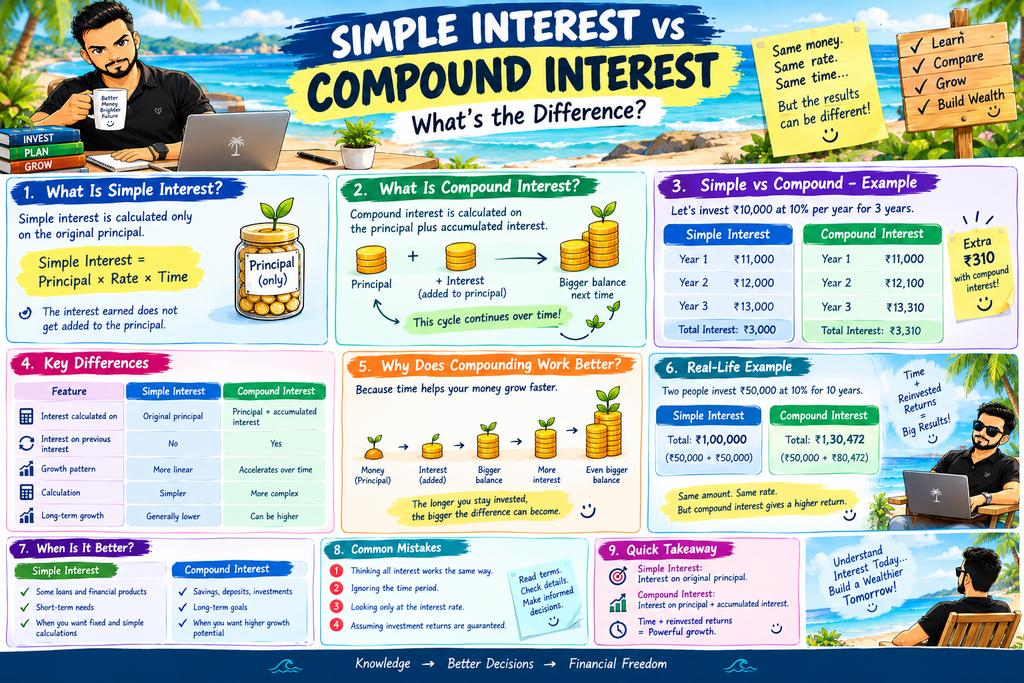
Simple Interest is calculated only on the original amount of money, called Principal.

The interest earned does not get added to the principal when calculating interest for the next period.

Simple Interest Formula

Simple Interest = Principal x Rate x Time

Example:

Let’s say you invests ₹10,000 at 10% simple interest per year for 3 years.

  • Principal = ₹10,000
  • Interest Rate = 10%
  • Time = 3 years

Interest Earned:

₹10,000 z 10% x 3 = ₹3,000

So after 3 years:

Total = ₹10,000 + ₹3,000 = ₹13,000

The interest is calculated on the original ₹10,000 eavet year.

What Is Compound Interest?

Compound Interest is different because the inetrest you earn can be added to your original money.

Then, Future interest can be calculated on both:

Original Money + Previously earned money

This is often described as “interest on interest.”

FV=PV(1+r)nFV=PV(1+r)^n

Example:

Let’s say you invests ₹10,000 at 10% simple interest per year for 3 years.

Year 1

₹10,000 earns ₹1,000 interest

Balance = ₹11,000

Year 2

Now the 10% interest is claculated on ₹11,000.

Interest = ₹1,100

Balance = ₹12,100

Year 3

Interest is calculated on ₹12,100.

Interest = ₹1,210

Balance = ₹13,310

So after 3 years:

Total = ₹13,310

This is higher than the ₹13,000 produced by simple interest.

Simple Interest Vs Compound Interest:

Example

Let’s compare noth using the same starting amount.

Suppose:

  • Intial amount = ₹10,000
  • Interest rate = 10% per year
  • Period = 3 years
YearSimple Interest BalanceCompound Interest Balance
Start₹10,000₹10,000
Year 1₹11,000₹11,000
Year 2₹12,000₹12,100
Year 3₹13,000₹13,310

Difference

After 3 years:

Simple Interest = ₹13,000

Compound Interest = ₹13,310

The difference is ₹310.

The difference may look small over small year, but it can become much larger when money compounds for many years.

Key Difference Between Simple and Compound Interest

The easiest way to remember the difference is:

Simple Interest works on the original Principal. Compound interest works can be calculated on the principal plus accumlated interest.

Simple Interest

You earn interest on the original amount.

Compound Interest

You can earn interst on the original amount and perviously earned interest.

Simple Interest vs Compound Interest

FeatureSimple InterestCompound Interest
Interest calculated onOriginal principalPrincipal + accumulated interest
Interest on previous interestNoYes
GrowthMore linearCan accelerate over time
CalculationSimplerMore complex
Long-term growthGenerally lowerCan be higher at the same rate
Common useCertain loans and financial calculationsSavings, deposits, investments and some loans

The exact way interest is applied depends on the financial product ans its terms.

Why Does Coompound Interest Become Powerful Over Time?

The biggest difference between the two becomes visible over a longer period.

With simple interest, the interest amount remains based on the principal original princicpal.

With compound interest, the base used to calculate future interest can keep investing.

Example:

Your investment earn interest and you leave that interest invested instaed of taking it out.

Your money can follow a cycle lile this:

Money ➔ Interest ➔ Larger Balance ➔ More Interest ➔ Even Larger balance

This is why is an important part of compounding.

The longer money remains invetsed and compounds, the greater the potential difference can become.

Is Compound Interest Always Better?

Nit necessarily.

It depends on whether you earning interest or paying it.

When you are earning interest

Compound interest can help your money grow because previously earned interest can generate additional interest.

When you are brorrowing money

Compound interest can increase amount you owe when unpaid interest is added to the balance and subsequently acruese more interest.

That’s why very important to understanding the temr sof loans, credit products, deposits and investment before making financial decisions.

Simple Interest vs Compound Interest In Everyday Finance

You may encounter these concept in different areas of personal finance.

Savings

Some savings products may pay interest according to specfic compounding rules.

Fixed Deposits

Interest may be calculated and compounded according to the terms of the deposits.

Loans

Some loans use interest clalculations that can involve compounding while others use different methods.

Investments

Compounding is an important mathematical concept behind long term investment growth when returns remains invested.

Always check the specfic product’s terms rather than asuming that every financial product uses the same interest method.

Why Started Early Matters?

One of the important lessons from compound interest is the value of time.

Supppose two investors eventually invest the sme amount of money, but one starts several years earlier.

The earlier investor has more time for returns to portentially generate additional returns.

Example:

₹10,000 ➔ Returns ➔ Larger Returns ➔ more returns ➔ Larger balance

Over a long period, this repested process can have a signifcant effect.

This is ine reason compound interest is often discussed when learning about long-term investing and wealth building.

Simple Interest vs Compound Interest:Which Formula Should You Know?

For Simple Interest:

Simple Interest = P x R x T

Where

  • P = Principal
  • R = Interest rate
  • T = Time

For Compound Growth, a commonly used annual-compounding formula is:

A = P(1 + r)ⁿ

where:

  • A = Final amount
  • P = Principal
  • r = Annual interest rate expressed as decimal
  • n = Number of years

the actual calulation can differ when interest compund monthy, quarterly or at another frequency.

Common Mistakes Beginners Make

1. Thinking all interest works the same way

Different financial products can use different interest calculations.

2. Ignoring the time period

A rate tht looks attractive overa shor period may have a very different effect over period a long period.

3. Looking only at the interest rate

Fees, taxation,inflation, compunding freuqency and prdsouct terms can also affect the actual outcome.

4. Assuming investment returns are guaranteed

Compound growth examples often use a fixed rate for simplicity. Real market investments can rise and fall and actual returns may differ.

FAQs

Is Compound intereet better than simple interest?

When you are earning interest, compound interest can produce more growth than simple interest at the same rate and over the same period because perviously earned interest can also genenrate interest.

What is the main difference between simple and compound interest?

Simple Interest works on the original Principal. Compound interest works can be calculated on the principal plus accumlated interest.

Does Compound Interest Help investment Grow?

Compounding can cintrubute to long term growth when returns remains invested, However, market investment do not guarantee a fixed returns.

Can compound Interest increase Debt?

Yes. Depending on the product’s terms, unpaid interest can become part of the balance on which future returns is calulated.

Why is compound interest important?

it helps explain why money can gorw increasingly faster over long periods when reurns remain invested.

Link this article to:

What Is a Dividend? A Simple Guide for Beginners

What Is a Dividend?

Hwn you start learning about stocks, you may hear the word dividend quite often.

But what exactly is dividend?

In Simple Words:

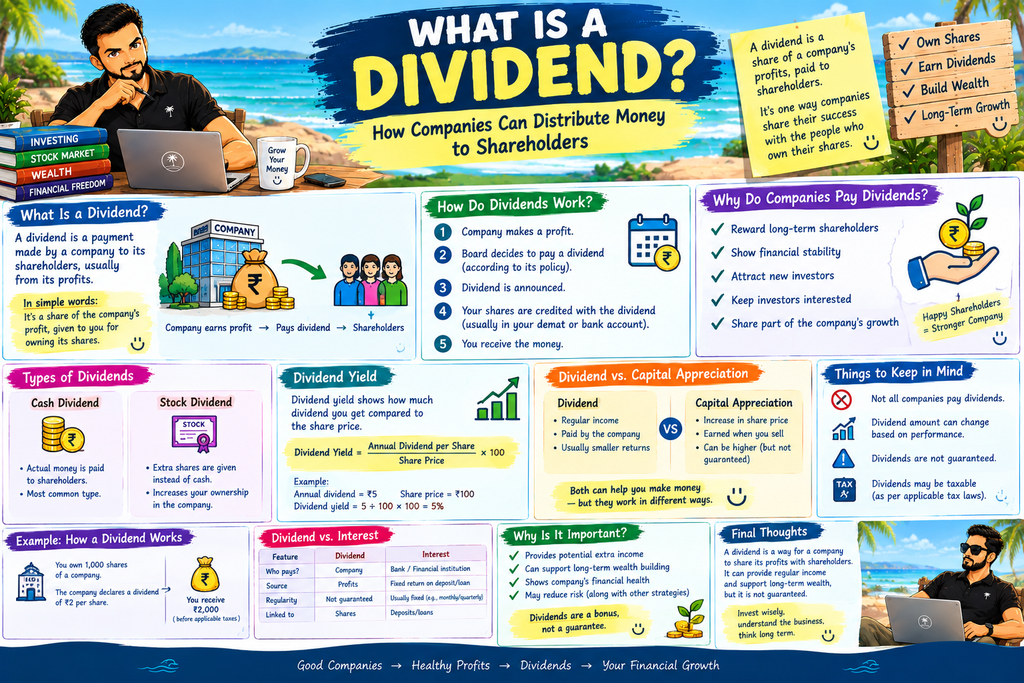
A dividend is a payment thaat a company may distribute to its shareholder, often from its profits or accumulated earnings.

When you own shares of a company that declares a dividend, you may receive money based on the number of eligible shares you own.

Example:

let you have 100 shares of a company.

If the company declare a dividend of:

₹6 per share

you could receive:

100 x 6 = ₹600

Before any applicable taxes or other consideration.

Companies are not required to pay divends simply because thay make a profit. Whether a dividend is declared depends onthe company’s policies, financial position, board decisions, applicables laws and other factors.

How Do Dividends Work?

The basic process is relatively simple.

Step 1: The company earns Money

A company operates it business and may generate profits.

Step 2: The company Decides what to Do with its Money

The company mau use it money for things such as:

  • Expanding the business
  • Buying Equipment
  • Developing Products
  • Paying debts
  • maintaining Cash reserves
  • Acquireing another business
  • Distributing money to shareholders

Step 3: A Dividend Id declared

If he company decides to ditribute a dividend, it announces the relevent details.

Step 4: Eligible Shareholders Receive the Dividend

Shareholders who meet the applicable eligibility requirements receive the dividend according to the company’s announced terms.

The payment may be credited to the investor’ bank account through the appplicable process.

Why Do Companies Pay Dividends?

Companies may pay dividends for several reasons.

1. Sharing Profits With shareholders

A company may distributes part of its earnings to shareholders.

2. Returing Capital to investors

Dividends can be one wayt to return capital to investors.

3. Attracting Certain Investors

Some investors prefer companies that have a history od ditributing dividends.

4. Showing Financial Strength

A consistent dividend history may be viewed by investors as one part of a company’s Financial profile athough a dividend by itself does not guarantee that a company if fiancially strong.

Do all Companies Pay Dividends?

NO.

This is one of the important things beginners should understand.

Some companies pay regular dividend, while other reinvest in company.

Example, instead of paying:

10 crore rupees in dividends.

A company might use that money to:

  • Open new location
  • Develop new procduct
  • Hire employees
  • Purchases machinary
  • Exapand internationally

The company’s approach depends on its busness strategy and financial circumstances.

Types of Dividends

There are different ways companies can distributes values to share holders.

1. Cash Dividends

A cahs divdiend is the most familier type.

The company pays aligible shareholders money.

Example:

  • ₹4 per share
  • If you own 500 shares:
  • 500 × ₹4 = ₹2,000

2. stock Dividend

Instead of paying cash. a company may distribute additional shares eligable shareholders under the applicable terms. Example

A company could distribute additional shares based on a specfied ratio.

This increases the number of shares an investor owns, athough the overall ecnomic eggects depdnds on the company’s valuation and terms od the distributions.

3. Special Dividend

A company may sometimes declares a speical dividend which is anadditional; or unusal distrubution outside its regular divdiend pattern.

This can happen when a company has excess cash or experiences an unusal financial event. Special divdiend are not necessarily recurring.

What Is Dividend Yield?

Another Important terms is Dividend Yield

Dividend yield shows the annual dividend relative to the current share price.

The basic formula is:

Dividend Yield = Annual Dividend Per share ÷ Share Price x 100

Example

Annual Dividend = ₹ per share

Share price =₹100

Tehre fore:

₹5 ÷ ₹100 x 100 = 5%

Dividend Yield = 5%

Dividend yield can change when the share price changes, even if the company dividend amount remains the same.

Simple Dividend Yield Example

Imagine Company A pays:

₹8 annual dividend per share

Its current share price is:

₹200

Dividend yield:

₹8 ÷ ₹200 × 100 = 4%

So the dividend yield is:

4%

But remember that dividend yield is based on the share price and dividend amount; it should not be interpreted as a guaranteed future return.

Dividend vs. Capital Appreciation

There are two different ways shareholders may potentially benfits from owning Stocks.

Dividend

Money distributed by the company to eligible shareholders.

Capital Appreciation

An icnrease in the market price of the shares.

Example:

But a share ₹100

Later sell at ₹140

The increase of ₹40 represent a ptoential cpaital gain if you sell at that price, before cosndiering taxes and transaction costs.

If tyhe company also pay dividend you may recieve noth:

Dividend + Potential Capital Appreciation

Neithe is guaranteed..

Dividend vs. Interest

Dividend and Interest are also different.

DividendInterest
Paid by a company to eligible shareholdersPaid according to a debt, deposit, or lending arrangement
Linked to share ownershipLinked to deposited or borrowed money, depending on the arrangement
Usually not guaranteedTerms depend on the financial product
Amount can changeRate may be fixed or variable depending on the product
Company decides according to applicable rulesUsually determined by the agreement/product terms

What Is a Dividend-Paying Stock?

A dividend paying stock is a company’s stock whose shareholders recieve divdiend when the company decalres and distributes them.

Some companies have along history of paying dividends.

Other may pay occasionally.

And some companies nolt pay any Kind of dividends at all.

Simple looking for whether a copmpany pay dividends is not enough to udnerstand whether the stock suitable for a particular investor.

Are Dividends Guaranteed?

No.

A company can change, rduce, suspend or stop its divdiend depending on its circumstances and applicbale rules.

Even long histoires f dividend company can change their policies.

This is why investor should not assume:

“The company paid a dividend last year, so it must pay th same divdind last year.”

Dividend are not guaranteed returns.

What Is a Divdiend Payout Ratio?

The dividend payout ratio indicates how much of a company’s earning are distributed as dividends.

A simple formula:

Dividend Payout Ratio = Dividends ÷ Earning x 100

Example

Company earning =₹100 crore

Dividend = ₹40 crore

Payout ratio

₹40 crore ÷ ₹100 crore x 100 = 40%

The interpretation of this ratioo depends on the company’s industry, fiancial position, accounting results and ther results.

Why Do Some Companies Not Pay Dividends?

There are several reasons.

A company may prefer to use its money for:

  • Business expansion
  • Research and development
  • New products
  • Acquistions
  • Debt reduction
  • working capital

Example:

A young companies with many growth opportunities ma choose to reinevst its earning isnted of sistributing them.

That doesn’t automatically means company is good or worse; its refects how the company chooses to alloacate capital.

What Should You Check Before Investing in Dividend Stocks?

If you are lookin for dividends paying compaqnies don’t look just on dividend pay out:

1. Dividend History

Has the company paids dividends consistently?

2. Profitability

Does the business generate sustainable profits?

3. Cash Flow

Does the company genrate enough Cash to support its operations and distributions?

4. debts

How much debt does the company have?

5. Payout Ratio

How muchof its earning is being Distributed?

6. Business Growth

Is the underlying business grwoing, stable or declining?

7. Dividend Yield

Is the yield reasonable relative to the company’s Circumstances.

A very highly divdiend yield should not automatically be cosndiered attractive because a falling share price can make yield appear unusually high.

Common Dividend Mistakes Beginners Make

1. Thinking Dividends Are Free Money

A divdiend is a distrbution asociated with owning shares. it isn’t free money separate from the ecnomics of the investment.

2. Looking Only at Dividend Yield

A high yield does not automatically mean a better insvestment.

3. Assuming Dividends Are Guaranteed

Companies can reduced or stop dividends.

4. Lgnoring The business

A divdiend should bot be only thing you research.

5. Forgetting Taxes

Divdiend income may ahve tax implications dpending on your country and circumstances.

Why Dividends Matter to Investors?

Dividends can be used for investors who want to understand how companies distribute cash to share holders.

They can poitentially provide:

  • An additional income of investment income
  • Cahs distributions
  • A way to paryicipate in company profits
  • Another companonets of total investment returns

Investors should consider divdiend alongside the company’s overall financial health, valuation, growth risks, and thier own goals.

FAQs

What is a divdiend in simple words?

A dividend is a payment thaat a company may distribute to its shareholder, often from its profits or accumulated earnings.

How do Dividend Work?

A company decides to distribute a divdiend, announces the relvent terms and dates and eligible shareholders recieve the declared amount according to those terms.

Do all Companies pays dividends?

No. some companies pays dividends,whle others reinevst their earnings into the business.

How is a dividend calculated?

Simple calculation

Dividend Recieved = Number of shares x Divdiend Per share

Example

100 shares x ₹5 dividend =₹500 before applicable taxes

What is dividend yield?

Dividend yield shows the annual dividend relative to the current share price.

The basic formula is:

Dividend Yield = Annual Dividend Per share ÷ Share Price x 100

Are dividends guaranteed?

No.

A company can change, rduce, suspend or stop its divdiend depending on its circumstances and applicable rules.

What is cash dividend?

A cash divdiend is a dividend paid in money to eligble shareholders.

Link this article to:

What Is a Stock? A Simple Guide to Owning a Company

What Is a Stock?

When you hear people talk about insvesting, youi will oftern hear words such as stcoks, shares, companies, and stocks markets.

But wha is an stocks?

Ins simple words:

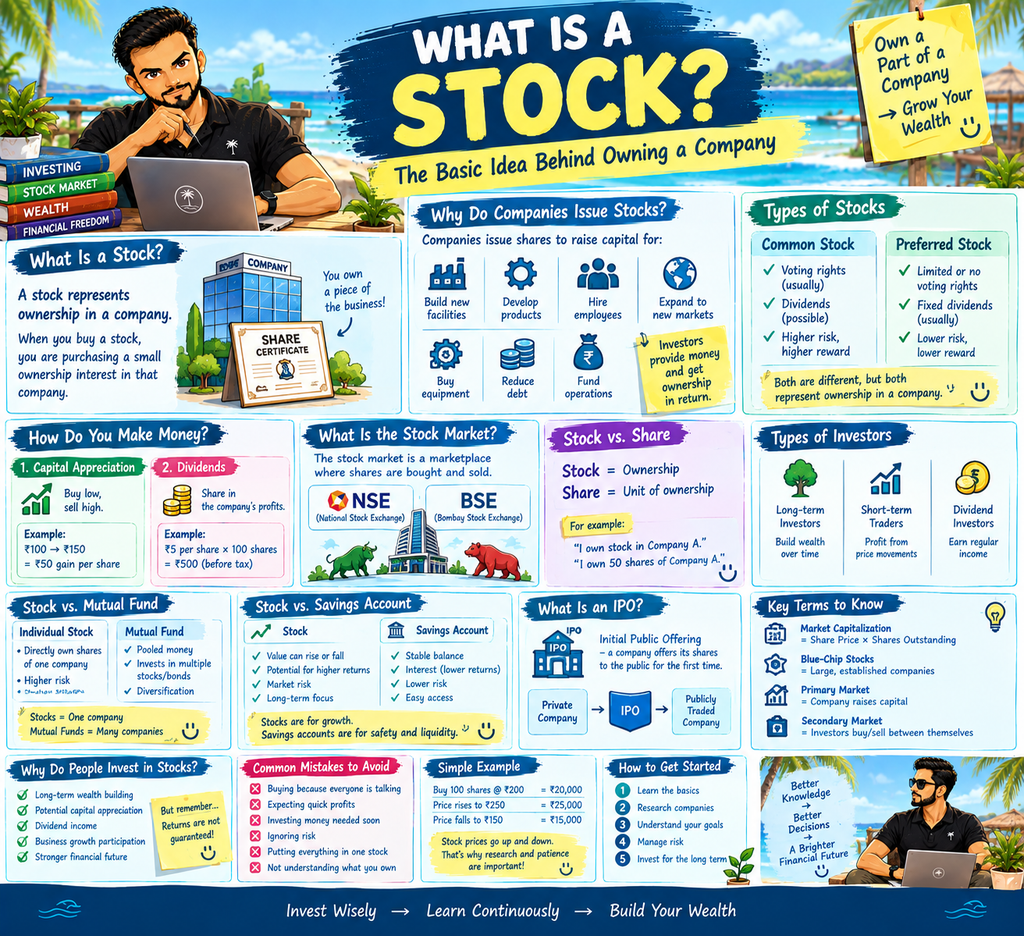
A stocks represents ownsrship in a company.

Hownever you buy a stock, you are purchasing your small onwership in a company.

Example:

Let say a company have 1,000 shaes in company and you own 10 shares of it.

You own:

10 ÷ 1000 = 1%

of the comapany’s shares, subjetc to the company’s share sturcure and types of shares involved.

This is the basic stock idea behind stock ownership.

What Does Owning a Stock Mean?

Owning stock means you own small portion of a company.

Owning a small numbers of shares does not mean you can walk into the company’s office and take something home.

Your iwnership is represented through shares reocreded in your investment account.

Depending on the types of shares, shareholder may have certain rights, such voting rights and potential egibility for dividends.

The exact rights depends on the company’s share structure and applicable taxes.

Why Do Companies Issue Stocks?

Companies needs money to grow their businesses.

They may needs capital to:

  • Develop products
  • Hire employees
  • Expand into new markets
  • Purchased equipments
  • Reduced certain debts
  • Fund business operations
  • Build new facilities

One way companies cn raise captial is by issuing share to a investors.

A company wants a arise ₹100 crore to expand its business.

It may issues shares to investors a spart of raising capital.

Investors provides money and in returns they recieve an ownership interest represented by shares.

What Is a Share?

The words stock and share are oftern used together, but they arent’t exactly identical.

Stock

Stock generally ferefers to ownership in one or more companies.

Share

A share is unit of ownership in a particular company.

Example:

“I own stock in Company A.”

You could Say:

“I own 50 Shares of Company A.”

Simple way to remember it:

Stock = Ownership

Share = Unit of Ownership

How Do Investors Make Money From Stocks?

There are two major ways investors may potentially benfits from owning stocks.

1. Capital Appreciation

Let say you buy a stock at:

₹100 per share

Later, its market price becomes:

₹200 per share

If you sell at ₹200, your gross gain is:

₹200 – ₹100 = ₹100 per share

For 100 shares:

₹100 x ₹100 ₹10,000

This is an example of a capital gain before consdiering taxes,fees and other costs.

the price could also fall.

If the stock fall from ₹100 to ₹60 , the investment hase lost ₹40 per share in market value.

2. Dividends

Some companies distribute part of their profits to shareholders in form of dividends.

Example:

If a company declares a dividend of

₹6 per share

and you own:

100 shares

you could recieve:

₹6 x 100 = 600

before applicabale taxes and subject to th company’s dividends terms.

Not every company pays dividends.

Some companies may choose to reinvest profits into the business instead.

Why Do Stock Prices Change?

Stock prices changes constantly during market trading because buyers and selelrs have different expectations about a company future.

Factors influeences stcock prices includes:

  • Company Earnings
  • Revenue growth
  • Business performance
  • Industry conditions
  • Economic codntions
  • Interests rates
  • Compelition
  • Government policies
  • Global events
  • Markey sentiments

Example:

If invetsors believe a company future earning could improve, demands for it shares may increases.

But if expectations become negative, demand may fall.

What Is the Stock Market?

The stock market is th market places where shares of pubilcly traded companies can be brought and sold.

In India, Examples of major stock market exchanges :

  • NSE – National Stock Exchanges of India
  • BSE – Bombay Stock Exchange

Investors genrally acces the markets through registered brokers and investment platforms.

The exact process may different vary on country and markets.

What Is a Stock Exchange?

A stock exchange is any organized market place where securties can be traded according to established rules and regulations.

Example:

NSE and BSE

are major stock Exchanges in India.

A company may have it shares listed on an exhanage, allowing eligible invetsors to buy and sell those share through the market.

What Is a Public Company?

A pubilcly traded company is a company whose shares are available for tading in a public market, Subjetc to applicable lisying and regualatory requirements.

This is different from a privately held company, whereownership is generally not freely traded on a public stock exchange.

When aprivately compny becomes Publicly listed through a proess such as an Inital Public Offering(IPO), its shares can become avilable to public invetsors udner the applicbales taxes.

What Is an IPO?

IPO stands for Initial Public Offering.

An IPO is th process through which a company offers its shares to the public for the first time a spart of becoming publicly listed.

Example:

Private Company ➔ IPO ➔ Publicly Traded Company

An IPo can allow a company to raise capital from investors.

After listing shares can genrally be brought and sold in the secondary market.

What Is the Difference Between Primary and Secondary Markets?

This is an important concept for beginners.

Primary Market

The company issues securties to investors to raise capital.

An IPO is an example of Primary market transaction.

Secondary Market

Investors buy and sell securities form one another after securties have already been issued.

Most everyday stock martket trading takes places in the secondary market.

Why Do companies’ Values Changes?

A comapny value changes because its future prospects changes.

Example, investors may pay attentions to:

Revenue

How much money is the money generating.

Profit

How much money remains after expenses?

Debt

How much Does the company Owe?

Growth

Is the Company Expanding?

Competition

Are competors taking market share?

Management

Hoe effectively is the business being Managed?

Industry

Is the company’s industries growing or declining.

These are the some investors maay considers when researching a company.

Stock vs. Mutual Funds

Stock and mutual are different investment structures.

Individual Stocks

You invest in directly in shares of a particular compnay.

Mutual Fund

A mutual fund pools money from investors and invest according to its stated strategy.

Example:

Many Investors – Mutual Fund – Multiple Investment

A mutual fund mayprovide diversification across multiple securties, depending on the fund.

Stock vs. Saving Accounts

A saving accounts and stock are very different purposes and risk charcherisitc.

FeatureStockSavings Account
OwnershipCompany ownershipBank deposit
ValueCan rise or fallDeposit balance is generally stable
ReturnNot guaranteedInterest according to account terms
RiskMarket riskDifferent risks and protections apply
LiquidityCan generally be sold during market hoursGenerally easy to access
Main purposeLong-term investing/growthSaving & liquidity

What Are Blue Chip Stocks?

You may hear of blue chips stocks when you learning about investing.

It generally refers to sharesof large and established company of the country with long history of significant operations.

Being considered a blue chip companies does not mean its prices not fall down.

Every stocks investment involves riskes.

What Is Market Capitization?

Market Capitalization often called market cap, is away of measuring the market value of thate public traded companies’s equity.

Simple Formula:

Market Capitalization = Share price x Shares outstanding

Example:

Share price =₹300

Shares oustanding = 10 crore

MArket capitalization:

₹300 x 10 crore = ₹3,000 crore

Market capitalization is commonly used to compare the size of publie traded companies.

Why Do People Invest in Stocks?

People may invest in stocks for different reasons includes:

  • Long term wealth building
  • Poteential Capital appreication
  • Dividend income
  • Building an Inmvestment Protfolio

But stocks are not guaranteed to icnrease in value.

The appropiate investment approach depends on a person:

  • Goals
  • Time hroizons
  • Risk tolerence
  • Financial situation

What Should a Beginner Understand Before Buying Stocks?

COnsider learning about:

1. What the company Does

Understand the products,services and business model.

2. Renvenue and profits

Look at how the company makes money.

3. Debt

Udnerstand the company’s brorrowing and financial obligations.

4. Valuation

A good company can still be expensive if investors are payinga very high prices relative to fundamentals.

5. Competition

Udnerstand the company’s psoition within is industry.

6. Risks

Every company Faces business and fiancial risks.

7. Your invstement horizon

Stocks can experience significant short term price movements, so consider how long you can remain invested.

Common Stock Market Mistakes Beginners Make

1. Buying Because veryone Is talking About It.

Popularity does not guarantee future returns.

2. Expecting Quick Profits

Stocks can rise or fall unexpectedly.

3. Investing Money Needed Soon

Money needed for rent, emergencies or near term expenses may not be suitable for volatile investments.

4. Ignoring Risk

A stock can lose a substantial portion of its martket value.

5. Puttuing Everything Into the Company

Concentration in one stock can expose your money to company specfic risk.

6. Not understanding what You own

Before Buying a Stock Understand the Business and The Investment case.

FAQs

What is stock in simple words?

A stocks represents ownsrship in a company. You buy a stock, you are purchasing your small onwership in a company.

What is the difference between a stock and a share?

Stock generally ferefers to ownership in one or more companies, while A share is unit of ownership in a particular company.

How do stocks make money?

Investor potentially make money through capital appreciation if the stock price rises and through dividends when company distributes them.

Can I Lose money in stocks?

Yes. Stock prices can fall and you can los part or ptotentially all the money invested in a particular stock.

What is a Dividend?

Some companies distribute part of their profits to shareholders in form of dividends, according to its polices and applicables rules.

What is the stock market?

The stock market is a marketplace where shares and other securities can be nrought ans sold.

What is an IPO?

IPO stands for Initial Public Offering. An IPO is th process through which a company offers its shares to the public for the first time a spart of becoming publicly listed.

Link this article to: