
What Is an ETF?
An ETF (Exhange-Traded Fund) is an investment fund whose units are traded on a stock exhange, similar to how shares of a company are bought and sold.
An ETF can hold a collection of investments, such as stocks, bonds or gold-related assets, depending on its investment objective. Many ETFs are designed to track an index, such as the nifty 50 or Sensex.
Example:
A nifty 50 ETF aims to track the performance of the Nifty 50 index by investing in securites that represent the index.
In Simple Words:
An ETF allows you to invest in a collection of assets by buying units of a fund thorugh a stock exchange.
Unlike a typical index mutual fund, an ETF’s market price changes throughout the trading day as buyers and sellers trade its units. It price may be Slightly different from the value of its underlying assets.
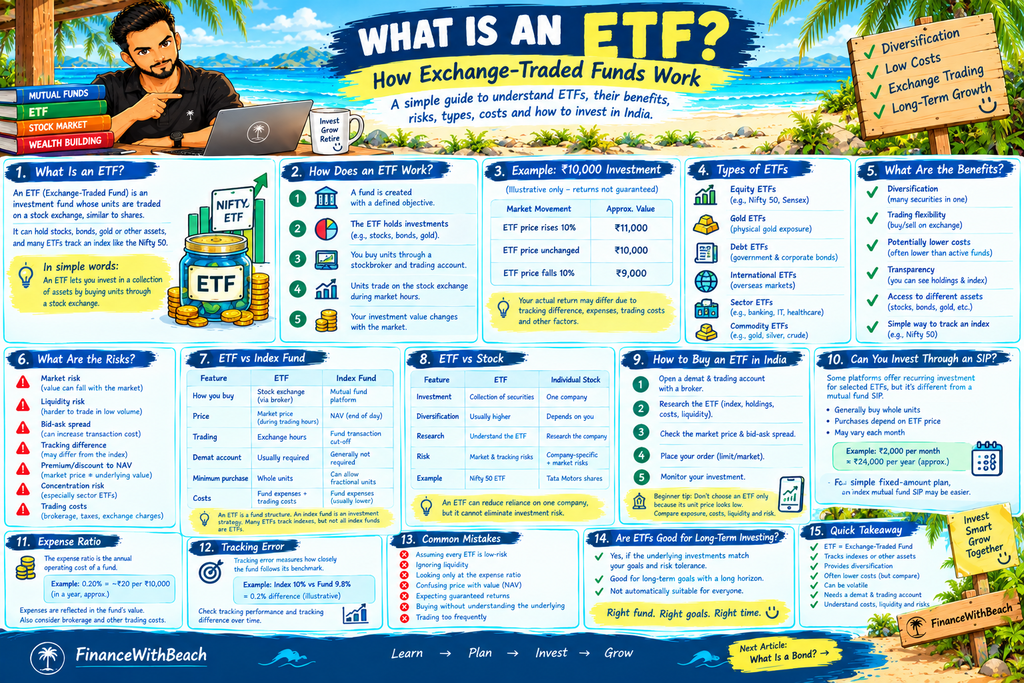
Table of Contents
How Does an ETF Work?
Let’s ynderstand how an ETF works step by step.
Step 1: A fund is created
A fund provider creates an ETF with a defined investment objective . For example, it may aim to track a stock market index or provide exposure to gold.
Step 2: The ETF holds investments
Dpending on its objective, the ETF holds a collection of securties or other eligible assets.
Example:
A Nifty 50 ETF aims to mirror the composition of the Nifty 50 Index.
Step 3: Investors buy ETF units
A retail Investors generally buy and sell ETF units through a stocknroker using a trading account. A demat account is used to hold the units electonically.
Step 4: The ETF trades on the stock exchange
ETF units can be bought or sold during exchange trading hours. Their market prices change according to supply an demand and the value of the underlying assets.
Step 5: Your Investment value changes
I fth ETFs market price rises, the value of your holding may increase. If its price falls, your holding may lose value.
Important: ETFs do not guranteed profits. Your returnss depend on the ETF’s onvestment, expneses, Trading price, and other relevent factors.
Example: Investing ₹10,000 in an ETF
Lety’s say you buy ETf units worth ₹10,000. Imagine the ETFs’s market price changes by 10%.
| Hypothetical price movement | Approximate investment value |
|---|---|
| ETF price rises 10% | ₹11,000 |
| ETF price remains unchanged | ₹10,000 |
| ETF price falls 10% | ₹9,000 |
These figures are simplied inllustrations before brokerage, applicable Taxes, other charges and any difference between the ETF’s market price and the value of its underlying assets.
Your actual return may differ from the return of the index or asset the ETF tracks.
What Are the Different Types of ETFs?
ETFs can provide exposure to different markets and asset classes.
1. Equity ETFs
Example:
A Nifty 50 ETF aims to track the nifty 50 inde, providing exposure to a group of major Indian companies through one investment.
Main Risk: The ETF can lose value when the stock market declines.
2. Gold ETFs
Gold ETFs aim to provide exposure to Gold prices thorugh a fund structure.
They can be an alternative to holding physical gold, although they involve fund expenses and market-related risks.
Main risk: The value of your investment can fall if gold prices decline.
3. Debt ETFs
Debt ETFs invest in fixed-income securties, such as government securities or other bonds, accroding to their investment objectives.
Main risk: Their prices can be affected by Interest-rate changes, credit risk and other market conditions.
4. International ETFs
International ETFs provide exposure to overseas markets or securities.
Example:
An ETf may aim to track an index representing companies in another country.
Main risk: Your investment may be affected by overseas market movements, currency fluctuatiopn and other international risks. Avilability and access can vary.
5. Sector ETFs
Sector ETFs focus on a particular industry, such as banking, information technology or healthcare.
They may offer targeted exposure, but concentrating on one setor can increase risk.
6. Commodity ETFs
Commodity-related ETFs aim to provide exposure to paticular commoditites or commodity-related investment, depending on their structure.
Investors should understand exactly what the fund holds and how it racks the relevent commodity.
Remember: An ETF’s name alone does not tell you everything about its risk. Always review its investment objective, underlying holdings and scheme documents.
What Are the Benefits of ETFs?
ETFs can offer several advantages, depending on the types of fund.
1. Diversification
An Etf holding multiple securities can give exposure to several companies or investments through a single purchase.
However, diversification does not eliminate market risk and sector-soecfic ETFs be concentrated.
2. Trading Flexibility
ETF units generally be brought and sold during stock exchange trading hours, unlike ordinary mutual fund transactions that use the applicable NAV-based proces.
This gives investors more control over the timing and price of their trades.
3. Potentially lower expenses
Many ETFs have relatively low fund-management costs, particularly those that track broad indexes.How ever, expenses ratios differ and brokerage and other trading costs can affect your total cost.
4. Price visibility
You can see the ETF’s market price during trading hours and place orders thorugh your broker.
The market price may differ from the ETF’s underlying net asset value.
5. Acccess to different assets
Depending on availability, ETFs can help investors access stock indexes, bonds, gold-relate investments and international markets thorugh an exchnage- traded product.
6. Simple Acces to a market Index
Instead of buying every share in an index spearately, youn can purchase units of an ETF that aims to track that Index.
What Are the Risks of ETFs?
ETFs are investment, not guaranteed savings products.
1. Market Risk
If the ETF’s underlying investments decline in vlaue, the ETF’s price can also fall.
Example:
An equity ETF may lose value during a stock market downturn.
2. Liquidity risk
Some ETFs have limited trading actviy. You may find it harder to buy or sell at your preferred price, especially when trading volumes are low.
3. Bid-ask spread
The Bid price is what buyers are willing to pay, while the ask price is what sellers are asking.
The difference between themis called the bid-ask spread. A wider spread can increase the cost increase the cost of buying or selling an ETF.
4. Tracking difference
An ETF designed to track an index may not deliver exactly the same return as that index. Expenses, trading costs, cash holdings and other factors can cause differences.
5. Premium or discount to NAV
An ETF’s market price can be higher or lower than its net asset value per unit.
This means you should not assume the market price always exactly equals the value of the ETF’s underlying assets.
6. Concentration risk
An ETF focused on one sector or a narrow group of investments may be more edxposed to particular risks than a broad- market ETF.
7. Trading costs
Brokerage, applicable taxes, exhange-relate charges and pther costs may apply. These costs depend on the broker, transaction and current rules.
Beofre investing investing, understand the ETF’s structure, trading liquidity, underlying investments and total costs.
What Is the Difference Between an ETF and an Index Fund?
An ETF and an index fund are related concepts, but they are not identical.
An index fund follows a partcular index as its investment strategy. An ETF is a fund structure that trades on a stock exchange.
Many ETFs track indexes and some index mutual funds track those same indexes without trading on the exchange like shares.
| Feature | ETF | Index Mutual Fund |
|---|---|---|
| How you buy | Through a stock exchange and broker | Through the mutual fund’s transaction process |
| Price | Market price changes during trading hours | Transaction price based on the applicable NAV |
| Trading | During exchange trading hours | According to mutual fund transaction rules |
| Demat account | Generally required for ordinary exchange-traded purchases | Generally not required for direct mutual fund transactions |
| Costs | Fund expenses plus applicable trading costs | Fund expenses and any applicable transaction costs |
| Minimum purchase | Usually whole units on the exchange | May allow fractional units based on the amount invested and scheme rules |
| Liquidity | Depends on exchange trading activity and market conditions | Depends on the fund’s redemption terms |
Niether option is automatically better. Your choice dpends on how you prefer to invest, the costs involved and the partcular fund.
What Is the Difference Between an ETF and a STock?
A stock represents ownershi in an individual company. An ETF represents units in a fund that holds investments according to its stated objectives.
| Feature | ETF | Individual Stock |
|---|---|---|
| What you own | Units of an investment fund | Shares of a company |
| Underlying exposure | May include many securities or assets | One company |
| Diversification | Can provide diversification through one purchase | Depends on your other investments |
| Main risks | Fund, market, tracking, and liquidity risks | Company-specific and market risks |
| Example | Nifty 50 ETF | Shares of one listed company |
An ETF may reduce reliance on the performance of a single company, but it cannot eliminate the risk of losing money.
How Do You Buy an ETF in India?
For a ordinary retail investor, buying and ETF typically involves a demat account and trading account.
Here are the basic steps.
Step 1: Open an account with a broker
Choose a registered stockbroder and complete the rquired account-opening and identity- vertification process.
step 2: Research the ETF
Understand what the ETF tracks, What it holds, it risk level, expenses ratio and trading actvity.
Step 3: Check the market price
Look at the current bid and ask prices, trading volumes and the difference between the market price and NAV wehere relvent.
Step 4: Place your order
use your broker’s platformto place an order for the number of units you want to buy.
A limit order can help you specify the maximum price you are willing to pay, athough execution is not guaranteed.
Step 5: Monitor your Investment
Review the ETF’s peerformance, costs and continued uitability for your financial goals.
Beginner Tip: Avoid choosing an ETF only because it unit price looks low. COmpare its underlying exposure, costs, Liquidity and risks instead.
Can You Invest in ETFs Through an SIP?
Some brokers and investment platforms offer recurring investment facilities for slected ETFs. However, this process may differ from a mutual fund SIP.
with an ETF, units are generally purchased on the stock exchange at market prices and purchases usually involve whole units. The amount invested each time can thereforevary depending on the ETF’s’s price and the platform’s features.
Example:
Let’s say you plan to invest approximately ₹2,000 every month in an ETF.
- Monethy target: ₹2,000
- Number of purchases: 12 per year
- Approximate yearly contribution: ₹24,000
This represents the amount you plan to contribute, not a guranteed future value. Actual purchases depend on the ETF price, available units and applicable costs.
If you prefer an automatic fixed-amount monthy investment, an index Mutual fund with a regular SIP facility may be simpler to operate.
What Is the Expense Ratio of an ETF?
The Expense ratio is the annual operating expense of a fund expressed as perecntage of its assets.
Let say An ETF has an expense ratio of 0.20%.
At that rate, the annual fund expense is equivalent to approximately ₹20 per ₹10,000 invested, based on tht percentage.
This is an Illustration, not a separate bill for exactly ₹20. Fund expesnes are reflected in the fund’s value over time and your actual cost depends on the fund and the amount invested.
Remember that the expense ratioo is not necessarily your only cost. Brokerage and other applicable transaction charges can also affect your net return.
How Should Beginners Choose an ETF?
Before buying an ETF, consider these points.
- Understand the underlying asset: know whether the ETF track an Equity index, bnds, gold or another investment.
- CHeck rhe Investment objectives: Make sure the ETF’s strategy matches yopur goals.
- Compare expense ratios: Lower costs can help, but they should not be your only slection criterion.
- Review liquidity: Look at Trading volume and the bid-ask spread.
- Check tracking peeformance : for Index ETFs, compare how closely the ETF follows its benckmarks.
- Understand all costs: Consider brokerage, applicable taxes, and other charges.
- Read the scheme documents: Review the holding, risks and investm,ent terms.
- Consider your time horizons: Don’t invest money needed for essential expesnses or near-term goals in a product whose value may fluactuate signifantoly.
Common Beginner Mistakes to Avoid
Mistake 1: Assuming every ETF is low-risk
An ETF that tracks a volatile market or focuses on one sector can carry subsantial risk.
Mistake 2: Ignoring Liquidity
An ETF with low trading actvity may have a wider bid-ask spread.
Mistake 3: Looking only at the expense ratio
Trading costs and tracking performance also matter.
Mistake 4: Confusing an ETF’s price with its value
The market price can differ from NAV.
Mistake 5: Expecting guaranteed returns
ETf prices can rise or fall and losses are possible.
Mistake 6: Buying without understanding the underlying investment
Always fiund out what you are imvesting in beofre placing an order.
Mistake 7: Trading too frequently
Frequent buying and selling cn increase costs and encourage inpulsive decision. Make investment decisions based on your plan rather than every shor-term market movement.
Are ETFs Good for Long-Term Investing?
ETFs can be useful for long-term investing when their underlying investments match your goals and risk tolerence.
Example:
A brad- market equity ETF may offer diversified expsoure to a stock index. A gold ETF, however, provides a different kind od exposure and has different risks.
The right choice depends on the asset class, your financial objectives, your investment horizon and your ability to tolerate losses.
These is no sinle ETF that is Best for everyone.
FAQs
1. What is an ETF in simple words?
An ETf is an investment fund whose units trade on a stock exchange. It may hold a collection od shares, bonds or other assets.
2. What Does ETf stand for?
ETF stands for exhange-Traded Fund.
3. Is an ETF a Mutual Fund?
An ETF is a type of investment fund. In India, ETFs are structured as mutual fund schemes but their units trade on stock exchanges, unlike ordinary open-ended mutual fund transactions.
4. Can I lose money in an ETF?
Yes. If the underlying investments decline in value, the ETF’s price can fall and you may lose some or all of your invested money.
5. Do I neededa Demat account to buy an ETF in India?
For ordinary retail purchases of ETFs on stock exchange, you generally need a demat account and a trading account.
6. Are ETFs Suitable for Beginners?
They can be, provided ou understand the underlying investments, market risks, lquidity and costs. Beginners should research a fund before investing.
7. Do ETFs pay dividends?
Some ETFs may distribute income if thier structure ans scheme terms allow it. Other may retain income or reflect it in the fund’s value. Check he particular ETF’s scheme documents.
8. Are ETFs guaranteed to make money?
No. ETFs returns depend on their underlying investments and market conditions. Returns are not guaranteed.
Link this article to:
- What is Saving?
- What is Income?
- What is Compound Interest?
- What Is Inflation?
- What is Insurance?
- What is investing?
- Types of Investment?
- What is Budget?
- Saving vs Investing
- What is Net worth?
- What Is Exapenses?
- What is Cash Flow?
- What is Liquidity
- What Is Loans?
- What Is EMI?
- What Is Credit Card?
- What Is Bank Account?
- What Is ATM?
- What Is UPI payment?
- What Is Recurring Deposit?
- What Is a Asset?
- What Is a Dividend?
- Simple Interest and Compound Interest
- What Is a Return on Investment?
- What Is Risk in Investing?
- What Is Diversification
- What Is a Portfolio?
- What Is an Index?
- What Is an Stock MArket Index?
- What Is an Mutual Fund?
- What Is an SIP?
- What Is an Index Fund?