What Is a Demat Account? — How Investors Hold Shares and Securities Electronically

What Is a Demat Account?

A Demat account is an account used to hold financial securities in electronic form. The word Dmat comes from dematerialisation, which means converting physical securities into electronic records.

In India, investors commonly use demat accounts to hold shares,exchanges-traded fund (ETFs), bonds and other eligible securities electronically.

Think of a demat account as digital locker for your investments. Instead of keeping physical share certificates, your securities are recorded electronically through India’s depository system.

Example:

Let’s suppose you buy 10 shares of a company through a stockbroker. Once the transaction is completed and settled the shares are credited to your Demat account according to the settlement porcess.

You can then view your holding thorugh the services provided by your Depository Participart(DP).

In Simple Words:

A demat account holds your investments electronically, while a trading account helps you buy and sell securitites in the market.

According to SEBI Investor, Investor generally need a Demat account , a trading account and a bank account to participate in securities-market transactions.
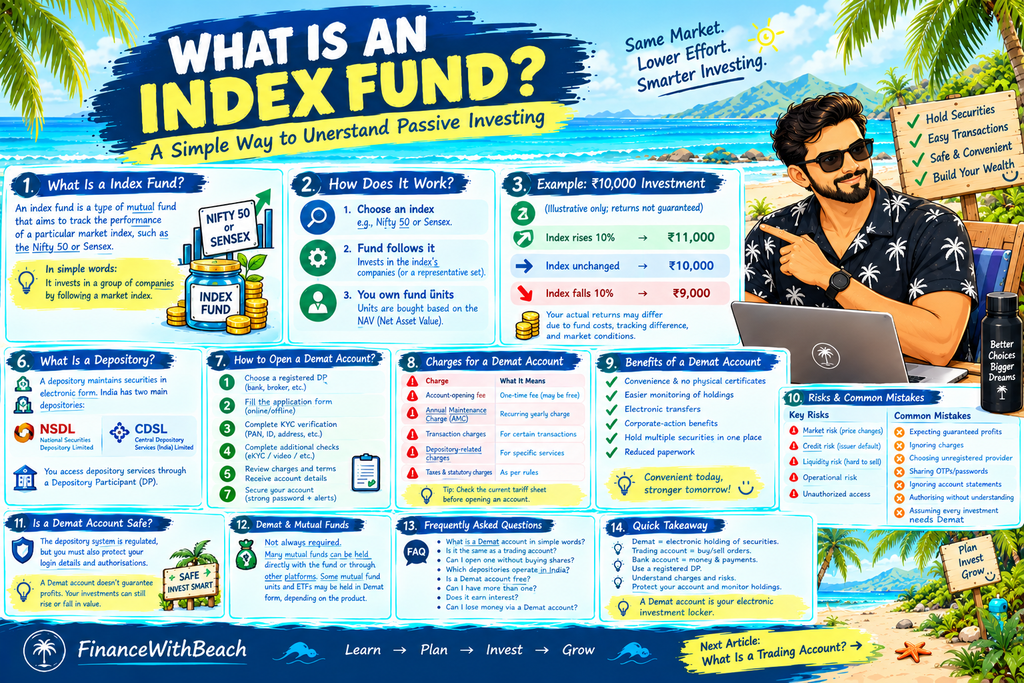
Table of Contents

Why Do You Need a Demat Account?

When securities were hed as physical certificates, Investors had to manage paperwork and deal with risks such as loss, theft, damage and forgery.

electronic Holding makes many investment-related processes easier.

Here are some important reasons Demat accounts are useful.

1. Hold Shares Electronically

A Demat account records eligible shares in electonic form, eliminating the need to store physical share certficates for those holdings.

2. Hold Differeent Types of Securities

Dpending on eligibility and the services offered, a Dmeat account can hold various securities, including shares, ETFs, Bonds and certains mutual fund units.

3. Make Transfer Easier

Eligible securities can be transfered electronically under the applicable procedures, reducing the need for physical paperwork.

4. Receive Corporate Benefits

Eligible corporate actions, such as bonus shares and stock splits can be reflected in your demat Holdings Through the relevent processes.

Dividends are generally paid through the applicable payment arrangements rather than stored as securities in the Demat account.

5. View Your Investment Holdings

You can check your holding and trasnaction records thorugh the services offered by your Depositiory participant or depository.

6. Reduce Physical-Cerificate Risks

Electronic records reduce the risks associated with lost, gamaged or forged physical certificates.

However, you still need to protect your account credentials and authorisations.

How Does a Demat Account Work?

Let’s Understand the process using a simple example.

You want to purchase shares worth ₹5,000.

Step 1: Open the required Accounts

You open a demat account with a registered depository Participart and a trading account with an eligible stockbroker. Your bank account is used to make or receive payments.

Some providers offer linked account-opening services, but the accounts perform different functions.

Step 2: Add Money to your Trading Account

You transfer money thorugh the supported banking method to fund your purchase.

Step 3: Place a Buy Order

You are the trading platform to place an order for the shares you want to buy.

The order is subject to market availability, execution and settlement rules.

Step 4: The Trade Is Settled

After the trade is executed, the relvent settlement process takes place.

Once settlement is completed, the purchased securities are credited to your demat account, subject to the applicable rules and timelines.

Step 5: View Your Holdings

You can check the shares held in your account through your broker’s platform or the services offered by your Depository Participant.

Step 6: Sell When You Choose

if you to sell the shares later, you place a sell order through your trading account. The securities are transfered through the applicable settlement process and the sale proceeds are credited according to the broker’s and market’s procedures.

What Is the Difference Between a Demat Account Trading Account and bank Account?

These three accounts serve different purposes.

FeatureDemat AccountTrading AccountBank Account
Main purposeHolds eligible securities electronicallyPlaces buy and sell ordersHolds money and processes payments
What it handlesShares, ETFs, bonds, and other eligible securitiesMarket transactionsMoney deposits, withdrawals, and transfers
Used to buy shares?Holds the shares after settlementUsed to place the orderProvides or receives money
Holds cash like a bank deposit?No, not like a bank accountUsually handles trading-related balances through the broker’s arrangementsYes
Opened withA Depository ParticipantA stockbrokerA bank
ExampleRecords 10 shares you ownPlaces an order to buy 10 sharesProvides funds to pay for the purchase

What Can You Hold in a Demat Account?

The eligible securites depend on the account and the applicable rules.

Common example includes:

1. Shares

Shares represent ownership in a company. If you buy shares and the transaction settles, eligible shares are recorded in your Demat account.

2. Exchanged-Traded Funds(ETFs)

ETFs are investment funds whose units trade on stocks excahnges. Eligible ETF units can be held electronically in a Dmeat account.

3. Bonds and Debentures

Certains bonds and debentures can be held in electronic form. Their interest payments, maturity and risks depend on the specific security.

4. Certain Mutual Fund Units

Eligible mutual fund units may be held in Demat form when the relevent facility and arrangements are available. Many invstors also hold mutual fund units directly with the mutual fund or thorugh other permitted arrangements.

5. Other Eligible Securities

Additional securities may be held depending on thr product, the depository system and the account’s facilities.

Remember: A Demat acount is way to hold eligible investments electronically. it is not itself an investment product and opening one does not require you to [urchase securities immediately.

What Is a Depository?

A depository is an institution that maintains securities in electronic from and supports their transfer through the securities-market system.

India has two main securities depositories:

  • Nationl Securities Depository Limited (NSDL)
  • Central Depository Services (India) Limited (CDSL)

Both operate within India’s securities-market regulatory framework.

A depository maintains the electronic records of securities, while invstors generally access depository services through a Depository Participant.

What Is Depository Participant(DP)?

A Depository Participant (DP) acts as the link between an investor and a depository.

A DP may be a bank, broker, financial institution, or another eligible entity registered to provide depository services.

You generally open a Demat account through a DP rather than opening it directly with NDSL or CDSL.

The DP may help you with:

  • Opening and maintaining your demat account.
  • Comparing the required vertifcation process.
  • Providing statements of holdings and transactions.
  • Processing eligible transfer and other instructions.
  • Providing services related to securities pleding and other permitted activities.

Before choosing a DP, verify its registration and review its charges, customer support, security features and available services.

How to Open a Demat Accounts in India?

Opening a Demat Account can often be completed online, although the exact process depends on the providers.

Step 1: Choose a Registered Depository Participant

Compare eligible providers, including banks, brokers and other registered participant.

checking their services, charges, security features and account conditions.

Step 2: Complete the application

Fill in the required details through the provider’s official website or app.

Step 3: Complete KYC Vertification

KYC means Know Your Customer. You may need to provide isentity, address, PAN,bank and other information as reuired under current rules.

The exact documents and vertification steps depends in your circumstances and the provider.

Step 4: Complete Any Required Vertification

The provider may require electronic verifcation, a video-based vertification step or other checks.

Follow the official instruction and do not share your passowrds or one-time passwords with anyone claiming to help you.

Step 5: Review the charges and terms

Read the account-opening documents and the sechdule of charges before accepting them.

Step 6: Receive Your Acccount Details

After the application is approved, the provider will give you your account details and access instructions.

Step 7: Secure Your Account

Use Strong, unique password, enable available security features and monitors transaction alerts and statements.

What Are the Charges for a Demat Account?

Demat accounts may involve different charges depending on the provider, servicees used and account type.

ChargeWhat It Means
Account-opening feeA fee that may be charged to open the account
Annual Maintenance Charge (AMC)A recurring charge for maintaining the account
Transaction chargesFees that may apply to certain debit or other transactions
Depository-related chargesCharges associated with certain services or instructions
Taxes and statutory chargesApplicable taxes or other charges under current rules

Some provider advertise zero account-opening fees or reduced maintenance charges. However that does not mean every service is free.

Always read the current traiff sheet before opening an account.

What Is a Basic Services Demat Account (BSDA)?

Basic Services Demat Account (BSDA) is a category of demat account intended to make securities holding more accessible to eligible indvidual investors, with specfiied service and charge conditions.

Eligibility and applicable maintenance charges depend on current SEBI rules and value and types of securites Held.

If you are a beginner with relatively small holdings, check whether you qualify for a BSDA and compare its condtitons with a regular Demat account.

What Are the Benefits of a Demat Account?

1. Convenience

You can hold eligible securities electronically without managing physical certificates.

2. Easier Monitoring

You can review your holding and transaction records using the services provided by your DP or depository.

3. Electronic Transfers

Eligible securities can be transfered electronically through the relevent procedures.

4. Corporate-Action Processing

Eligible Bonus shares, stock splits and other coprate actions can be reflected in your holdingd thorugh the applicable processes.

5. Muiltiple Securities in one Place

Depending on eligibility, you may be able to hold different types of securities in a single account.

6. Reduced paperwork

Electronic holding reduces many of the administrative tasks associated with physical certficates.

However, convenience does not remove investment risk. The value of your haolding can still rise or fall.

What Are the Risks and Common Mistakes?

A Demat account is an account Facility, not a guaranteed of investment safety or returns.

Beginners should avoid these common mistakes.

Mistake 1: Believing a Demat Account guranteed Profits

Your returns depends on the investments you choice. You can lose money if the maket value of your holding declines.

Mistake 2:Ignoring account charges

Small recurring or transaction-related charges may affect your overall. review the traiff sheetcarefully.

Mistake 3: Choosing an Unregistered provider

Open accounts through appropriately registered and authorised entities. Verify the provider’s registration using official sources.

Mistake 4: Sharing OTPs and Passwords

Never discloses your password, PIN or one-time password to strangers or people prmising guaranteed returns or trading profits.

Mistake 5: ignoring account statements

review your holding and transaction records regualry. report unauthorised transaction or disrepancies promptly.

Mistake 6: Authorising transactions without understanding them

Read the instruction carefully before authorising transfers, Pledges or other actons involving your securities.

Mistake 7: Assuming every investment must be held in demat form

Different investment products have different holding arranagements.Check the available options for each product.

Mistake 8: Forgetting account administration

Keep your contact information and KYC details updated, review nominee arrangements where applicable and follo current account requirements.

Is a Demat Account Safe?

A demat account provides electronic record-keeping for eligible securities and India’s depository system operates within a regulatory framework.

However, there are two separate issues to undeerstand:

  • Account security: Porctecting your login credentials transaction authorisation and personal information.
  • Investment risk: Understanding that the market value of shares, bond ETF and other investments can fluctuate.

A secure account does not make a risky investment safe.

Use official apps and website, enable available security features, check alerts and contact your provider promplty if you notice an unfamiliar transaction.

Do you Need a Demat Account to Invest in Mutual Funds?

Not Always.

Many mutual fund investors hold units directly with the mutual fund or through permitted investment platforms without using a Demat account.

However, certain mutual fund units may be held in Demat form and ETFs generally trade on stock exchanges and are held electronically through a Demat Account.

The appropriate arranagements depends on the investment product and how you choose to hold it.

FAQs

What is Demat account in simple account?

A demat account holds your investments electronically, while a trading account helps you buy and sell securitites in the market.

Is a Demat account the same as a trading account?

No. A demat account holds securities electroniclly, while a trading account is used to place buy and sell orders in the market.

Can I open a Demat account without buying Shares?

Yes. Opening a Demat account does not automatically require you to buy shares. you can open the account and decide whether and when to invest, subject to the provider’s terms.

Is a Demat account free?

Some providers offer free account opening, but maintebnance or transaction-related charges may apply. Check the current fee schdule before opening an account.

Can I have more than one dmat account?

Investors may have mulitple Demat accounts, subject to applicable rules amd prviders requirements. Cosnider the additional administration and potential charges before opening mulitple accounts.

Which Companies operate India’s main Depositories?

India’s two main securities depositories are NDSL and CDSL. Investors generally access their services through registered Depository Participant.

What documents are required to open a Demat account in India?

Requirements depend on current rules and your circumstances. Common reuirements may include PAN, Identity and address infrmation, bank details and KYC verfications.

Link this article to:

What Is an ETF? — How Exchange-Traded Funds Work

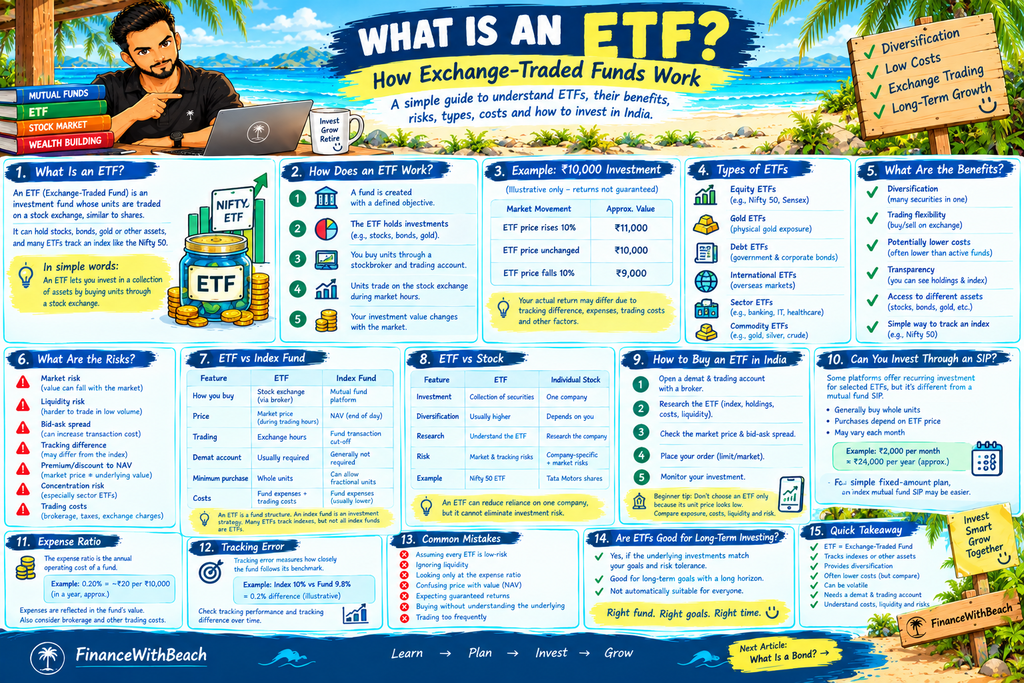
What Is an ETF?

An ETF (Exhange-Traded Fund) is an investment fund whose units are traded on a stock exhange, similar to how shares of a company are bought and sold.

An ETF can hold a collection of investments, such as stocks, bonds or gold-related assets, depending on its investment objective. Many ETFs are designed to track an index, such as the nifty 50 or Sensex.

Example:

A nifty 50 ETF aims to track the performance of the Nifty 50 index by investing in securites that represent the index.

In Simple Words:

An ETF allows you to invest in a collection of assets by buying units of a fund thorugh a stock exchange.

Unlike a typical index mutual fund, an ETF’s market price changes throughout the trading day as buyers and sellers trade its units. It price may be Slightly different from the value of its underlying assets.

Table of Contents

How Does an ETF Work?

Let’s ynderstand how an ETF works step by step.

Step 1: A fund is created

A fund provider creates an ETF with a defined investment objective . For example, it may aim to track a stock market index or provide exposure to gold.

Step 2: The ETF holds investments

Dpending on its objective, the ETF holds a collection of securties or other eligible assets.

Example:

A Nifty 50 ETF aims to mirror the composition of the Nifty 50 Index.

Step 3: Investors buy ETF units

A retail Investors generally buy and sell ETF units through a stocknroker using a trading account. A demat account is used to hold the units electonically.

Step 4: The ETF trades on the stock exchange

ETF units can be bought or sold during exchange trading hours. Their market prices change according to supply an demand and the value of the underlying assets.

Step 5: Your Investment value changes

I fth ETFs market price rises, the value of your holding may increase. If its price falls, your holding may lose value.

Important: ETFs do not guranteed profits. Your returnss depend on the ETF’s onvestment, expneses, Trading price, and other relevent factors.

Example: Investing ₹10,000 in an ETF

Lety’s say you buy ETf units worth ₹10,000. Imagine the ETFs’s market price changes by 10%.

Hypothetical price movementApproximate investment value
ETF price rises 10%₹11,000
ETF price remains unchanged₹10,000
ETF price falls 10%₹9,000

These figures are simplied inllustrations before brokerage, applicable Taxes, other charges and any difference between the ETF’s market price and the value of its underlying assets.

Your actual return may differ from the return of the index or asset the ETF tracks.

What Are the Different Types of ETFs?

ETFs can provide exposure to different markets and asset classes.

1. Equity ETFs

Example:

A Nifty 50 ETF aims to track the nifty 50 inde, providing exposure to a group of major Indian companies through one investment.

Main Risk: The ETF can lose value when the stock market declines.

2. Gold ETFs

Gold ETFs aim to provide exposure to Gold prices thorugh a fund structure.

They can be an alternative to holding physical gold, although they involve fund expenses and market-related risks.

Main risk: The value of your investment can fall if gold prices decline.

3. Debt ETFs

Debt ETFs invest in fixed-income securties, such as government securities or other bonds, accroding to their investment objectives.

Main risk: Their prices can be affected by Interest-rate changes, credit risk and other market conditions.

4. International ETFs

International ETFs provide exposure to overseas markets or securities.

Example:

An ETf may aim to track an index representing companies in another country.

Main risk: Your investment may be affected by overseas market movements, currency fluctuatiopn and other international risks. Avilability and access can vary.

5. Sector ETFs

Sector ETFs focus on a particular industry, such as banking, information technology or healthcare.

They may offer targeted exposure, but concentrating on one setor can increase risk.

6. Commodity ETFs

Commodity-related ETFs aim to provide exposure to paticular commoditites or commodity-related investment, depending on their structure.

Investors should understand exactly what the fund holds and how it racks the relevent commodity.

Remember: An ETF’s name alone does not tell you everything about its risk. Always review its investment objective, underlying holdings and scheme documents.

What Are the Benefits of ETFs?

ETFs can offer several advantages, depending on the types of fund.

1. Diversification

An Etf holding multiple securities can give exposure to several companies or investments through a single purchase.

However, diversification does not eliminate market risk and sector-soecfic ETFs be concentrated.

2. Trading Flexibility

ETF units generally be brought and sold during stock exchange trading hours, unlike ordinary mutual fund transactions that use the applicable NAV-based proces.

This gives investors more control over the timing and price of their trades.

3. Potentially lower expenses

Many ETFs have relatively low fund-management costs, particularly those that track broad indexes.How ever, expenses ratios differ and brokerage and other trading costs can affect your total cost.

4. Price visibility

You can see the ETF’s market price during trading hours and place orders thorugh your broker.

The market price may differ from the ETF’s underlying net asset value.

5. Acccess to different assets

Depending on availability, ETFs can help investors access stock indexes, bonds, gold-relate investments and international markets thorugh an exchnage- traded product.

6. Simple Acces to a market Index

Instead of buying every share in an index spearately, youn can purchase units of an ETF that aims to track that Index.

What Are the Risks of ETFs?

ETFs are investment, not guaranteed savings products.

1. Market Risk

If the ETF’s underlying investments decline in vlaue, the ETF’s price can also fall.

Example:

An equity ETF may lose value during a stock market downturn.

2. Liquidity risk

Some ETFs have limited trading actviy. You may find it harder to buy or sell at your preferred price, especially when trading volumes are low.

3. Bid-ask spread

The Bid price is what buyers are willing to pay, while the ask price is what sellers are asking.

The difference between themis called the bid-ask spread. A wider spread can increase the cost increase the cost of buying or selling an ETF.

4. Tracking difference

An ETF designed to track an index may not deliver exactly the same return as that index. Expenses, trading costs, cash holdings and other factors can cause differences.

5. Premium or discount to NAV

An ETF’s market price can be higher or lower than its net asset value per unit.

This means you should not assume the market price always exactly equals the value of the ETF’s underlying assets.

6. Concentration risk

An ETF focused on one sector or a narrow group of investments may be more edxposed to particular risks than a broad- market ETF.

7. Trading costs

Brokerage, applicable taxes, exhange-relate charges and pther costs may apply. These costs depend on the broker, transaction and current rules.

Beofre investing investing, understand the ETF’s structure, trading liquidity, underlying investments and total costs.

What Is the Difference Between an ETF and an Index Fund?

An ETF and an index fund are related concepts, but they are not identical.

An index fund follows a partcular index as its investment strategy. An ETF is a fund structure that trades on a stock exchange.

Many ETFs track indexes and some index mutual funds track those same indexes without trading on the exchange like shares.

FeatureETFIndex Mutual Fund
How you buyThrough a stock exchange and brokerThrough the mutual fund’s transaction process
PriceMarket price changes during trading hoursTransaction price based on the applicable NAV
TradingDuring exchange trading hoursAccording to mutual fund transaction rules
Demat accountGenerally required for ordinary exchange-traded purchasesGenerally not required for direct mutual fund transactions
CostsFund expenses plus applicable trading costsFund expenses and any applicable transaction costs
Minimum purchaseUsually whole units on the exchangeMay allow fractional units based on the amount invested and scheme rules
LiquidityDepends on exchange trading activity and market conditionsDepends on the fund’s redemption terms

Niether option is automatically better. Your choice dpends on how you prefer to invest, the costs involved and the partcular fund.

What Is the Difference Between an ETF and a STock?

A stock represents ownershi in an individual company. An ETF represents units in a fund that holds investments according to its stated objectives.

FeatureETFIndividual Stock
What you ownUnits of an investment fundShares of a company
Underlying exposureMay include many securities or assetsOne company
DiversificationCan provide diversification through one purchaseDepends on your other investments
Main risksFund, market, tracking, and liquidity risksCompany-specific and market risks
ExampleNifty 50 ETFShares of one listed company

An ETF may reduce reliance on the performance of a single company, but it cannot eliminate the risk of losing money.

How Do You Buy an ETF in India?

For a ordinary retail investor, buying and ETF typically involves a demat account and trading account.

Here are the basic steps.

Step 1: Open an account with a broker

Choose a registered stockbroder and complete the rquired account-opening and identity- vertification process.

step 2: Research the ETF

Understand what the ETF tracks, What it holds, it risk level, expenses ratio and trading actvity.

Step 3: Check the market price

Look at the current bid and ask prices, trading volumes and the difference between the market price and NAV wehere relvent.

Step 4: Place your order

use your broker’s platformto place an order for the number of units you want to buy.

A limit order can help you specify the maximum price you are willing to pay, athough execution is not guaranteed.

Step 5: Monitor your Investment

Review the ETF’s peerformance, costs and continued uitability for your financial goals.

Beginner Tip: Avoid choosing an ETF only because it unit price looks low. COmpare its underlying exposure, costs, Liquidity and risks instead.

Can You Invest in ETFs Through an SIP?

Some brokers and investment platforms offer recurring investment facilities for slected ETFs. However, this process may differ from a mutual fund SIP.

with an ETF, units are generally purchased on the stock exchange at market prices and purchases usually involve whole units. The amount invested each time can thereforevary depending on the ETF’s’s price and the platform’s features.

Example:

Let’s say you plan to invest approximately ₹2,000 every month in an ETF.

  • Monethy target: ₹2,000
  • Number of purchases: 12 per year
  • Approximate yearly contribution: ₹24,000

This represents the amount you plan to contribute, not a guranteed future value. Actual purchases depend on the ETF price, available units and applicable costs.

If you prefer an automatic fixed-amount monthy investment, an index Mutual fund with a regular SIP facility may be simpler to operate.

What Is the Expense Ratio of an ETF?

The Expense ratio is the annual operating expense of a fund expressed as perecntage of its assets.

Let say An ETF has an expense ratio of 0.20%.

At that rate, the annual fund expense is equivalent to approximately ₹20 per ₹10,000 invested, based on tht percentage.

This is an Illustration, not a separate bill for exactly ₹20. Fund expesnes are reflected in the fund’s value over time and your actual cost depends on the fund and the amount invested.

Remember that the expense ratioo is not necessarily your only cost. Brokerage and other applicable transaction charges can also affect your net return.

How Should Beginners Choose an ETF?

Before buying an ETF, consider these points.

  1. Understand the underlying asset: know whether the ETF track an Equity index, bnds, gold or another investment.
  2. CHeck rhe Investment objectives: Make sure the ETF’s strategy matches yopur goals.
  3. Compare expense ratios: Lower costs can help, but they should not be your only slection criterion.
  4. Review liquidity: Look at Trading volume and the bid-ask spread.
  5. Check tracking peeformance : for Index ETFs, compare how closely the ETF follows its benckmarks.
  6. Understand all costs: Consider brokerage, applicable taxes, and other charges.
  7. Read the scheme documents: Review the holding, risks and investm,ent terms.
  8. Consider your time horizons: Don’t invest money needed for essential expesnses or near-term goals in a product whose value may fluactuate signifantoly.

Common Beginner Mistakes to Avoid

Mistake 1: Assuming every ETF is low-risk

An ETF that tracks a volatile market or focuses on one sector can carry subsantial risk.

Mistake 2: Ignoring Liquidity

An ETF with low trading actvity may have a wider bid-ask spread.

Mistake 3: Looking only at the expense ratio

Trading costs and tracking performance also matter.

Mistake 4: Confusing an ETF’s price with its value

The market price can differ from NAV.

Mistake 5: Expecting guaranteed returns

ETf prices can rise or fall and losses are possible.

Mistake 6: Buying without understanding the underlying investment

Always fiund out what you are imvesting in beofre placing an order.

Mistake 7: Trading too frequently

Frequent buying and selling cn increase costs and encourage inpulsive decision. Make investment decisions based on your plan rather than every shor-term market movement.

Are ETFs Good for Long-Term Investing?

ETFs can be useful for long-term investing when their underlying investments match your goals and risk tolerence.

Example:

A brad- market equity ETF may offer diversified expsoure to a stock index. A gold ETF, however, provides a different kind od exposure and has different risks.

The right choice depends on the asset class, your financial objectives, your investment horizon and your ability to tolerate losses.

These is no sinle ETF that is Best for everyone.

FAQs

1. What is an ETF in simple words?

An ETf is an investment fund whose units trade on a stock exchange. It may hold a collection od shares, bonds or other assets.

2. What Does ETf stand for?

ETF stands for exhange-Traded Fund.

3. Is an ETF a Mutual Fund?

An ETF is a type of investment fund. In India, ETFs are structured as mutual fund schemes but their units trade on stock exchanges, unlike ordinary open-ended mutual fund transactions.

4. Can I lose money in an ETF?

Yes. If the underlying investments decline in value, the ETF’s price can fall and you may lose some or all of your invested money.

5. Do I neededa Demat account to buy an ETF in India?

For ordinary retail purchases of ETFs on stock exchange, you generally need a demat account and a trading account.

6. Are ETFs Suitable for Beginners?

They can be, provided ou understand the underlying investments, market risks, lquidity and costs. Beginners should research a fund before investing.

7. Do ETFs pay dividends?

Some ETFs may distribute income if thier structure ans scheme terms allow it. Other may retain income or reflect it in the fund’s value. Check he particular ETF’s scheme documents.

8. Are ETFs guaranteed to make money?

No. ETFs returns depend on their underlying investments and market conditions. Returns are not guaranteed.

Link this article to:

What Is an SIP? — Investing a Fixed Amount Regularly

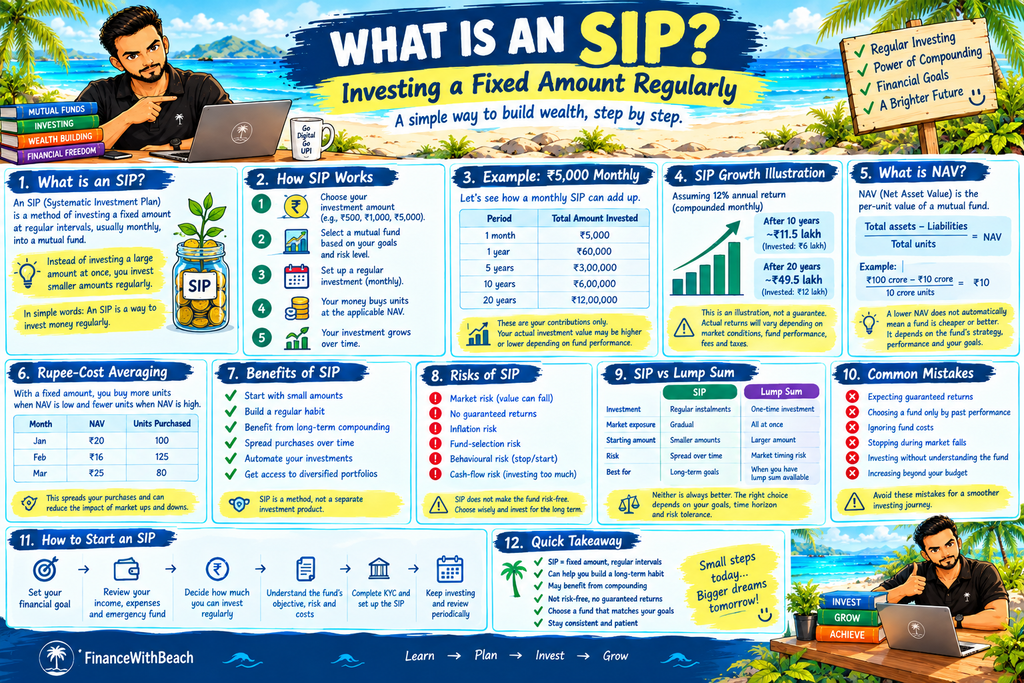
What Is an SIP?

An SIP(Systematic Investment Plan) is method of investing a fixed amount of money at regular intervals, usually monthy, into a mutual fund.

Instead of investing a large amount all at once, you can invest smaller amounts regularly, This makes investing easieer to organise and helps build a consistent investing habits.

Example

Let’s say you decide to invest ₹2,000 every month ina mutual fund.

  • Month 1: ₹2,000
  • Month 2: ₹2,000
  • Month 3: ₹2,000
  • Month 4: ₹2,000

After four months, you would have invested ₹8,000 in total.

Over time, regular investments may help you build wealth, depending on the performance of the mutual fund and the length of time you remain invested.

In simple Words:

An SIP is a way to invest money regularly instead of investing everything at once.

How Does an SIP Work?

An SIP makes investing systematic. You choose an amount, selecta mutual fund and set a regular investment schedule.

Step 1: Decide your investment amount

Choose an amount that fits your income nd expenses, suchs, ₹500,₹1000 or ₹1,500 per month, subject to the fund’s minimum.

Step 2: Select a mutual fund

Choose a fund based on your financial goals, time horizons, risk tolerence and the fund’s investment strategy.

Step 3: Invest regularly

Your SIP is scheduled at your chosen frequency. Monthy SIPs are common and payment arrangements depend on the platform and fund.

step 4: Continue and review

Your money buys mutual fund units at the applicable NAV. Review your investment periodically to check that it still suits your goals.

Example: Investing ₹5,000 Every Month

Let’s understnad how regulaar investing works with a simple example.

You invest ₹5000 every month.

PeriodTotal amount invested
1 month₹5,000
1 year₹60,000
5 years₹3,00,000
10 years₹6,00,000
20 years₹12,00,000

These figures show your contributions only. Your actual investment value may be higher or lower depending on return, fess and taxes.

The important ideas is that investing a managable amount regularly can help you build a long-term investment habits.

What Is Rupee Cost Averaging in an SIP?

One portential bebfits of investing regularly is rupee cost averaging.

When the NAV os lower, your fixed investment amount buys more units.

When the NAV is higher, it buys fewer units.

Example:

Let’s say uou invest ₹2,000 in a mutual fund each month.

MonthNAVUnits purchased
January₹20100
February₹16125
March₹2580
Total—305 units

Your Investment is ₹6,000 and you own 305 units. Your average purchase cost os approximately ₹19.67 per unit.

What Are the Benefits of SIP Investing?

1. Start with mangable amounts

You may be able to start with a relatively small amount, depending on the mutual fund’s minimum investment rules.

2. Build a Regular Habit

A recurring investment can help you make investing part of your monthy financial routine.

3. Benefit from long -term compounding

If your investment earns positive returns and those returns remain invested growth can build over time.

4. Avoid needinmg a large Lump Sum

You don’t have to wait until you have a large amount of moneu before beginning to invest.

5. Spread purchases over time

Regular investing means you buy units at different NAV levels instead of making all your purchases at one point in time.

6. Automate Contributions

Automatic payments can make ir easier to stay consistent, Provided your account has sufficient funds and the payment instruction remains active.

What Are the Risks of SIP Investing?

SIP is only an investment method. It does not make the mutual fund iitself safe.

  • Market Risk: The underlying investment can fall in value.
  • No guaranteed returns: A SIP does not guarantee porfit.
  • Inflation Risk: Your future money may buy less than expected.
  • Fund-slection risk: A poorly suited fund may not matchn your goals or risk tolerance.
  • Behavioural risk: Stopping or changing your plan in reponse to every market movement can disrupt your strategy.
  • Cash-Flow risk: Investing too much may leave you short of money for regular expenses or emergencies.

Before investing, consider your emergency savings, expensive debt, fianncial goals and ability to handle losses.

SIP vs Lump Sum: What Is the Difference?

FeatureSIPLump Sum
Investment methodRegular instalmentsOne larger investment
TimingMoney enters at different timesMost money is invested at once
Starting amountOften more manageableRequires a larger amount
Market exposureBuilds graduallyBegins on the investment date
Return guaranteeNoneNone

Niether approach is alwys better. The choice depends on your available money, investment objective, time horizons and comfort with market fluctuations.

Is an SIP Better Than a Recurruing Deposits(RD)?

An SIP and an RD are different financial Products.

FeatureSIPRecurring Deposit
ProductInvestment method into a mutual fundBank deposit product
ReturnsMarket-linked, depending on the fundInterest rate set under deposit terms
RiskDepends on underlying investmentsDepends on the institution and applicable deposit protection
ValueCan rise or fallPrincipal and interest generally follow the deposit contract, subject to its terms
Suitable forInvestment goals based on risk and time horizonPlanned savings with defined deposit terms

Choose based on the purpose of the money, how soon you need it, and the risks you can accept.

Common SIP Mistakes Beginners Should Avoid

  • Expecting Guaranteed Returns: Mutual Fund investments can lose money.
  • Choosing a fund only because of recent performance: Past Performance does not guranteed future results.
  • Investing before planning essential Expenses: Keep Money available for emergencies and near-term needs
  • Stopping every time the market falls: Reassess your goals and fund rather than reacting automatically.
  • ignoring fund costs: Expenses and taxes can reduce your final outcome.
  • Assuming every SIP is Long-term: Select a fund and time horizon that match the goal.
  • Increasing contribution beyond your budget: A sustainable amount is better than one that creates financial stress.

How Can A Beginner Start an SIP in India?

here is a simple checklist:

  • Set a Clear Financial Goal.
  • review your income, expense,mergency savings and debt.
  • decide how much you can invest regularly
  • Understand the fund’s invetment objective and risk level
  • Review the expense ration and other applicable costs.
  • Complete hthe required account and identity-vertfication porcess through a legitmate investment platform or fund provider.
  • Set the SIP schedule and make sure the money is available.
  • Review your plan periodically rather than judging it by short-term market movements.

Do not select a mutual fund merely because someone promises high returns.

FAQs

1. What does SIP stand For?

SIP stands for Systematic Investment Plan. It is a way to invest a fixed amount regualrly into a mutual fund.

2. Can I start an SIP with ₹500?

Some mutual fund Permit SIPs starting at ₹500 or less, while others require more. Check the minmum amount for the specfic fund.

3. Can I lose money in an SIP?

Yes. If the underlying fund investment fall in value, your SIP investment can also lose value.

4. Is SIP suitable for beginners?

It can be a convenient way to build e regular investment habit, but neginners should first understand the fund, it risks, and their own financial needs.

5. is an SIP suitable Guranteed to make money?

No. Nither SIP investing nor mutual fund returns are guaranteed.

Link this article to: