What Is Risk vs Return?
when you invest money, two important ideas you should understand are risk and return.
- Risk means the possibility that your investment may lose money or perform differently than expected.
- Return means the money you gain or lose from an investment over period of time.
Risk vs return describes the relationship between the amount of risk you take and the potential return you may receive.
In simple Words:
Investments with higher potential returns often come with higher levels of risk.
However, Higher risk does not guarantee higher returns.
Understanding this relation ship can help beginners make informed investment decisions.
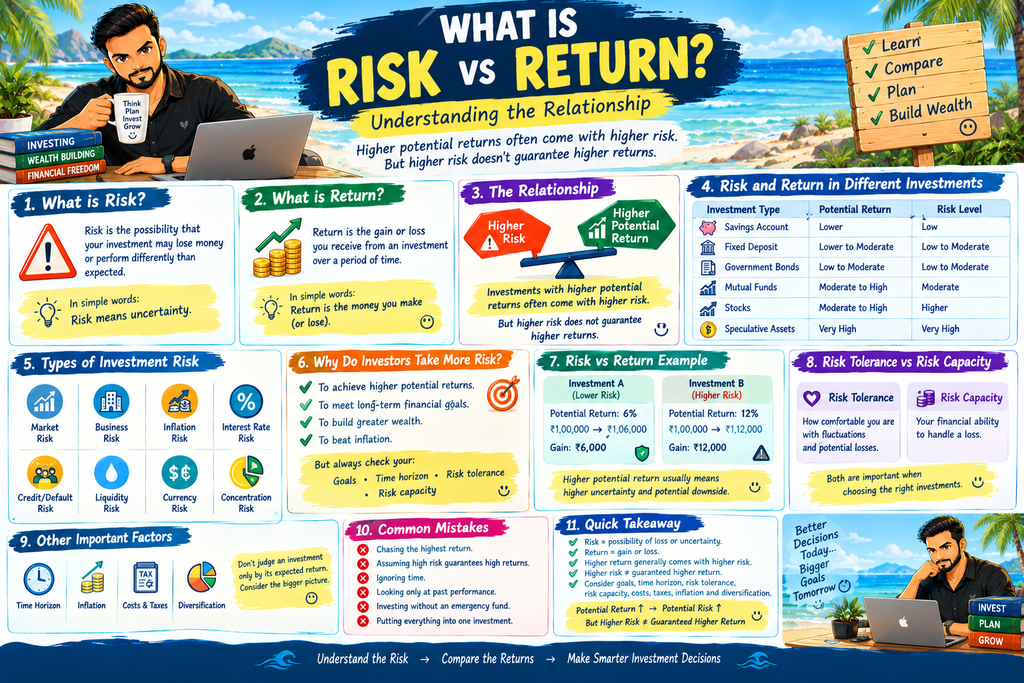
Table of Contents
Risk and return: The Basic Idea
Let’s say you have ₹10,000 to invest.
You have several possible choices.
| Investment Type | Potential Return | Risk |
|---|---|---|
| Savings account | Lower | Low |
| Fixed deposit | Lower to moderate | Relatively low |
| Government bonds | Low to moderate | Relatively low |
| Mutual funds | Moderate to high | Moderate |
| Stocks | Moderate to high | Higher |
| Speculative investments | Very high potential | Very high |
Actual risk and returns vary dpending on the specfic Investment, tim period market conditions and products.
The important idea is that you generally cannot expect high potential returns without accepting some possibility of loss or uncertainty.
What Is Risk?
Investment risk is the possibility that your investment may not produce the results you expected.
Example:
You invest ₹10,000 in stock.
Later, its value falls to ₹8,500.
Your investment has decreased by ₹1,500.
That is an example of investment risk.
Risk can come form many sources including:
- Market movment
- business problems
- inflation
- inetrest rate changes
- default or credit problems
- Lack og liquidity
- Currency movemnts
- Concentrationm in one investment
We discussed these different types of investment risk in the pervious article,”What Is Risk in Investing?“
What Is Returns?
Returns is th gain or loss you recieve from an investment.
Example:
You invest ₹10,000
After sometime, your investment becomes ₹11,500.
Your gain is:
₹11,500 – ₹10,000 = ₹1,500
Your return is:
₹1,500 ÷ ₹10,000 x 100 = 15%
So, your investment produced a 15%n return before considering applicable costs, taxe or other factors.
Returns can be:
Positive Return
you make money
- ₹10,000 ➔ ₹12,000
- Return = 20%
Zero Return
You neither gain or loss.
- ₹10,000 ➔ ₹10,000
- Return = 0%
Negative return
You lose money.
- ₹10,000 ➔ ₹9,000
- Return = -10%
How Are Risk and Returns Related?
The basic relationship can be undrstood like this:
Higher potential return ➔ Usually higher potential risk
Lower potential return ➔ Usually lower risk
But this is not guarantee.
Example
Let say Investment A has a potential return of 6%, while Investment B could Potentially earn 12%.
This means an investor seeking the possinility of higher returns may have to acdcept greater uncertainty.
Does Higher Risk Always Men Higher Return?
NO.
This is one of the most importan things beginners should understand.
Taking more risk does not guarantee that you will make more money.
Consider two investments:
- Investment A has moderate risk and eventually earns 10%.
- Investment B has high risk but eventually loses 20%.
Investment B involved more risk, but it produced a negative return.
Higher risk = Higher potential return, nit guranteed higher return.
The word potential is important.
Why Do Investors Accept More Risk?
Investors may accept greater risk because they want the possibility od achieving higher returns.
Example:
Someone investing for a lonf term financial goal may consider investment with higher potential frowth than atraditional savings product.
But beofre taking additional risk, an investor should cosnsider.
- Fiancial Goals
- Investment time horizons
- Ability to handle losses
- Emergency savings
- Existing investments
- Income Stability
- Investment Knowledge
Risk should not be taken simply because an investment promises a higher return.
Risk vs Return and Time Horizon
Your time horizon can also affect how you think about risk.
A time horizon is the length of time you expect to keep your money invested.
Short Term Goals
Let’s say you need ₹2 lakh for an expense next year.
A large loss shortly before you need the money could create a problems.
Long Term Goal
Let’s say are investing for a goal many years away.
You may have more time to deal with market fluctuations,athough losses are still possible.
This does not mean long term investments are automatically safe.
It means the amount of time available can effect how much short term volatility you may be able to tolerate.
Risk Tolerance vs Risk Capacity
Two Term are useful for beginners:
Risk Tolerence
This refers to how confortable you are with investment losses and price fluctuations.
Example:
If you seeing your investment fall 20% would make you panic and sell immediately, you may have lower tolerance for large fluctuations.
Risk Capacity
This refers to how much financial loss you can actually afford.
Example:
Someone with an emergency fund, stable income and a long investment horizon may have greater financial cpacity to withstand temporary losses than someone who needs the money soon.
These are different concept.
You ight be emotionally comfortable with high risk but financially unable to afford a large loss.
Risk vs Return Example in Real Life
Let’s say three Hypothetical investors.
Investor A – Low Risk Preference
Invest mostly in reltively lower risky-risk products.
Potential returns may be lower but large fluctuationsmay also be less likely
Investor B – Moderate Risk
Uses a mixture of idfferent investments.
The protfolio may have a balance between growth potential and risk.
Investor C – Higher Risk
Invests a Larger portion in assets with significant price fluctuations.
There may be greater potential form growth, but also greater potential losses.
None of these approches automatically produces a better results.
The appropriate level of risk depends on the person’s fiancial situation, goals, time Horizon and ability to handle losses.
Risk vs Return in Stocks
Stocks are a common example of the risk return relationship.
A stock’s price can rise signifantly.
But it can also fall signifcantly.
Example:
You invest ₹50,000
If the investment rises by 20%.
₹50,000 ➔ ₹60,000
Gain = ₹10,000
But if it falls by 20%:
₹50,000 ➔ ₹40,000
Loss = ₹10,000
The same investment can produce very different outcomes.
This is why potential return should al;ways be considered longside risk.
Risk vs Return in Mutual Funds
Mutual funds invest in a collection of securities according to their investment strategy.
Different types of mutual funds can have different levels of risks.
Example:
- Some funds focus on equities.
- Some focus on bonds
- Some combine different types of assets.
A fund’s historical return does not gurantee its future returns.
Therefore beginners should look at more than just the return percentage.
The Role of diversification
One way investors can manage certain types of risk is through Diversification.
Diversification means spreding money across different investmebnt insted of putting everything into one investment.
Example:
Instead of investing your entire ₹1,00,000 in one stock, an investor may spread money across different assets.
Diversification cannot eliminate investment risk, but it can help reduce the impact of apoor performance from one particular investment.
Our nect article will explain diversification in detail.
Risk, Return, and Inflation
There is another factor beginners should remember:
Let say your investment earns 6% per years, but inflations is 5%.
Your money has grown in nominal terms, but its puchasing power not have not have increased by the same amount.
Therefore, when thinking about returns, investors should consider:
Return + Risk + Inflation + Costs + Time
Looking at the return percentage alone may not give you the comlete picture.
Risk vs Return vs ROI
These concept are related but differently
| Concept | Meaning |
|---|---|
| Risk | Possibility of loss or uncertainty |
| Return | Gain or loss from an investment |
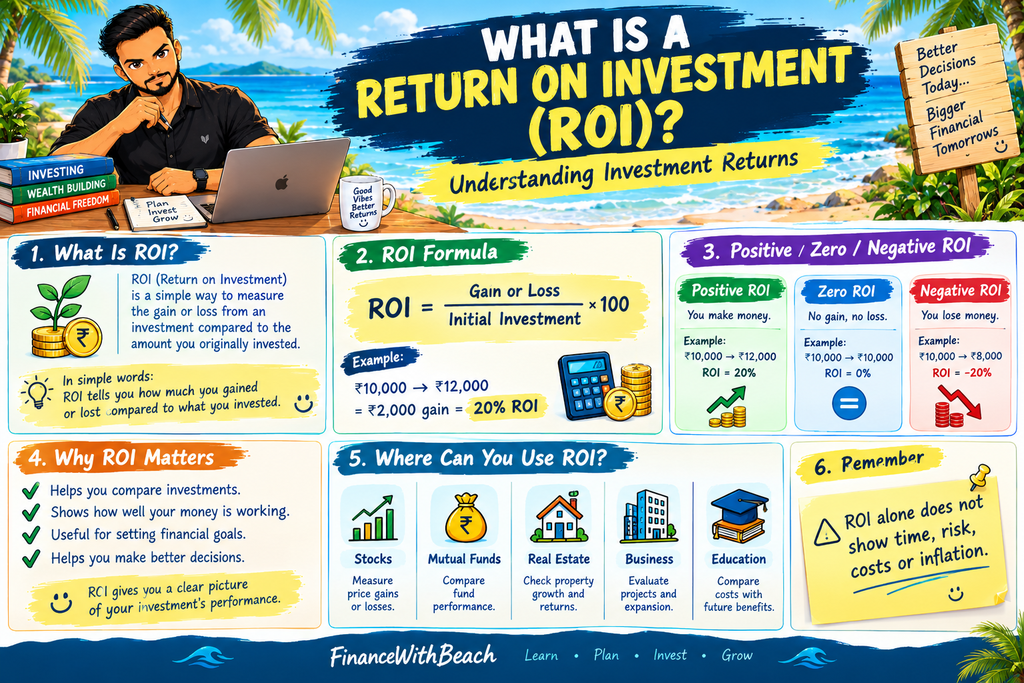
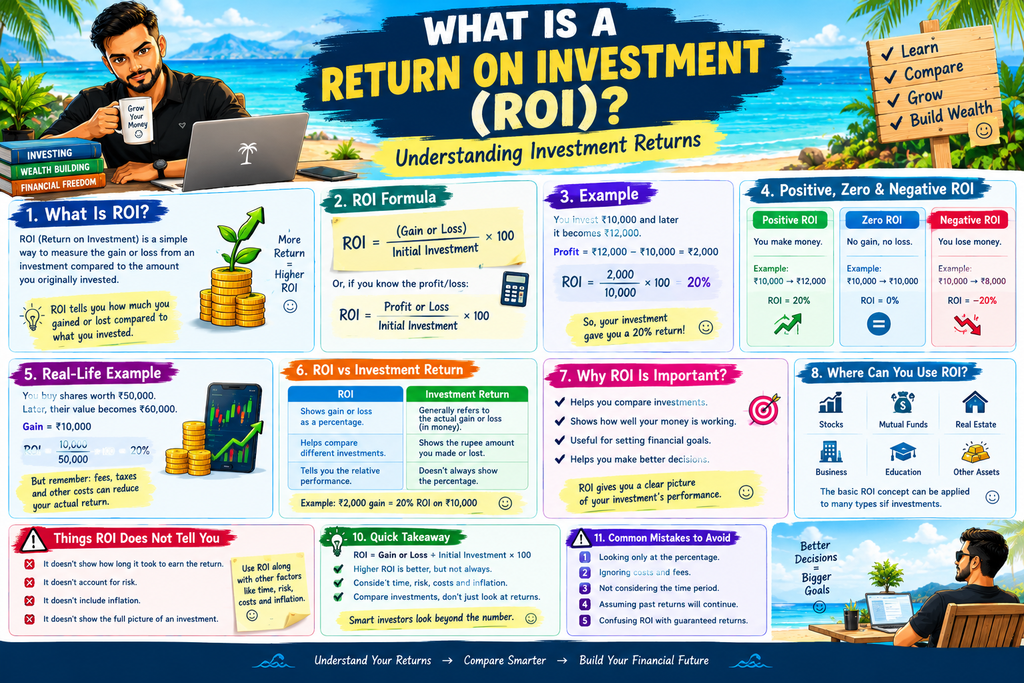
| ROI | A percentage measure comparing gain or loss with the original investment |
| Risk vs Return | Relationship between potential returns and the level of risk involved |
Example:
You invest ₹10,000 and recieve ₹12,000.
Your gain is ₹2,000.
Your ROI is:
₹2,000 ÷ ₹10,000 x 100 = 20%
But ROI Alone doesn’t tell you how much risk was invilved or how long it took to acieve that returns.
Common Beginner Mistakes
1. Chasing the Highest Return
A high expected return can come with significant risk.
2. Assuming High Risk Gurantees High Returns
It doesn’t
Higher risk means greater uncertainly, not guranteed profit.
3. Ignoring Time
A 20% return over one year is different from a 20% return over ten years
4. Looking Only at past Peformance
Past Performance does not gurantee future results.
5. Investing Without an Emergency Fund
Money Needed for emergencies generally shouldn’t depend on risky investment.
6. Putting Everything Into One Investment
Concentration can increase the impact of a single invesment performing poorly.
FAQs
Is Higher risk Always better?
No Higher risk simply means greater unceertainly and potential downside. Whether a particular level of risk is appropiate depdns on the investor’s circumstances and goals.
Can a low risk investment lose money?
Yes.”Lower risk” does not mean “zero risk.”
Does higher return mean a better investment?
Not necessarily. You Should also consider risk, time period, costs, taxes, inflation, anmd your financial goals.
What is the main idea of risk vs return?
The basic idea is that investment offering higher potential returns generally ivolve greater uncertainly and potential losses.
Can Diversification reduce risk?
Diversification can reduce certain concertration related risks, but it cannot eliminate all investment risk.
Should Beginners always choose low risk investments?
Not necessaril;y. The appropriate level of risk depends on factors such as financial goals, time horizons, financial capacity and riskl tolerences.
Link this article to:
- What is Saving?
- What is Income?
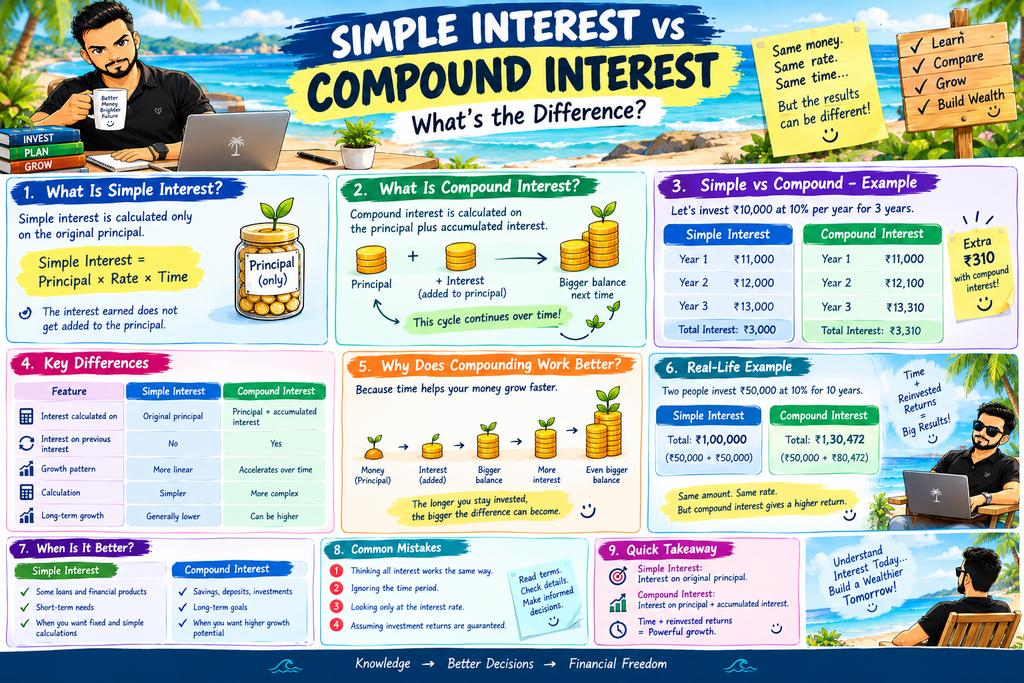
- What is Compound Interest?
- What Is Inflation?
- What is Insurance?
- What is investing?
- Types of Investment?
- What is Budget?
- Saving vs Investing
- What is Net worth?
- What Is Exapenses?
- What is Cash Flow?
- What is Liquidity
- What Is Loans?
- What Is EMI?
- What Is Credit Card?
- What Is Bank Account?
- What Is ATM?
- What Is UPI payment?
- What Is Recurring Deposit?
- What Is a Asset?
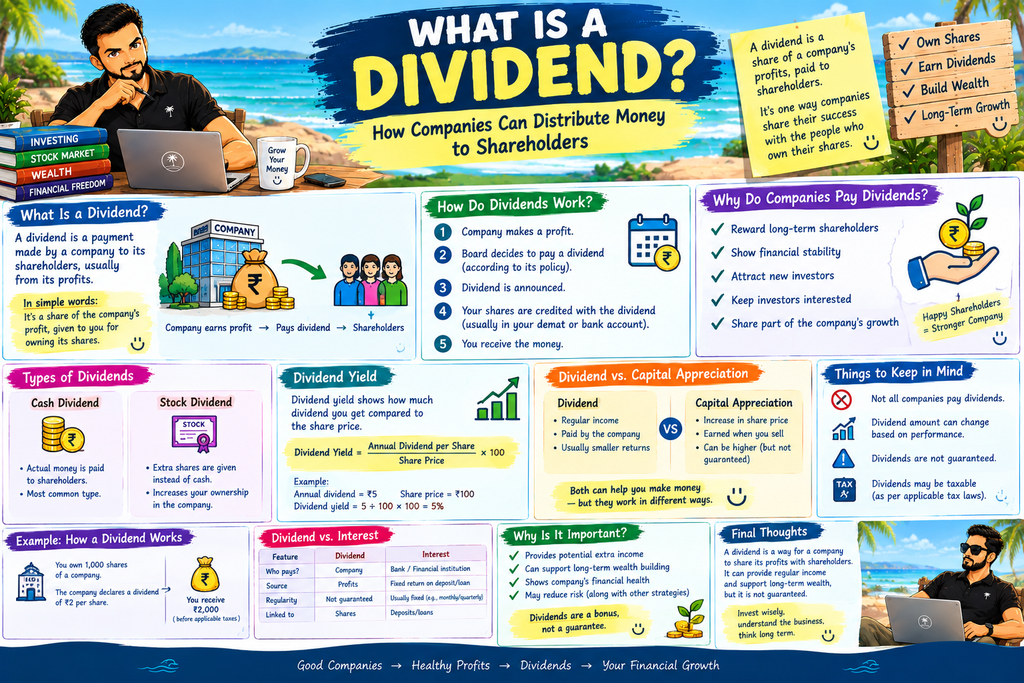
- What Is a Dividend?
- Simple Interest and Compound Interest
- What Is a Return on Investment?
- What Is Risk in Investing?